By Marcus Halloway · Published May 8, 2026 · Updated September 10, 2026
Last updated: September 10, 2026.
The science of crop circles begins where the folklore ends. Two retired men confessed in 1991 to making the patterns with planks and rope. A meteorologist named Terence Meaden floated a plasma vortex hypothesis, then watched it fail. A biophysicist named W.C. Levengood claimed plant nodes told a different story, and a generation of skeptics have answered him in print. The record is documentary. The record is mixed. The record is what this report quotes.
The premise of this report is that the question deserves the same evidentiary discipline a defense reporter would apply to a procurement controversy. Witnesses go on the record by name and case where possible. Documents are quoted, not paraphrased into headlines. Counter-evidence is given the floor. Where the public record is silent, that silence is reported as silence, not filled in with inference. The phenomenon is interesting. The case for what it is, and is not, is built one cited document at a time.
What the Documentary Record Says
On September 9, 1991, the British tabloid Today ran the headline “Men who conned the world.” The men were Doug Bower and Dave Chorley, two Southampton painters in their sixties. They told reporters they had been flattening wheat in southern England since 1978 with a four-foot wooden plank, a length of rope, and a cap fitted with a sighting wire. They claimed responsibility for more than 200 patterns. [1] Before the press conference broke, the pair invited cereologist Pat Delgado into a circle they had made the night before; Delgado declared the formation “genuine” on the record. Then he was told. [2]
The confession reset the burden of proof. Anyone arguing for a non-human origin now had to explain why a phenomenon associated with two specific hoaxers had only complicated after their methods went public. Within four years a London arts collective calling itself Circlemakers, led by John Lundberg with collaborators Rod Dickinson and Rob Irving, was producing commissioned formations for Greenpeace, Microsoft, Nike, the BBC, and music videos. [3] Lundberg coauthored The Field Guide: The Art, History and Philosophy of Crop Circle Making in 2006. The artists publish their methods. They publish their commissions. The record on this much is closed.
Operation Blackbird, July 1990
Cereologist Colin Andrews, funded by the BBC and Japan’s Nippon TV with British Army assistance, set up cameras on a Wiltshire hilltop between Bratton and Westbury from July 23 to August 12, 1990. The operation was meant to record a crop circle forming. A formation appeared on July 25 inside the camera arc. Closer inspection found a horoscope board game, wooden sticks, and a length of wire planted at the center of each of six circles. The hoax was almost certainly intentional, aimed at the surveillance itself. [4] Andrews kept investigating. The footage of him reacting on camera survives.
Operation Blackbird is the cleanest natural experiment in the file. A funded, instrumented, military-assisted watch with explicit predictions about non-human formation produced a confirmed human formation inside its own observation window. The hoaxers had specifically baited the cameras. That fact constrains how seriously a researcher can take any later surveillance claim that did not include identical chain-of-custody controls. Single-night vigils with handheld cameras and overheard testimony do not clear the bar that Andrews’s team failed to clear with twenty-one nights of military-grade kit.
The Plasma Vortex Hypothesis and Its Limits
In 1980 the meteorologist and physicist Terence Meaden, founder of the Tornado and Storm Research Organisation, proposed that simple circular formations were the trace of an “ionised plasma vortex,” a tight downdraft modulated by the chalk-hill terrain of southern England. For early circles his hypothesis fit. Meteorologists took it seriously. As the formations grew geometrically more elaborate through the late 1980s, Meaden extended the model into an electromagneto-hydrodynamic vortex that could, in theory, sketch pictograms. [5]
The model broke on its own physics. Critics noted that a vortex acting in under a second cannot orient itself to seed lines spaced ten centimeters apart. Meaden’s published evidence ran mostly through his own journal and self-published volumes. By the end of 1991, after the Bower-Chorley confession and a controlled circle-making experiment that fooled his cereologist colleague, Meaden conceded that the complex designs were human. He kept the door open for the simplest pre-1980 rings. The peer-reviewed atmospheric-physics literature did not follow him through it. [6]
There is a quieter point in the Meaden story worth recording. His original hypothesis was disciplined. He named a specific physical mechanism, predicted observable terrain dependence, and did not invoke intelligence. As the data set grew non-circular and pictographic, the only honest options were to retract the model or to stretch it. Meaden stretched, then retracted, then stopped publishing on the subject. That sequence is what falsification looks like in practice. The atmospheric anomaly does not get to grow legs because the data did. The discipline of letting a model die when its predictions stop matching is the part of his career that ought to survive him.
Hawkins, Geometry, and What the Math Actually Showed
Gerald S. Hawkins, the Boston University astronomer who had argued in Stonehenge Decoded that the Wiltshire monument tracked solar and lunar alignments, turned to crop formations in 1990. He measured 18 multi-ring patterns and found that 11 of them encoded ratios of the diatonic musical scale. He went further and derived four Euclidean theorems from the area-relationships among nested circles, then a more general fifth theorem from which the other four fell out. He published a challenge in Science News and The Mathematics Teacher asking readers to derive the unpublished fifth from the four; nobody managed it. [7]
Hawkins did not claim aliens. He claimed the geometry was mathematically nontrivial and exceeded the casual ability of an untrained hoaxer. The follow-on question is empirical: can trained hoaxers produce nontrivial geometry? The Circlemakers answered yes in print, in commission, and in field. Hawkins’s mathematics survives as a fact about specific surviving formations. The inference about who or what produced them is a separate question, and a weaker one.
The geometric record narrows further when you read it case by case. Hawkins’s diatonic-ratio finding describes 11 of 18 measured formations, not all of them. Selection effects bite hard: the most photogenic patterns are the ones photographed from the air, surveyed, and forwarded to the people who measure. Plain rings get logged and forgotten. The dataset is filtered before it reaches the analyst. None of that erases Hawkins’s published theorems. It clarifies what the theorems are evidence of: that some elite formations are mathematically rich, that mathematically rich formations are produced by entities capable of performing or copying nontrivial geometry, and that the artist community has both motive and method to do exactly that.
The Levengood Papers and the Replication Question
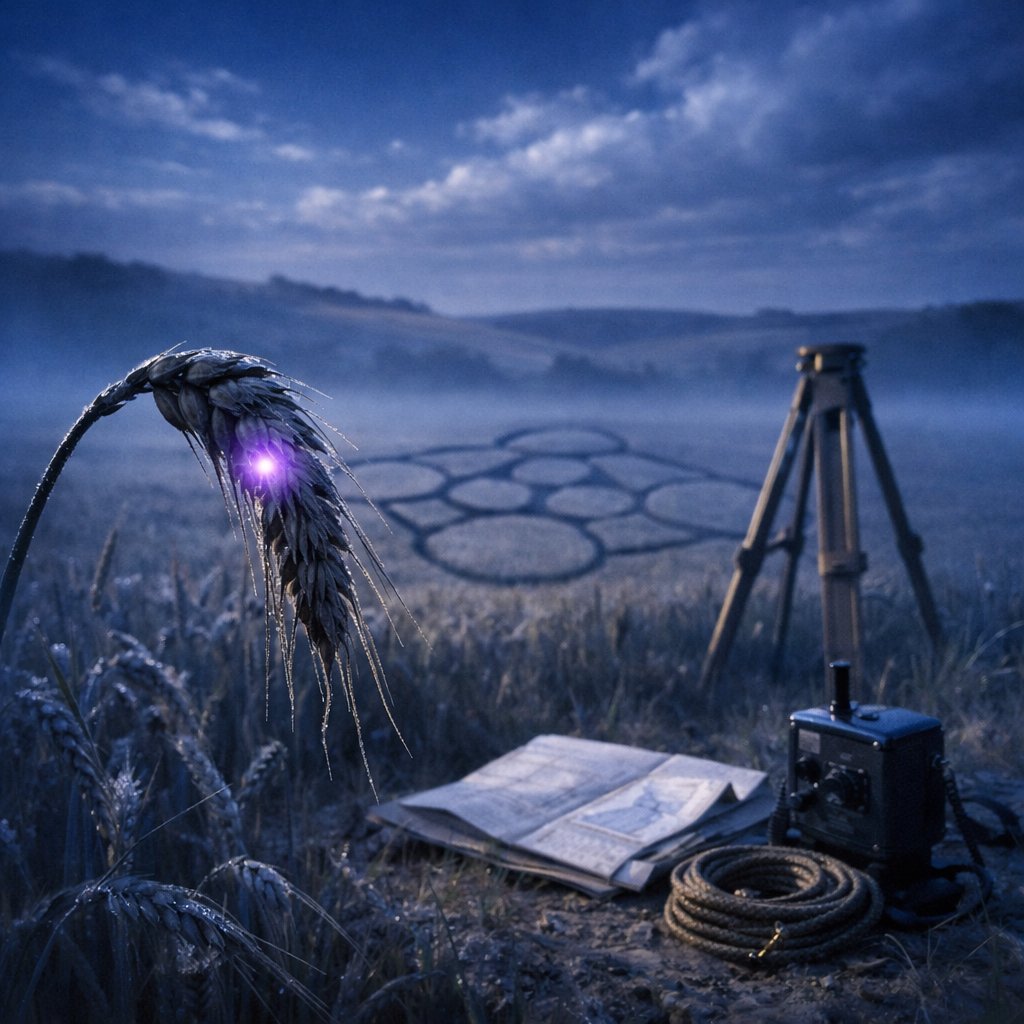
Between 1994 and 1999, Michigan biophysicist William C. Levengood published three peer-reviewed papers in Physiologia Plantarum documenting what he described as anatomical anomalies in crop-circle plants: enlarged stem nodes, bent nodes, and small “expulsion cavities” blown through the wall of the node from the inside. Levengood worked with the BLT Research Team, a nonprofit field-sampling group based in Cambridge, Massachusetts. He proposed that the deformations were consistent with rapid internal heating, the kind a directed microwave pulse would produce by boiling sap inside the node like a popcorn kernel. [8]
The methodological objections came fast. Joe Nickell, writing in Skeptical Inquirer, identified the central circularity. Levengood distinguished “genuine” circles from “hoaxed” circles by the presence of node anomalies, then cited the node anomalies as evidence the genuine circles were real. The reasoning loops on itself. Independent double-blind replication has not been published. A Colgate University researcher who attempted to verify Levengood’s seed-germination effects with samples Levengood himself supplied could not reproduce them. [9]
The Microwave-Magnetron Counterproposal
In the August 2011 issue of Physics World, Richard Taylor, director of the Materials Science Institute at the University of Oregon, argued that contemporary circle-makers are most plausibly using GPS, handheld lasers for layout, and a microwave magnetron pulled from a kitchen oven and powered off a 12-volt battery. A magnetron pulse against a stem briefly boils internal moisture and forces the stalk down in a clean horizontal layer, producing the very node deformations Levengood attributed to a non-human source. Taylor’s framing inverts the inference. The anomalies are real. Their human reproducibility is also real. [10]
Taylor’s paper is not an exhaustive proof. It is a sufficiency argument. Show that the strongest “non-human” plant-tissue signal can be matched by gear bought at a hardware store and a kitchen recycler, and the inferential ladder Levengood was climbing has its bottom rungs sawn off. Field demonstrations of magnetron-bent stalks have been published since. The point of the paper is not that every circle is microwaved. The point is that microwaved nodes do not, by themselves, exclude human authorship the way Levengood’s reasoning required.
What Is Genuinely Open and What Is Not
The case for human authorship of the modern complex designs is closed enough for ordinary purposes. Bower and Chorley confessed. The Circlemakers commissioned. Matt Ridley wrote up his own technique in Scientific American after entering a 1992 making competition. The 2001 Milk Hill formation in Wiltshire, 878 feet across with 409 individual circles arranged in a six-armed triskelion, has been pointed at as too elaborate to be human; the Circlemakers’ field log and the magnetron-and-GPS hypothesis together cover its production envelope. [2]
Worth flagging directly: the Milk Hill argument from complexity has a quiet flaw. The “one circle every thirty seconds” claim assumes a single linear maker. A team of six experienced builders, working from a pre-surveyed master diagram with GPS waypoints and laser sightlines, fits the production envelope without strain. The math against human authorship only works if you assume the absence of teamwork, planning, and modern surveying gear, none of which Wiltshire’s circle-making community lacks.
What remains scientifically open is narrower and more interesting. The earliest pre-1980 simple rings have no confessed authors and no surveillance video. Meaden’s atmospheric mechanism may apply to a small subset. The plant-tissue chemistry on the Levengood side has not had the rigorous double-blind replication a final ruling would require. Treating that residual uncertainty as proof of an extraterrestrial visit is not the conclusion the documentary record actually licenses. Treating it as proof there is nothing left to study is not the conclusion the chemistry actually licenses either.
A better-shaped research program would look like this. Sampled stems collected under chain-of-custody from formations of contested origin, paired with stems hand-flattened and microwaved by named practitioners, blinded and coded before reaching the lab. Analysis run by independent groups against pre-registered hypotheses about node-cavity geometry and apical meristem damage. Atmospheric records cross-checked for the small subset of pre-1980 cases. None of that requires belief in a non-human craft. It requires belief in a process. The phenomenon would benefit from the same evidentiary discipline anyone applies to a contested radar return or a contested witness statement.
The cultural geography deserves one final note. The Wiltshire concentration is not random. Roughly half of UK formations sit within fifteen kilometers of Avebury and Stonehenge, where the chalk landscape, soft contours, and Neolithic ritual sites pull a steady tourist economy. Local farmers have shifted from prosecution to selective tolerance to admission gates and viewing platforms. Crop circles are now, materially, an attraction. That economy does not prove every Wiltshire formation is human. It does explain why a hoaxer with a board and a magnetron would prefer Wiltshire to anywhere else, and why a researcher should account for that incentive structure before reasoning from formation density to formation cause.
Frequently Asked Questions
Who first confessed to making crop circles?
Doug Bower and Dave Chorley, two Southampton painters, confessed on September 9, 1991, in the British newspaper Today under the headline “Men who conned the world.” They claimed authorship of more than 200 patterns made since 1978 using a wooden plank, rope, and a cap with a sighting wire.
Did Doug and Dave really make all the crop circles?
No, and they never claimed to. They claimed roughly 200 over thirteen years. After their confession, the London-based Circlemakers collective and a global network of unaffiliated artists continued the work. Most contemporary complex designs are attributed to known human teams, often by commission.
What is the plasma vortex hypothesis?
Meteorologist Terence Meaden proposed in 1980 that small circular crop formations were caused by ionised plasma vortices, atmospheric whirls modulated by chalk-hill terrain. The model worked for simple early rings. It failed for the geometric pictograms that emerged in the late 1980s, and Meaden conceded those were human-made.
Did Gerald Hawkins prove crop circles were not man-made?
No. Hawkins demonstrated that several complex formations encoded mathematically nontrivial diatonic ratios and Euclidean area-theorems, including a fifth theorem he challenged readers to derive. He did not assert a non-human origin. The geometry’s existence and its agency are separate claims.
What did W.C. Levengood actually find in crop-circle plants?
Levengood reported enlarged stem nodes, bent nodes, and small expulsion cavities consistent with rapid internal heating. He published three papers in Physiologia Plantarum between 1994 and 1999. Independent double-blind replication has not appeared, and skeptics including Joe Nickell flagged a circular definition of “genuine” formations.
Can humans reproduce the Levengood node anomalies?
Plausibly yes. Physicist Richard Taylor argued in Physics World in 2011 that a handheld microwave magnetron from a kitchen oven, powered by a 12-volt battery, can boil internal node moisture and produce the same expulsion-cavity signature, alongside GPS for layout precision and lasers for sightlines.
What was Operation Blackbird?
A July 1990 surveillance operation led by Colin Andrews and funded by the BBC and Nippon TV, with British Army support. The team camped on a Wiltshire hill from July 23 to August 12 to film a circle forming. A formation did appear, but inspection found planted board games and wire, identifying it as a deliberate hoax targeting the cameras themselves.
Why are most crop circles concentrated in Wiltshire?
Roughly half of all UK formations cluster within fifteen kilometers of the Avebury and Stonehenge Neolithic sites. The chalk geology, soft contour terrain, broad cereal monoculture, and existing tourist infrastructure for ancient-mystery visitors combine to make the region both physically and economically attractive to circle-makers.
What is circlemakers.org?
An online archive launched in 1995 by John Lundberg documenting the work of the Circlemakers arts collective. The group, founded in the early 1990s, has produced commissioned formations for advertising, music videos, films, and PR campaigns, and has openly published methodology including in the 2006 Field Guide.
Is there any reputable scientific case for a non-human origin?
There is no peer-reviewed, independently replicated finding that requires a non-human cause. The strongest scientific dossier, Levengood’s plant-tissue work, has methodological objections on record and an uncontested human counter-mechanism via microwave magnetrons. The residual unexplained subset is small and plausibly atmospheric.
Sources
- [1] Britannica. “Doug Bower.” Accessed 2026.
- [2] Smithsonian Magazine. “Crop Circles: The Art of the Hoax.” Patrick Sawyer.
- [3] Wikipedia. “John Lundberg” / “Crop circle.”
- [4] Hoaxes.org. “Operation Blackbird (July 1990).”
- [5] Wikipedia. “Crop circle.” Plasma-vortex section, citing Meaden.
- [6] Washington Post archive. “Against the Grain.” August 19, 1991.
- [7] Science News. “Theorems in Wheat Fields.” Ivars Peterson, on Gerald Hawkins.
- [8] North Atlantic Books. “Proof That Crop Circles Are Not a Hoax.” On Levengood and BLT.
- [9] Skeptical Inquirer. “Levengood’s Crop-Circle Plant Research.”
- [10] Physics World. “Coming soon to a field near you.” Richard Taylor, August 2011.
For more documentary investigations of contested aerial and atmospheric phenomena, see our Alien and Extraterrestrial Mysteries hub.
For wider context on alien and extraterrestrial mysteries, see also our investigations of The Drake Equation and Alien Life and The Phoenix Lights Mystery.