By Sloane Reeve · Published May 8, 2026 · Updated September 10, 2026
Last updated: September 10, 2026.
Direct Answer: What Was the Mothman of Point Pleasant?
The Mothman is a winged, red-eyed humanoid reportedly seen in and around Point Pleasant, West Virginia, between November 15, 1966, and December 15, 1967. The case rests on roughly 100 eyewitness reports clustered near the abandoned West Virginia Ordnance Works (the “TNT area”), the December 1967 Silver Bridge collapse that killed 46 people, and John Keel’s 1975 book that linked the two.
The First Sighting: Two Couples, One Country Road, November 15, 1966
A field cryptozoologist starts where the witnesses started. On the night of November 15, 1966, Roger and Linda Scarberry and Steve and Mary Mallette drove past the abandoned West Virginia Ordnance Works north of Point Pleasant when they reported seeing a tall, gray, vaguely human figure with folded wings and large red eyes near the road. Linda Scarberry described the creature as roughly seven feet tall and muscular; the witnesses said it lifted off without flapping and pursued their 1957 Chevrolet to the city limits, emitting a high-pitched squeal [1].
The Point Pleasant Register ran the story the next morning under the headline “Couples See Man-Sized Bird…Creature…Something.” Within two weeks, additional Mason County residents had filed similar reports with the Mason County Sheriff’s office. Estimates compiled later by John Keel and by cryptozoologist Loren Coleman put the total number of reported encounters at roughly 100 across thirteen months [2][3].
The TNT Area as Habitat Hypothesis
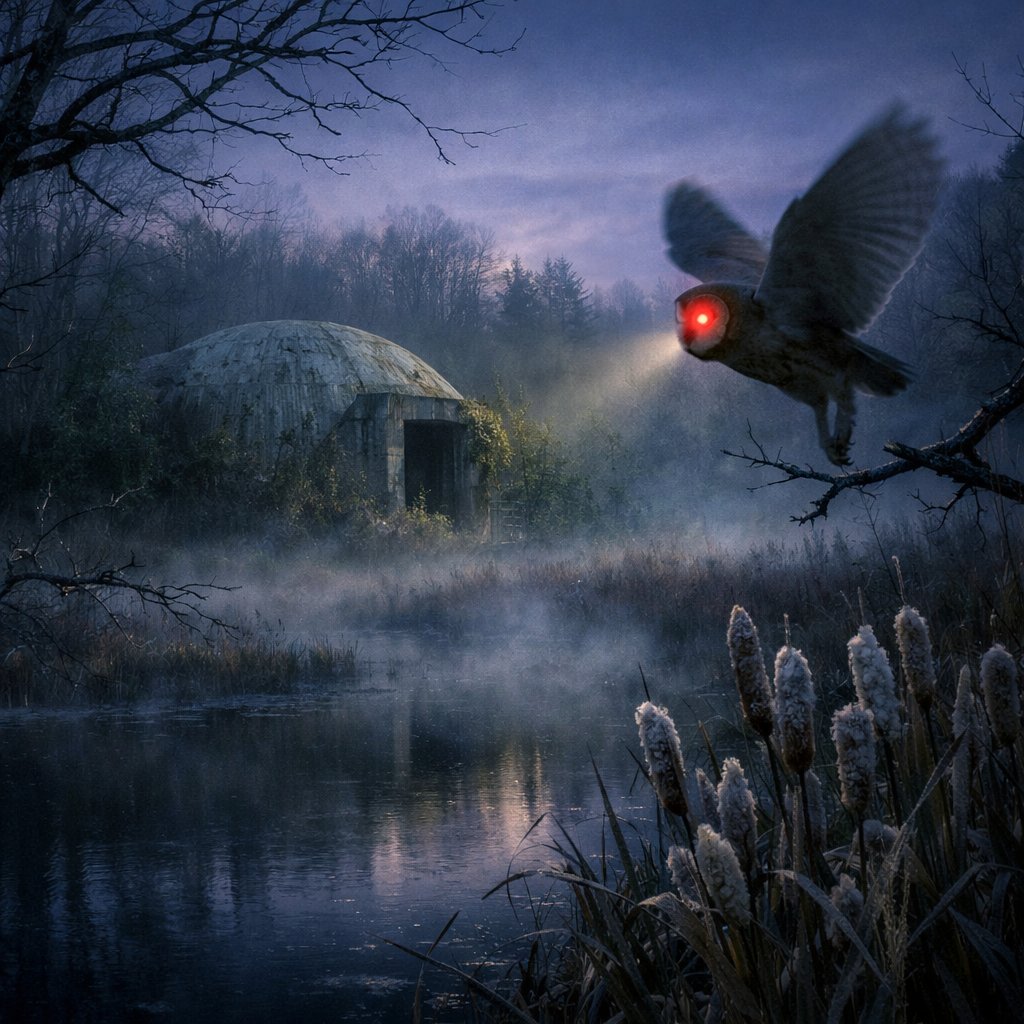
The reported epicenter is geographically specific. The West Virginia Ordnance Works was a 1942-1945 munitions plant on roughly 8,300 acres seven miles north of Point Pleasant; after decommissioning, much of the site became the McClintic Wildlife Management Area. Concrete igloo bunkers, brushy second-growth forest, and a network of small ponds remain. From a working zoologist’s standpoint, this is plausible owl habitat: hollow concrete structures function as substitute cavity-roosts, and rodent prey density is high in old-field successional brush [4].
The Silver Bridge: Where Folklore and Tragedy Intersect
On December 15, 1967, at approximately 5:00 p.m., the Silver Bridge spanning the Ohio River between Point Pleasant and Gallipolis, Ohio, collapsed during rush-hour traffic. Forty-six people died; two bodies were never recovered. A 1971 federal investigation traced the failure to a single eyebar, designated number 330, in which a hairline crack from fretting wear had grown by stress corrosion cracking until the chain link separated [5].
The collapse was a metallurgical failure, fully documented in engineering literature, and it directly led to the first national bridge inspection program under the Federal-Aid Highway Act of 1968. The cryptozoological narrative grafted onto this event by John Keel—that Mothman sightings preceded and somehow forewarned of the bridge’s failure—is not supported by the engineering record. The bridge collapsed because of corrosion in a 1928 alloy-steel eyebar, not because of a winged omen [5].
John Keel, Loren Coleman, and Two Different Cryptozoologies
John A. Keel arrived in Point Pleasant as a working journalist and stayed long enough to interview dozens of witnesses. His 1975 book, The Mothman Prophecies, published by Saturday Review Press, framed the encounters within a wider thesis about “ultraterrestrial” intelligences that interact with human consciousness through paranormal phenomena rather than as conventional flesh-and-blood animals [6]. Keel’s framework is not zoology. It is a metaphysics that treats the witness reports as data about something other than a vertebrate.
Loren Coleman, in Mothman and Other Curious Encounters (2002), takes the opposite tack. Coleman has argued for treating the case as a problem in cryptozoology proper: comparative analysis of large bird and owl sightings, regional distribution maps, and a sober separation of the original 1966-67 testimony from the secondary mythology that accreted after Keel’s book and the 2002 film [3]. The two writers respectfully disagree, and the disagreement is instructive: it marks the seam between cryptozoology-as-natural-history and cryptozoology-as-folklore-studies.
What Biology Would Actually Require
A seven-foot-tall, red-eyed, winged biped is a specific zoological claim. To take it as a literal undescribed species, the working naturalist would need a viable population, a habitat carrying capacity, a feeding ecology, a reproductive strategy, and at least one specimen, carcass, feather, scat, or footprint cast that survives laboratory analysis. None of these has been produced in nearly six decades. The TNT area has been repeatedly searched; the McClintic ponds have been dredged; no morphological evidence has entered the scientific record.
The misidentification hypothesis is the parsimonious alternative, and it has two flavors. Dr. Robert L. Smith, a wildlife biology professor at West Virginia University in 1966, suggested at the time that witnesses were describing a sandhill crane (Antigone canadensis)—a five-foot bird with gray plumage and a bare red facial patch [7]. The hypothesis has weaknesses: sandhill cranes were not common in West Virginia in the 1960s, and witnesses described a tailless biped rather than a long-necked wading bird.
The stronger candidate, advanced later by skeptical investigator Joe Nickell of the Skeptical Inquirer, is a large owl, most likely a barn owl (Tyto alba) or a barred owl (Strix varia). Barn owls have heart-shaped faces that resemble a humanoid mask in poor light, fly silently, vocalize with a startling raspy shriek, and have eyes that reflect light in a manner often described as glowing red, especially when caught in headlights [8]. The TNT bunkers offer ideal cavity-roosts; the wildlife management area is dense rodent habitat; and a startled barn owl rising in the path of a moving car can subtend the visual angle of a much larger creature.
Why Owls Get Mistaken for Bipeds
An owl in flight, viewed head-on through a windshield at night, presents a vertically oriented body, two large forward-facing eyes, and a flat facial disc. The brain’s face-detection circuitry pattern-matches aggressively under stress. Add the fact that the witnesses had just driven past an abandoned munitions plant on a dark country road, and the conditions for a high-confidence misidentification are fully met. This is not a dismissal. It is the alternative explanation a working zoologist is obligated to consider before invoking a new species.
The 2002 Film and the Folklore Layer
The 2002 Sony film The Mothman Prophecies, directed by Mark Pellington and starring Richard Gere, is fictional. It transposes Keel’s 1966-67 events into a contemporary setting, invents a deceased wife for the protagonist, and merges the separate figures of Mothman and the “Indrid Cold” contactee (a different 1960s case involving Woodrow Derenberger) into a single narrative arc [9]. The film is a useful object lesson in how rapidly cryptozoological cases acquire layers of borrowed mythology once they enter mass media.
In the years since, Point Pleasant has built a tourism economy around the case. Sculptor Bob Roach’s twelve-foot stainless-steel Mothman statue was unveiled on Main Street in September 2003 with John Keel in attendance; the Mothman Museum opened across the street in 2006; the annual Mothman Festival now draws between 10,000 and 20,000 visitors each September [10]. The economic and cultural reality of the legend is unambiguous, regardless of the zoological status of the original creature.
The Field-Notebook Verdict
Held against the standards of vertebrate zoology, the Mothman case has no specimen, no carcass, no remains, no eDNA, and no reproducible track. It has, instead, a tightly clustered set of witness reports in a small geographic area over thirteen months, a documented engineering tragedy that the public connected to the sightings retrospectively, a 1975 book that wove the two together within a paranormal frame, and a 2002 film that consolidated the legend into popular culture. That is a folklore case, not a zoological one—though the witnesses were almost certainly seeing something, and the most parsimonious something is a large owl in poor light at high adrenaline.
The graveyard chapter of cryptozoology is full of cases that resolved this way: the Beast of Bodmin became feral cats and dogs, the Iliamna Lake monster became sturgeon, the New Jersey Devil became composite folklore. The graveyard chapter is also where the discipline earns its honesty. What Point Pleasant retains, irreducibly, is the testimony of credible witnesses describing an experience for which the parsimonious explanation is owl-shaped—and the bridge collapse, which would have taken its 46 lives whether or not the creature ever existed.
Frequently Asked Questions
Was Mothman ever photographed?
No verified photograph of Mothman exists. Photographs that occasionally circulate online are either misattributed images of large birds, deliberate hoaxes, or stills from the 2002 film. No image survives forensic provenance review.
How many people reported seeing the Mothman?
Tallies differ by source. Compilations by John Keel and Loren Coleman put the total at roughly 100 separate reports over the thirteen months between November 15, 1966, and December 15, 1967, clustered most densely near the TNT area north of Point Pleasant.
Did Mothman cause the Silver Bridge collapse?
No. The 1971 federal engineering investigation traced the December 15, 1967, collapse to stress corrosion cracking in eyebar 330, a structural component manufactured in 1928. The cause was metallurgical failure, fully accounted for by materials science, with no causal link to the sightings.
What is the most likely identification of Mothman in zoological terms?
Skeptical investigator Joe Nickell’s barn owl (Tyto alba) hypothesis is the most parsimonious explanation. Barn owls fit the size class, the heart-shaped facial disc, the silent flight, the rasping shriek, the cavity-roost behavior in concrete bunkers, and the red eye-reflection seen in headlights.
Did sandhill cranes really live near Point Pleasant in 1966?
Not in any abundance. Dr. Robert L. Smith of West Virginia University proposed the sandhill crane (Antigone canadensis) hypothesis in 1966 based on plumage and red facial-patch matching. Critics noted the species was not regularly resident in West Virginia, weakening the identification.
Is John Keel’s book a reliable historical source?
Keel’s 1975 book The Mothman Prophecies is the most extensive primary collection of witness interviews from the period. It is reliable as an ethnographic record of testimony but unreliable as natural history; Keel framed the data within an “ultraterrestrial” thesis that is metaphysical, not biological.
What does the 2002 film get wrong?
Several substantive points. The film relocates the events to the early 2000s rather than 1966-67, invents a deceased wife for the protagonist, and merges Mothman with the unrelated “Indrid Cold” case from a contactee narrative involving Woodrow Derenberger. It is a fictional adaptation, marketed as “based on true events.”
Can I visit the original Mothman sighting locations?
Yes. The McClintic Wildlife Management Area, which encompasses the former West Virginia Ordnance Works (the TNT area), is open to the public for hiking and birdwatching. The Mothman statue and Mothman Museum are on Main Street in Point Pleasant; the annual Mothman Festival is held the third weekend of September.
Is cryptozoology a recognized scientific discipline?
Cryptozoology operates at the margins of mainstream zoology. It applies zoological methods—track analysis, habitat assessment, eDNA sampling, comparative anatomy—to creatures whose existence has not been confirmed. Successful cases (the okapi in 1901, the coelacanth in 1938) have been absorbed into zoology proper; unconfirmed cases remain folklore.
Sources
[1] Point Pleasant Register, “Couples See Man-Sized Bird,” November 16, 1966.
[2] Keel, John A. The Mothman Prophecies. New York: Saturday Review Press, 1975.
[3] Coleman, Loren. Mothman and Other Curious Encounters. New York: Paraview Press, 2002.
[4] McClintic Wildlife Management Area, West Virginia Division of Natural Resources public-lands record.
[5] National Transportation Safety Board / Federal Highway Administration. Collapse of U.S. 35 Highway Bridge, Point Pleasant, West Virginia, December 15, 1967. Final Report, 1971.
[6] Wikipedia, “The Mothman Prophecies” (book entry, accessed 2026).
[7] Smith, Robert L., quoted in regional press coverage, November 1966; archival summary in Audubon magazine, “Is the Mothman of West Virginia an Owl?”
[8] Nickell, Joe. “Mothman Revisited: Investigating on Site.” Skeptical Inquirer.
[9] The Mothman Prophecies (film), directed by Mark Pellington, Sony / Lakeshore Entertainment, 2002.
[10] Mothman Festival official records and Mason County Tourism, Point Pleasant, West Virginia.
For a wider naturalist’s survey of related cases, see the parent pillar at Cryptids and Mythical Creatures.
Related reading from the cryptids and mythical creatures archive: The Cardiff Giant: A Famous Hoax and North American Sasquatch: Tribal Tales.