
By EsoVitae Editorial · Published
Drafted with AI assistance from the sources listed; images are AI-generated illustrations. How EsoVitae is made
Who Is Satoshi Nakamoto?
Satoshi Nakamoto is the pseudonym used by the unknown author or group who released the Bitcoin whitepaper on October 31, 2008, mined the genesis block on January 3, 2009, and disappeared from public communication on April 23, 2011. The identity has never been verified, despite multiple high-profile claims and lawsuits.
The chase has its own subculture now. Forum threads from 2009 are mirrored on archive.org. Old mailing-list posts get parsed for stylistic tells. Cryptographers run timestamp analyses on early blocks. The interesting part is not the leaderboard of suspects. It is how a single anonymous author became one of the most studied authorial fingerprints of the early internet, and how every confident answer keeps getting demolished by the evidence chain underneath.
This piece works the chain backward. The original posts. The first replies. The exact wording. Where confident claims have been tested in court and lost, that record stands. Where the Patoshi pattern points without naming a person, that ambiguity stays preserved. The story sits inside the wider field of contemporary mysteries and theories, where digital provenance does what folklore once did.
The Original Post: October 31, 2008
The whitepaper was not dropped on a website. It went to a mailing list. On October 31, 2008, an account named “satoshi” posted a message titled “Bitcoin P2P e-cash paper” to the cryptography mailing list at metzdowd.com, a small list run by cypherpunks and security researchers [1]. The post linked to a nine-page PDF titled Bitcoin: A Peer-to-Peer Electronic Cash System. The opening sentence stated that the author had been working on a new electronic cash system “that’s fully peer-to-peer, with no trusted third party.”
The reception was tepid. A handful of list members replied. James A. Donald wrote back skeptically about scaling. Hal Finney, a cryptographer who had worked on PGP and the earlier Hashcash proof-of-work scheme, took the proposal seriously and began testing the software within weeks. The thread is preserved by the Satoshi Nakamoto Institute and mirrored across archive.org snapshots [1][2]. There is no record on the list of any author behind “satoshi” beyond the mailing-list signature itself.
What the Whitepaper Actually Solved
The paper proposed a way to prevent double-spending of digital coins without a central mint. The mechanism was a chain of cryptographic timestamps secured by proof of work, with the longest valid chain treated as canonical. The eight pages cited prior work by Adam Back (Hashcash, 1997), Wei Dai (b-money, 1998), Nick Szabo (bit gold, late 1990s), Stuart Haber, and W. Scott Stornetta (linked timestamping, 1991). The synthesis was new. The components were not.
The Genesis Block and Its Newspaper Headline
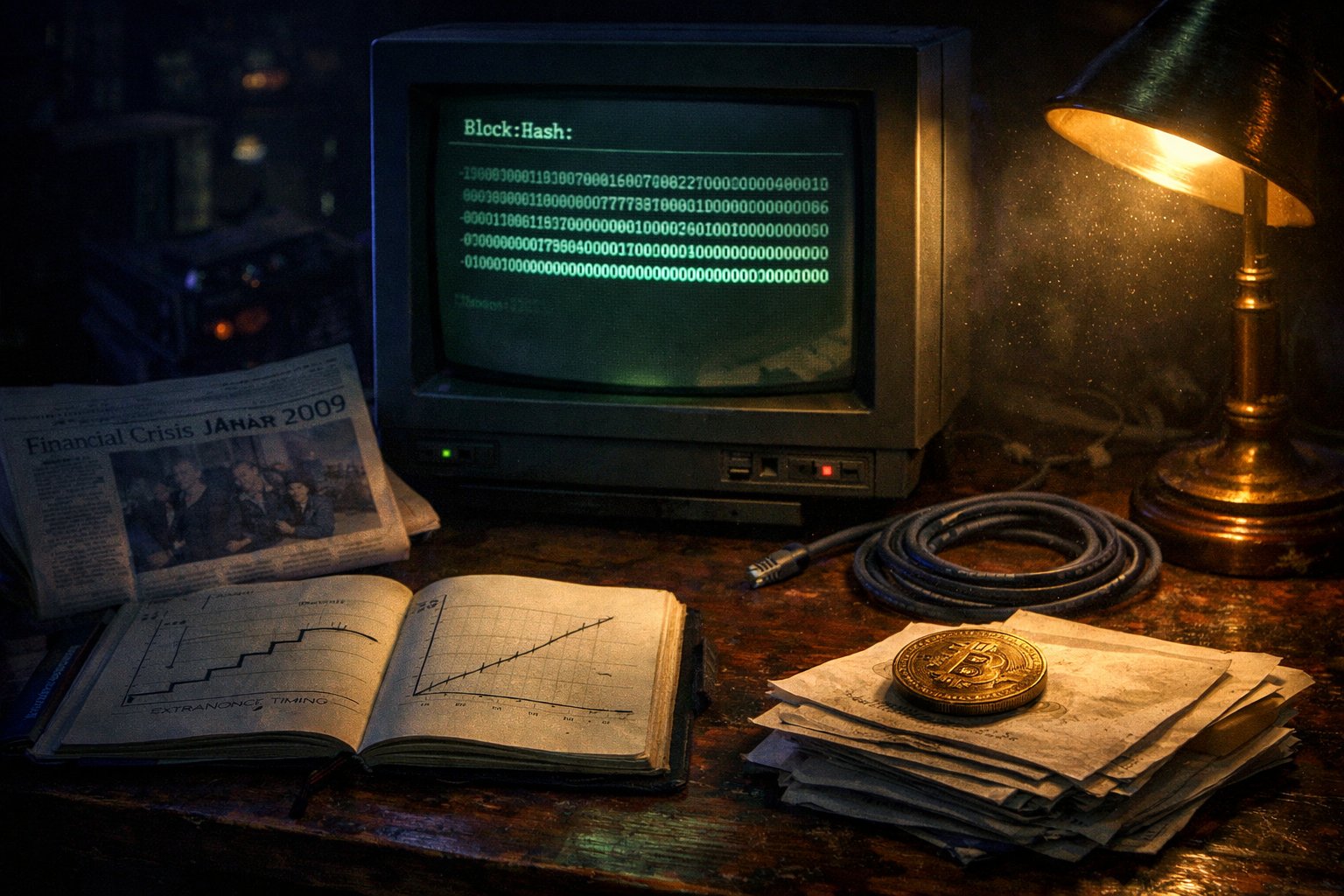
On January 3, 2009, Satoshi mined the first Bitcoin block. The coinbase parameter, a free-form field used in the first transaction of every block, contained a string in plain ASCII bytes: “The Times 03/Jan/2009 Chancellor on brink of second bailout for banks” [3]. The line was lifted directly from that day’s front page of The Times of London. The reference accomplished two things at once. It proved the block could not have been mined earlier than that date. It also tied the project’s launch to the political moment of the financial crisis.
The genesis block paid 50 BTC to a coinbase address that has never moved. The block’s hash starts with an unusually long run of leading zeros, which has been read as ceremonial difficulty rather than a side effect of normal mining. Hal Finney received the first peer-to-peer Bitcoin transaction six days later, on January 12, 2009, when Satoshi sent him 10 BTC.
Email Style and Working Hours
Researchers have parsed every public Satoshi message for clues. The English uses British spellings (favour, colour, cheque, optimisation) more often than American ones, though the pattern is not perfectly consistent. Timestamp analyses of forum posts and emails show low activity during the hours that correspond to nighttime in the United Kingdom, which has been used to argue for a UK-aligned timezone, or for a deliberate misdirection. The data set is small enough that confident attribution from style alone has not held up.
April 23, 2011: The Last Email
On April 23, 2011, Satoshi sent a private email to developer Mike Hearn that ended with the line, “I’ve moved on to other things. It’s in good hands with Gavin and everyone” [4]. Gavin Andresen had already taken over as lead maintainer of the Bitcoin reference client. The handoff was complete. After that email, the Satoshi accounts on the Bitcointalk forum, on the SourceForge project, and at the email addresses tied to the project went silent. The associated PGP keys have not signed any verifiable message since.
The wallets associated with early mining have stayed dormant for more than fifteen years. Roughly one million bitcoin attributed to Satoshi sit untouched across thousands of addresses [5]. At any reasonable price level, this is one of the largest concentrated stashes of unspent value in the world. It has not moved.
The Suspects, in Chronological Order
Naming a real person behind the pseudonym has proven harder than naming the pseudonym. Several candidates have been put forward, sometimes by themselves, sometimes by reporters. None has been verified to a standard that holds up under the simplest cryptographic test, which is signing a message with one of Satoshi’s known keys.
- Hal Finney: Cryptographer who received the first Bitcoin transaction. Lived in Temple City, California, near Dorian Nakamoto, which fueled later speculation. Denied being Satoshi. Died in 2014. The Patoshi mining pattern continued during periods Finney was hospitalized, which weighs against the attribution.
- Nick Szabo: Designed bit gold, a 1998 proposal that anticipated several Bitcoin features. Stylometric studies in 2014 by Aston University and the Reedy network analysis pointed at his writing as a closer match than other candidates. Has consistently denied being Satoshi.
- Adam Back: Inventor of Hashcash, cited in the whitepaper. Cypherpunk mailing-list veteran. Founder of Blockstream. Has denied being Satoshi.
- Dorian Nakamoto: Japanese-American engineer in Temple City, California, named in a March 2014 Newsweek cover story by Leah McGrath Goodman [6]. He denied any involvement, sued the magazine, and the identification has been treated by most subsequent researchers as a misfire of name-similarity reporting.
- Craig Wright: Australian computer scientist who began publicly claiming to be Satoshi in 2015. Filed multiple lawsuits to defend the claim. In March 2024, the UK High Court ruled, in COPA v Wright, that he is not Satoshi Nakamoto. The full written judgment was handed down on May 20, 2024 [7].
Why Stylometry Keeps Failing
Stylometric attribution treats word frequency, sentence length, and punctuation choice as a fingerprint. The method works on long, unambiguous corpora. The Satoshi corpus is short, technical, and possibly written by more than one person. Different studies have ranked Nick Szabo, Hal Finney, and others as top matches depending on which corpus and which features were chosen. Treating any single ranking as conclusive overweights the method.
The COPA v Wright Ruling: Court-Tested Evidence
The 2024 ruling is the closest the Satoshi question has come to a courtroom verdict. The Crypto Open Patent Alliance, joined by several Bitcoin developers, brought a case in the High Court of England and Wales asking the court to declare that Craig Wright was not Satoshi. Mr Justice James Mellor presided over a six-week trial. On March 14, 2024, he delivered an oral ruling: “the evidence is overwhelming. Dr Wright is not the person who adopted or operated under the pseudonym Satoshi Nakamoto” [7].
The written judgment, released on May 20, 2024, runs to 1,736 paragraphs. It dissects document forgeries, edited PDFs, mismatched timestamps, and inconsistencies in Wright’s testimony. Justice Mellor referred the matter to the Crown Prosecution Service for consideration of perjury and forgery charges. Whatever else the Satoshi question contains, the question of whether Craig Wright is Satoshi has been answered by a UK court of record.
The Patoshi Pattern: A Fingerprint Without a Face
In 2013, cryptographer Sergio Demian Lerner mapped the ExtraNonce field across the first roughly 50,000 Bitcoin blocks. He identified a single dominant mining slope visible in the data, distinct from the patterns produced by other early miners [5]. The pattern, nicknamed Patoshi, accounts for an estimated 1.1 million BTC mined between January 2009 and the spring of 2010. Patoshi appears to have deliberately throttled the hash rate, leaving room for other miners to win blocks during the same window.
Patoshi is widely treated as Satoshi. The behavior is consistent: the throttling reflects an early-network operator trying to keep the chain alive without dominating it. The 1.1 million BTC has never moved. Patoshi’s coins sit across roughly 22,000 addresses and have not been spent, even through years of price spikes that would have made any partial liquidation life-changing for an ordinary holder.
What the Pattern Cannot Tell You
The Patoshi pattern is a behavioral signature, not an identity. It does not name a person. It does not name a country. It rules out anyone who could not have been operating a single coordinated mining setup during early 2009 and 2010. It does not rule between Hal Finney, Nick Szabo, Adam Back, an unknown sole author, or a small collaborating group. The pattern narrows the suspect set without resolving it.
Why the Disappearance Matters
An anonymous founder who walks away clean is rare. Most projects accumulate a public face. Bitcoin did the opposite. The disappearance turned the protocol into something closer to public infrastructure, with no founder to lobby, sue, subpoena, or pressure. Several Bitcoin developers have argued that the project’s continued credibility depends on Satoshi staying gone. A return, even a verified one, would change the social contract around the network.
The economic argument cuts the same way. The dormant Patoshi coins act as a credible commitment. As long as they do not move, the float of circulating Bitcoin stays predictable. Any sudden movement of a single early-2009 wallet would be detected within minutes by chain-watching services and would propagate through markets in seconds. The threat of that movement is itself a structural feature of the network.
What the Evidence Chain Actually Supports
A short list of claims survive every serious test. The whitepaper went out on October 31, 2008 to the metzdowd cryptography list. The genesis block was mined on January 3, 2009 and embedded a London Times headline. The last verified email is dated April 23, 2011. The Patoshi pattern fingerprints a single coordinated miner who controlled an estimated 1.1 million BTC. Craig Wright is not Satoshi, per the UK High Court. Beyond those, attribution rests on circumstantial evidence and stylistic inference. That gap is the mystery, and it has held for more than seventeen years.
Frequently Asked Questions
Who is Satoshi Nakamoto?
Satoshi Nakamoto is the pseudonym used by the unknown author or authors of the Bitcoin whitepaper, the Bitcoin reference client, and the early forum and email correspondence that launched the network. No verified identification has ever been made. Several candidates have been proposed, denied, or legally dismissed.
When did the Bitcoin whitepaper come out?
October 31, 2008. The paper, titled Bitcoin: A Peer-to-Peer Electronic Cash System, was posted to the cryptography mailing list at metzdowd.com under the email signature “Satoshi Nakamoto.” The post is preserved on the Satoshi Nakamoto Institute mirror and in archive.org snapshots.
What was the message in the genesis block?
The first Bitcoin block, mined on January 3, 2009, contained a coinbase parameter reading “The Times 03/Jan/2009 Chancellor on brink of second bailout for banks.” The line was the front-page headline of The Times of London that day, used to timestamp the block and signal the project’s framing.
When did Satoshi disappear?
The last verified Satoshi communication is a private email to developer Mike Hearn on April 23, 2011, ending with “I’ve moved on to other things. It’s in good hands with Gavin and everyone.” All Satoshi accounts have been silent since. No PGP-signed message has been published from a Satoshi key in the years since.
Was Craig Wright proven not to be Satoshi?
Yes, in a UK court. In COPA v Wright, Mr Justice James Mellor ruled on March 14, 2024 that “Dr Wright is not the person who adopted or operated under the pseudonym Satoshi Nakamoto.” The written judgment, dated May 20, 2024, ran to 1,736 paragraphs and referred the matter to the Crown Prosecution Service for possible perjury and forgery charges.
What is the Patoshi pattern?
The Patoshi pattern is a distinctive ExtraNonce fingerprint identified by cryptographer Sergio Demian Lerner in 2013. It traces a single coordinated miner active in early 2009 and 2010, who mined an estimated 1.1 million BTC and capped their hash rate at roughly 50 percent. Patoshi is widely treated as Satoshi, though the pattern names a behavior, not a person.
How much Bitcoin does Satoshi have?
An estimated 1.1 million BTC, mined during the network’s first year, sit across roughly 22,000 addresses tied to the Patoshi pattern. None of these coins have ever moved. At market prices in the millions of dollars per coin range, this represents one of the largest dormant concentrations of value in any modern asset.
Who is Dorian Nakamoto?
Dorian Prentice Satoshi Nakamoto is a Japanese-American engineer named as Bitcoin’s creator in a March 2014 Newsweek cover story by Leah McGrath Goodman. He denied any role and later sued the magazine. Most subsequent researchers treat the identification as a misfire of name-similarity reporting rather than a positive lead.
Why are Hal Finney, Nick Szabo, and Adam Back suspects?
All three were active in the cypherpunk milieu and produced prior work the whitepaper either cites or echoes. Finney was the first peer to test Bitcoin and received the first peer-to-peer transaction. Szabo’s bit gold proposal anticipated several core ideas. Back authored Hashcash, the proof-of-work scheme cited in the paper. All three have publicly denied being Satoshi.
Has anyone signed a message with a Satoshi key?
No. Satoshi’s PGP key and the private keys to the early-block addresses can produce signatures that any independent verifier can check. No claimant has produced such a signature from a verifiable Satoshi key. Court testimony in COPA v Wright explicitly noted Wright’s failure to do so.
Could Satoshi be a group rather than one person?
Possibly. The codebase shows different commenting and naming styles across modules, which some researchers read as evidence of multiple hands. Stylometric studies of the writing have produced mixed results. The available evidence is consistent with a sole author, a small collaborating group, or a primary author working with editorial input.
What happens if Satoshi’s coins ever move?
Chain-watching services would detect the movement within minutes. Markets would react in seconds. The float of circulating Bitcoin would shift. Beyond the price impact, a movement would represent a re-entry of the founder into the system after more than fifteen years of silence, with implications for the network’s social structure that no developer has fully modeled.
Related contemporary mysteries coverage: War of the Worlds Broadcast: Mass Panic or Exaggerated Response? and The Disappearance of A.I. Gary McKinnon’s Discoveries.