
By EsoVitae Editorial · Published
Drafted with AI assistance from the sources listed; images are AI-generated illustrations. How EsoVitae is made
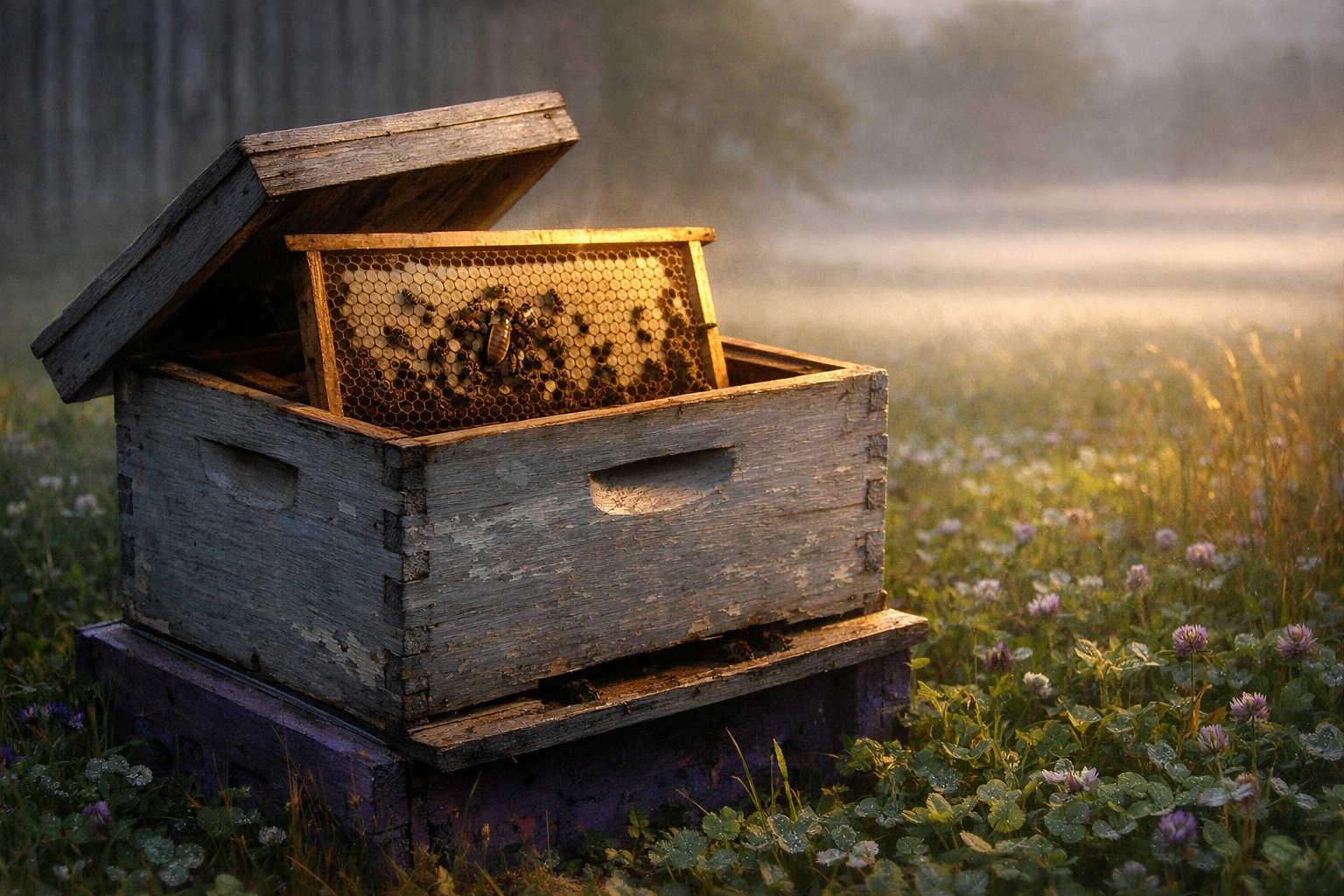
In the autumn of 2006, a Pennsylvania commercial beekeeper named David Hackenberg trucked roughly 400 colonies of Apis mellifera from the Susquehanna Valley to a wintering yard in central Florida. When he came back to inspect them in early November, the boxes still stood. The honey was still in the supers. The queens were still on the comb, attended by a thin handful of nurse bees and surrounded by capped brood. The foragers, by the tens of thousands, were simply gone — not piled at the entrance, not crawling in the grass, not trailing back to the hive at dusk. They had walked off the map [1].
That absence is the diagnostic signature of what would, by the following winter, be named Colony Collapse Disorder. It is also the reason this story belongs in a chapter on unexplained migrations rather than in the more ordinary file of pollinator pathology. CCD is not, in the strict sense, a disease that kills bees in place. It is a behavior — the disappearance of foragers from a still-functional hive — and behaviors are measurements of the world the animal is in.
Direct Answer: What CCD Is and What It Is Not
Colony Collapse Disorder is a syndrome in which the adult worker bees of an Apis mellifera colony abandon the hive in winter, leaving behind a live queen, capped brood, and stored honey, with few or no dead bees on site. The term was coined in winter 2006 to 2007 by a Penn State-led working group after sudden, unexplained losses among US migratory beekeepers; current evidence implicates an interaction of Varroa destructor mites, viral co-infection (notably Israeli Acute Paralysis Virus), Nosema ceranae, neonicotinoid sublethal exposure, and nutritional stress, with no single cause established [1][2][3].
The Field Picture in 2006: An Empty Hive Is a Strange Thing
A working ethologist learns early to read absences. A trampled circle on a forest floor where deer were the night before. A canopy gone abruptly silent because a Cooper’s hawk has come to perch. CCD presents as an absence of a particularly puzzling kind, because the social architecture is still in place. The colony is not collectively dying so much as it is collectively leaving, and the foragers are not coming home.
In the months following Hackenberg’s report, beekeepers in 27 US states and parts of Canada reported similar losses. The pattern was consistent enough that the Mid-Atlantic Apiculture Research and Extension Consortium, working with Penn State’s College of Agricultural Sciences, formally described the syndrome and named it. Diana Cox-Foster of Penn State, Dennis vanEngelsdorp (then state apiarist of Pennsylvania), and Jeff Pettis of the USDA Bee Research Laboratory anchored the early investigation [1][4].
Two features made CCD difficult to triage with standard apiary diagnostics. The first was the missing-bodies problem: a colony that dies of Varroa-vectored deformed wing virus typically leaves a carpet of dead workers on the bottom board, but CCD hives were emptied without any such record. The second was the delayed-robbing observation. Healthy bees and pests like wax moth and small hive beetle, which normally invade an abandoned hive within days, did not enter CCD-collapsed boxes for weeks. Something about the residual chemistry of the comb was, briefly, repellent [3].
The Suspect List, Read Carefully
Honey bees are obligate eusocial insects with one of the most heavily studied immune and behavioral repertoires in entomology. The CCD investigation drew on that literature, and what it produced is best read as a list of co-stressors, none of which fully explains the phenomenon alone.
Varroa destructor and Its Viral Cargo
The ectoparasitic mite Varroa destructor jumped from Apis cerana (the Asian honey bee) to Apis mellifera in the mid-twentieth century and reached North American apiaries in 1987. It feeds on the fat body of developing pupae and adult bees, which compromises immune signaling and acts as a mechanical vector for at least eighteen honey bee viruses. By the time CCD emerged, Varroa had been the dominant managed-bee health problem in the US for two decades [3][5].
Israeli Acute Paralysis Virus
In 2007, a metagenomic survey published in Science by Cox-Foster, W. Ian Lipkin of Columbia, and colleagues found Israeli Acute Paralysis Virus (IAPV), a dicistrovirus first described in Israeli apiaries in 2004, in 96.1 percent of CCD-affected samples and far less frequently in healthy colonies [2]. The authors were careful: IAPV was a marker for CCD, not proven cause. Subsequent work showed IAPV strains had been present in US bees before the CCD outbreak, that Varroa can vector IAPV, and that infected foragers exhibit altered homing behavior — a clue that connects a virus to the missing-bee phenotype.
Nosema ceranae and Sublethal Stress
A microsporidian gut parasite, Nosema ceranae, also crossed from Asian to European honey bees and was identified in the mid-2000s as more virulent than its long-known relative N. apis. Nosema infection alone does not produce CCD, but laboratory and field studies show synergistic toxicity when bees are co-exposed to Nosema and sublethal doses of certain pesticides, particularly the neonicotinoids [6].
Neonicotinoids and the Sublethal Threshold
Neonicotinoid insecticides — imidacloprid (Bayer, market introduction 1991), clothianidin, and thiamethoxam — bind nicotinic acetylcholine receptors in insects. Used as seed coatings, they translocate systemically into pollen and nectar at concentrations far below those that kill foragers outright. The ecological question that mattered for CCD was whether sublethal exposures impair learning, navigation, and immune function. Multiple controlled studies have shown they do, with effects measurable on homing success, waggle-dance fidelity, and viral load [6][7].
The European Food Safety Authority assessed these data and the European Commission acted. In 2013, Regulation (EU) No 485/2013 restricted clothianidin, imidacloprid, and thiamethoxam on flowering crops. In 2018, after a renewed EFSA assessment, the Commission banned all outdoor uses of the three substances; greenhouse use remains permitted [7]. The US response has been comparatively narrow, and the substances remain in widespread agricultural use.
Why CCD Reads as a Migration Anomaly, Not a Mortality Event
A honey bee colony is a single distributed organism whose foragers extend its sensory and metabolic reach across roughly five kilometers of landscape. The forager population is not a static labor pool; it is the colony’s outward-facing limb, recruited and renewed daily through the dance language. When that limb fails to retract — when foragers leave and do not return — the colony loses its food acquisition system within days, and a queen with capped brood and no nurses to warm them is sentenced to starvation.
There are several behaviorally plausible mechanisms by which CCD foragers might fail to return. Sublethal pesticide exposure can disrupt mushroom-body learning circuits used in path integration. Viral infection (IAPV, deformed wing virus) shifts the timing of the transition from in-hive nurse work to outside foraging, sending bees into the field underdeveloped. Nosema shortens forager lifespan. Any of these, in combination with high Varroa load and thin late-season nutrition, can push the colony past the threshold at which foragers depart faster than they can be replaced — and the population implodes from the outside in [3][6].
This is the place where ethology earns its keep. The CCD phenotype is not “the bees got sick.” It is “the bees got disoriented, and a colony of disoriented foragers cannot find its way home.” Reading the syndrome that way reframes the field’s central question: what combination of insults disorients an animal whose entire evolutionary history is a triumph of orientation?
What Happened After 2010, and What Pollinator Decline Means Now
The reported rate of CCD-classic losses in US migratory operations declined through the 2010s. By 2015 the syndrome was no longer the primary diagnostic category for managed-colony losses; Varroa, viral disease, and queen-related failures had reasserted themselves as the dominant causes [8]. CCD did not vanish so much as recede into the longer story it had always been part of.
That longer story is sobering. The annual loss rate of US managed honey bee colonies, as tracked by the Bee Informed Partnership and University of Maryland surveys, has averaged roughly 39 to 45 percent over the last fifteen years — well above the 15 percent threshold beekeepers consider economically sustainable. The 2022 to 2023 season recorded a 48 percent loss [8]. Beekeepers compensate by splitting surviving colonies, so total managed-colony numbers in the US have remained relatively stable; the workload and replacement cost have not.
For wild bees the picture is more difficult to track and more concerning. The FAO’s 2024 status reports estimate that around 40 percent of invertebrate pollinator species assessed by IUCN are at risk of extinction, with documented declines of approximately 23 percent across US wild-bee species between 2008 and 2013 [9]. The two-track distinction matters: managed Apis mellifera is functionally agricultural livestock and can be replenished by beekeeper labor; wild bumblebees, mason bees, leafcutter bees, and squash bees cannot.
When I sit at the edge of an alfalfa field at first light and watch the first Bombus queen of the morning lift off a clover head, I am watching a sensor with a half-billion-year evolutionary history register the chemistry, the temperature, the floral resource map of a square kilometer. CCD was the moment we noticed that the sensor was failing. The full report is still being written.
Where the Field Stands
The most defensible synthesis is that CCD was a syndrome — a stable cluster of symptoms — produced by the interaction of multiple stressors in a specific managerial context (large-scale migratory pollination, high Varroa pressure, agricultural pesticide exposure, monocultural foraging, and emerging viruses). No single cause was found because there was no single cause. The bees were trying to do their work in an environment whose chemistry, parasitology, and floral ecology had all shifted at once. For the curious reader interested in further animal anomalies of this kind, the broader pillar at animal anomaly mysteries on this site collects related cases.
The work continues. Penn State, USDA-ARS, the Bee Informed Partnership, and EU national reference laboratories track colony losses each year. Genomic tools that did not exist in 2006 — the same metagenomic methods that identified IAPV — are now used routinely to screen for emerging pathogens. Breeding programs select for Varroa-tolerant stock. The neonicotinoid debate is not closed; it continues in court filings and on agricultural ministry desks. And every spring a beekeeper opens a hive and reads, in the warmth of the cluster and the spread of the brood pattern, whether the colony came through.
An empty hive on a clean bottom board, in November, with the queen still on the comb. That is what we still owe an explanation for. The honest answer is that we have most of one.
More from the animal anomaly mysteries archive: Elephant and Rhino Odd Friendship and Crop Circles: The Animal Connection.