
By EsoVitae Editorial · Published
Drafted with AI assistance from the sources listed; images are AI-generated illustrations. How EsoVitae is made
Crop Circles and the Animal Connection: What the Field Record Shows
Most flattened-cereal crop circles in southern English wheat are anthropogenic, traceable to the 1991 admission by Doug Bower and Dave Chorley and the artists who followed them. The animal connection is a different question. Across deserts, forests, and pastures, vertebrates and invertebrates produce circular and tessellated ground patterns that ecology can measure: Namibian fairy circles, Australian Pilbara fairy circles, deer beds, livestock trails, badger latrines, mole networks, and the cardinal-axis spin of a defecating dog [1][2][7].
My field notebooks from five oceans and seven forest biomes return to one habit. Watch the animal. Watch what the animal watches. A geometric pattern on a landscape almost always has a behavioral or ecological cause that is testable in principle. The mystery of “crop circles” as flattened-wheat formations belongs in a separate file from the mystery of why a herd of cattle traces a particular curve through a pasture, or why a colony of subterranean termites in the Namib rim its grazing zone with a near-perfect bare disc. The first is a story about people. The second is a story about animals reading their world.
This guide separates the two. It walks through the documented animal-pattern phenomena that the ecological literature has measured and replicated, distinguishes them from the human-made cereal-crop variant, and places the animal record inside the broader landscape of animal anomaly mysteries. The voice is patient and specific; the hypotheses are humble and testable; the conclusions are provisional in the way working biology is always provisional.
Two Different Mysteries Under One Name
A working ethologist begins with definitions. The phrase “crop circle” in popular usage means a flattened geometric formation in a cereal field, mostly wheat, mostly in southern England, mostly produced since the late 1970s. That phenomenon is now well attributed to human artists and pranksters. Bower and Chorley described their plank-and-rope method to journalists in 1991, and contemporary circle-makers including the team behind the late-summer Wiltshire formations openly publish their methodology [3][4].
Ecological circles are different in every measurable way. They appear on multiple continents, they recur on the same coordinates over decades, they have biomass dynamics, and they associate with specific species. The Namib Desert hosts millions of them. Western Australia hosts hexagonal mosaics of them. North American shortgrass prairie shows them as ant-disc clearings. Forests show them as deer beds and yarding paths. The patterns repeat because the animals (or the plants under their grazing pressure) repeat their behavior. The argument here is that “the animal connection” should mean these biotic patterns, not the human ones.
What Counts as an Animal-Made Circle
For the purposes of this article, a circle counts as animal-made when at least one of three conditions holds. First, an identifiable species (or guild) is present and active in the structure. Second, removing or excluding that species causes the structure to fade or fail to renew. Third, the geometry is reproducible across sites in a way that hoaxers cannot easily duplicate at the relevant scale. The Namib fairy circles meet all three; deer bedding rings meet the first two; cattle trail networks meet the first and third; the cereal-wheat formations meet none.
Namibian Fairy Circles: The Best-Studied Animal Pattern
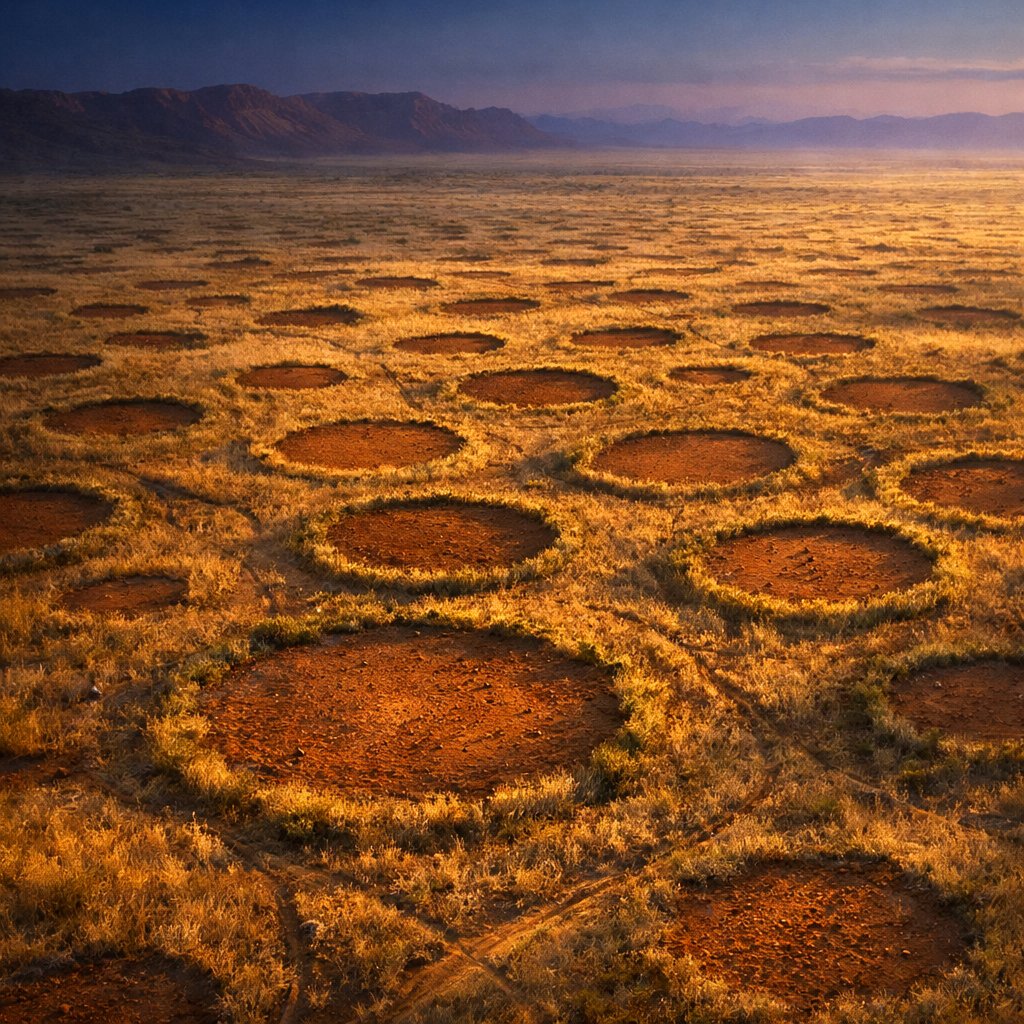
The Namib Desert in southwestern Africa is dotted with millions of bare circular patches in a matrix of perennial grasses, each circle two to fifteen meters wide, ringed by taller grass, persisting in place for decades. The phenomenon has driven a sustained, productive scientific argument since the 1970s. The two leading hypotheses are not mutually exclusive, and the current consensus is moving toward a synthesis [1][5].
The Sand Termite Hypothesis
The German biologist Norbert Juergens published in Science in 2013 the case that the sand termite Psammotermes allocerus, a subterranean species ranging across the wider Namib, drives the formation of the bare patches. The argument is mechanistic. After rare rainfall events, termites consume the roots of newly germinated grass within a defined territory, creating a bare disc that becomes a moisture trap. Sandy soil percolates the water below the evaporation zone; the termite colony then has a long-term subsurface reservoir. The ring of taller grass at the perimeter feeds on residual moisture flowing outward from the disc. Recent work confirms a strong correlation between active Psammotermes colonies and the bare patches, including phylogeographic evidence for seven differentiated genetic groups across the wider Namib region [5].
The Self-Organization Hypothesis
Independently, Stephan Getzin and colleagues at the Helmholtz Centre for Environmental Research developed a vegetation self-organization model. In water-limited grasslands, plants compete for moisture in feedback with soil-water diffusion. The mathematics produces hexagonally tessellated bare-patch patterns whether or not termites are present. Getzin et al. published in PNAS in 2016 the discovery of analogous fairy circles in the Pilbara region of Western Australia, on flat terrain about ten to twenty kilometers around the mining town of Newman, and showed that the Australian patterns lack the termite signature predicted by the Juergens model. Their data and modeling supported soil-crusting and plant biomass-water feedbacks as the driver [2][6].
What the Synthesis Looks Like
The pragmatic reading, supported by recent papers across both research lineages, is that termite engineering and plant self-organization are both real and that they reinforce each other in the Namib. Termites create initial bare patches; the bare patches set up the soil-water feedbacks that the self-organization model describes; the resulting tessellation is more regular than either mechanism alone would generate. In Australia, the termite component is absent or much weaker, and the self-organization mechanism appears to act largely on its own. Either way, the geometric pattern is generated by behavior and ecology that is open to experiment.
Patterns from Hooves and Hides: What Vertebrates Make
Step out of the desert and into temperate forests and pastures. Vertebrates leave a different family of geometric traces, all of them shaped by the same logic of repeated behavior in a constrained environment. The shapes are oval, linear, lobed, and starlike rather than circular, but they are real, persistent, and species-specific.
Deer Beds and Winter Yards
A white-tailed deer (Odocoileus virginianus) bed reads at first sight as an oval depression in flattened grass, leaves, or snow, with shed hair caught at the edges and a fecal-pellet group near the rim. Does often bed in groups, leaving clusters of three or four ovals close together; bucks tend to bed alone in more secluded settings, with backs to a deadfall or hillside [8]. In northern winters, snow depth above 25-30 centimeters begins to restrict movement, and at 40 centimeters or more the herd forms a “yard,” a multi-acre conifer-canopied area where dozens to hundreds of deer trample a network of well-defined trails through deep snow. The yard’s pattern from the air is a starlike radiation of trampled corridors converging on heavily browsed cedar and hemlock stands [9].
Cattle Paths and the Least-Effort Geometry
A pasture grazed by cattle for more than one season acquires a network of faint trails that, traced from the air, resemble a partial venation pattern. Research published in Applied Animal Behaviour Science showed that livestock trails on rugged terrain follow least-effort routes, with cattle preferring cross-slope angles that effectively reduce a 13.5 percent slope to about 8 percent of effective grade [10]. Fractal analysis of grazing paths on homogeneous pastures found a transition scale at roughly ten meters, with sub-ten-meter paths straighter and supra-ten-meter paths more meandering, consistent with the way a herd consolidates trailheads at known water and shelter and then disperses to graze [11]. The pattern is not a circle, but it is geometric in the precise sense that it can be measured and predicted from the herd’s foraging optimization.
The Defensive Ring of Musk Oxen
Among Arctic ungulates, the most precisely circular formation is the musk ox (Ovibos moschatus) defensive ring. Threatened by wolves or bears, a herd will run uphill to a defensible position and then turn outward, bulls forming a ring with horns lowered, cows and calves at the center. The arrangement is a literal living circle and one of the better-documented examples of geometric formation as antipredator behavior in any large mammal [12]. A flock of sheep under stress shows a milder analogue: selfish-herd compression toward the geometric center, with each individual minimizing its angle of exposure relative to the perceived threat [13].
Subterranean Networks and Marked Borders
Some of the most rigorously geometric animal patterns are not visible from the surface at all without trained survey. The European mole (Talpa europaea) maintains a permanent tunnel system covering 600 to 900 square meters per individual, with a deep network of corridors connecting a central nest, a larder for stored earthworms, and shallower foraging tunnels [14]. Mapped with frequency-domain ground-penetrating radar, the system shows a hierarchical organization with main highways used by multiple animals and side branches reserved for the resident.
European badger (Meles meles) social groups perform a different geometric act. Latrines, the dug pits in which the clan deposits dung, are spaced regularly around the territory boundary, with placement biased toward the section of the perimeter nearest each group’s main sett. Buesching et al. demonstrated in 2016 that latrine distribution functions as a coordinated mosaic, partitioning the boundary so the entire territorial edge is marked at near-uniform spacing rather than concentrated at the most-used patches [15]. From the air the latrine layout reads as the lattice of a defended polygon. The animals are doing geometry; they are simply doing it in scent rather than in trampled grass.
The Compass Inside the Spinning Dog
A field anecdote that has become a published result is the alignment of a defecating dog (Canis lupus familiaris) along the Earth’s geomagnetic axis. Hart et al. analyzed 1,893 stool placements and 5,582 urinations across 70 dogs of 37 breeds, off-leash and away from walls or fences, and found a statistically significant preference for north-south body alignment during defecation under stable geomagnetic conditions [16]. When solar storms perturbed the field, the alignment effect vanished. The finding does not yet explain why dogs do this, only that they reliably do, and that the cue is the magnetic field rather than visual or thermal landmarks. The point for the present argument is small but real. Even an everyday “spin in a circle and squat” routine, replicated across millions of dogs, is producing a non-random geometric output that ecology and ethology can characterize.
What These Patterns Are Not
An honest field article must close one door before opening another. The animal patterns above are not equivalent to flattened-cereal crop circles in southern England, and treating them as evidence of a single phenomenon would confuse two unlike things. Cereal crop circles are mostly anthropogenic art and prank, with a small residual fraction that meteorologist Terence Meaden once tried to attribute to a “plasma vortex” and that current consensus regards as either undocumented or also human-made [3][4]. Animal patterns, by contrast, are produced by living organisms following testable behavioral rules in measurable environments. They are anomalies only in the sense that they look strange to a casual observer; once the species is identified and the behavior is described, the strangeness becomes ecology.
The deeper continuity is methodological. Whether a pattern is a Namibian fairy circle, a deer yard radiating through hemlock cover, a badger-latrine lattice on Wytham Wood, or the magnetic squat of a Labrador retriever in a Czech meadow, the same approach applies. Identify the species or guild. Map the pattern. Hypothesize the proximate behavioral mechanism and the ultimate ecological function. Design a falsification. Watch the animal. Watch what the animal watches. The geometry is the residue of the watching.
Frequently Asked Questions
Are crop circles really made by animals?
No. The flattened-cereal formations popularly called crop circles, mostly in southern English wheat fields, are overwhelmingly the work of human artists and pranksters since the late 1970s. The “animal connection” in the broader literature refers to a separate category of geometric ground patterns made by termites, plants under grazing pressure, deer, livestock, badgers, moles, and other animals.
What causes the Namibian fairy circles?
Two complementary mechanisms. The sand termite Psammotermes allocerus consumes grass roots within a discrete territory, creating a bare patch that traps moisture in the sandy substrate. Vegetation self-organization through plant biomass and soil-water feedbacks then regularizes the spacing into hexagonal tessellation. Both effects appear to be real in the Namib, while the Australian Pilbara fairy circles seem to be produced by self-organization alone.
How big are the Australian fairy circles, and where are they?
Australian fairy circles average about four meters in diameter and occur on flat terrain in a roughly ten- to twenty-kilometer radius around the town of Newman in the Pilbara region of Western Australia. Getzin et al. published the discovery in PNAS in 2016. The Australian circles lack the termite signature seen in the Namib and appear to support the plant self-organization model.
What does a deer bed look like in the field?
A typical white-tailed deer bed is an oval depression about a meter long in flattened grass, leaves, or snow, often with shed hair at the perimeter and fecal pellets nearby. Does bed in clusters of three or four; bucks bed alone with their backs to a hillside, deadfall, or other windbreak. Beds are most often found in dense cover or on slight rises with good downwind sightlines.
Why do dogs spin before they defecate?
A 2013 study by Hart and colleagues analyzed nearly 1,900 defecation events across 70 dogs and found a reliable tendency to align the body along the north-south magnetic axis under stable geomagnetic conditions. The effect disappears during solar storms when the field fluctuates. The functional significance is not yet known; the magnetoreception itself is.
Do cattle trails follow predictable geometric rules?
Yes, in a measurable sense. GIS analysis of livestock trails in rugged terrain shows that cattle preferentially traverse cross-slope rather than straight up or down, reducing the effective grade they walk by roughly a third. Fractal analysis of grazing paths on homogeneous pastures finds a characteristic transition at about ten meters, with paths consolidating into straighter trunks below that scale.
What is the geometry of a badger territory?
European badger clans space their latrines at near-uniform intervals along the territorial boundary, biased toward the section of the perimeter closest to the main sett. The result, mapped from above, is a polygon-like lattice of marked points that defines the clan’s defended area. Buesching et al. described the pattern in 2016.
What about elephants and other megaherbivores?
African savanna elephants establish least-effort pathways between resources such as water, salt licks, and fruiting trees, and they show multigenerational fidelity to the same routes. Trails through savanna are notably narrower than through forest because elephants follow them more closely; the network is not circular, but it is geometrically reproducible across decades.
Are ant colonies known for circular ground patterns?
Yes. North American harvester ants in the genus Pogonomyrmex clear a roughly circular disc of bare ground around the nest mound and radiate trunk trails outward; the trail bifurcations follow geometric rules with a characteristic 60-degree angle that supports efficient reorientation by foragers. Many social insects produce comparable architectural geometry.
Could any cereal crop circles really be animal-made?
No documented case shows a non-human animal producing the geometric crop-flattening seen in southern England. Deer beds and wallows do flatten cereal crops occasionally on field margins, but the resulting impressions are oval, irregular, and unmistakably distinct from the precise geometric designs that distinguish the cultural phenomenon.
More from the animal anomaly mysteries archive: The Sudden Vanishing of Bees: CCD and Elephant and Rhino Odd Friendship.