
By EsoVitae Editorial · Published
Drafted with AI assistance from the sources listed; images are AI-generated illustrations. How EsoVitae is made
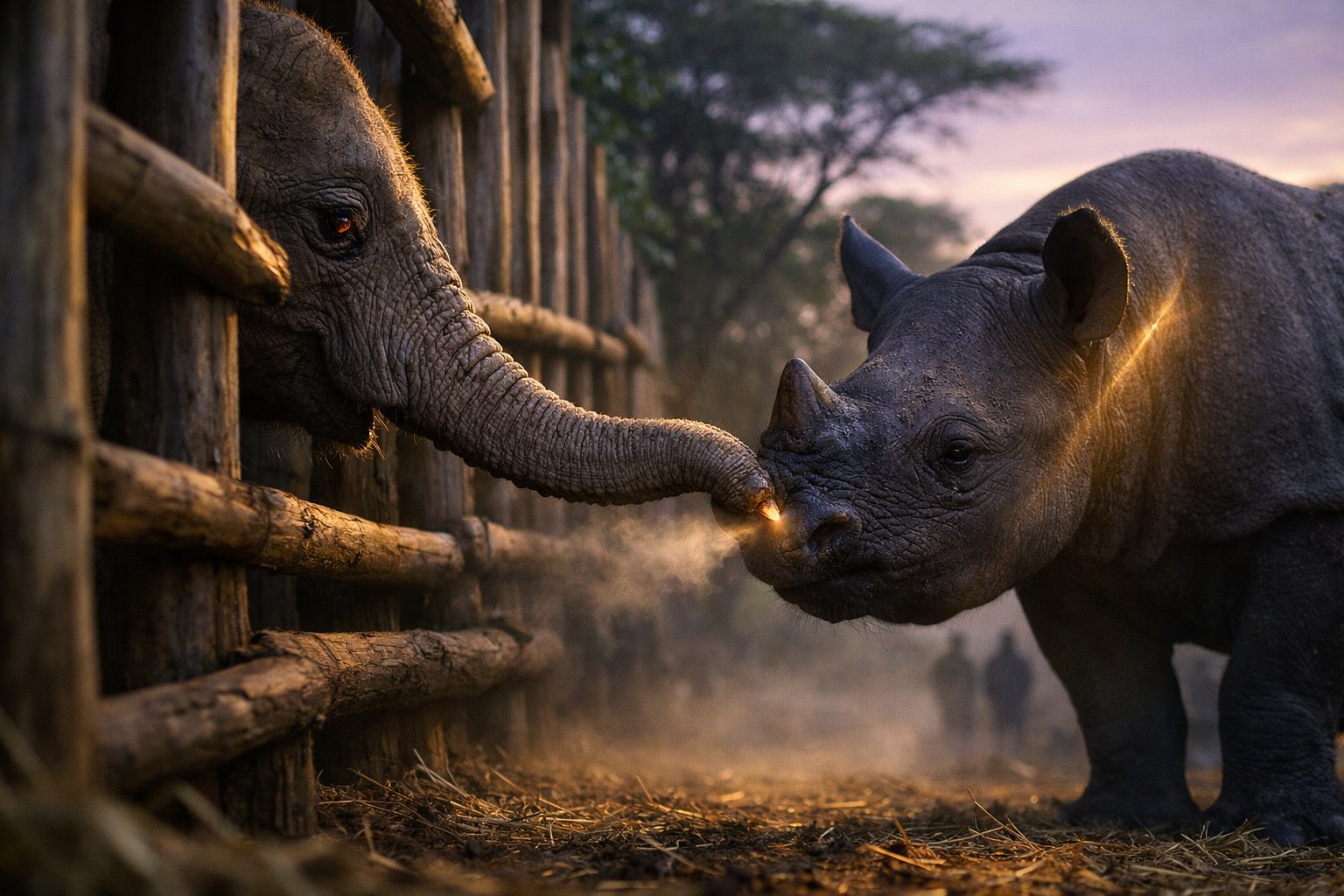
A picture circulates every few years online: a small elephant calf with its trunk laid against the flank of a young rhinoceros, the two animals lying side by side in shaded straw. The caption usually reads as the simplest version of the story, friendship across species. The story underneath the caption is more interesting and more honest. Where elephant and rhino orphans share a stockade or a forest fence at a Kenyan sanctuary, the bond is real, the mechanism is mostly known, and the cases are rarer than the internet suggests.
Direct Answer
Documented elephant-rhino bonds happen at orphan sanctuaries, not in the wild, and they involve calves whose normal social attachment systems have been interrupted by the loss of a mother. The most carefully recorded cases, including Maxwell the blind black rhino at the Sheldrick Wildlife Trust nursery and the rhino calf Solio housed beside the elephant Kandecha, run on stress reduction, neonatal proximity tolerance, and the elephant’s maternal vocalizations registering as calming, not on a human-style decision to be friends [1][2].
What the Bond Actually Looks Like
At the Sheldrick Wildlife Trust’s nursery in Nairobi National Park, the daily routine is small and specific. The orphaned elephant calves walk past the stockade of Maxwell, a teenage black rhino blinded by congenital bilateral cataracts, on their way out to the forest each morning. Some of the calves stop at the gate. They reach a trunk through the bars. Maxwell, who has lived at the stockade for more than fifteen years, comes to the fence to be touched and breathed on [1][3]. The encounter is brief, repeats daily, and is not coerced.
The behavior reads at three layers. The elephants are exhibiting the same affiliative trunk-greeting they direct at calves of their own species, a tactile and olfactory exchange that elephant ethologists have documented at greeting events between reunited family groups. Maxwell, a solitary species in adulthood, is accepting close-range contact with a heterospecific juvenile, which is anomalous on paper. The keepers, working in patient continuity, allow the encounter without staging it. None of those layers requires a friendship narrative to be observed and recorded. They require the encounter to be observed in the first place, which the literature now does.
The Solio and Kandecha Recording
In a separately recorded case from the Sheldrick keepers’ diaries, the orphaned female rhino Solio was crated to the dividing entrance of the orphan elephant Kandecha’s night stockade. Kandecha produced the soft exhalation that elephant mothers use to call calves, a low-frequency vocalization with a measurable infrasonic component, and the rhino’s stress posture relaxed, evident in the carriage of her ears [2]. That sequence, vocalization to ear-position change, is exactly the kind of small testable observation a working ethologist looks for, because it converts a friendship anecdote into a hypothesis about cross-taxon signal compatibility. It does not require either animal to know what species the other is.
Why Orphan Sanctuaries Generate These Cases
A wild juvenile elephant in the absence of trauma never meets a wild juvenile rhino at close range. The species occupy overlapping savanna and woodland but operate on incompatible social schedules, herd-living matrilineal elephants on one timetable, largely solitary rhinoceros species on another. What sanctuaries do is collapse a normally dispersed habitat into a few hundred meters of stockade-and-forest geography, and what trauma does is leave juveniles in a hormonal and behavioral state that makes them unusually receptive to non-typical attachments [4][5].
Calves of both species who have lost mothers exhibit the recognizable signs of grief and attachment-seeking documented across mammals: reduced feeding, restlessness, vocalizations directed toward absent caregivers, and accelerated bonding to the next available, predictably present individual. Sheldrick keepers rotate among the elephant calves precisely because permanent attachment to a single human is undesirable, and they let the calves form attachment in the herd. When a young rhino is in residence at the same nursery and the calves walk past, the rhino becomes one of the predictably present individuals. The bond that follows is a measurable behavioral consequence of the geography and the attachment system, not a coincidence.
The Hormonal and Cognitive Substrate
Both elephants and rhinoceroses are large-bodied, long-lived, slow-developing mammals with extended maternal care, and both run their early social attachment on overlapping endocrine pathways. Oxytocin modulates affiliative behavior in elephants, where it has been linked to greeting events, reconciliation after agonistic encounters, and matrilineal cohesion [6]. The rhinoceros literature is thinner, partly because rhinos are difficult research subjects and partly because their solitary adult ecology makes affiliative work less obvious to design, but cortisol-stress profiles in orphaned rhino calves track the same shape as elephant calves and stabilize when proximity to predictable caregivers is established [4].
Cognitively, both lineages are unusually equipped for cross-individual recognition. Elephants discriminate the calls of related and unrelated conspecifics across decades and recognize the bones of deceased family members during ritualized investigations. Rhinos, on the available evidence, recognize keepers individually by scent and gait. The point is not that they recognize members of another species as members of their own. The point is that the cognitive infrastructure for sustained recognition of specific individuals exists in both lineages, and a daily-repeating fenceline encounter at a nursery is exactly the kind of stimulus that infrastructure can hold.
Where the Coverage Goes Wrong
Three errors recur in popular treatments of elephant-rhino bonds.
The first is conflation. The most famous cross-species orphan bond in East Africa is Owen the hippo and Mzee the 130-year-old Aldabra giant tortoise, paired at Haller Park near Mombasa in late 2004 after the Indian Ocean tsunami stranded Owen as a juvenile. Their pairing was popularized in the Hatkoff and Greste children’s book in 2006, and the species are sometimes substituted in the retelling [7]. Owen was not an elephant. Mzee was not a rhino. The substitution is so common that it is worth flagging once at the start of any honest writeup.
The second is novelty inflation. Elephant-rhino orphan proximity has been an operational fact at the Sheldrick nursery since the 1970s and is part of the trust’s documented combined elephant-and-rhino orphan program; the website’s own description of the work catalogs both species under one rescue and reintegration umbrella [3][8]. Each new viral image is treated as if the encounter were unprecedented. It is not unprecedented; it is unobtrusively continuous, recorded in keepers’ diaries that have been published for years.
The third is anthropomorphic projection. The animals are described as having chosen each other, having decided to be friends, having found in the other a mirror for their grief. The recoverable behavioral picture is more compact and more useful. Two juvenile mammals with disrupted attachment systems are housed in proximity by humans who are skilled at reading attachment signals. The juveniles, who have not finished sorting the world into species categories the way adults eventually will, accept the encounter. The encounter repeats. The behavior the encounter produces is real care, real tactile bonding, real reduction in stress hormones. None of that requires the human friendship frame to land. The hormones are doing the work the frame describes.
What the Cases Tell Us About the Animals
A patient reading of these cases yields a small set of testable claims worth carrying forward. The mammalian attachment program is not species-locked at the receptor level; it requires a stimulus configuration of size, proximity, predictable presence, and matched signal modality, and where those conditions are met the program runs across taxonomic boundaries [9]. Sanctuaries that house multiple orphan species in shared geography are unusually productive observation sites for this fact, because they reproduce the conditions the program tolerates without trying to engineer the bond [3][8]. The bonds are best understood not as exceptions to the species’s normal social ecology but as windows into the deeper substrate that the species’s normal ecology rests on.
For the curious lay reader, the practical takeaway is small and exact. The next time a sanctuary photo of an elephant and rhino at a fenceline circulates with a friendship caption, the caption is not lying, but it is also not the most interesting thing about the picture. The interesting thing is that the encounter happened at all, that the keepers recognized it as worth photographing, and that the long arc of mammalian sociality was wide enough to absorb it. Treat the animals as working biological systems, not as small actors in a human story. The story takes care of itself, the way it did for Owen and Mzee, the way it does at the Sheldrick gate every morning when Maxwell ambles over to be greeted by elephants who do not know they are crossing a line.
Frequently Asked Questions
Do elephants and rhinos befriend each other in the wild?
There is no peer-reviewed documentation of stable, repeated affiliative bonds between wild adult elephants and rhinoceroses. The species share habitat across parts of East and Southern Africa but operate on different social schedules; herd-living matrilineal elephants and largely solitary rhinos rarely encounter each other at close range outside of water-source proximity. The documented bonds are sanctuary cases involving orphaned juveniles whose normal attachment systems have been interrupted [3][4].
Where did the famous Owen and Mzee story come from, and was it elephant and rhino?
Owen was a juvenile hippopotamus orphaned by the December 2004 Indian Ocean tsunami; Mzee was a 130-year-old Aldabra giant tortoise; their pairing happened at Haller Park near Mombasa, Kenya, and was popularized by Isabella and Craig Hatkoff and photographer Peter Greste in a 2006 children’s book. The species are often misremembered as elephant and rhino. They were not [7].
Who is Maxwell at the Sheldrick Wildlife Trust?
Maxwell is a black rhinoceros born blind from bilateral congenital cataracts who has lived at the Sheldrick nursery in Nairobi National Park since 2007. He cannot survive in the wild and has a permanent home in a stockade adjacent to the elephant nursery, where he receives daily morning greetings from the orphan elephant calves on their way out to forest browse [1][3].
Is the elephant-rhino bond at a sanctuary the same kind of bond as elephant-elephant?
Behaviorally similar in some respects, structurally different in others. The trunk greetings, low-frequency vocalizations, and tolerance of close-range tactile contact mirror the affiliative repertoire elephants direct at conspecifics. The bond does not become a substitute family group; the rhino does not integrate into the elephant herd, and the elephants do not abandon their species-typical herd attachments. It is best read as an additive, not replacement, social link [3][6].
What is allonursing or cross-fostering, and does it apply here?
Allonursing is the nursing of young not the female’s biological offspring; cross-fostering is the rearing of young by a female of a different species. Neither applies cleanly to elephant-rhino sanctuary cases, because rhinos and elephants do not share milk-compatible chemistry and human keepers handle the bottle feeding. What does apply is heterospecific affiliative bonding, the broader category that allonursing belongs to, documented across more than 120 mammalian species since the 1980s [9].
Is the bond a sign of empathy in the animals involved?
It is consistent with the empathy-as-cooperative-substrate framework that ethologists like Marc Bekoff and Jessica Pierce develop in their work on mammalian social cognition. A single behavior does not prove the larger claim. The careful position is that the components of empathic behavior, including stress-reduction in proximity to a predictable caregiver across species lines, are present and measurable in the hormonal and behavioral data of both elephants and rhinoceroses [10].
Why do these bonds form at sanctuaries instead of zoos?
Some bonds are documented in zoos as well, where curated companion pairings have been used deliberately to address social development in young carnivores and ungulates. Sanctuaries differ in two relevant ways: the orphans arrive in the same trauma-disrupted attachment state, and the keeper philosophy at facilities like Sheldrick prioritizes letting attachments form rather than engineering specific pairings. The result is that the bonds that emerge are less curated and somewhat closer to what a working ethologist can read as the animal’s own behavior [3][8].
Does cross-species bonding harm the animals’ chances of being released?
It depends on the species and the duration. Sheldrick’s reintegration data shows that orphan elephants who pass through the nursery, including those who interact daily with rhinos like Maxwell, return to wild herds at Tsavo at meaningful rates; over one hundred orphans have been reintegrated to date. The cross-species exposure has not been identified as a barrier. For rhinos, the picture is similar; Solio, after extensive nursery time, was released and was photographed in 2022 with her own newborn calf in Nairobi National Park [2][8].
Are there documented cases outside Kenya?
Yes, in lower numbers. Elephant-and-rhino combined orphan facilities exist in Zimbabwe, South Africa, and India, with the largest documented programs at Imire Rhino and Wildlife Conservancy and at the Care for Wild rhino sanctuary. Specific named bonds tend to be reported in those facilities’ newsletters and in conservation journalism, with less peer-reviewed coverage than Sheldrick’s longer publication history. The behavioral pattern, where it is reported, is the same: orphaned juveniles, shared housing geography, predictable caregivers, gradual cross-species tolerance [4][8].
Can the public visit and observe these bonds?
Yes, with constraints. The Sheldrick Wildlife Trust nursery in Nairobi National Park is open to the public for one hour each day, during which the orphan elephant calves are brought out for their late-morning feed and Maxwell can be observed at his stockade. Photography is permitted; close approach to the rhino is not, for his welfare and for the visitors’ safety. Reteti Elephant Sanctuary in northern Kenya hosts elephant-only viewing; rhino orphan facilities such as Solio and Lewa operate on a more restricted access basis [1][3].
More from the animal anomaly mysteries archive: The Sudden Vanishing of Bees: CCD and Crop Circles: The Animal Connection.