By Iris Kowalczyk · Published May 13, 2026 · Updated May 13, 2026
The Rendlesham Forest Incident is the documentary spine of British UFO history. Three winter nights in 1980. Two adjacent NATO airbases. American servicemen on British soil. A handwritten patrol log, a tape recorder rolling in the dark, and a memo that took two and a half years to surface. The file is unusual not because the witnesses were exotic, but because so much of what they did was logged in the ordinary way.
Direct Answer: What Happened at Rendlesham Forest
The Rendlesham Forest Incident was a series of reported unidentified-craft sightings on December 26 to 28, 1980, in Rendlesham Forest near the joint US-UK airbases RAF Woodbridge and RAF Bentwaters in Suffolk, England. United States Air Force personnel filed sworn statements; Deputy Base Commander Lt. Col. Charles Halt later sent a one-page memo to the UK Ministry of Defence on January 13, 1981 [1].
The Three-Night Chronology
Build the timeline first. Names, posts, last seen, last contacted, the weather that night. The Rendlesham file rewards that discipline.
December 26, 1980: The First Sighting
In the early hours, USAF Security Police at the East Gate of RAF Woodbridge reported lights descending into the forest. Three airmen were sent to investigate: Sergeant James Penniston, Airman First Class John Burroughs, and Airman First Class Edward Cabansag [2]. Penniston filed a sworn statement on January 2, 1981, describing a triangular craft in a forest clearing. Burroughs filed his own statement the same week. Cabansag’s account is the most cautious of the three; he described lights in the distance but did not approach the object the others described.
By dawn, USAF investigators photographed three small ground depressions in a roughly triangular pattern at the reported landing site. The photographs reportedly came out underexposed. The Forestry Commission was consulted about whether the marks were animal-made. The record is not conclusive either way.
December 27 to 28, 1980: The Halt Patrol
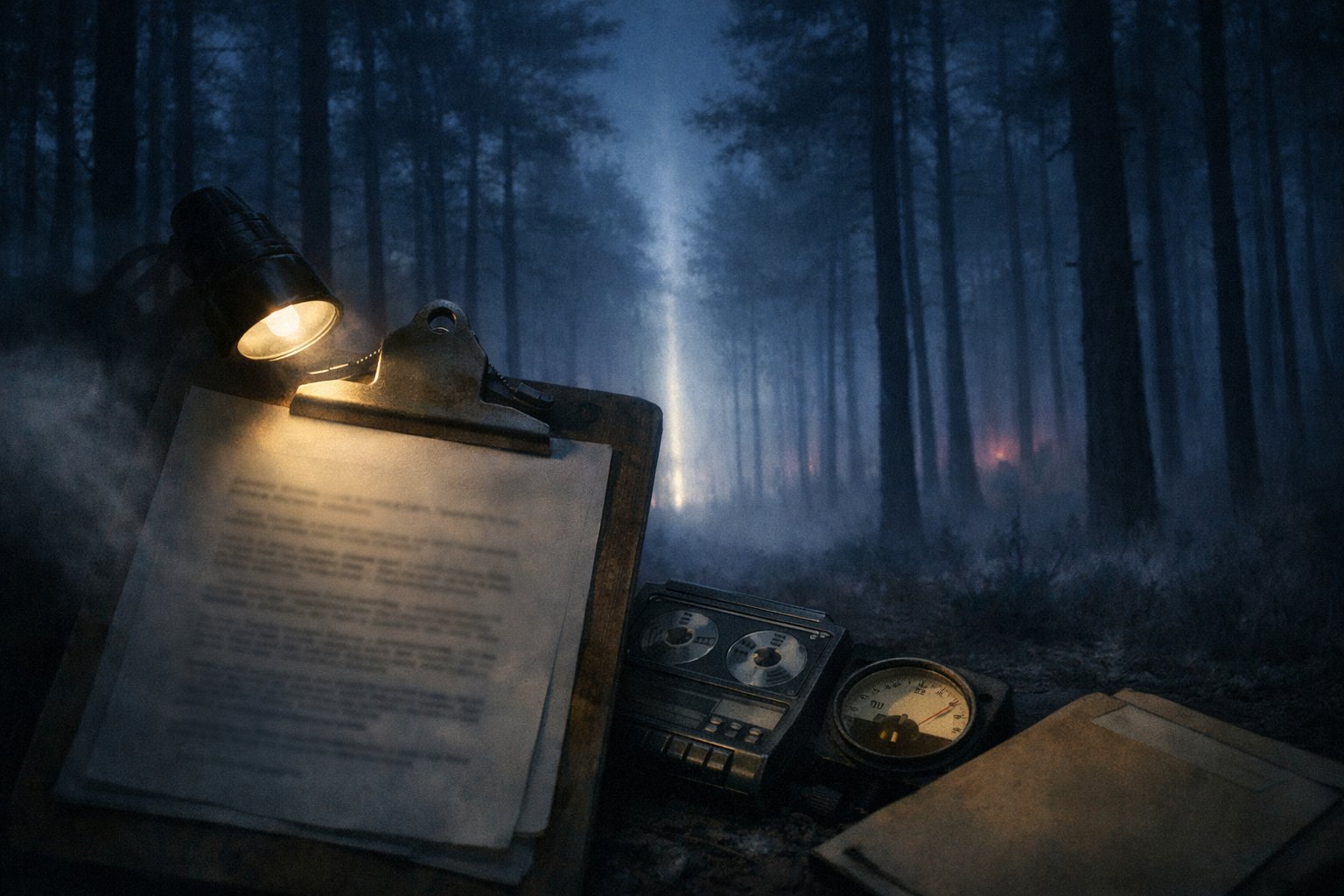
On the third night, Deputy Base Commander Lt. Col. Charles I. Halt led a patrol back into the forest with a hand-held cassette recorder and a Geiger counter. The eighteen-minute audio recording, later released by Halt himself, is the closest thing the case has to contemporaneous documentation [3]. On the tape, Halt and his men describe a pulsing red light to the east and additional lights to the north. Halt reads radiation readings aloud at the suspected landing site. The figures are low, in the same range as natural background, but he flags them as elevated relative to the surrounding forest floor.
The Halt Memo: The Document Everything Else Rests On
On January 13, 1981, Halt sent a one-page memo titled “Unexplained Lights” to the UK Ministry of Defence. The memo is brief, dated, and signed. It describes the December 26 sighting in three paragraphs, the December 27 to 28 patrol in two, and notes the ground depressions and radiation readings without speculation about origin. The memo was released under the US Freedom of Information Act in 1983 after a request by researchers, and copies have been reproduced in the National Archives file DEFE 24/1948 [1].
Two points are easy to lose. First, the memo is not a sighting report; it is an after-action summary written more than two weeks later. Halt’s own tape from the second night, by contrast, is contemporaneous. Second, the memo was sent through ordinary diplomatic channels to the British Ministry, not to a covert UFO unit. The British side filed it with their general air defence correspondence.
Physical Trace Claims and Why They Are Contested
Three categories of physical evidence are usually advanced: the ground depressions, the radiation readings, and damage to nearby trees.
The depressions were measured at roughly seven inches across and an inch and a half deep. Plaster casts were reportedly taken; the casts have not surfaced in the declassified file. The Forestry Commission’s local view, recorded second-hand, was that rabbits could have made the marks. That is not a closed case, but it is a documented alternative reading [2].
The radiation question is the most argued. Halt’s tape gives readings on a hand-held meter at the suspected landing site. The British Ministry’s later review, conducted with input from the Defence Intelligence Staff, judged the readings to be within natural background variation for forest floor at that latitude [4]. Researchers who favor the anomaly reading point out that Halt described the readings as “significant” on the night; reviewers point out that he was not a radiation specialist and that the meter type and calibration are not in the surviving record.
Tree damage at the alleged landing site was reported, including burn marks and a triangular branch-break pattern. Independent botanical inspection in later years could not confirm a singular cause; some of the damage is consistent with axe marks used by foresters to mark trees for thinning.
The Witness Layer: What the Servicemen Said, and What Changed Later
Sworn statements from January 1981 form the baseline witness record. They are short, written in the first person, signed and dated. Penniston’s January 1981 statement describes a craft of unknown origin in a clearing. It does not mention touching the craft. It does not mention binary code.
The binary-code claim entered the public record in 2010, when Penniston said in interviews and a co-authored book that he had touched the craft and received a stream of binary digits in his head, which he later transcribed and decoded into coordinates [5]. Researchers including Nick Pope, the former UK Ministry of Defence official who ran the UFO desk from 1991 to 1994, have flagged the thirty-year gap between the contemporaneous statement and the later, more elaborate account as a chain-of-custody concern. A cold-case investigator would say the same thing: the 1981 statement is the document the file will bear; the 2010 account is testimony layered on top of it.
Larry Warren, who claimed in the 1980s to have been present on the third night, is a separate witness-credibility question. Warren’s account in the 1984 book Sky Crash by Brenda Butler and Dot Street is foundational to the UFOlogy literature on the case. Subsequent researchers, including those previously sympathetic to Warren, have raised significant credibility concerns about elements of his testimony [6]. Halt himself has publicly distanced from parts of Warren’s account.
Competing Conventional Explanations
Two conventional explanations recur in the literature, with a third occasionally raised.
First, the Orfordness Lighthouse. The lighthouse stands about 7.5 miles east of the East Gate of RAF Woodbridge, on the Suffolk coast. Astronomer Ian Ridpath argued in 1983 that the pulsing red light the patrol described on the second night is geometrically consistent with the lighthouse, seen across flat coastal terrain and through trees [7]. Ridpath’s analysis was later expanded with photographic comparisons. Defenders of the case point out that the men knew the lighthouse and would not mistake it for an object 100 yards away. Critics point out that fatigue, fog, and tree-line parallax can do strange things to perception at 3 a.m. in late December.
Second, the Cosmos 749 re-entry. The Soviet satellite Cosmos 749 re-entered the atmosphere over Western Europe in the small hours of December 26, 1980. Fireballs and trail debris were reported across multiple countries. The initial East Gate report of lights “descending into the forest” is broadly consistent with a re-entry observed at low elevation [8]. This explanation addresses the first night’s opening report but not Penniston’s clearing description or the second night’s pulsing red light.
A third, less-evidenced thread is the covert-exercise hypothesis. Some researchers have speculated that a US or NATO test of an experimental craft or sensor system, or a now-declassified intelligence drill, could account for the deployment pattern. No documentary evidence of such an exercise on those dates has been produced through FOIA or the UK’s 2008 to 2013 UFO file release.
The Paper Trail: National Archives and the MoD UFO Desk
The British state’s documentary footprint on Rendlesham is unusually full. The UK Ministry of Defence operated a small section informally known as the UFO Desk from the 1950s until December 1, 2009, when its public reporting function was closed [9]. From 2008 to 2013, the MoD released its entire UFO file collection to The National Archives at Kew under file series DEFE 24. The Rendlesham material sits within DEFE 24/1948 and related files.
What survives is mundane in form: typed correspondence, a few handwritten notes, the Halt memo, photocopies of newspaper articles, and internal MoD comments. What is absent matters too. There is no record in the surviving file of any intelligence operation tied to the dates. There is no record of an investigation conducted by a covert special access program. The British state’s documented position was, and remains, that the events were not assessed as a threat to UK air defence and warranted no further action [4].
Why Rendlesham Stays Unresolved
Cold cases close on details that warm ones swallow. Rendlesham resists closure for four reasons the record actually supports.
The plaster casts of the depressions are not in the file. The original photographs are reportedly underexposed and have never circulated in a form independent researchers can examine. The radiation meter’s make, model, and calibration history are not documented in the surviving record. The witness testimony has grown, in some cases, well beyond what the 1981 sworn statements support, which makes the later layer harder to evaluate against the earlier.
None of those gaps prove a craft of unknown origin entered the forest. None of them disprove it. The case is what cold-case work calls a documented anomaly with degraded physical evidence and a stratified witness record. The Halt memo, the Halt tape, and the January 1981 statements are the parts the record will bear. The rest belongs in the notes column, plainly labeled.
Sources and Further Reading
For readers who want to work from primary documents, the most useful single starting point is The National Archives file DEFE 24/1948, which contains the Halt memo and the contemporaneous British departmental correspondence [9]. Ian Ridpath’s 1983 lighthouse analysis remains the most-cited conventional reconstruction [7]. For the case’s afterlife in UFOlogy, Brenda Butler and Dot Street’s Sky Crash (1984) and Georgina Bruni’s You Can’t Tell the People (2000) are foundational, with the caveats noted above. Compare against other unsolved aerial-phenomena cases catalogued at the Unsolved Mysteries and Enigmas pillar.
Other open cases from the unsolved mysteries archive: Rex Heuermann’s Guilty Plea: The Resolution of the Long Island Serial Killer Case and The FBI Missing-Scientists Investigation: An Archive-Style Evidence Ledger.