
Drafted with AI assistance from the sources listed; images are AI-generated illustrations. How EsoVitae is made
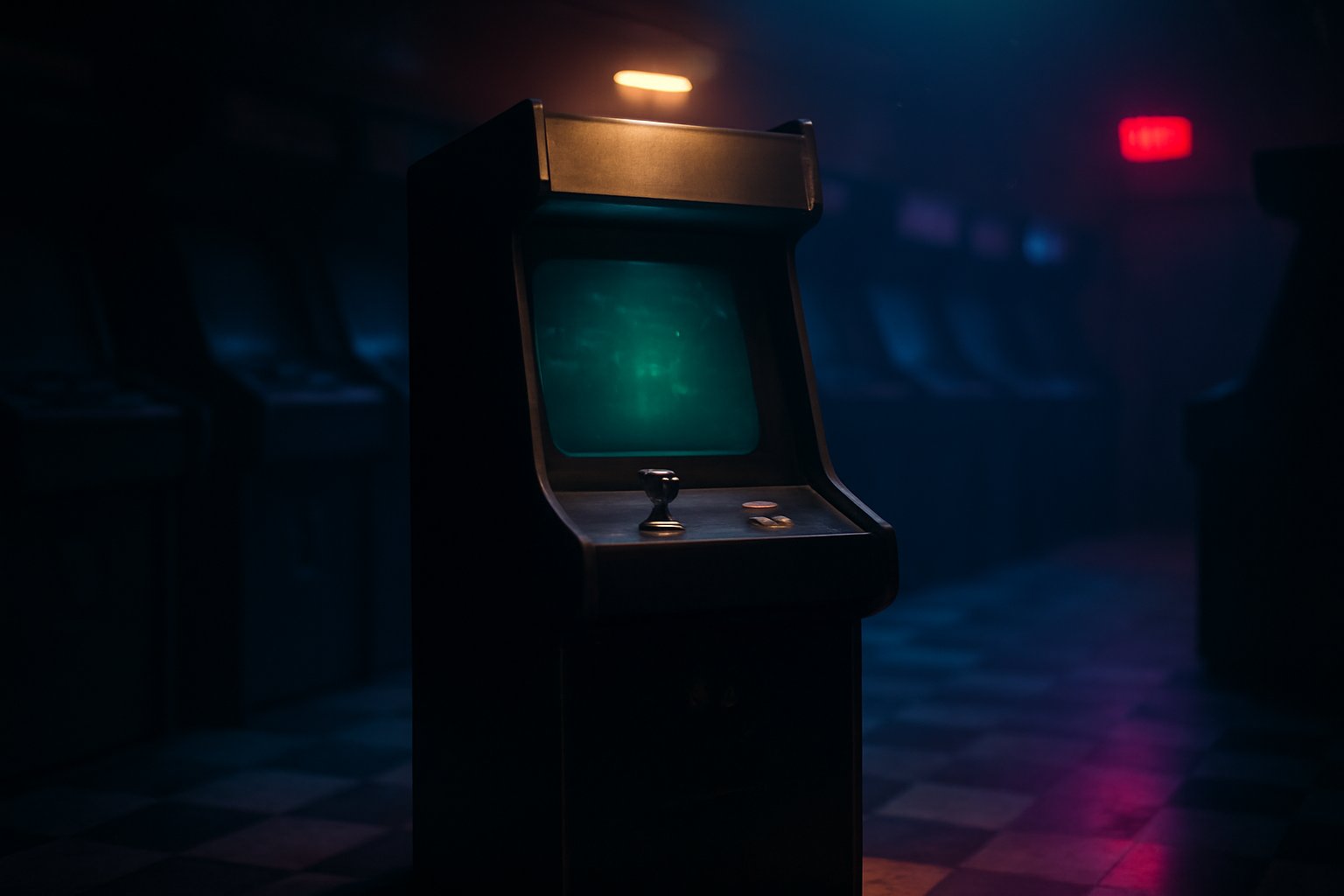
The Polybius arcade game is an internet urban legend about a 1981 black cabinet that allegedly appeared in Portland arcades, sickened players, and was collected by government agents. There is no pre-1998 documentary evidence the game ever existed. The story was seeded on coinop.org in February 2000 by site owner Kurt Koller.
What Polybius Is, and What the Record Actually Shows
The Polybius legend claims a black arcade cabinet labeled “Polybius” appeared in suburban Portland, Oregon, in 1981, induced seizures and amnesia in players, and was secretly collected at night by men in dark suits acting on behalf of a government psychological-research program. None of those claims are attested in any newspaper, trade magazine, arcade-operator catalog, or coin-op service bulletin published before 1998.
I work the chain backward. The first datable trace of “Polybius” as a named entity on the public web is a February 6, 2000 entry on coinop.org, posted shortly after Kurt Koller acquired the site. The page presented Polybius as a real but obscure arcade title with a screenshot and minimal sourcing. Gaming journalist Stuart Brown later identified that entry, and a series of follow-ons by Koller, as the legend’s patient-zero post [1][2].
The story spread from coinop.org into Usenet retro-gaming threads, then jumped to print when GamePro ran the legend in its September 2003 issue after Koller pitched it to the magazine [1]. From print, it migrated into early creepypasta archives, then into YouTube documentary culture, then into mass-market reference points such as a background gag in The Simpsons (2006) and a fictional cabinet built for Stranger Things ephemera [1][3]. The transmission path looks ordinary for any popular folk narrative of the broadband era, but the dateline at the front of the story stays anchored to 1981, a year nineteen winters before any verifiable mention of the name.
Origin Post: The 2000 coinop.org Entry and the 2003 GamePro Pitch
On February 6, 2000, the newly transferred coinop.org domain published a page describing Polybius as a 1981 black-cabinet game produced by a German-sounding company called “Sinneslöschen” and pulled from arcades within weeks of release. The entry sat on the site as an isolated curio for three years before any mainstream pickup [1].

No surviving cabinet, ROM dump, schematic, marketing flyer, distributor invoice, or arcade-operator service log naming “Polybius” or “Sinneslöschen” predates that February 2000 page. Coin-op historian Cat DeSpira and the Museum of the Game’s Arcade Museum forums have catalogued the absence in detail [4]. The German word “Sinneslöschen” translates roughly to “sense-deletion,” a coinage no German speaker would naturally produce, and the name does not appear in any 1981-era German or American coin-op trade publication [1].
In 2003, Koller pitched the story to GamePro, which ran it in its September 2003 issue as an unverified mystery [5]. That print appearance is what carried the legend out of the coinop.org niche and into general retro-gaming consciousness. The story’s growth from 2003 onward tracks the propagation curve of early creepypasta rather than the propagation curve of a recovered historical artifact.
What the screenshot actually captures
The “Polybius” screenshots circulated in early-2000s threads were either hand-built mock-ups or repurposed footage of unrelated vector-graphics titles. No image has chain-of-custody documentation back to a 1981 arcade location. The Ahoy documentary team in 2017 ran provenance checks on the most-cited screenshot and found no pre-2000 metadata [1].
The Real 1981 Portland Arcade Incidents the Legend Conflates
Two genuine 1981 Portland arcade incidents involving Tempest, Asteroids, and an unrelated FBI gambling raid ten days later anchor the legend to a real date and place, then get welded onto invented Polybius details. The sicknesses are documented; the black cabinet is not. Period coverage in The Oregonian and Willamette Week supplies the verifiable spine; everything labeled “Polybius” is later accretion.
On one day in 1981, two players became ill at the same Portland arcade. Twelve-year-old Brian Mauro played Asteroids for roughly 28 hours during a publicity-stunt attempt at a world record and developed acute stomach pain. Earlier the same day, fellow Portland teen Michael Lopez developed a severe migraine after a session of Tempest, walked out, blacked out, and was later found unconscious in a stranger’s yard [1][6]. Both incidents made local press at the time, and both are recoverable in period reporting. Tempest’s rapid-rotation vector display is a known photosensitivity trigger in small percentages of players, and the medical literature on photosensitive seizures predates the Polybius story by decades.
The FBI raids were a gambling case, not a mind-control case
Ten days after those sicknesses, the Federal Bureau of Investigation raided several Portland-area arcades. The raids were not related to the player illnesses. Operators in the area had been modifying cabinets with score-counter circuits to convert games into illegal gambling devices, paying cash for high scores. The FBI was documenting which machines had been tampered with [1][6]. Agents recorded high scores and inspected hardware; nothing in the raids’ actual paper trail involves brain-altering software. The contemporary coverage in The Oregonian treats the raids as a gambling-enforcement story, which is what they were.
The conflation worth resolving: arcade sicknesses (real, two players, photosensitivity plus exhaustion), FBI presence (real, gambling-related), and a sinister black cabinet (invented, post-1998) collapsed into a single composite memory after the 2000 coinop.org post gave the composite a name. Period reporting in The Oregonian and Willamette Week, recovered by later researchers, separates the strands cleanly when read in isolation [5][6].
Steven Roach and the 2006 Source-Code Hoax
In 2006, a forum poster using the handle Steven Roach appeared in the coinop.org forums and on Retro Gamer’s community threads claiming to have been a programmer at Sinneslöschen during Polybius’s 1981 development [1][7]. The Roach story supplied the missing insider perspective the legend had lacked.
The claims were dismantled fast. Inconsistencies surfaced in a 2006 GameSpot interview, including a Usenet-history detail that had been lifted nearly verbatim from the then-current Wikipedia entry on the game [1]. In September 2007, forum administrators confirmed that the Roach account and several supporting accounts in the Retro Gamer thread had been created by the same user, with overlapping IP signatures [7]. Coinop.org’s owners later publicly stated that “Steven Roach is full of himself, and knows nothing about this game” [1].
In 2017, the YouTube channel Ahoy tracked down the real person behind the Roach handle for the documentary “POLYBIUS – The Video Game That Doesn’t Exist” and confirmed on-camera that the source-code claim was fabricated [1]. The Roach episode is now treated by coin-op historians as a second-generation hoax layered on top of the original 2000 hoax, an insider-narrative graft that gave the legend an apparent provenance it had been missing for five years. The pattern repeats across other artifact-of-the-internet legends: an authored opener, a quiet period, a fake insider, an exposure, then a self-fulfilling cultural artifact.
What the post-mortem shows
Stripped of folklore, the Polybius timeline is a documented chain of internet-era authorship: 2000 coinop.org entry, 2003 GamePro pickup, 2006 fake-programmer graft, 2007 sockpuppet exposure, 2017 video-documentary confirmation. Every load-bearing claim originates after 1998. The 1981 dateline is borrowed scenery.
The Polybius Timeline: Six Inflection Points in the Legend’s Spread
The Polybius legend’s documented propagation between February 2000 and May 2017 runs through six discrete platform shifts, each one widening the audience by roughly an order of magnitude and grafting new narrative material onto a core that began as a single coinop.org page. The table below tracks the chain backward.
| Date | Platform / Event | What was added | Verifiability |
|---|---|---|---|
| Feb 6, 2000 | coinop.org entry by Kurt Koller | Name “Polybius,” 1981 dateline, Sinneslöschen publisher | Archive.org snapshots confirm date |
| Sept 2003 | GamePro magazine print article | National retro-gaming audience exposure | Print issue archived |
| 2006 | Steven Roach “former programmer” posts | Insider narrative; fake source-code claim | Debunked 2007; confirmed false 2017 |
| 2006 | The Simpsons background gag | Mass-market reference; cabinet visible in arcade scene | Episode “Please Homer, Don’t Hammer ‘Em” |
| 2017 | Ahoy YouTube documentary | First serious provenance investigation on video | Public video, sourced screenshots |
| 2017 | Llamasoft commercial release “Polybius” | Legend becomes self-fulfilling: a real game named for the fake one | Shipped on PlayStation VR |
Game designer Jeff Minter released his Llamasoft title Polybius in May 2017 for PlayStation VR, a deliberately psychedelic vector-shooter that nods to the legend without claiming to be the lost original [1]. Minter’s game has the cultural side effect of making the search term ambiguous: a query for “polybius arcade” in 2026 returns the real Llamasoft title and the fictional 1981 cabinet in the same SERP. The legend now propagates through its own simulacrum. Cabinet replicas built by fans for arcade conventions get photographed, those photographs circulate stripped of caption, and the resulting images get cited as evidence of the original. The chain runs sideways, not backward.

Why the Legend Sticks: Polybius as Folklore of the Internet
Academic treatments increasingly classify Polybius as a foundational case in the folklore-of-the-internet literature, where transmission, accretion, and platform-specific aesthetics matter more than any underlying fact. Folklorist Trevor J. Blank and scholars including Lynne S. McNeill have argued that creepypasta operates by the same propagation logic as oral folk narrative, with comment sections and screenshot reposts performing the role of the campfire [3][8]. Polybius shows up by name in syllabi for digital-folklore seminars at Utah State, Penn State, and Indiana University, often paired with Slender Man and Cicada 3301 as the canonical triad of early online folk objects.
The Polybius legend layers three durable folk motifs: the cursed object, the suppressed-by-authorities cover-up, and the kid-who-played-too-much. Each motif predates arcades by centuries. The 1981 Portland scaffolding gives the composite a date specific enough to feel checkable but distant enough to resist easy refutation, which is the temporal sweet spot urban-legend researchers including Jan Harold Brunvand have identified across the canonical 20th-century cycle of vanishing-hitchhiker and microwave-cat tales [9]. The 1981 date sits at the front edge of arcade-cabinet collective memory for the Gen X demographic that drove the legend’s first amplification, which makes it socially plausible without being individually verifiable.
The popular telling vs the actual record
The popular telling vs the actual record: the popular telling has a black cabinet, a German shell company, MK-Ultra-adjacent psychotronics, and men in suits. The actual record has a 2000 web entry, a 2003 magazine pickup, a 2006 sockpuppet, and two unrelated 1981 incidents the legend annexed. The first telling makes a better story; the second telling is what archive timestamps support.
Polybius now functions as a teaching case for the digital-folklore syllabus. Whitney Phillips and other scholars of online culture cite it as an early instance of a deliberately authored hoax that achieved organic folk-narrative status without its origin ever being concealed, then resisted debunking because the debunking was less culturally satisfying than the original story [3]. The internet has a memory; it is just not evenly distributed, and Polybius is the case study for what happens when the gaps fill themselves in.