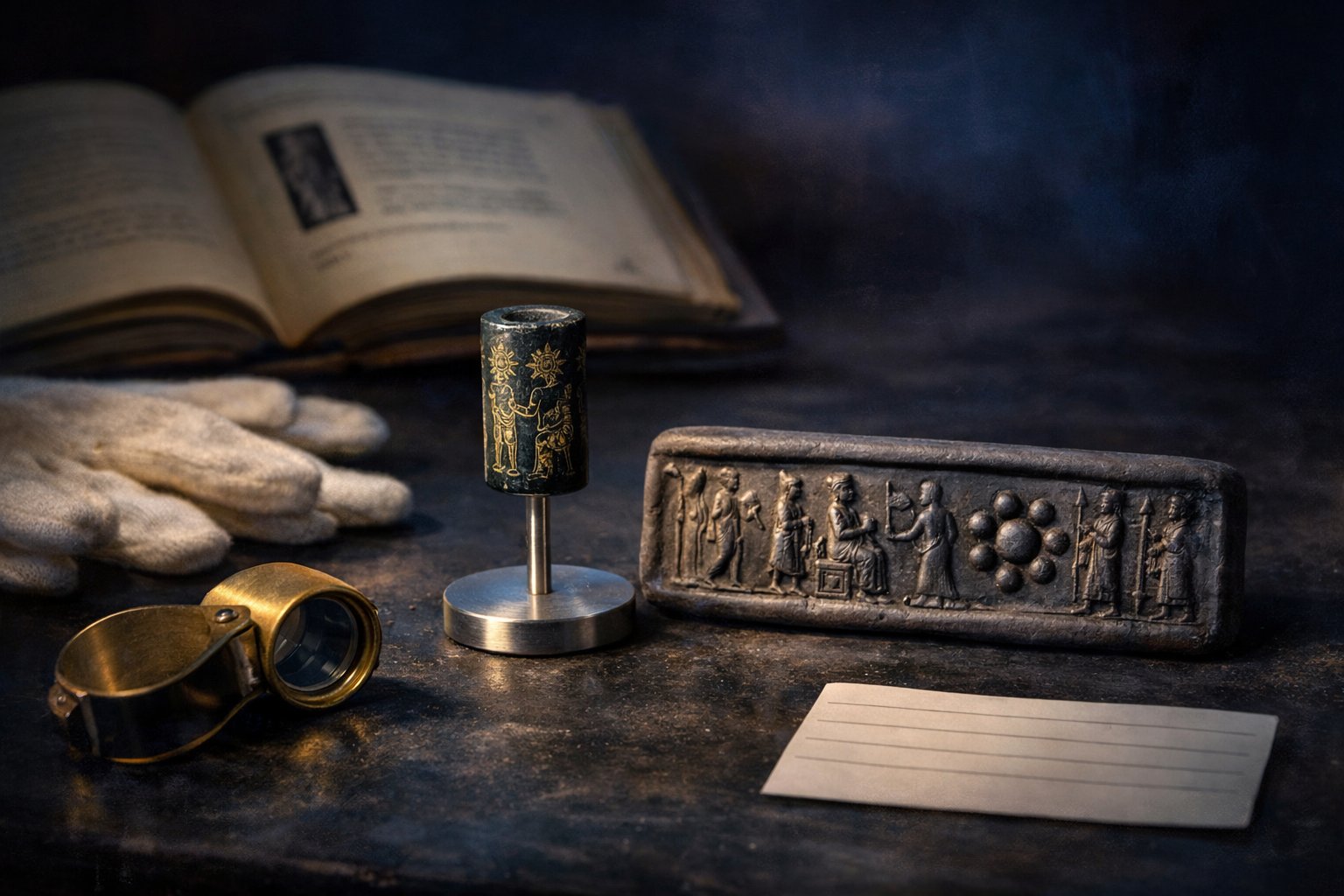
Cylinder Seal VA 243, a 2.7 cm Akkadian-period stone cylinder catalogued at the Vorderasiatisches Museum in Berlin, became famous in 1976 when Zecharia Sitchin claimed its star-and-disc rosette depicted the solar system with an extra planet, “Nibiru.” Assyriologists who read the inscription identify the rosette as a standard divine symbol, not an astronomical map.
Published: 2026-05-18. Last reviewed: 2026-05-18.
The Object on the Record: What VA 243 Actually Is
Cylinder Seal VA 243 is an Old Akkadian-period stone cylinder, roughly 2.7 centimeters tall and 1.7 centimeters in diameter, accessioned by the Vorderasiatisches Museum Berlin (now part of the Pergamonmuseum) under the inventory number VA 243. The Berlin museum dates the piece to circa 2300-2100 BCE, the late third millennium, and lists it as a “presentation scene” seal carved in serpentine [1][2].
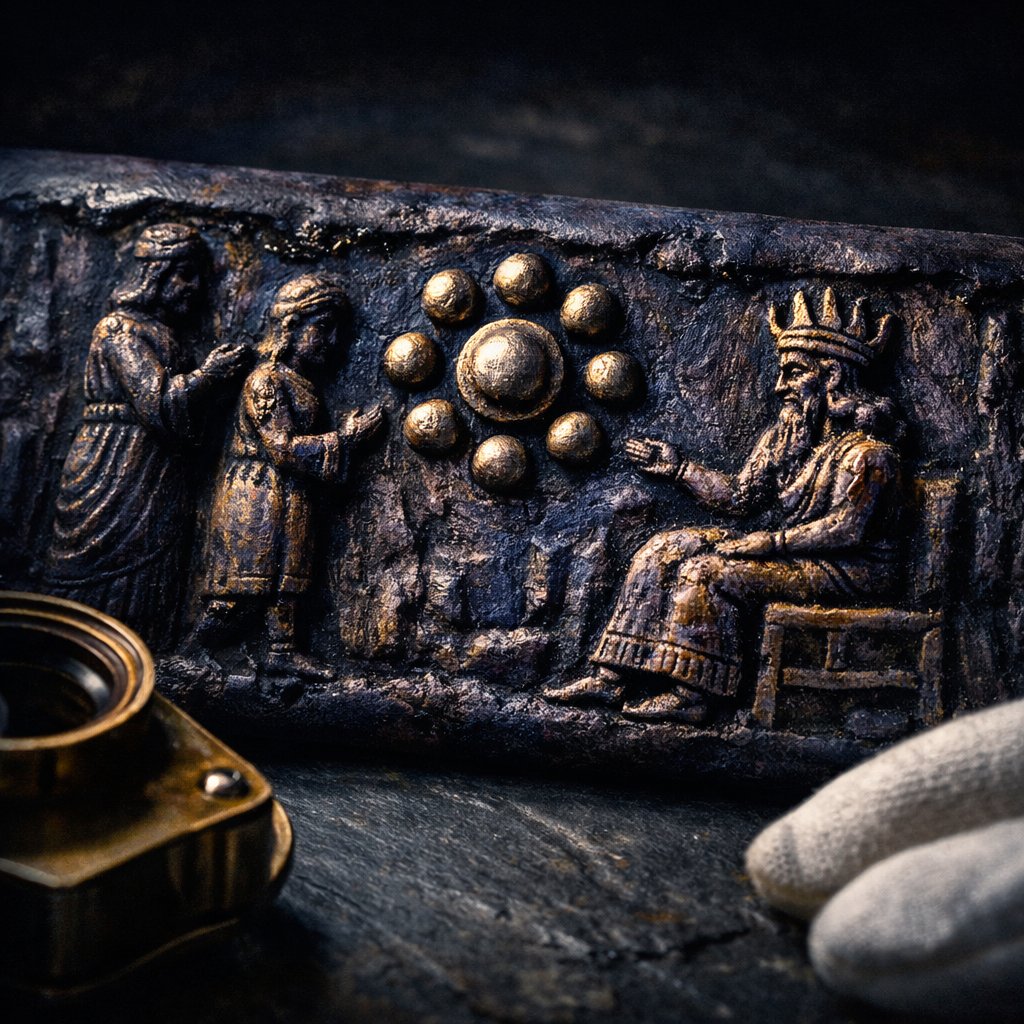
The carving, when rolled onto wet clay, produces a continuous frieze. A seated figure receives a smaller standing figure led by an intercessor — the canonical Mesopotamian “audience scene.” Above the figures sits a three-line cuneiform inscription naming the seal’s owner: Dubsiga, a scribe attached to the household of an official whose name reads in part Ili-Ilum [3]. Off to the upper left, separate from the figural scene, sits the symbol that drives the entire dispute — a central disc surrounded by eleven smaller spheres arranged in a rosette.
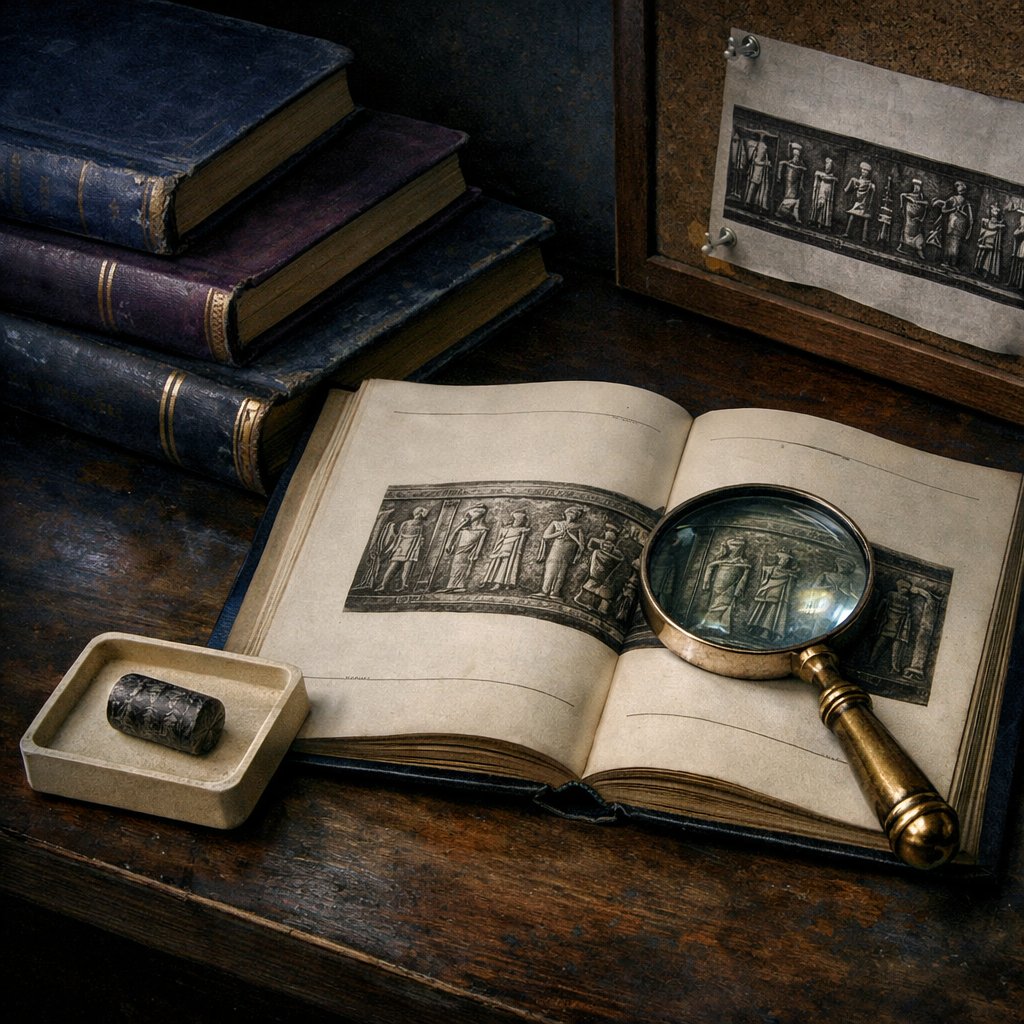
The seal is small, the carving is shallow, and the rosette occupies less than a quarter of the rolled image. Photographs and high-resolution rollouts are available through the museum’s online catalogue and through the published volume Vorderasiatische Rollsiegel (Anton Moortgat, 1940), entry 339 [4].
The 1976 Claim: Sitchin’s Reading of the Rosette
Zecharia Sitchin published The 12th Planet in 1976 and reproduced VA 243 as the keystone exhibit for his thesis: that the Sumerians knew of a twelfth body in the solar system — Sun, Moon, and ten planets, including a hypothetical large outer planet he called Nibiru [5]. Sitchin counted the central disc plus eleven surrounding spheres and read the assembly as a heliocentric diagram, with Pluto, Mercury, Venus, Earth, the Moon, Mars, Jupiter, Saturn, Uranus, Neptune, and Nibiru orbiting a central Sun [5].
Sitchin’s argument depended on three claims. First, that the disc at the center of the rosette is, by size and central position, the Sun. Second, that the eleven surrounding spheres are scaled to approximate relative planetary sizes — a point he illustrated by overlaying the seal motif on a modern heliocentric chart. Third, that the inclusion of a body beyond Pluto was knowledge Sumerian astronomers could only have received from the Anunnaki, the “those who from heaven to earth came,” who in his reading were extraterrestrial visitors [5].
The book sold widely. By the early 1990s Sitchin had built a seven-volume Earth Chronicles series around the framework, with VA 243 retained as the visual proof-text across reprints and translations [5][6]. The seal photograph reached a mass audience that the museum’s catalogue card never did.
The Assyriological Reading: What the Symbol Actually Means
Mesopotamian iconography uses the star-rosette as a divine emblem, not as a planetary map, and that reading is the standard one across Assyriological literature from Henri Frankfort in 1939 through the present [7][8]. A central disc surrounded by rays or smaller spheres is the conventional way Akkadian and later Babylonian seal-cutters represented the goddess Inanna, the Akkadian Ishtar, whose primary astral correspondence is the planet Venus [7][9].
The number of points or spheres in the rosette varies across the Akkadian corpus from six to sixteen, with eight being most common. Frankfort, in Cylinder Seals (1939), catalogued the variation explicitly: eight-point, twelve-point, and sixteen-point rosettes all appear, with no astronomical correlate to the count [7]. The 1995 Berlin Museum publication Mit sieben Siegeln and the 2010 reference work Mesopotamian Cosmic Geography by Wayne Horowitz both treat the rosette as an emblem of the Inanna-Ishtar cult, not as a diagram [8][9].
Stripped of folklore, the symbol is a star — the visible Venus, rendered as a stylized rosette — and the seal owner Dubsiga was probably invoking divine protection by including it, the same way later seals include emblems of Shamash (the sun god, rendered as a four-pointed star inside a disc) or Sin (the moon god, rendered as a crescent) [9][10]. There is no Mesopotamian cylinder seal in any major museum collection that has been independently authenticated as a planetary diagram.
Counting the Spheres: The Mechanical Problem with the 1976 Claim
A direct count of the rosette on VA 243 produces eight surrounding spheres around the central disc — not eleven — when the seal is measured against the published Moortgat rollout, and that count has been verified by the Berlin Museum’s high-resolution photography released between 2010 and 2020 [4][2]. Sitchin’s count of eleven appears to have been read from a low-resolution line drawing rather than from the seal itself.
Michael Heiser, who held a PhD in Hebrew Bible and Semitic Languages from the University of Wisconsin-Madison and ran a public-facing critique of Sitchin’s translations from the early 2000s until his death in 2023, walked through the seal’s iconography in a 2008 white paper. Heiser noted three discrepancies on the math: the count of surrounding bodies is wrong; the spheres are uniform in size, not scaled to relative planetary diameters; and the central disc is the same size as the largest surrounding sphere, breaking the “Sun at scale” reading [11].
On the math, the rosette also fails on geometry. The eight surrounding spheres sit in a flat, evenly spaced rosette pattern around the central disc — a planar, symmetrical arrangement. Solar-system bodies, even in a stylized model, sit at unequal distances along a near-flat ecliptic plane, with sharply non-uniform spacing and dramatically different sizes. Frankfort and Moortgat both classified the VA 243 rosette as a planar symmetric emblem, the standard divine-symbol form, not a positional schematic [7][4].
The Cuneiform Inscription: What the Owner Wrote on His Own Seal
The three-line cuneiform inscription on VA 243 names the seal’s owner and his patron, and the published reading by the Berlin Museum’s Akkadian specialists does not reference any planetary body, the Anunnaki, or astronomy of any kind [3][2]. The inscription reads, in the standard transliteration, “Dubsiga / Ili-Ilum / ARAD-zu” — “Dubsiga, Ili-Ilum, his servant.” It is a property-marking text identifying the seal as belonging to the scribe Dubsiga in the service of his master Ili-Ilum [3].
Cylinder seals functioned as personal signatures in the ancient Near East. A merchant rolled his seal across the clay envelope of a tablet to authenticate the document; an official rolled hers across the bullae closing a jar of grain. The inscription was the legal anchor. If VA 243’s rosette had encoded astronomical knowledge of a hypothetical Planet X, the inscription would be the place to say so. It does not.
| Reading | Source | Year | Central disc = | Surrounding count | Surrounding = |
|---|---|---|---|---|---|
| Sitchin | The 12th Planet | 1976 | Sun | 11 | Planets including Nibiru |
| Frankfort | Cylinder Seals | 1939 | Star/divine emblem | varies (8 typical) | Rays of the rosette |
| Moortgat | Vorderasiatische Rollsiegel | 1940 | Star/divine emblem | 8 | Rays |
| Heiser | Sitchin critique white paper | 2008 | Star/divine emblem | 8 | Rays |
| Horowitz | Mesopotamian Cosmic Geography | 2010 | Inanna-Venus emblem | varies | Stylized rays |
The Nibiru Astronomy Problem: What Sumerian Texts Actually Say
Sumerian and Akkadian astronomical texts have been published in critical editions since the 1950s, and the word nibiru appears in them with a specific technical meaning unrelated to a twelfth planet: it denotes a “crossing point” — most often the planet Jupiter or the celestial equator at a specific season [12][13]. The reference catalogue is the Astronomical Diaries edited by Hermann Hunger and Abraham Sachs (Austrian Academy of Sciences, 1988-2014), which compiles Babylonian observational records from roughly 750 BCE through the first century CE [12].
In the canonical Babylonian astronomical compendium MUL.APIN, dated to roughly 1000 BCE in its surviving form, “nibiru” is identified with Jupiter at its meridian crossing, and the texts give no indication of a hypothetical outer planet [13]. The Akkadian term for Venus is Dilbat; the term for Mars is Salbatanu; the term for Mercury is Shihtu. None of these is encoded in the VA 243 rosette under any reading consistent with the surviving lexica [13].
The conflation worth resolving: Sitchin treated nibiru as a proper noun for an outer planet; the surviving Akkadian-language texts treat it as a positional descriptor for a “crossing” of an already-known body, almost always Jupiter [12][13]. As of 2024, no published critical edition of any Akkadian, Sumerian, or Babylonian text has identified a planetary body beyond the five visible to the naked eye (Mercury, Venus, Mars, Jupiter, Saturn) [12][13].
The Decades-Long Debate: How the Claim Survives
Between Sitchin’s 1976 publication and 2024, the academic response has been thin in volume but consistent in content — and the popular version has continued to circulate in parallel, with VA 243 reproduced across television programs, YouTube videos, and self-published books that rarely cite the museum record [11][14]. Heiser’s white paper, two essays in the journal Skeptic by Robert Carroll and Brian Dunning between 2002 and 2014, and a 2019 article in the German archaeology magazine Antike Welt by curatorial staff at the Vorderasiatisches Museum constitute most of the published rebuttal record [11][14][15].
The asymmetry is partly structural. Specialists in Akkadian seal iconography produce technical literature for a specialist audience; the Sitchin framework circulates in trade paperback, cable documentary, and social-media short-form. The seal photograph survives the medium translation; the museum’s cataloguing detail does not. Per the public record, the Vorderasiatisches Museum’s published position remains that VA 243 is a standard Akkadian audience-scene seal carrying an Inanna-Venus emblem, with no astronomical content beyond that single divine reference [2][15].
As of 2024, no peer-reviewed publication has supported Sitchin’s reading of VA 243, and the seal’s museum catalogue entry has not been amended to reflect a planetary-diagram interpretation. The “ancient solar system” claim survives as a popular-culture artifact, not as an evidentiary one.
What the Audit Yields: Where the Record Lands
The audit of VA 243 between 1976 and 2024 produces a clear evidentiary verdict: the seal is a documented Akkadian-period audience-scene cylinder carrying a standard Inanna-Venus divine emblem, and there is no surviving textual, iconographic, or astronomical evidence from Mesopotamia that supports a twelve-body solar-system reading [2][7][12]. The argument rests on a single object’s rosette, miscounted in the original 1976 reading, set against a sixty-year-old standard Assyriological corpus that has been independently corroborated across at least four major published sources.
What the case study illustrates is the gap between a single visually compelling artifact and the documentary apparatus around it. Sitchin’s reading worked because a small photograph of an exotic-looking carving travels farther than a museum catalogue card. The corrective work — Frankfort 1939, Moortgat 1940, Heiser 2008, Horowitz 2010, the museum’s 2019 curatorial restatement — sits in the documentary record but rarely reaches the audience that received the original claim [7][4][11][9][15]. For more grounded explorations of how artifact-based extraterrestrial-contact claims are made and tested, see our pillar overview at the Alien and Extraterrestrial Mysteries hub.
The seal sits in Berlin. The inscription names Dubsiga. The rosette signals Inanna. The audit, as of the 2024 public record, finds no twelfth planet on the cylinder.