

Drafted with AI assistance from the sources listed; images are AI-generated illustrations. How EsoVitae is made
The Rohonc Codex is a 448-page bound manuscript held by the Library of the Hungarian Academy of Sciences in Budapest, written in an unknown script of roughly ten to fifteen recurring signs, illustrated with eighty-seven mixed Christian, Islamic, and pagan scenes, and undeciphered since it entered the public record in 1838. [1][2]
The Codex on the Evidence Table
The Rohonc Codex arrived in the Library of the Hungarian Academy of Sciences in 1838 as part of a donation of roughly 30,000 volumes from Count Gusztáv Batthyány, who had inherited the codex with his family’s library in the western Hungarian town of Rohonc (today Rechnitz, Austria). [1][3] Catalog shelfmark K 114 has held it ever since. The codex is small in the hand: about 12 by 10 centimeters, 448 pages, written in a script that has no known parent and no known descendant. [2]
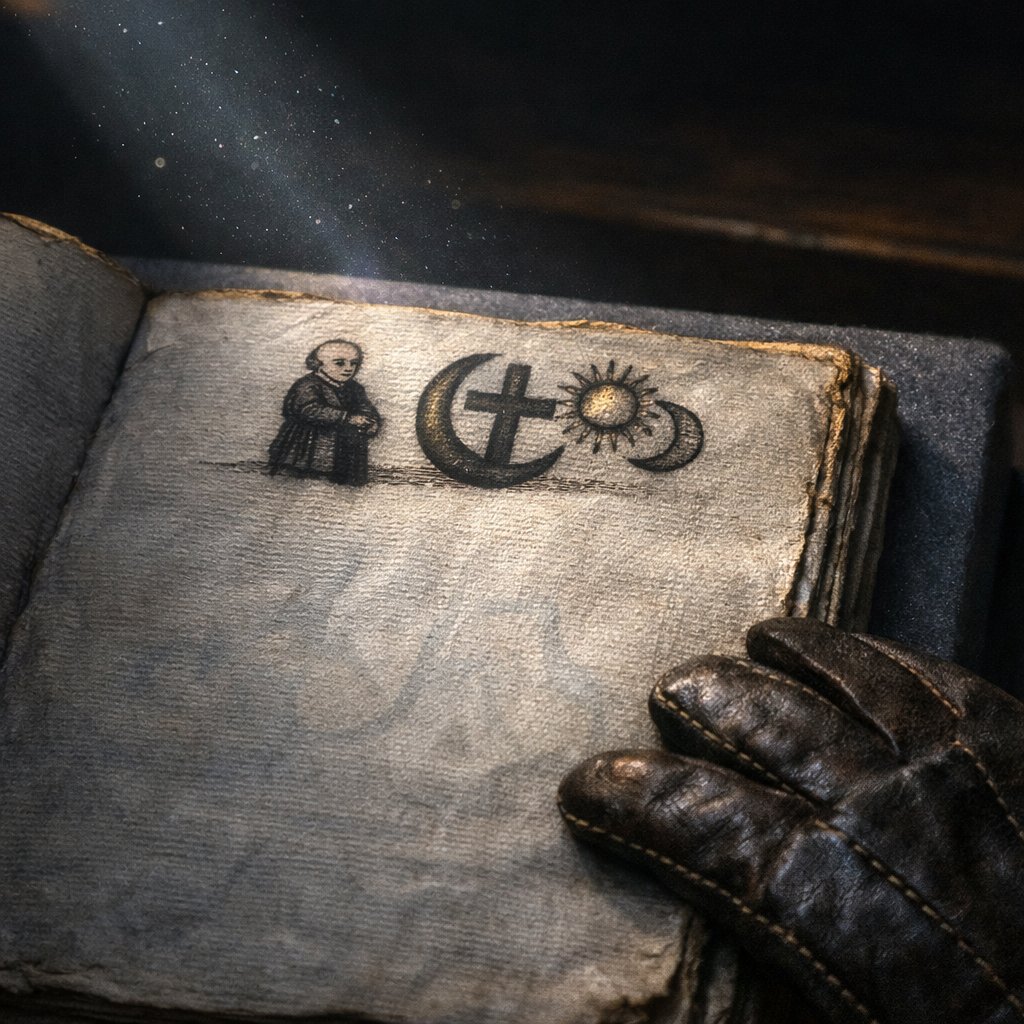
Eighty-seven illustrations sit alongside the text. They are not decorative. Crosses share pages with crescents; turbaned figures kneel near tonsured monks; one scene shows a sun and moon over what looks like a crucifixion sequence. [2][4] The mix is the puzzle. A purely Christian devotional book from sixteenth-century Hungary would not show Islamic crescents this casually; a purely Islamic text would not center a crucifixion. The Rohonc Codex sits where those traditions overlap, and the script will not tell us why.
The 1838 Donation and the First Decade of Confusion
Count Gusztáv Batthyány donated the codex with the rest of his family’s library to the newly founded Hungarian Academy of Sciences on April 23, 1838, and the manuscript was inventoried in the academy’s Manuscript Department later that year. [1][3] The donation gave the codex a chain of custody back to the Batthyány family library at Rohonc, but no earlier. A 1743 inventory of the Rohonc library lists “Magyar imádságok, Volumen I in 12mo” — “Hungarian prayers, one volume in duodecimo” — which some scholars have proposed as the codex’s first documentary mention, though the identification is not certain. [2][5]
In 1840, two years after the donation, the Transylvanian scholar István Sumegh produced the first claimed decipherment, reading the text as a Dacian-era Hungarian devotional. [2] His reading was not accepted by his peers and is now considered either an error or a deliberate hoax; it survives mostly as a cautionary line in the bibliography. The Hungarian Academy quietly shelved the codex for several decades after Sumegh’s reading collapsed, and serious scholarly attention did not return until the twentieth century. [2][5]
What the Manuscript Physically Is
The codex is written on paper, not vellum, in brown iron-gall ink, bound in a plain leather cover with no surviving title page or colophon. [2][4] Paper analysis published by the Hungarian Academy dates the watermarks to a north Italian papermill active between roughly 1529 and 1540, which puts the writing material — not necessarily the writing event — in the second quarter of the sixteenth century. [4][6] The text runs right-to-left, top-to-bottom on most pages, though scholars disagree about whether that direction is original or a binding artifact.
The script itself uses between 150 and 200 distinct glyphs depending on whose count you trust, but Levente Zoltán Király’s 2018 statistical analysis collapsed these to a working alphabet of roughly 10 to 15 base signs plus combining marks, ligatures, and positional variants. [6] That is a small alphabet — smaller than Latin, smaller than Greek, comparable to a syllabary or an abjad. The reduction is itself a finding: a 150-glyph corpus that resolves to fifteen base signs behaves like an engineered script, not a natural one.
The Eighty-Seven Illustrations
The eighty-seven images are the codex’s most accessible feature and the one outside specialists usually engage with first. They depict, in roughly narrative order: a creation sequence, an Old Testament arc, a Christ-figure with a crown of thorns, a crucifixion with two flanking figures, and a final-judgment scene with mixed crescent-and-cross imagery. [2][4] Art historian Benedek Láng’s 2010 study reads the cycle as a Christian Passion narrative interrupted at irregular intervals by what may be commentary on Islamic-Christian theological friction in the post-Mohács Hungarian frontier. [5]
The artistic execution is rough — closer to a parish-priest’s sketchbook than to a court illuminator’s manuscript. Figures are drawn in flat profile, faces are reduced to a few lines, drapery is minimal. The roughness is itself evidence: this is not a presentation copy made for a wealthy patron. The codex looks like a working document, perhaps a personal devotional record or a teaching aid made by someone who needed the script to be unreadable to a specific outside audience. [5] Whether that audience was Ottoman authorities on the post-1526 Hungarian frontier, a rival Christian confession during the Reformation, or a parish congregation untrusted with the underlying text — the record will not say.
The 2004 Brahmi Hypothesis
In 2004, Indian researcher Mahesh Kumar Singh published a partial reading of the Rohonc Codex as an archaic Brahmi-script Hindi-language gospel, asserting that the manuscript transmitted a lost Indian Christian devotional tradition into central Europe. [2][7] His reading covered the first 24 pages and produced fluent Hindi narrative paragraphs about the Christ-child.
The Hungarian academic response was skeptical. Reviewers including Benedek Láng noted that Singh’s glyph-to-Brahmi mappings were inconsistent — the same Rohonc sign was read as different Brahmi letters in different passages — and that the recovered Hindi was grammatically modern rather than period-appropriate. [5][7] The conflation worth resolving: Singh’s reading is not the same kind of claim as Király’s later statistical analysis, even though both are called “decipherments” in popular coverage. Singh proposed a phonetic mapping; Király proposed only that the script encodes a real, internally consistent language without yet identifying which language.
The 2018 Király-Tokai Statistical Reading
Levente Zoltán Király and Gábor Tokai published “A Possible Decipherment of the Rohonc Codex” in Cryptologia in 2018, applying letter-frequency analysis, positional clustering, and bigram-distribution tests to the full 448-page corpus. [6] Their headline finding was that the script encodes a real underlying language with consistent grammatical structure, not a hoax-glossolalia like the patterns seen in the Codex Seraphinianus or the inscriptions on the Phaistos Disc.
Király and Tokai identified recurring sign-clusters that they propose function as proper nouns — Jesus, Pilate, Herod — by cross-referencing the illustrated scenes with the sign-clusters appearing on the same pages. [6] Their reading suggests the text is a Christian devotional or paraphrastic gospel, written in a constructed cipher-script, possibly Hungarian or Old Hungarian underneath. They do not claim to have read the text fluently; they claim to have established that there is a text TO read.

What the timeline reveals: between 1838 and 2018, decipherment attempts moved from confident full-text readings (Sumegh, Singh) to careful structural analyses (Király, Tokai) that establish what the codex IS before claiming what it SAYS. That methodological shift mirrors the broader transition in undeciphered-script scholarship since Michael Ventris’s 1952 decipherment of Linear B — work the proper sequence and the readings come slowly; skip the sequence and the readings collapse.
The Voynich Comparison and Why Rohonc Is Different
The Rohonc Codex and the Voynich Manuscript are routinely paired in popular coverage as “Europe’s two great undeciphered books,” but the comparison flatters Voynich more than it flatters Rohonc. [8] Voynich is the more famous case, recovered by Wilfrid Voynich at the Villa Mondragone in 1912 and held at Yale’s Beinecke Rare Book and Manuscript Library since 1969. Voynich has been carbon-dated to 1404-1438 by a 2009 University of Arizona analysis. [8]
Rohonc has no carbon date, only a paper-watermark range; it has no celebrity provenance; it has had a fraction of Voynich’s scholarly attention. But Rohonc has the stronger twenty-first-century statistical result. Király and Tokai’s 2018 analysis is more advanced than anything currently published on Voynich, where competing statistical studies disagree on whether the script encodes a natural language at all. [6][8] Reduced to its evidence: Voynich is more famous; Rohonc has the better recent cryptanalysis.
| Property | Rohonc Codex | Voynich Manuscript |
|---|---|---|
| Pages | 448 | 240 (~36 missing) |
| Dating evidence | Paper watermark 1529-1540 | Vellum carbon-14 1404-1438 |
| Current location | Hungarian Academy of Sciences, Budapest (shelfmark K 114) | Beinecke Library, Yale University (MS 408) |
| Script glyph count | 10-15 base signs (Király 2018) | ~25-30 base signs (Voynich A/B hands) |
| Illustrations | 87 (religious cycle) | ~200+ (botanical, astronomical, balneological) |
| First documented | 1743 Rohonc inventory (probable); 1838 donation (definite) | 1639 letter from Georg Baresch to Athanasius Kircher |
| Strongest 21st-c. analysis | Király-Tokai 2018 (statistical, structural) | Multiple competing readings; no consensus |
What the Record Will Bear, and What It Will Not
The defensible claims about the Rohonc Codex, as of mid-2026, are these: it exists; it is held at the Hungarian Academy of Sciences; it was donated in 1838; its paper dates to circa 1529-1540; its script reduces to roughly fifteen base signs with combining marks; its illustrations depict a recognizable Christian Passion sequence with mixed Christian-Islamic-pagan elements; and Király and Tokai (2018) demonstrated that the script encodes a real underlying language. [1][2][4][5][6]
The undefended claims include: who wrote it, when exactly, in what language, for what audience, why the script was invented, why the illustrations mix traditions, and what — if anything — the text actually says. Sumegh’s 1840 reading and Singh’s 2004 reading do not survive peer-level scrutiny; Király and Tokai stop short of full translation deliberately. [5][6][7] The honest answer to “what does the Rohonc Codex say” is: we know there is something to say, and we know enough about the script to know we have not yet read it.
For further investigative reading on parallel manuscript mysteries, see our pillar on unsolved mysteries and enigmas. The case file remains open, the watermarks remain dated, and the next move belongs to whoever can put the script on a corpus the size of our related coverage.