
Drafted with AI assistance from the sources listed; images are AI-generated illustrations. How EsoVitae is made
The grey goo scenario, named in K. Eric Drexler’s 1986 book Engines of Creation Chapter 11, describes a hypothetical extinction-by-self-replicating-nanobot event. By 2004 Drexler himself walked the framing back. By 2024 the working risk surface for advanced nanotech is biotech misuse, AI alignment, and nanomedicine regulation — not runaway molecular machines.
Where the phrase came from
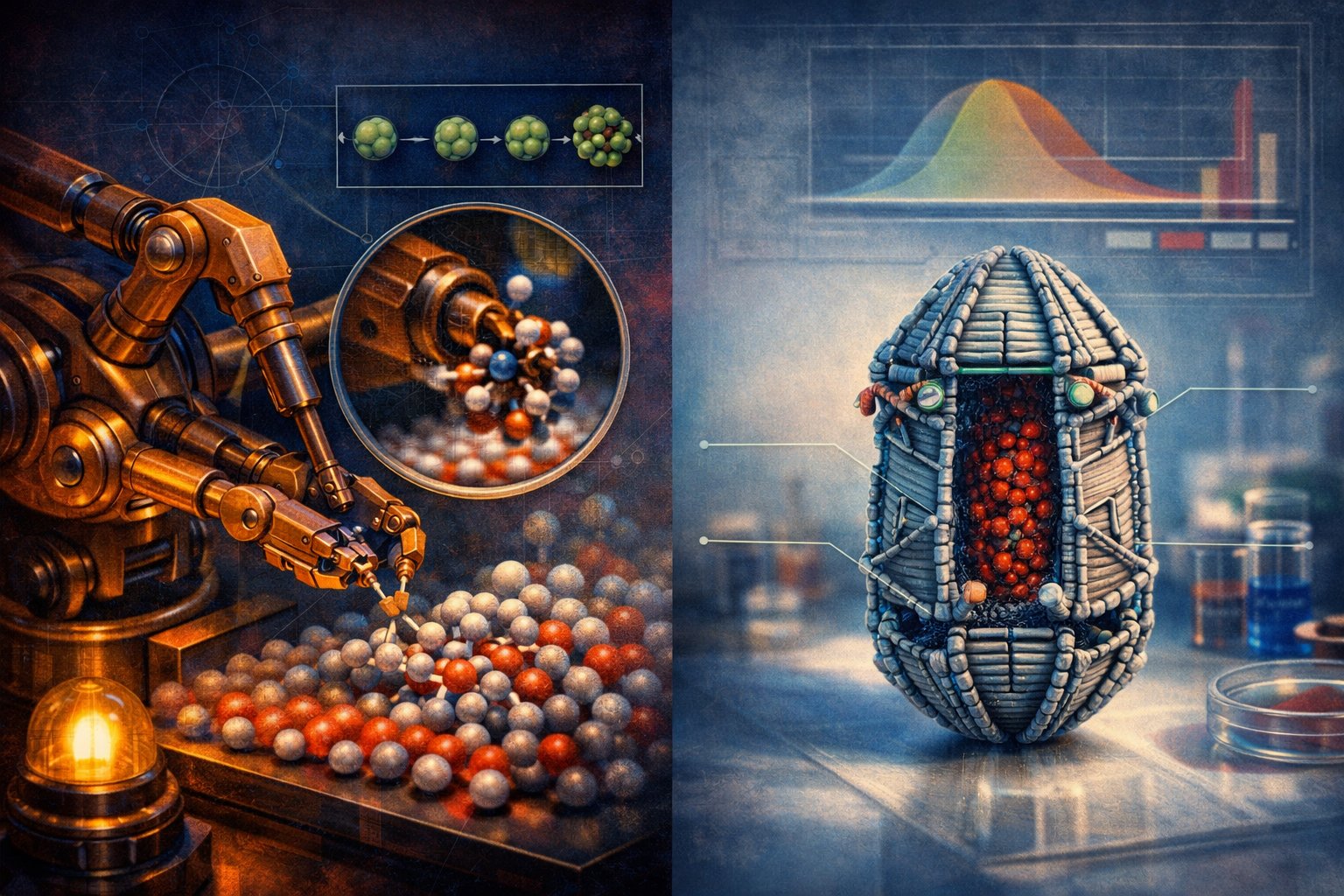
K. Eric Drexler introduced the phrase “gray goo” in Engines of Creation, published in 1986 by Anchor Books, specifically in Chapter 11, “Engines of Destruction,” to illustrate why a future molecular assembler capable of unconstrained self-replication would be dangerous [1]. The thought experiment is short. A self-replicating assembler that consumes biomass and copies itself in roughly 1,000 seconds, doubling unchecked, would exhaust the planet’s surface biomass on a timeframe Drexler estimated in days [1]. The argument was meant to license caution about replicator design choices, not to forecast an actual event.
Drexler did not coin the underlying idea from nothing. The 1986 book sits downstream of Richard Feynman’s 1959 Caltech talk “There’s Plenty of Room at the Bottom” [2] and of John von Neumann’s mid-1950s work on self-reproducing automata, which Arthur Burks edited and published posthumously in 1966 [3]. Drexler’s own MIT doctoral dissertation, defended in 1991 and published in 1992 as Nanosystems: Molecular Machinery, Manufacturing, and Computation by Wiley, carried the technical scaffolding the popular book sketched [4]. The phrase, not the idea, is what stuck.

What Drexler actually argued in 1986
Chapter 11 of Engines of Creation argues that the danger is a design choice, not an inevitability — a replicator that uses an onboard parts inventory, refuses to scavenge ambient matter, and answers to broadcast-architecture controls is, in Drexler’s framing, safe by construction [1]. Read the chapter and the actual policy ask is narrow. Drexler wanted the research community to commit, early, to “limited assemblers” and to active shields. The grey goo image was the worst case used to motivate the constraint, not a prediction. The popular reception of the book inverted that emphasis almost immediately. By the early 1990s, “grey goo” was a freestanding sci-fi trope; Michael Crichton’s 2002 novel Prey, published by HarperCollins, is the cultural high-water mark of that misreading [5].
The Foresight Institute and the early policy frame
Drexler co-founded the Foresight Institute in 1986 with Christine Peterson, partly to steward exactly that distinction between the trope and the technical policy ask [6]. Foresight’s first Guidelines on Molecular Nanotechnology, drafted in 1999 and revised in 2000, encoded the “no self-replication in the wild” rule as design principle one [6]. The guidelines were voluntary and aimed at a research field that did not yet exist in the form Drexler imagined; nonetheless, they framed the next decade of public discussion.
The 2003 Drexler-Smalley debate
In December 2003 Chemical & Engineering News, published by the American Chemical Society, ran a four-letter exchange titled “Drexler vs. Smalley” in which Nobel laureate Richard E. Smalley, who shared the 1996 Chemistry prize for the discovery of buckminsterfullerene, argued that Drexler’s mechanosynthesis proposal violates two constraints he called the “fat fingers” problem and the “sticky fingers” problem [7]. Smalley’s claim was that the manipulator atoms in any molecular assembler would be too large to fit in the working volume around a target bond, and that even if they did fit, atom-to-atom adhesion would prevent clean release [7].
Drexler’s response, in the same exchange, argued Smalley had described enzyme catalysis as if it were impossible despite the existence of enzymes [7]. The debate did not produce a winner. It did produce a research-community split: most synthesis chemists sided with Smalley’s intuition, while a smaller community around the Center for Responsible Nanotechnology, founded in 2002 by Chris Phoenix and Mike Treder, continued to advance the Drexlerian assembler line [8]. The exchange is still cited as the canonical record of the “is mechanosynthesis even buildable” question. The primary documents — four letters totaling roughly 4,000 words — sit behind the ACS paywall but are mirrored at archive.org snapshots dated through 2024.
Drexler’s 2004 walk-back
In June 2004 the journal Nanotechnology, published by IOP Publishing, ran “Safe exponential manufacturing” by Chris Phoenix and Eric Drexler, which explicitly retired the grey goo framing as the central nanotech risk and replaced it with a focus on factory-style centralized manufacturing safer by design [9]. The paper’s blunt-line summary was widely quoted at the time: self-replicating nanomachines are neither necessary for atomically precise manufacturing nor desirable, so the grey goo scenario describes a design space researchers should not enter [9]. Drexler followed up in Nature Nanotechnology interviews through 2007 and in his 2013 PublicAffairs book Radical Abundance, reiterating that the public framing had distorted the technical case [10].
What the 2004 paper actually establishes: the original grey goo image required a specific architectural choice — autonomous, untethered, biomass-consuming replicators — that no plausible research path was selecting. The technical risk surface, on the documentary record, had migrated to programmable matter abuse, autonomous-weapons miniaturization, and dual-use medical nanodevices long before the public conversation caught up [9][10].
Where the existential-risk conversation actually went
The 2010s saw the existential-risk research community shift its center of gravity away from nanotech-replicator scenarios toward AI alignment and engineered-pathogen risk, a shift documented in Nick Bostrom’s 2014 Oxford University Press book Superintelligence and in successive annual reports from the Centre for the Study of Existential Risk at Cambridge, founded in 2012 by Huw Price, Martin Rees, and Jaan Tallinn [11][12]. Bostrom’s book mentions nanotech-replicator scenarios in roughly four pages out of 328; the bulk of the argument is alignment-shaped [11]. The Future of Humanity Institute’s 2008 Global Catastrophic Risks volume, edited by Bostrom and Milan Ćirković, had already weighted biotech misuse and AI risk above nanotech misuse on expert-elicited probability rankings [13].
Where the consensus and the evidence diverge: popular search engines still surface grey goo articles dated 2003-2008 at the top of nanotech-risk SERPs, while the active research literature has spent fifteen years on different threats. The Drexler-Smalley debate is preserved in C&EN‘s digital archive; the 2004 retraction sits behind IOP’s paywall but is mirrored at Eric Drexler’s personal site under permissive licensing [9]. The popular telling vs. the actual record is a textbook case of cultural sediment outliving its source.
What 2024 risk assessments actually cover
The U.S. National Nanotechnology Initiative, coordinated through the National Nanotechnology Coordination Office and authorized by the 21st Century Nanotechnology Research and Development Act of 2003, publishes a triennial Strategic Plan; the 2021 plan, which governs through 2024 reporting cycles, identifies four risk axes: occupational exposure to engineered nanoparticles, environmental persistence, medical-device safety, and dual-use research-of-concern [14]. None of the four is grey goo. The National Institute for Occupational Safety and Health recommended exposure limit for carbon nanotubes, published in 2013 and reaffirmed through the 2024 review cycle, is 1 µg/m³ as an 8-hour time-weighted average — a regulatory number anchored to real lung-tissue studies, not to runaway-replicator scenarios [15].
On the documentary record: the 2024 working risk surface for nanotechnology is a set of mundane-sounding but consequential exposure, environmental, and dual-use questions. The dramatic version of the risk — the runaway replicator — has been off the live agenda for two decades.
Why the trope outlived the science
Two things get conflated when people use “grey goo” in 2024 conversation: the technical thought experiment Drexler used in 1986 to argue for design constraints, and the freestanding extinction-by-nanobot trope that Crichton’s Prey, the 2008 G.I. Joe film franchise’s “Nanomite” plot device, and a generation of YouTube explainers established as cultural common knowledge. The trope has a comprehensible visual grammar: silver swarms, biomass dissolving, a single laboratory accident scaling to planetary loss [5]. The technical thought experiment has none of that — it is a constraint-satisfaction argument in a hardware design space that nobody is actually building.
What the post-mortem shows: the 1986 framing was an argument for caution that succeeded culturally and failed technically. Drexler’s research community now treats the original scenario as a teaching example for why early framing matters in a new field, not as a live risk. The internet has a memory, and in this case the memory is heavier than the science.
Frequently asked questions
Is the grey goo scenario considered a real threat in 2024?
No. The original architect of the scenario, K. Eric Drexler, retired the framing in a 2004 Nanotechnology journal paper, and the active existential-risk literature has spent fifteen years on AI alignment and engineered-pathogen risk instead [9][11].
Who first used the phrase “grey goo”?
K. Eric Drexler in Engines of Creation, published by Anchor Books in 1986, specifically in Chapter 11 “Engines of Destruction” [1]. The underlying self-replicating-automata mathematics goes back to John von Neumann’s mid-1950s lectures published posthumously in 1966 [3].
What was the 2003 Drexler-Smalley debate?
A four-letter exchange in Chemical & Engineering News, December 2003, in which Nobel laureate Richard E. Smalley argued that the molecular assembler Drexler proposed is barred by “fat fingers” and “sticky fingers” constraints. Drexler argued back that enzymes refute the in-principle claim. No winner emerged [7].
Did Drexler retract the grey goo idea?
He walked it back. The 2004 paper “Safe exponential manufacturing” by Phoenix and Drexler in Nanotechnology argued that self-replicating assemblers are neither necessary nor desirable for atomically precise manufacturing, retiring the grey goo framing as the field’s central risk [9].
What does the National Nanotechnology Initiative track in 2024?
The 2021 NNI Strategic Plan, which governs 2024 reporting, identifies four risk axes: occupational nanoparticle exposure, environmental persistence, medical-device safety, and dual-use research-of-concern. Grey goo is not among them [14].
What is the difference between grey goo and runaway AI?
Grey goo is a hardware-replication scenario from 1986 — physical assemblers consuming biomass. Runaway AI, as treated in Nick Bostrom’s 2014 Superintelligence, is a goal-misalignment scenario in software systems. Different mechanisms, different research communities, different mitigations [11].
Where can I read the original Drexler text?
Engines of Creation was reissued in a 2007 e-book edition titled Engines of Creation 2.0, released under a permissive license through the Foresight Institute and mirrored at archive.org. Chapter 11 is the relevant section for the grey goo argument [1][6].
Is any current research building Drexler-style assemblers?
No mainstream synthesis-chemistry program is building autonomous self-replicating molecular assemblers. The closest live research is DNA nanotechnology, including the work of Paul Rothemund (Caltech, 2006 DNA origami paper in Nature) and Ned Seeman (NYU, foundational papers from 1982 onward), which builds programmable nanoscale structures with no replicator architecture [16].
What is the Center for Responsible Nanotechnology?
A nonprofit founded in 2002 by Chris Phoenix and Mike Treder to advance policy discussion of molecular manufacturing. CRN continued to advocate for Drexler-style scenarios after the 2004 walk-back; its policy outputs are archived on its website and at archive.org snapshots through 2018, after which the organization went largely dormant [8].
The takeaway
The grey goo scenario is a 1986 thought experiment that did its rhetorical job too well. It motivated the design-safety culture in early nanotech research, then ate the field’s public conversation for two decades. The 2024 nanotech risk surface is real, regulated, and unrelated to runaway replicators — it is exposure science, environmental fate, medical-device safety, and dual-use research governance. The dramatic version of the threat survives in popular culture; the technical conversation moved on twenty years ago.
Sources
- Drexler, K. Eric. Engines of Creation: The Coming Era of Nanotechnology. Anchor Books, 1986. Chapter 11, “Engines of Destruction.”
- Feynman, Richard P. “There’s Plenty of Room at the Bottom.” Lecture, American Physical Society, Caltech, December 29, 1959. Published in Engineering and Science, February 1960.
- von Neumann, John. Theory of Self-Reproducing Automata. Edited by Arthur W. Burks. University of Illinois Press, 1966.
- Drexler, K. Eric. Nanosystems: Molecular Machinery, Manufacturing, and Computation. Wiley, 1992.
- Crichton, Michael. Prey. HarperCollins, 2002.
- Foresight Institute. “Foresight Guidelines on Molecular Nanotechnology, Version 4.0.” 2000. Foresight.org archive.
- Baum, Rudy, ed. “Nanotechnology: Drexler and Smalley Make the Case For and Against ‘Molecular Assemblers.'” Chemical & Engineering News 81, no. 48 (December 1, 2003): 37–42.
- Center for Responsible Nanotechnology. Policy archive, 2002–2018. Crnano.org.
- Phoenix, Chris, and K. Eric Drexler. “Safe Exponential Manufacturing.” Nanotechnology 15, no. 8 (June 2004): 869–872. IOP Publishing.
- Drexler, K. Eric. Radical Abundance: How a Revolution in Nanotechnology Will Change Civilization. PublicAffairs, 2013.
- Bostrom, Nick. Superintelligence: Paths, Dangers, Strategies. Oxford University Press, 2014.
- Centre for the Study of Existential Risk. Annual reports, 2014–2024. Cser.ac.uk.
- Bostrom, Nick, and Milan M. Ćirković, eds. Global Catastrophic Risks. Oxford University Press, 2008.
- National Nanotechnology Initiative. “2021 NNI Strategic Plan.” National Nanotechnology Coordination Office, October 2021.
- National Institute for Occupational Safety and Health. “Current Intelligence Bulletin 65: Occupational Exposure to Carbon Nanotubes and Nanofibers.” NIOSH Publication 2013-145, April 2013. Reaffirmed 2024.
- Rothemund, Paul W. K. “Folding DNA to Create Nanoscale Shapes and Patterns.” Nature 440 (2006): 297–302.
For more on the broader landscape of post-1980 extinction-class hypotheses, see the Contemporary Mysteries & Theories pillar.