What Is Asgard in Norse Mythology?
Asgard (Old Norse Ásgarðr, “enclosure of the Æsir”) is the fortified celestial stronghold of the principal Norse gods, joined to the human world of Midgard by the bridge Bifröst. Its fullest description survives in Snorri Sturluson’s Prose Edda, composed in Iceland around 1220 [1][2].
Published: 2026-06-05. Last reviewed: 2026-06-05.
I have gone looking for Asgard in two places that could not be more unlike each other. The first was the royal mounds at Gamla Uppsala in eastern Sweden, three green hills swelling out of a flat plain under a sky the colour of pewter, where the wind comes off the Fyris valley with nothing to break it. The second was a reading room, the kind with cotton gloves and a foam cradle, where the thirteenth-century manuscripts that describe Asgard sit under glass and low light. The Land of the Gods has no grid reference; it has never been a place on a survey sheet. But it has always been a place on a page, and a place that the page keeps insisting is just over the horizon. This guide stands at both addresses, the mound and the manuscript, and walks through what Asgard actually was to the people who first wrote it down, how its halls and walls were laid out, and why a sky-fortress assembled out of skaldic verse still shapes the way we picture the divine within the broader landscape of mystical places and lost worlds.
The Texts That Built Asgard
Almost everything specific we know about Asgard comes from two Icelandic books of the thirteenth century: Snorri Sturluson’s Prose Edda, composed around 1220, and the anonymous Poetic Edda, preserved in the Codex Regius manuscript of about 1270 [2][3]. The older verse the Codex collects is centuries earlier, carried orally by skalds, but the parchment that fixes it is late medieval and Christian.
The single richest source is the Gylfaginning (“The Deluding of Gylfi”), the first book of Snorri’s Edda. It frames its cosmology as an interrogation: a Swedish king named Gylfi travels in disguise as Gangleri to a hall in Asgard and questions three enthroned figures, High, Just-as-High, and Third, who describe the gods and their dwellings, as preserved in Anthony Faulkes’s translation for the Viking Society for Northern Research [1]. The device matters to a careful reader. Every detail of Asgard reaches us through a thirteenth-century antiquarian explaining a pre-Christian world he no longer worshipped to an audience that no longer believed it.
The Eddic Sources, Dated
The verse layer is older and stranger. In the Poetic Edda, the poem Grímnismál (“The Lay of Grímnir”) has Odin, half-tortured between two fires, recite the halls of the gods one after another, and that catalogue is where most of Asgard’s named architecture originates [3][4]. Two further poems, Hymiskviða and Þrymskviða, name Asgard directly, and the prophetic Völuspá supplies its beginning and its end. The implication is worth holding onto: the place is a literary construction with a documented birth date, not a survey coordinate, and the texts that build it can be dated to within a human lifetime.
The Halls Behind the Wall
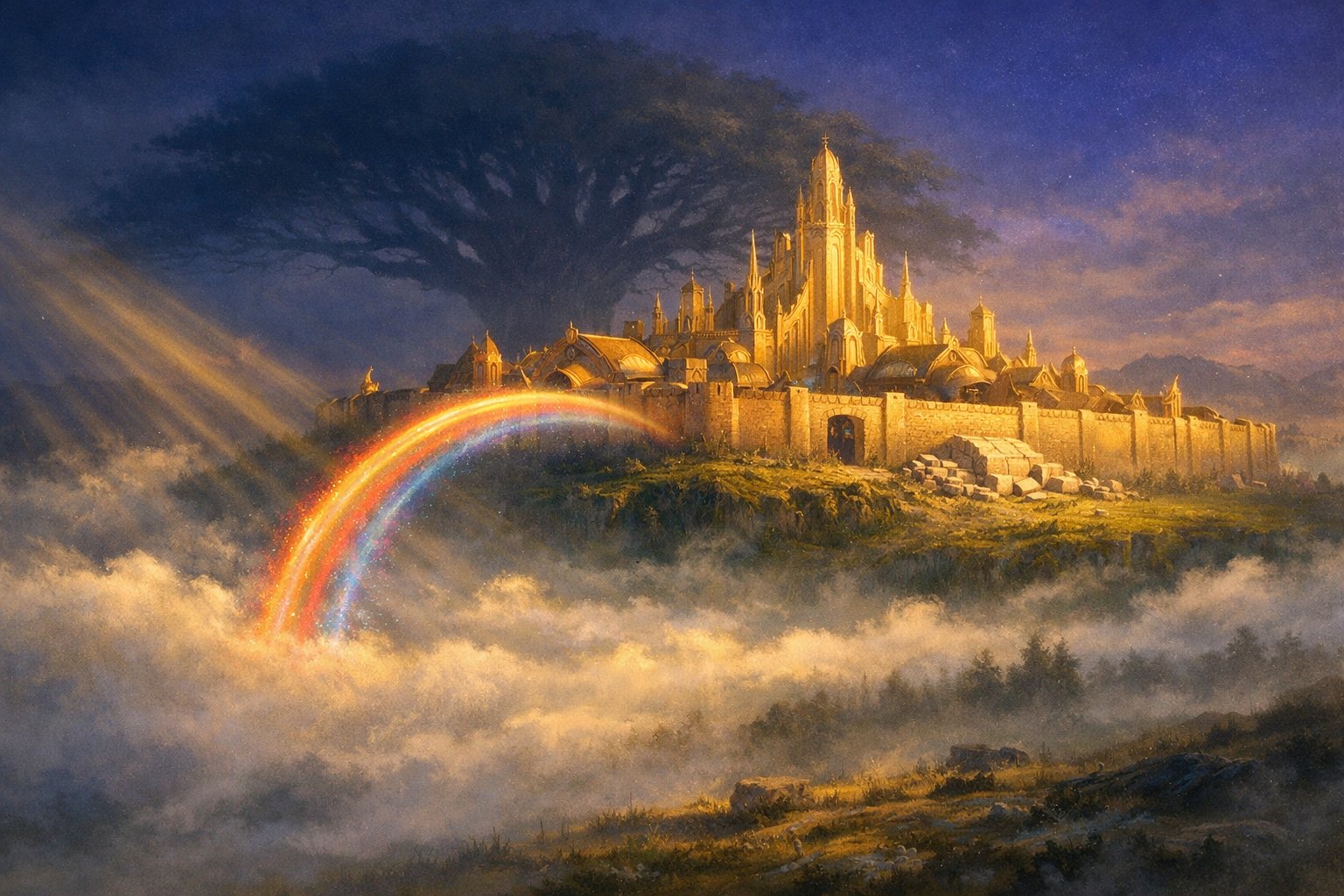
Asgard is not a single building but a walled precinct of named halls arranged across a central plain called Iðavöllr, the field where the Æsir first raised their forges, their temple, and their thrones [1]. Snorri describes a citadel roofed and benched in gold, and the verse catalogues count more than a dozen separate dwellings, each assigned to a god and each carrying a meaning in its name.
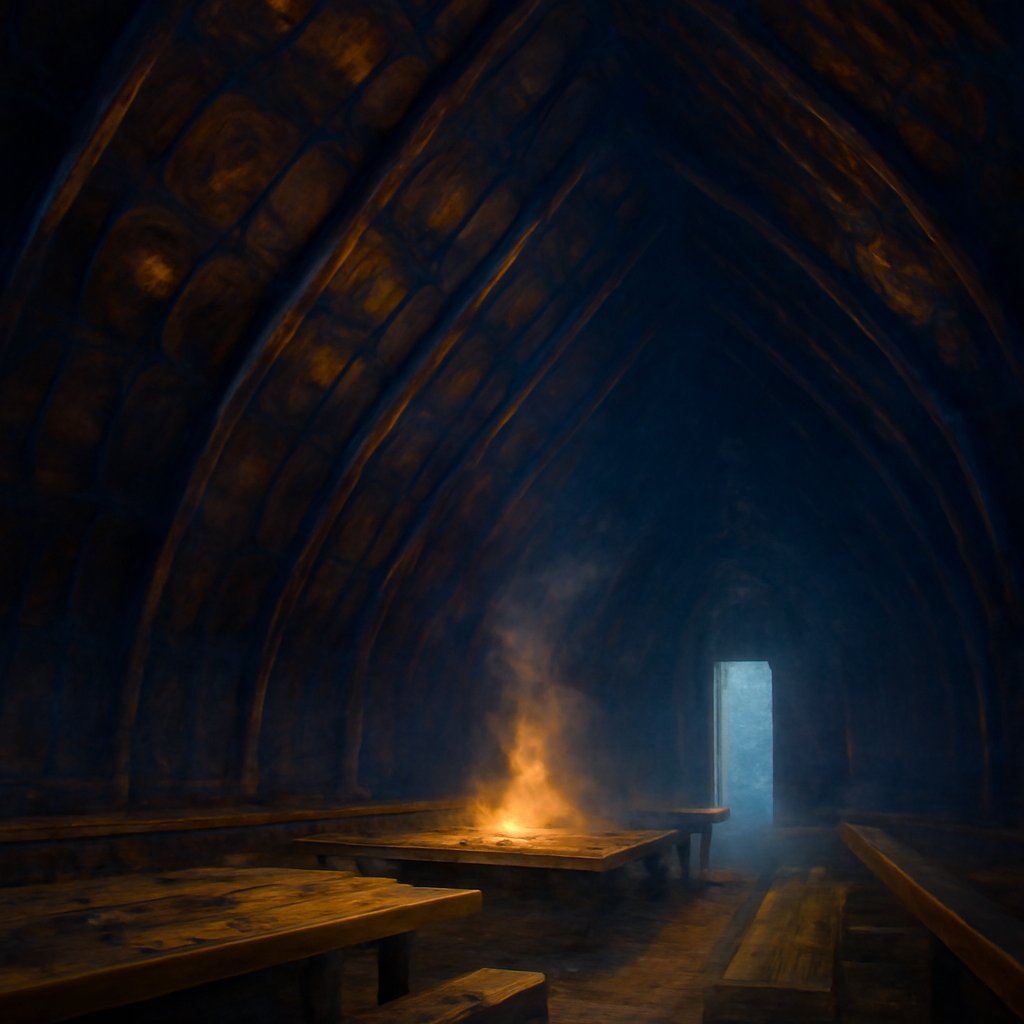
At the centre stands Glaðsheimr (“bright home”), the hall of the twelve high seats of the Æsir, and beside it Vingólf, set aside for the goddesses. Odin’s Valhalla (Valhöll, “hall of the slain”) is the most famous of them, its rafters spears, its roof shields, its benches mailcoats, holding the warrior dead who will fight at the world’s end. Grímnismál gives it an architecture of pure hyperbole: five hundred doors and forty more, with eight hundred warriors able to march abreast through each one [4]. The load-bearing fact: the hall is sized for an army, because its entire purpose is to stockpile one.
| Hall | Old Norse | Owner / Function | Primary Source |
|---|---|---|---|
| Valhalla | Valhöll | Odin’s hall of the chosen slain | Grímnismál; Gylfaginning |
| Gladsheim | Glaðsheimr | Hall of the twelve Æsir thrones at Iðavöllr | Gylfaginning |
| Vingolf | Vingólf | Hall of the goddesses (Ásynjur) | Gylfaginning |
| Valaskjalf | Valaskjálf | Odin’s silver-roofed hall; seat Hliðskjálf | Grímnismál |
| Bilskirnir | Bilskírnir | Thor’s hall of 540 rooms | Grímnismál |
| Breidablik | Breiðablik | Baldr’s hall, where nothing impure stands | Grímnismál |
| Folkvang | Fólkvangr | Freyja’s field and hall Sessrúmnir | Grímnismál |
| Himinbjorg | Himinbjörg | Heimdall’s hall at Bifröst’s end | Grímnismál |
Valhalla and the Hall-Plain of Iðavöllr
The hall-plain has a strange recursive quality worth noticing. Iðavöllr is both where the gods begin, raising their first buildings in a golden age the Völuspá remembers fondly, and where the survivors of the world’s destruction will reconvene afterward [3]. Thor’s Bilskírnir, by the same poem’s reckoning, holds five hundred rooms and forty, making it the largest building ever roofed [4]. These are not measurements. They are a poetic grammar of abundance, the skald’s way of saying that the dwellings of the gods exceed any hall a chieftain could raise on earth.
Bifröst and the Watchman at the Gate
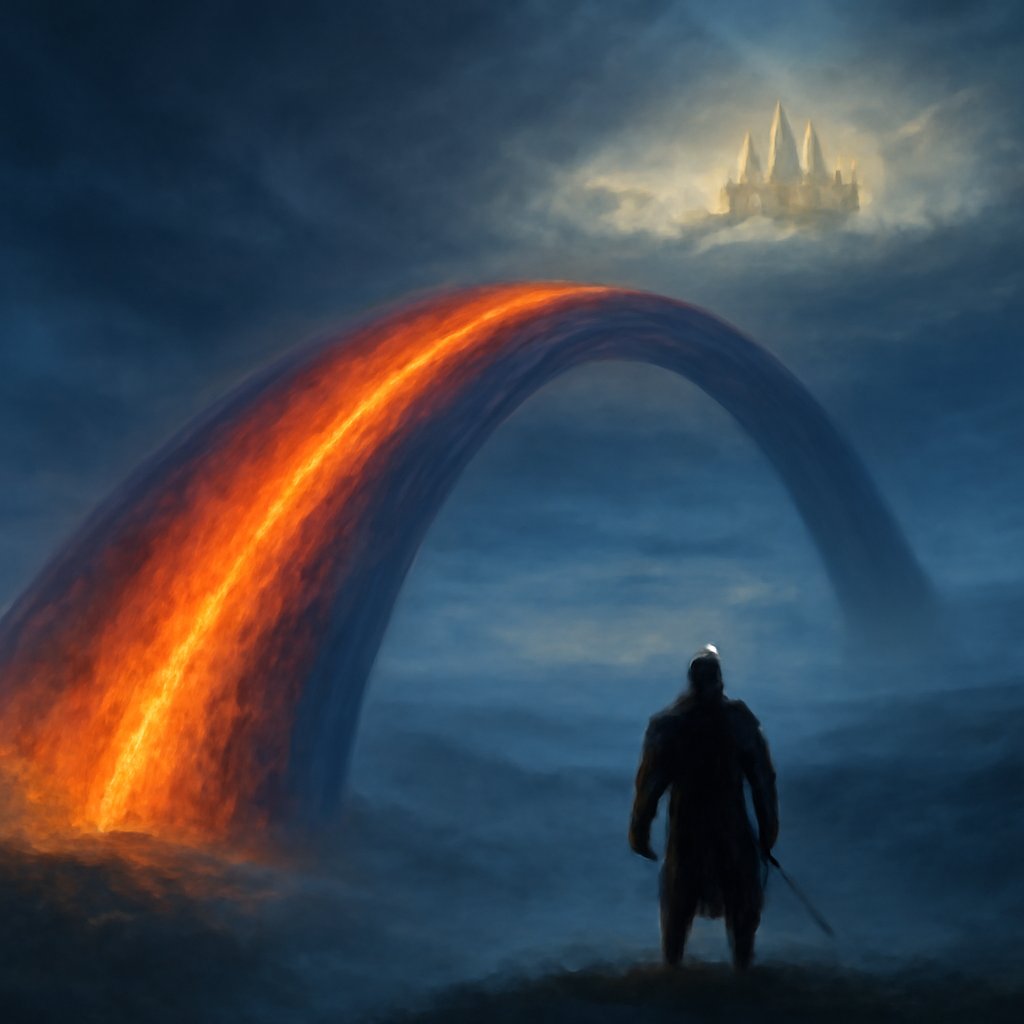
Bifröst is the burning, trembling bridge that links Asgard to the lower worlds, appearing as Bilröst in the Poetic Edda and as Bifröst in Snorri’s prose, and the rainbow is the form it takes when mortals glimpse it [5]. The Æsir ride across it each day to hold their court at the roots of the world-tree Yggdrasil, and its red band is fire, set there to keep the frost-giants from storming the gods’ road.
The bridge ends at Himinbjörg (“heaven-cliffs”), the hall of Heimdall, the watchman who needs less sleep than a bird, sees a hundred leagues by night or day, and hears the wool growing on a sheep and the grass growing in a field [5]. Across his shoulder hangs Gjallarhorn, the resounding horn whose single blast will carry to every world when the giants finally come. Heimdall is the security architecture of Asgard rendered as a person, the sensor array at the one approach a fortress in the sky cannot wall off. When the bridge breaks, it breaks under the weight of the riders he is built to announce.
The Wall and the Giant Who Built It
The most revealing single story about Asgard is the building of its wall, told in Gylfaginning, in which an unnamed jötunn (giant) craftsman offers to raise an impregnable fortification in one winter in exchange for the goddess Freyja, the sun, and the moon [1][6]. On Loki’s advice the Æsir accept, certain the work cannot be finished in time, on the condition that the builder have no help from any man.
The builder has one ally the bargain did not forbid: his stallion Svaðilfari, who hauls stone through the nights at a pace no horse should manage, and three days from the deadline the wall stands nearly complete [6]. The Æsir, facing the loss of sun and moon, turn on Loki, who has engineered the whole crisis. His solution is characteristically grotesque. He becomes a mare, lures Svaðilfari away into the woods for a night, and the wall goes unfinished. Thor settles the broken contract with his hammer Mjölnir, and the giant’s skull with it. Loki, some months later, bears the eight-legged grey foal Sleipnir, who becomes Odin’s horse [6]. Stripped of the comedy, the myth is a meditation on the cost of a perfect defence: Asgard’s wall stands because the gods broke an oath, and the broken oath is the first crack the Völuspá will later remember.
Where Is Asgard? The Cartography of a Place Off the Map
The texts place Asgard in three incompatible locations at once: at the centre of the cosmos above Midgard, across the sea and the burning bridge, and, in Snorri’s rationalising frame, in Asia near Troy. The conflation worth resolving is that these are not rival map readings but three different jobs the same name is doing.
In the mythological cosmology, Asgard sits at the top of the world-tree, reachable only by Bifröst, a sky-realm that no traveller walks to. In Snorri’s Prologue and his Ynglinga saga, by contrast, the Æsir are recast as human migrants: Trojan or Asian nobles who travelled north out of Ásíá, were mistaken for gods because of their superior craft, and whose old capital, “Ásgarðr,” lay east of the river Don [1][2]. This is medieval euhemerism, the reflex of a Christian author who could preserve the old stories only by demoting their gods to clever ancestors.
Snorri’s Trojan Asgard
The Troy connection is not a stray fancy. It plugs the Norse gods into the same prestigious origin myth that medieval English, Frankish, and Icelandic writers used to give their dynasties a classical pedigree, the same impulse that traced Britain to Brutus of Troy. Snorri even glosses Æsir as “men of Asia.” It is, on the documentary record, the earliest attempt to answer the question this section asks, and it answers it by refusing the supernatural altogether and pointing east instead of up.
The Site You Can Actually Stand In: Old Uppsala
The closest physical analogue to Asgard that a traveller can actually visit is Gamla Uppsala (Old Uppsala) in Sweden, the great cult centre of the Norse gods. Writing in the 1070s, the cleric Adam of Bremen described a gold-adorned temple housing statues of Thor, Odin, and Freyr at its heart [7]. The temple itself is gone, contested, and probably exaggerated; the landscape is emphatically not.
Standing on the royal mounds: three great barrows, each roughly nine to ten metres high, rise from the plain in a line, raised in the sixth century and folk-attributed in later tradition to Odin, Thor, and Freyr themselves [7]. They are the nearest the Æsir come to a postcode. A good local guide, and the on-site museum runs them, will walk you from the mounds to the medieval church that replaced the pagan precinct and explain how much of Adam of Bremen’s lurid account, the nine-day sacrifices, the bodies hung in the sacred grove, rests on a single hostile second-hand source. The honest version is more interesting than the gory one: a real ceremonial centre of the Norse gods, archaeologically rich, around which a literary Asgard could plausibly crystallise.
Visitor Ethics on Sacred Ground
A note on practice. The mounds at Gamla Uppsala are protected burial monuments; the marked paths run beside them, not over them, and climbing the barrows is both prohibited and a small act of vandalism against a grave. Contemporary Norse-pagan practitioners, the Ásatrú community among them, hold ceremonies on this ground, and a visitor owes their rite the same quiet they would owe any working church. The place rewards the patient: come at the blue hour, after the coaches leave, when the mounds go violet and the plain holds the last gold light, and the reason a culture located its gods just past the visible edge of things becomes legible without a single word of explanation.
What Happens to Asgard at Ragnarök
Asgard is built to be destroyed, and the Völuspá describes its end in detail: Heimdall blows Gjallarhorn, the giants and the fire-host of Muspell ride out, Bifröst shatters beneath their horses, and the gods fall in a last battle on the plain of Vígríðr [3][5]. The fortress whose every feature was a defensive measure, the wall, the watchman, the army in Valhalla, loses anyway. That foreknowledge is the engine of the whole mythology.
Then comes the detail that makes the place worth standing in. After the burning, a green earth rises again from the sea, and a remnant of the gods, Baldr returned from the dead among them, gather once more at Iðavöllr, the same hall-plain where Asgard began [3]. There, in the new grass, they find the golden game-pieces the old Æsir had once owned and lost. What lingers is that image: not paradise, not a throne-room, but survivors picking small gold tokens out of the turf on the exact ground where the first hall stood. Asgard endures in our imagination because it was never sold as permanent. It was a fortress that knew its own ending, and chose, on a remembered plain, to begin again.
Frequently Asked Questions
What does Asgard mean?
Asgard renders the Old Norse Ásgarðr, a compound of áss (“god,” a member of the Æsir) and garðr (“enclosure, yard, fortified wall”). The usual translation is “enclosure of the gods” or “stronghold of the Æsir,” and the second element survives in English “yard” and “garden.”
Who lives in Asgard?
The Æsir, the principal tribe of Norse gods, including Odin, Thor, Frigg, Baldr, Týr, Heimdall, and Bragi. After the war between the Æsir and the Vanir, three Vanir deities, Njörðr, Freyr, and Freyja, also came to dwell in Asgard. Loki, though of giant descent, lives among the Æsir as well.
Is Asgard the same as Valhalla?
No. Valhalla (Valhöll) is one hall inside Asgard, Odin’s hall of the chosen slain, where the warrior dead feast and train for Ragnarök. Asgard is the entire walled realm that contains Valhalla along with a dozen other halls such as Gladsheim, Breidablik, and Himinbjörg.
How do you get to Asgard?
In the myths, by way of Bifröst, the burning rainbow bridge that links Asgard to Midgard and the lower worlds. The Æsir ride across it daily to their court at the roots of Yggdrasil. The bridge is guarded at its upper end by Heimdall and is destined to break during Ragnarök.
Where is Asgard supposed to be located?
The mythological texts place it in the heavens at the centre of the cosmos, above Midgard and reachable only by Bifröst. Snorri Sturluson, rationalising the myths, instead located a historical “Ásgarðr” in Asia near Troy and treated the gods as deified human migrants. There is no real-world site that the medieval sources identify as Asgard.
Who built the wall around Asgard?
An unnamed giant builder, aided by his stallion Svaðilfari, undertook to raise the wall in a single winter in exchange for Freyja, the sun, and the moon. Loki sabotaged the deal by luring the stallion away in the form of a mare, and Thor killed the builder with his hammer Mjölnir before payment fell due.
What is Bifröst?
Bifröst is the bridge connecting Asgard to the other worlds, seen by humans as a rainbow and described in the sources as a burning, three-coloured span. It is guarded by Heimdall from his hall Himinbjörg and is fated to collapse when the sons of Muspell ride across it at the world’s end.
Who guards Asgard?
Heimdall, the watchman of the gods, guards Bifröst and therefore the only approach to Asgard. He requires less sleep than a bird, can see for a hundred leagues, and hears grass and wool grow. His horn Gjallarhorn will sound to summon the gods when Ragnarök begins.
Was Asgard a real place?
Not as the myths describe it. Asgard is a literary and religious construction preserved in thirteenth-century Icelandic manuscripts. The nearest physical analogue is the cult centre at Gamla Uppsala in Sweden, with its royal mounds and the lost temple described by Adam of Bremen, where the Norse gods were genuinely worshipped.
How is Asgard connected to Yggdrasil?
Asgard is one of the realms set within or upon Yggdrasil, the world-tree that structures the Norse cosmos. The Æsir cross Bifröst each day to hold council at Yggdrasil’s roots, beside the Well of Urðr, where the Norns who shape fate dwell. The tree binds Asgard, Midgard, and the other worlds into one living frame.