By Emilia Wellesley · Published May 4, 2026 · Updated May 13, 2026
Last reviewed: May 4, 2026.
Prelude to the Journey
As dawn broke over the bustling lagoon city of Venice, the stage was set for one of history's greatest tales of adventure and discovery. In the 13th century, Venice stood as a thriving hub of commerce and trade, its economic tentacles stretching across the Mediterranean and beyond. Amidst this backdrop of maritime prowess and mercantile ambition, a young Marco Polo was molded by the cosmopolitan spirit of his Venetian heritage.
Marco's initiation into the world of exploration began not as a scholar or a nobleman's whim but borne out of the family trade of mercantile ventures to the far reaches of the known world.
- Family Influence: Inspired by stories of distant lands told by returning traders and enhanced by their familial legacy of travel, Niccolò and Maffeo Polo, Marco's father and uncle, fueled the fires of curiosity in the young Marco.
- Educational Background: He was not just any Venetian youth; he was a scion of determined merchants, educated in the arts of trade, languages, and diplomatic intrigue.
The allure of the East, with tales of unimaginable wealth and exotic cultures, beckoned, but more immediately, it was the promise of establishing trading links and religious diplomacy under the auspices of the Mongol-dominated Asia that stirred the Polos towards their epic journey to the court of Kublai Khan. This detailed mission had two fronts:
- To fulfill the Khan’s request for educated men to tutor his court in Christian doctrine
- To secure profitable trade agreements.
Furthermore, the Venetian mercantile empire, continuously expanding its influence, sought not only wealth but also knowledge. The Polo family's decision to head East was both a testament to their daring and to Venice's strategic ambitions.
- Preparation and Planning: Their journey was meticulously planned, gathering information from various traders about routes, diplomatic customs, and the political landscapes of the regions they would traverse.
- Gift Selection: Even the choice of gifts for the Mongol emperor was crafted to convey respect and foster fruitful discussions.
Thus, with his father Niccolò and uncle Maffeo, Marco embarked on his fateful journey at the tender age of seventeen. They prepared not merely to cross physical distances but also to bridge vast cultural divides, a young Marco perfectly poised to absorb the wonders of the unknown world.
- Journey's Impact: An adventure enveloped in mystery and fraught with peril, this journey would ultimately thread Marco Polo into the fabric of global history.
- Cultural Exchange: Through lands few Europeans had ever seen, their path would pave the way for a deepened understanding of the interconnectedness of East and West, setting the framework for what would indeed be a monumental intercultural exchange.
As the trio set sail from Acre to journey through the heart of Asia, Marco Polo's destiny as an emissary of cultures and a chronicler for the ages was irrevocably set into motion.
The Route Through the Silk Road
Traversing the Silk Road, the ancient artery of commerce and culture, Marco Polo embarked on an epic journey that stretched from the Mediterranean basin across the heart of Asia. This vast network of trade routes not only connected distant civilizations but also served as conduits for cultural exchange, influencing Marco's observations and experiences profoundly.
Traversing Rugged Lands and Cultures
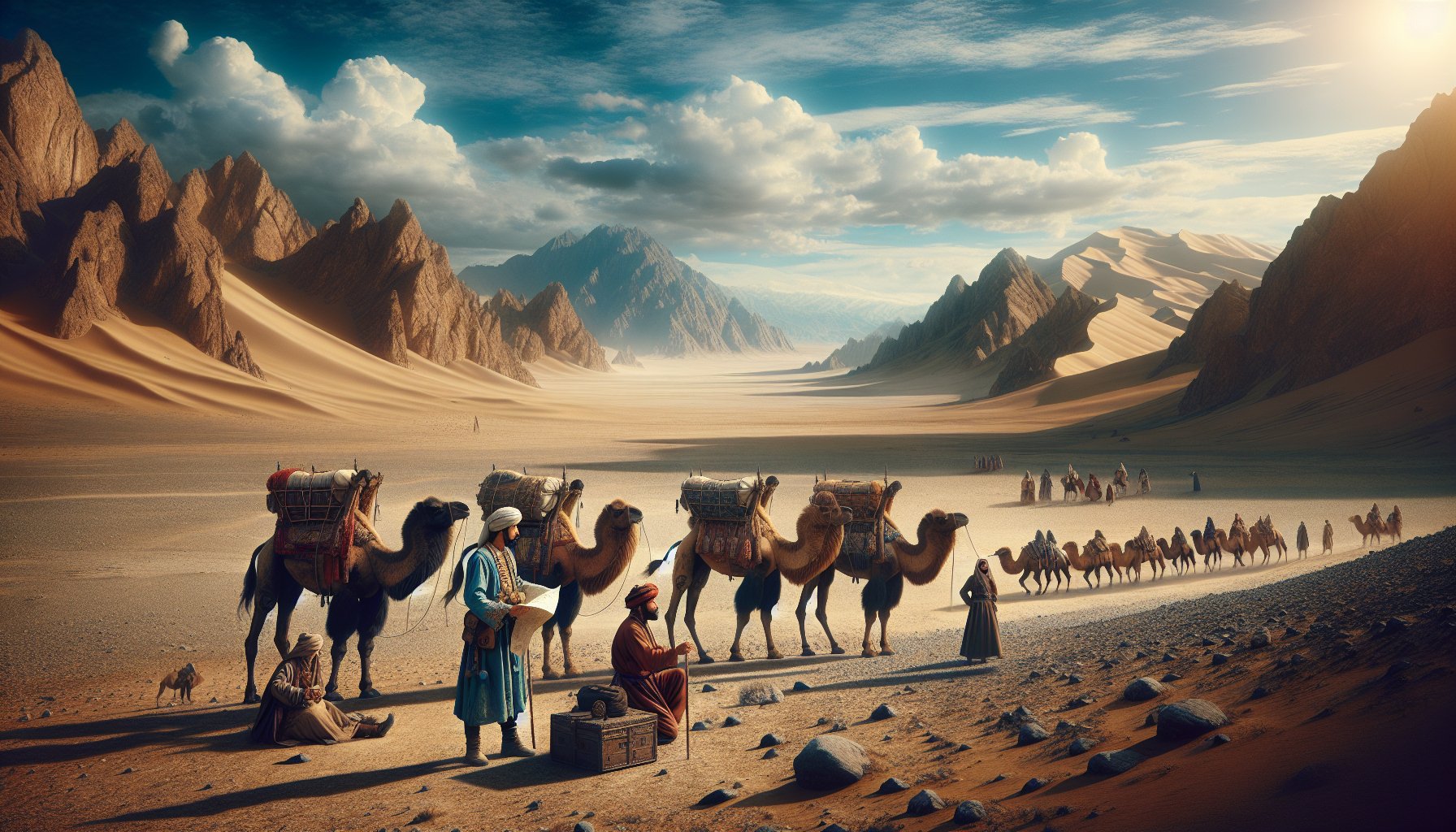
Starting from Venice, the young Polo ventured into the unknown with his father Niccolò and uncle Maffeo. Their path led them through the rugged landscapes of the Middle East and Central Asia, including daunting stretches like the Gobi Desert—a vast, arid region that tested the endurance of travelers with its harsh environment. As they traveled the Silk Road, it wasn't just the physical landscape that varied dramatically; the Polos encountered a mosaic of cultures and peoples, from Persian traders to Mongolian nomads, each contributing to Marco's growing understanding of the world.
Leaving behind the relative familiarity of the Byzantine Empire, Marco Polo marveled at the bustling bazaars of Persia, where silks and spices perfumed the air, signaling the wealth flowing through these trade networks. His route likely took him through storied cities such as Bukhara and Samarkand in present-day Uzbekistan—cities that were centers of scholarship and commerce in the Islamic world. These places, teeming with traders and artisans from across Eurasia, offered the young Polo profound insights into the complexity and diversity of the civilizations connected by the Silk Road.
Key Stoppages on the Silk Road
Significant cities like Kashgar and Balkh served not only as rest stops but as vital hubs where knowledge, goods, and cultural practices were exchanged. In these caravanserais—roadside inns where travelers rested and recuperated—Marco Polo would have heard stories from other merchants, each narrative adding layers to his understanding of the vast lands he traversed. Samarkand, a jewel along the route, particularly impressed Polo with its rich tapestries and robust markets. Here, Marco first encountered the wealth of the East in tangible forms: precious gems, gold, and fine porcelain, fostering his fascination with Eastern riches.
Bukhara played another crucial role in Marco’s journey, offering him a glimpse into the scholarly and religious life of the region. It was here that Marco would have witnessed a vibrant mix of religious practices, from Islam to Zoroastrianism, each co-existing within the dynamic cultural landscape of the medieval Silk Road.
As Marco Polo moved deeper into Central Asia, the influence of the Mongol Empire became increasingly evident. The Pax Mongolica, or Mongol Peace, ushered by Genghis Khan’s conquests, had made it possible for merchants to travel these roads more safely than ever before. This relative stability was crucial in enabling Polo’s passage through territories that might once have been perilously fragmented by tribal conflicts.
Marco Polo's transit through the Silk Road was more than a mere travel; it was an odyssey that brought him face-to-face with the mosaic of cultures that shaped the medieval world. Each stop enriched his travelogue with vivid descriptions that would captivate the imaginations of Europeans for centuries, offering them a window into the allure of the East and its myriad treasures. His journey remains a testament to the enduring lure of discovery and the unifying power of the Silk Road as a channel for historical and cultural synthesis.
Arrival at Kublai Khan's Court
The Welcome by the Great Khan
Upon reaching the magnificent court of Kublai Khan situated in Shangdu, also known famously as Xanadu, Marco Polo was met not just with curiosity but with a preserved grandeur that marked this era of the Pax Mongolica. The lavish reception that greeted the Polos underscored Kublai Khan's appreciation for knowledge and diplomatic connections transcending the vast Mongol Empire's borders. Being a strategic and insightful leader, Kublai was keen on integrating diverse cultures and technologies, which was evident in his cordial reception of foreign dignitaries.
- Impressive Ceremonies: Upon their arrival, the Polos were immediately embroiled in the luxuries of the court—sumptuous banquets, elaborate ceremonies, and a display of Mongol military prowess—which were intended not just to impress but also to signify the stability and wealth under Kublai Khan's reign.
- Marco's Influence Begins: The Great Khan’s interest in Marco, triggered perhaps by stories of his travels or the potential diplomatic leverage such a traveler could bring, marked the beginning of Marco's influential years within one of the most storied courts of medieval Asia.
Role in the Yuan Dynasty
Marco Polo’s role within the Yuan Dynasty unfolded as more than just an onlooker; he became a valuable administrator and envoy. Entrusted with missions along the colossal stretches of the Silk Road and even beyond to the remote areas of Yunnan and Burma, Marco’s travels under the authority of the Khan were fundamental both for the empire's internal management and for its external diplomatic engagements.
- Skills Leveraged: The Venetian’s grasp of different languages and customs, thanks to his mercantile background, greatly aided his role in easing communications within the diverse ethnic groups under Mongol rule.
- Insights Gained: Furthermore, his service garnered him unique insights into the administrative innovations and military strategies of the Mongols, including the use of paper currency, postal systems, and highly structured urban planning observed in Khanbaliq (modern Beijing), the winter capital of the Yuan Dynasty.
These experiences were meticulously documented in what would later transform into "The Travels of Marco Polo," providing a vibrant account of life in East Asia during the 13th century, significantly embellishing the West's knowledge and fascination with the region. His detailed observations served not just as travel logs but as potential blueprints for governance and diplomacy adaptations, intriguing and inspiring policy-makers and adventurers alike back in Europe. Through his narratives, a higher resolution of the Eastern world was etched into the Western consciousness, challenging preconceived notions and sparking an undeniable yearn for exploration among his contemporaries.
In sum, Marco Polo's tenure at Kublai Khan’s court was pivotal; it was a time of deep cultural immersion, significant learning, and substantial influence, probing the vigorous exchanges between the East and West during a time when such interactions were both rare and laden with profound implications.
Cultural Observations and Experiences
Insights into Yuan Dynasty China
Marco Polo's recordings offer an unparalleled glance into the Yuan Dynasty, revealing facets of Chinese life that were then unknown to the Western world. His detailed descriptions encompassed the widespread use of paper currency—a concept not yet embraced in Europe—and highlighted sophisticated urban planning seen in cities like Khanbaliq (modern-day Beijing) and Shangdu, known to the West as Xanadu. Polo marveled at the efficiency of the Grand Canal, a testament to advanced Chinese engineering that facilitated the rapid movement of goods and personnel across vast distances.
The Venetian was particularly struck by the Mongols' postal system, an elaborate network of stations that allowed for swift communication across the empire, enhancing diplomatic and trade relations. This system mirrored the grandeur and organization of the Mongol governance under Kublai Khan, aspects that Polo noted meticulously, recognizing their strategic importance in maintaining the vast empire.
Religious and Cultural Integration
Marco Polo's journey was not just one of geographic exploration but also a profound cultural immersion. The religious landscape of Yuan Dynasty China was a tapestry woven with the threads of Buddhism, Islam, and Confucianism, each coexisting under Kublai Khan's rule with a degree of harmony. Polo's accounts provide insights into how these religions influenced the governance and daily life of the people, such as the construction of majestic temples and the celebration of diverse religious festivals, which he documented with keen interest.
His narratives also delve into the daily lives of the Chinese people, from the farmers in the fields to the craftsmen in the markets, presenting a picture of a bustling, vibrant society. Polo’s exposure to such a variety of cultural practices helped demystify the East for his European readers, challenging existing prejudices and sparking a curiosity that would inspire countless future explorers.
In documenting these experiences, Marco Polo not only bridged two worlds but also painted a picture of a society rich in culture, technology, and complexity. His travelogue, therefore, stands as a critical conduit through which medieval Europe was introduced to the sophisticated cultures of East Asia, marking a significant moment in cultural transmission and global history.
The Return Journey to Venice
Challenges and Reflections
Upon leaving the entrancing court of Kublai Khan, Marco Polo embarked on a challenging return voyage to Venice, laden both physically and metaphorically with the treasures and experiences of the East. In 1292, after nearly two decades of immersion in the Yuan Dynasty’s rich cultural and administrative life, Polo's journey homeward was far from straightforward or safe.
The perils began in the maritime legs of their return, as Marco, his father Niccolò, and uncle Maffeo, sailed through treacherous waters from the southern ports of China towards the Persian Gulf. The voyage was not merely a navigation challenge but a journey through a political minefield. The seas were rife with the threats posed by warring factions, and the group narrowly escaped naval skirmishes that reflected the turbulent politics of late 13th-century Asia.
Their path led them through the pirate-infested Strait of Malacca and past the southeastern coasts pocked with hostile territories. After a brief stop in Sumatra, plagued by monsoon delays, they rounded the southern tip of India, skirting the territories influenced by the emergent Mongol offshoots in the Ilkhanate. Every port called for a delicate dance of diplomacy and discreet trading to replenish their dwindling supplies without falling foul of local authorities or brigands.
The overland segments through the Middle Eastern realms, particularly Persia, now under the rule of the Mongol Ilkhanate, posed its blend of challenges and intrigues. The Polo party witnessed the landscape that was a juxtaposition of the devastation wrought by Mongol conquests and the burgeoning exchanges in ideas, religion, and technology, themes Marco had become deeply familiar with during his stay in China. This leg of the journey underscored the perils Marco faced—the harsh deserts and towering mountain passes were as much a test of endurance as they were of the will.
Impact of Eastern Wealth
Upon reaching Venice in 1295, Marco Polo was a transformed man, not just in age or in wisdom but laden with treasures that transcended the material. The silks, spices, gems, and knowledge of sericulture and paper currency he brought back were mere tokens of a much richer cargo of experiences and ideas he had amassed.
This tangible wealth, however spectacular, paled in comparison to the stories and insights Marco shared about the East. His accounts, though initially met with skepticism, eventually stirred insatiable curiosity and awe in Europe. The tales of vast wealth, intricate bureaucracies, advanced technologies, and a bewildering diversity of peoples and customs under the rule of the great Kublai Khan painted a picture of a world far more complex and intertwined than previously imagined.
These narratives served not only as records of a personal adventure but as catalysts for Europe's burgeoning interest in the East, manifesting much later in the concerted pushes into Asia by explorers like Christopher Columbus and Vasco da Gama. The influence of Marco’s recounted experiences encouraged an expansion of trade routes southward to avoid the overland Silk Road’s dangers, leading to the age of maritime discoveries.
Marco Polo’s return to Venice marked the end of a monumental journey geographically, culturally, and historically. It significantly marked the beginning of Europe’s long engagement with the East, which would shape centuries of global interaction. In personal terms, while Marco regained the familiar sights and sounds of Venice, he bore the indelible imprint of his Eastern adventures—his ultimate legacy to the world.
Legacy and Influence of Marco Polo
Contributions to Cartography and Geography
Marco Polo's extensive travels and subsequent detailed accounts in "The Travels of Marco Polo" significantly enhanced European knowledge of Asia, fundamentally influencing medieval cartography and geographic understanding. Polo's descriptions of the Yuan Dynasty, the sprawling cities such as Khanbaliq (now Beijing), and remote regions like the Gobi Desert provided European mapmakers with invaluable data, previously unknown or inaccurately represented. His accounts aided in the crafting of more accurate maps, particularly of East Asia, revealing trade routes such as the Silk Road with greater clarity and encouraging further exploration.
Moreover, his detailed navigational data about the Maritime Silk Road and descriptions of coastal cities and ports like Quanzhou sparked interest in maritime exploration. These insights would later impel adventurous souls like Christopher Columbus, who reportedly carried a copy of Marco Polo’s travelogue on his voyages, to explore alternative routes to the riches of the East. Polo’s narrative was not merely a travelogue but a crucial geographical reference that pushed the boundaries of European exploration during the Renaissance.
The Polo Narrative: Fact vs. Fiction
The veracity of Marco Polo's accounts has been hotly debated among historians and scholars for centuries. While some critics argue that the fantastical elements within his stories, such as descriptions of exotic beasts, or the immense wealth of the Mongol Empire, are exaggerated or borrowed from hearsay, others suggest these could be Polo’s attempts at interpreting and narrating unfamiliar sights and events using the knowledge and vocabulary available to a 13th-century Venetian.
Questions about whether Marco Polo even reached China or if he possibly compiled accounts from other traders permeate academic discussions. The nitty-gritty of his days at Kublai Khan's court, his role as an emissary, and the extent of his exploration in the Mongol Empire are subjects of speculation. However, researchers leveraging historical texts, archaeological evidence, and comparative analysis with other historical sources from China and Persia, continue to uncover evidence supporting many of Polo’s claims, thereby affirming the substantial basis of his narratives.
These ongoing debates not only underline the complexity of medieval travel narratives but also demonstrate Polo's enduring influence on historical knowledge and understanding. By sparking critical examination and scholarly discourse, Polo’s narrative enhances our appreciation of the interplay between historic narratives and cultural perception, providing a layered understanding of the past that goes beyond mere fact or fiction.
Through his unprecedented documentation of life across Asia and substantive interaction with various cultures and religions, Marco Polo laid down not just a travelogue but a foundation for intercultural acknowledgment and the exchange that would shape the course of world history. By doing so, he exemplifies how exploration transcends physical journeys, encompassing the realms of understanding, influencing, and connecting worlds.
Marco Polo in Literature and Culture
"The Travels of Marco Polo"
In the dim confines of a Genoan prison, Marco Polo, the renowned Venetian explorer, found himself dictating the tales of his 24-year sojourn across Asia to Rustichello da Pisa, a fellow inmate and a scribe. This collaboration birthed "The Travels of Marco Polo," a work that stands as a seminal piece in travel literature even today. While Marco Polo introduced the West to the wonders of the East through his detailed accounts of Khanbaliq (Beijing) and Xanadu (Shangdu), it was Rustichello who organized these narratives, embellishing them with the flair of a romance writer.
- Content and Style: The book does not merely chronicle Marco Polo’s travels but also ventures into fantastical territories with descriptions of magical creatures and exotic lands, blending real observations with myth.
- Scholarly Debate: This mingling of fact with fiction has stirred much debate among scholars concerning the exactness of the accounts.
- Cultural Impact: However, the impact of this work on Europe’s understanding of Far Eastern geography and culture is incontrovertible.
Enduring Impact on Global Exploration Narratives
Marco Polo's vivid portrayals of the silk and spice trades, as well as the complex religious and cultural tapestry of the Yuan Dynasty, captured the European imagination.
- Influence on Explorers:
- His detailed descriptions of the Mongol Empire, from the grandeur of Kublai Khan's court to the commercial vibrancy of cities along the Silk Road like Kashgar and Samarkand, created a blueprint for future explorers.
- Notably inspired historical figures like Christopher Columbus, who reportedly carried a copy of Polo's book on his voyages.
- Inspiration for the Age of Discovery:
- The narrative encouraged a broader canvas of intercontinental exploration, paving the way for the Age of Discovery, with European explorers motivated to find new trade routes to the riches of the East described by Polo.
- Contributions to Cartography:
- The work contributed significantly to cartography, providing insights that led to improved maps which featured areas like the South China Sea and the coastlines of India and Arabia more accurately.
Moreover, "The Travels of Marco Polo" bridged the cultural divides between the East and the West during the Middle Ages, igniting a spirit of adventure and curiosity that propelled centuries of exploration.
The legacy of Marco Polo's travels continues to resonate within modern narratives of global exploration. By documenting his experiences and observations through storytelling, Marco Polo highlighted the interconnectedness of the world’s cultures and economies. His narrative remains a compelling testament to the power of exploration literature in shaping our understanding of the world and spurring further adventures into unknown lands.