By Emilia Wellesley · Published May 4, 2026 · Updated May 13, 2026
Last reviewed: May 4, 2026.
Dive into the depths of the Atlantic as we explore the mystery of Atlantis, the legendary sunken city first described by the Greek philosopher Plato. Uncover the philosophical origins, archaeological investigations, and cultural impact of this enigmatic tale. Here is a deeper look into the ancient narratives, speculative geography, and advanced societal descriptions that define the enduring legend of Atlantis.
Plato's Dialogues: Timaeus and Critias
In the cradle of Western philosophy, among the olive groves of ancient Greece, the figure of Plato emerges as a pivotal bearer of world-altering ideas. It is within his seminal works, the dialogues "Timaeus" and "Critias," where he unveils the narrative of Atlantis—a sophisticated island nation doomed to vanish beneath the waves. These texts do not merely recite a story; they serve as philosophical tools, employing the tale of a lost civilization to probe deeper into Plato's theories of societal structures and the cyclic nature of human success and demise.
"Timaeus," introduces Atlantis indirectly through a discourse on the cosmos, personified entities, and the creation of the universe, setting a grand stage. Plato details a harmoniously ordered cosmos that mirrors his ideal state theory, positioning Atlantis not just as a geographical entity but as a symbol of celestial perfection and humanly attainable utopia. It is here that Plato first mentions Atlantis's antagonism towards the ancestral city of Athens, presenting a conflict that serves as a moral and ethical examination of the ideals he cherished.
Transitioning to "Critias," the narrative shifts to a vivid exposition of Atlantis, where the dialogue names the sea god Poseidon as its protector. This part, richly interwoven with theological elements, portrays Atlantis as a marvel of engineering and moral integrity, initially.
- City Structure: Critias outlines the meticulous layout of the city with its concentric circles of land and water, bridged together to form a formidable naval fortress.
- Societal Organization: This structural sophistication extends to a description of the Atlantean society—a blend of warrior integrity and philosophical wisdom, marking them as bearers of an advanced civilization, potentially surpassing their contemporaries.
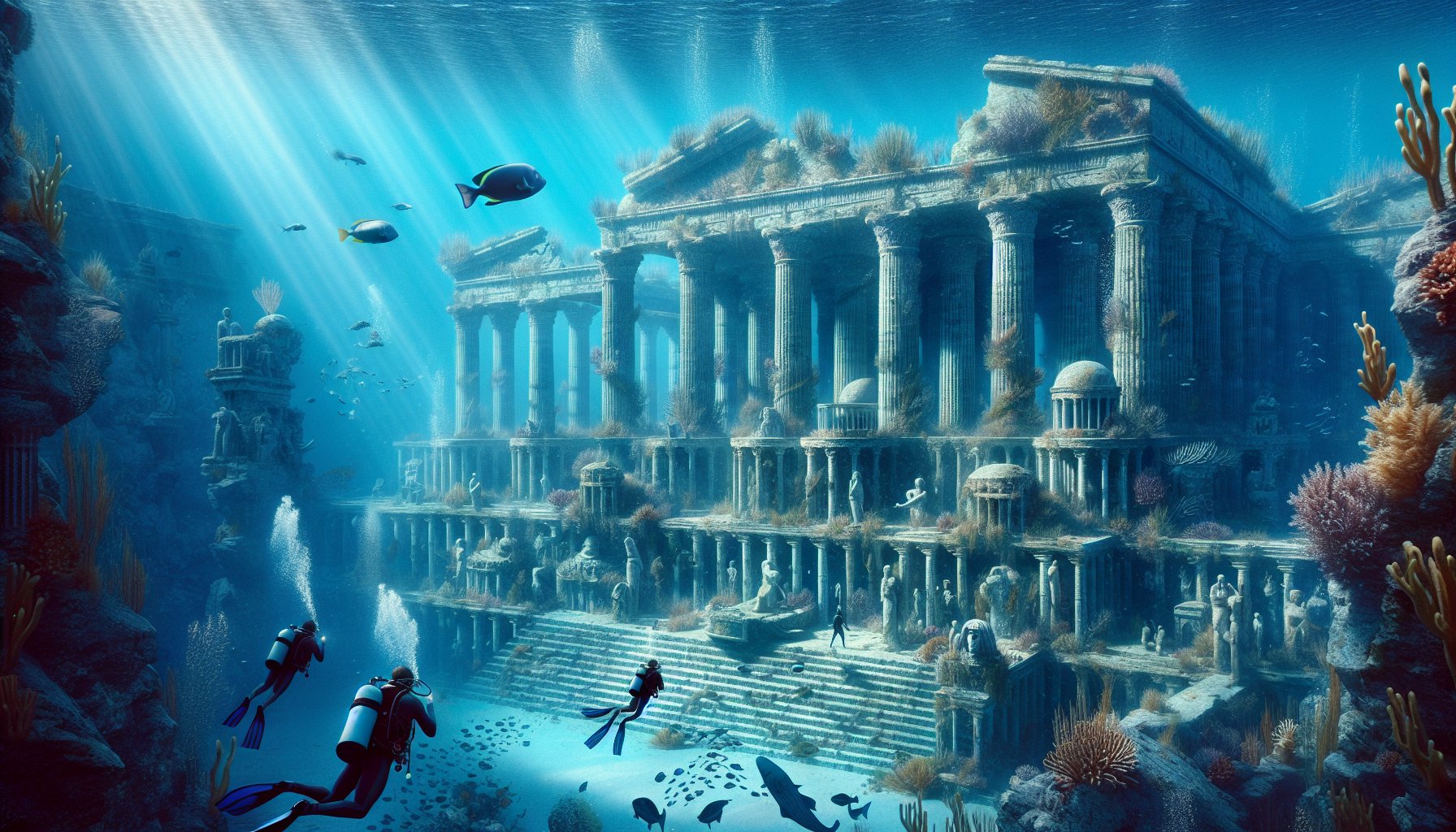
The dialogues paint a picture of Atlantis at the zenith of its glory, adorned with grand palaces, vast pools, and the resplendent temple dedicated to Poseidon. The island is described as self-sufficient, blessed with rich natural resources and lush landscapes, embodying a self-contained ecosystem. Cultural and technological advancements are subtly hinted at through mentions of exotic zoology and complex hydraulics, suggesting a society that was not just surviving, but thriving through its ingenuity and harmony with nature.
Yet, what elevates Plato’s account from mere historical speculation to a philosophical masterpiece is the underlying theme of hubris. "Critias" brings a dramatic turn—the moral degeneration of the Atlanteans. Their growing arrogance and ethical decay provoke a divine cataclysm, leading to their disappearance. This narrative twist serves as a broader philosophical commentary on the fragile nature of civilization and the perils of human excess.
In Plato’s hands, Atlantis is thus transformed from a simple tale of an ancient maritime power into a profound allegory. It challenges the complacency of societies, warning of the dangers of moral and ethical lapses, no matter how technologically or culturally advanced. Through "Timaeus" and "Critias," Atlantis is embedded within the Western psyche, not merely as a sunken city, but as a cautionary tale about the cyclical rise and fall of great powers, reminding future generations of the perils of human hubris.
Geographical Theories and Archaeological Pursuits
Exploring the legendary city of Atlantis sends us traversing through a labyrinth of geographical theories and remote islands of speculation, pulling together the fragments left by Plato and aligning them with modern technological tools in the relentless quest to pin down this enigmatic civilization's coordinates. The pursuit merges the ancient with the ultramodern, as it spans from the volcanic soils of Santorini to the contentious sea floor formations near the Azores.
Exploring Potential Locations: From Santorini to the Azores
The Santorini theory, pivoting around the catastrophic eruption of Thera around 1600 BCE, offers a tangible, albeit debated, clue in the Atlantis puzzle. Most intriguingly, this theory aligns with Plato's descriptions of cataclysmic natural disasters—earthquakes and tsunamis—which are hallmarks of volcanic activity. This connection doesn't just draw a line from the myth to the Minoan Civilization; it sketches potential geographic outlines for Atlantis itself.
Moving deeper into the Atlantic, the Azores hypothesis unfurls across a strategically intriguing locale—right outside what Plato described as the Pillars of Hercules. As remote as it is compelling, this theory benefits from recent advances in underwater archaeology and geographical surveys, inspiring a series of deep-sea explorations that aim to unravel the Atlantic's submerged secrets. Despite the high-tech equipment and sophisticated data models, what lies beneath waves is still largely a canvas painted with the broad strokes of speculation and unconfirmed reports.
Archaeological Investigations and Underwater Discoveries
Transitioning from maps to shovels—albeit marine ones—the realm of underwater archaeology in search of Atlantis illuminates a path speckled with both artifacts and anomalies. The exploration of sunken ruins not only tests the limits of human diving capabilities but also expands our understanding of ancient maritime power and cultural exchanges across the Mediterranean and beyond.
Significant findings have occasionally stirred the pot of public and academic interest—a patterned arrangement of stones near Bimini often referenced as the "Bimini Road," considered by some as a fragment of Atlantean highways, poses more questions than it answers. However, these submerged structures often suffer from a lack of conclusive evidence directly tying them to the Atlantean narrative, as many might just as well be attributed to other ancient civilizations that populated the Earth's variegated landscapes.
The dance between mythology and technology thus continues, as each underwater expedition employs ROVs (Remotely Operated Vehicles) and sonar mapping to sweep the ocean’s dark depths in hopes of catching a glimmer of Atlantis’s grandeur. Yet, for every shadow of a potential lead, there are heaps of seaweed and piles of natural marine formations, reminding seekers that the ocean guards its secrets with tenacious, saline silence.
This perpetual push and pull between ancient texts and modern investigative techniques forge a tapestry of deep intrigue and profound curiosity—as explorers and scholars alike strive to piece together the puzzle left by Plato, entranced by the enigmatic allure of a civilization lost beneath the waves but enduring in our quests and questions.
The Society and Technology of Atlantis
Within the pantheon of historical enigmas, the tale of Atlantis stands uniquely colored by descriptions of advanced technologies and a structured, utopian society. Plato’s dialogues, especially in "Critias," provide a canvas on which the Atlantean society is portrayed as not only advanced in terms of governance and culture but also in its technological prowess.
Descriptions of Advanced Atlantean Technology
Plato hinted at an Atlantean civilization that possessed knowledge far beyond its contemporaries, boasting technologies that, if existent today, would still be considered advanced.
- Advanced Metallurgy: The dialogues describe Atlantis having "advanced metallurgy," where the manipulation of metals like orichalcum, a material second only to gold in value, was common. This fictional metal was said to gleam with a reddish gleam, used extensively in the decoration of temples and other structures, showcasing their advanced knowledge in alloy composition and metallurgical techniques.
- Engineering and Navigation: Furthermore, the Atlanteans were described as master engineers and navigators.
- Canal Systems: They constructed intricate canal systems.
- Monumental Bridges: Impressive bridges facilitated robust trade and warfare capabilities.
- Harbor Facilities: Advanced harbor constructions indicate knowledge of advanced engineering and hydraulics.
- Maritime Skills: Their reputed navigation skills, supported by deep-sea voyages and exploratory expeditions, further underline a society that had potentially surpassed even our current understanding of ancient maritime power.
The Social Structure and Utopian Aspects
Beyond technology, the societal fabric of Atlantis as described by Plato was profoundly sophisticated and marked by stark utopian ideals.
- Concentric Circles: The Atlanteans are portrayed living in concentric circles of land and water, promoting a societal structure that balanced the populous evenly across the capital city.
- Democratic Principles: Each division of this society was said to be responsible for electing leaders who would represent them in a larger conclave, illustrating profound democratic principles.
- Philosophical Balance: Philosophically, the Atlanteans are said to have led lives that balanced material wealth and spiritual development, embodying Plato’s vision of an ideal state.
This blend of philosophical rigor with societal practice underlines the utopian society where justice, law, and civic duty were of paramount importance. Such descriptions compel us to consider the potential cultural impact these narratives had on Greek society, promoting as they did a mix of realistic governance ideals and mythological grandeur.
- Holistic Knowledge: The mystic knowledge encompassed not only practical technologies but also holistic sciences and humanities, suggesting a civilization where philosophy, science, and spirituality were deeply intertwined.
This holistic approach to knowledge and governance could suggest why Atlantis, as a narrative, held such sway over Plato’s audiences and why it continues to fascinate to this day.
In examining these facets of Atlantean society and its technological advancements, we tread a fine line between analyzing the mythic elements and acknowledging the philosophical allegories intended by Plato. Such an exploration challenges us to reflect on our societal constructs and technological achievements, pondering what legacies we, as modern societies, choose to leave behind.
Cataclysmic Downfall and Symbolic Meanings
Theories of Natural Disasters: Earthquakes and Tsunamis
Venture into the cataclysmic theories that strive to unravel the disappearance of Atlantis, a topic that bridges the past with present-day geological science. When Plato penned dialogues like Timaeus and Critias, he not only crafted a detailed portrayal of Atlantis but also forewarned of its abrupt demise, attributed to earthquakes and tsunamis—forces capable of engulfing entire civilizations overnight.
Eminent geologists speculate that such cataclysmic events are not mere fabrications; rather, they draw parallels to known disasters like the Thera Eruption, which devastated Minoan Civilization on Santorini. This theory suggests that Atlantis could have suffered a similar fate:
- Tectonic Activity: The convergence of tectonic plates near Atlantis might have triggered massive seismic activities.
- Geological Evidence: Points towards great underwater landslides in regions like the Azores, indicative of monumental earthquakes.
- Credibility of Theories: When considering the Atlantic basin's propensity for geological disturbances, the idea of a sunken city succumbing to the ocean's wrath gains credibility, melding mythological accounts with tangible, earth-shattering phenomena.
These scientific inquiries not only resurrect Plato’s allegory but also encourage today’s scholars to dissect ancient tales under the unforgiving lens of modern seismology.
Symbolism in Atlantis's Story
Aside from its geological significance, the story of Atlantis brims with rich symbolism and moral contemplation. Here, Atlantis isn't merely a sunken city; it embodies the hubris of man and the eternal struggle between societal perfection and moral decay.
- Depiction: In Critias, Atlantis is depicted as a utopian society with unparalleled advancements in navigation and metallurgy.
- Moral Decay: However, it's their growing moral corruption and military hubris that incurs the wrath of the gods, leading to their ultimate downfall.
- Divine Retribution: Echoes throughout Greek mythology, offering a stark warning to the civilizations of both Plato’s era and today.
The pursuit of perfection or imperial dominance, without heed to ethical decrees, can lead directly to decline and disaster. Thus, Atlantis serves as a profound allegory, reflecting eternal values and the catastrophic consequences of human excess and moral deviance.
Plato's narrative, enriched with philosophical undertones, uses Atlantis as a cautionary tale of a lost golden age—evoking a sense of nostalgia and loss that resonates across centuries, reminding us of the impermanence of even the most advanced societies. This allegorical layer enhances the myth's relevance, cementing Atlantis not just as a subject of archaeological inquiry but as a perpetual mirror reflecting human folly and the imperiousness of nature’s will.
As Atlantis continues to captivate the imagination and scholarly efforts, we delve deeper into the blend of mythological allegory and geological potentiality, exploring the boundaries between what was, what could have been, and what is remembered. This exploration not only enriches our understanding of ancient narratives but also underscores the intricate interplay between human narratives and natural phenomena.
Atlantis in Cultural and Historical Context
Atlantis, a name that stirs the imagination, has not only remained a topic of academic debates but has also significantly influenced modern media and the arts. This mystical city, as first penned by Plato in his dialogues "Timaeus" and "Critias," has become a versatile symbol in various cultural expressions, reflecting humanity’s fascination with the unknown and the allure of ancient wisdom.
The Enigmatic Island in Modern Media
From blockbuster movies to intricate novels, Atlantis has been portrayed as both a utopian paradise and a warning of hubris.
- Films and Books: Films like "Atlantis: The Lost Empire" and books such as "Atlantis Found" by Clive Cussler have brought the legend to life for contemporary audiences, blending historical elements with creative liberties.
- Superhero Lore: The story of Atlantis serves as an archetype in superhero lore, often depicted as the home of advanced beings possessing esoteric knowledge and technology, influencing characters and story arcs in comics and animations.
A Catalyst for Artistic Imagination
Not just in literature and film, but artists and musicians have also drawn inspiration from the lost city.
- Artworks and Music: The mystical aspects of Atlantis have ignited imaginations, leading to a plethora of artworks and musical compositions that echo the grandeur and mystery associated with the Atlantean narrative.
- Themes: These works often explore themes of disappearance, rediscovery, and the profound knowledge that Atlantis is said to hold, satisfying a collective curiosity about forgotten advanced civilizations.
Atlantis in Educational and Scientific Discourses
Beyond entertainment, Atlantis has sparked considerable academic interest.
- Scholarly Analysis: Scholars and historians have dissected Plato’s texts to unravel the allegorical from the historical.
- Archaeological Pursuits: Archaeologists have delved deep into the ocean’s abyss with hopes of uncovering evidence. This quest for the real Atlantis, despite often being met with skepticism, has spurred advancements in underwater archaeology and deep-sea exploration technology.
New Age Mysticism and Esoteric Theories
In addition to its historical and entertainment value, Atlantis has found a place within new age mysticism and various esoteric traditions.
- Psychic Predictions: Figures like Edgar Cayce have contributed to this mystic allure by providing psychic readings that suggest the existence of Atlantis and its future rediscovery.
- Spiritual Interpretations: These interpretations depict Atlantis not just as a physical location but as a state of consciousness, offering metaphysical insights and lessons for modern spiritual seekers.
Contemporary Philosophical and Ethical Debates
The legend of Atlantis also resonates in contemporary philosophical and ethical discussions.
- Technological Arrogance: Serves as a metaphorical cautionary tale about the dangers of technological arrogance and moral decay, relevant to today's global challenges.
- Philosophical Framework: Philosophers and ethicists use Atlantis as a framework to debate the role of technology in society and the moral obligations of advanced civilizations to avoid the pitfalls of their predecessors.
Atlantis, as a cultural and historiographical entity, thus provides a rich tapestry for exploration, debate, and artistic expression. It remains a mirror reflecting human aspirations and fears, continuously reshaping its narrative through the lenses of different eras and disciplines. This enduring legacy ensures that Atlantis will continue to fascinate and inspire discussions and explorations for generations to come.
Addressing the Skeptics: Critiques and Debates
Historical Accuracy and Scholarly Debates
Oh, where to begin? The debates surrounding the historicity of Atlantis are as deep and murky as the ocean depths it's supposed to lie beneath. Plato’s narratives in Timaeus and Critias have opened up floodgates of scholarly debate that have surged through centuries. Historians and archaeologists chew over every detail, questioning whether Atlantis was a real place or a philosophical allegory cooked up by Plato to illustrate his ideals on society and governance. As researchers pour over ancient texts and trace lines on dusty maps, the discourse intensifies.
While some cling to every word of Plato as gospel, claiming Atlantis's advanced civilization was swallowed by the sea due to cataclysmic events like earthquakes and tsunamis—a hypothesis supported by geological surveys revealing historical sea level rise—others wave it off, pointing out that Plato wasn’t a historian but a philosopher. They argue that he might've conjured up Atlantis out of the myths and rumors of his time, perhaps twisting the tale to fit his philosophical narratives.
The Impact of Pseudoscience on Atlantis's Legacy
Hang on tight—here's where things get really wobbly! Atlantis hasn’t just been a subject of serious academic musings; it has also been swept up in the whirlpools of pseudoscience. From Edgar Cayce's psychic readings claiming Atlantis's power crystals can be dug up from the seafloor, to fantastical ideas about Atlanteans zipping around in flying vehicles, the boundaries of plausible speculation have been well and truly drowned.
This concoction of myth, mystery, and downright mysticism has muddied the waters for academics trying to sift through layers of cultural sediment. The result? An armada of mixed messages that navigate between established historical methodologies and the more bizarre reaches of lost civilization theories. Critics argue that this intermingling has skewed public perceptions, making it tough to distinguish between credible history and enticing myth.
The Science of Extinction: Rising Sea Levels and Submerged Civilizations
Let’s veer back into the realm of legitimate science for a sec. The idea of civilizations wiped out by rising sea levels isn't just cinematic lore; it’s a scenario backed by solid geological evidence. Modern science supports the notion that entire communities could have been submerged due to climatic shifts and catastrophic events like the Thera eruption—often linked to the downfall of the Minoan civilization, another candidate for the Atlantis connection.
In this context, studying the tale of Atlantis offers a fascinating lens through which to examine other potentially submerged sites around the globe. Underwater archaeology and investigations like those near the Bimini Road have showcased how natural phenomena and human activities intersect, leading to civilizations being lost beneath waves.
In chewing over these elements, it’s crystal clear that while the tale of Atlantis stirs up a tempest of excitement and skepticism, it also offers invaluable insights into how we interpret the past. Whether as a literal sunken city or a metaphorical cautionary tale, Atlantis continues to fascinate, frustrate, and fuel scholarly and scientific discussion, proving that its ripples reach far beyond its mythological roots.