By Emilia Wellesley · Published May 4, 2026 · Updated May 13, 2026
Last reviewed: May 4, 2026.
Explore the allure of Zerzura, the mythical oasis city believed to be hidden within the vast sands of the Sahara Desert. Known as the White City, it has fascinated explorers and historians with its tales of lush vegetation, grand treasures, and elusive location.
The Legend of Zerzura
The myth of Zerzura has woven itself into the rich tapestry of Egyptian mythology and Arabian folklore over centuries. Said to be the "Oasis of Little Birds," also widely renowned as the "White City," Zerzura's legend sparkles with tales of opulence buried beneath the vast and unforgiving Sahara Desert. But is it just pristine sands and caravan whispers, or is there, hidden beneath layers of time and mirage, a slice of truth?
Origins and Mythology
Rewinding back to the dawn of Zerzura's myth, we find our roots tangled amidst ancient Egyptian myths and Arab legends—both rich sources of tales about hidden cities bursting with wealth waiting for the righteous, or perhaps merely the lucky, to discover. Notably, it was John Gardner Wilkinson in the 1830s who toggled the curiosity of the Western world towards Zerzura, after recording local stories during his forays through Egypt. These tales often portrayed Zerzura not merely as a physical location but a symbol of mystic allure and human ambition, a lush utopia hidden from ordinary sight and accessible only to those brave enough to traverse endless seas of sand.
The White City Described
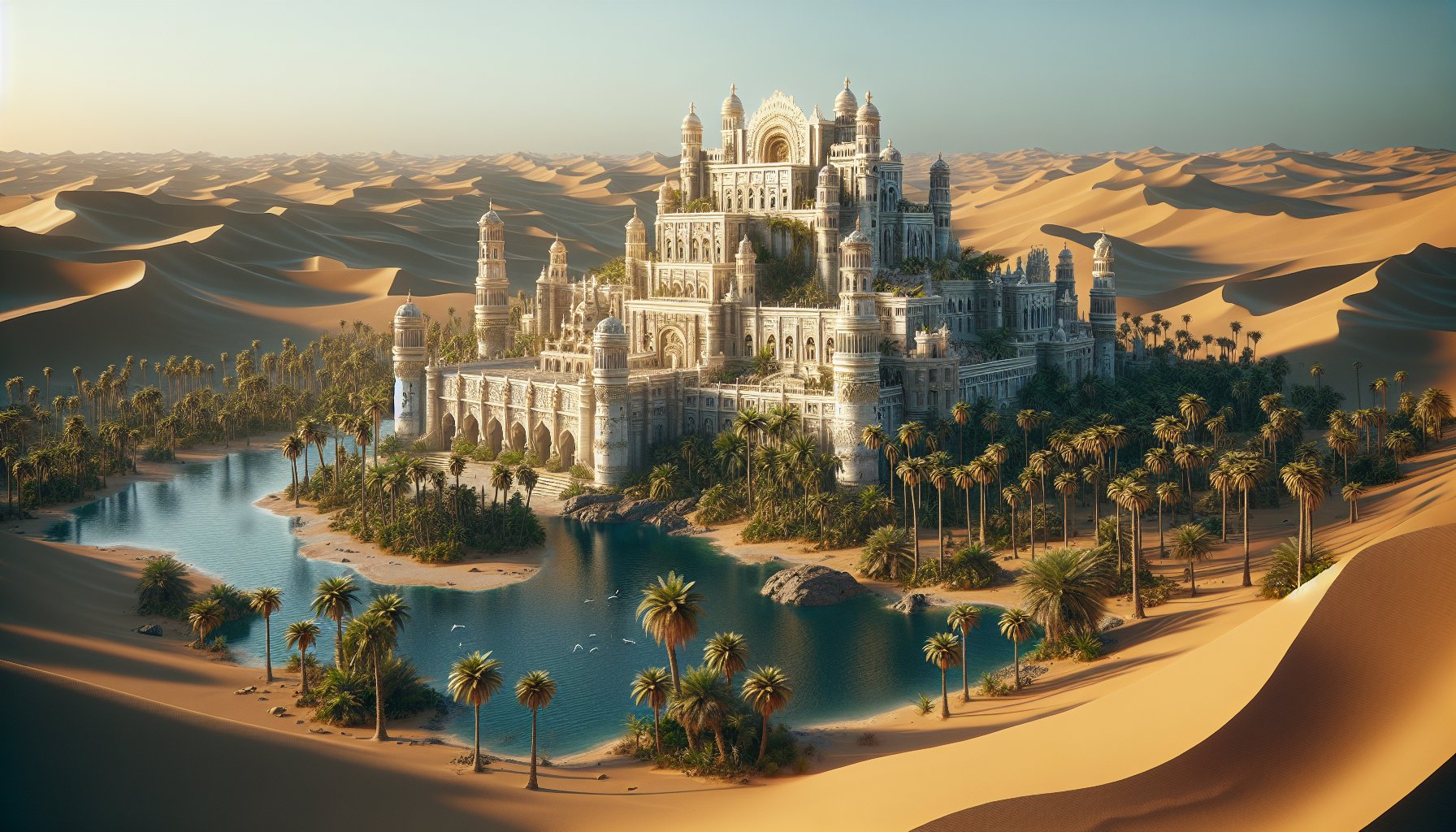
Moving deeper into the sinews of legends, Zerzura was often described in ancient manuscripts and esteemed historical records as a city whitewashed with bright limestone or salt, shimmering under the cruel sun, in stark contrast to the surrounding sprawling dunes. Such descriptions teased the imaginations of would-be adventurers with images of lush oases and great treasures, including gold, jewels, and artifacts of inestimable cultural value, all guarded by tribes of giants or spectral beings according both to ancient Egyptian hieroglyphs and Arab narrative poems.
Moreover, the Scrolls of Zerzura, those mythical texts believed to chronicle the vast wealth and detailed geography of this lost oasis city, added layers of intrigue and credibility to the legend. These scrolls, while never found, have been referenced in explorer's journals and have fueled generations of treasure hunters, scholars, and daydreamers aiming to reconcile myth with reality.
In both ancient and modern contexts, Zerzura represented more than a mere location—it symbolized the human quest for exploration, the desire to confront the unknown, and the unyielding yearning for discovery and understanding, not only of the world but perhaps, also of oneself. Through each narrative, whether etched in stone or spun in the glow of a campfire surrounded by the endless desert, Zerzura persists—a mirage of hope and history, continuously reshaping the hearts and maps of those who dare to look for it.
Geographical Context
The Sahara Desert Setting
Imagine the Sahara Desert, an immense landscape stretching across North Africa, famously known for its hostile, arid conditions and formidable expanse of sand seas. Within this vast desert lies the legend of Zerzura, often described as the elusive "White City," a concept that flourishes amidst the desolation. The very geography of the Sahara, with its rolling dunes and extreme temperature fluctuations, plays into the mystique of Zerzura, painting a backdrop of isolation and mystery that is both daunting and inviting to adventurers.
Significant Locations
Central to the Zerzura legend are several specific locations in the Sahara, each bearing its own set of myths and historical significance:
- Western Desert of Egypt:
- Role: A vast area known to harbor ancient Egyptian artifacts and a myriad of archaeological sites.
- Connection to Zerzura: Provides a historical tangibility to the myths surrounding Zerzura.
- Libyan Desert:
- Description: Part of the greater Sahara and often considered one of the most arid regions on Earth.
- Significance: Serves as the canvas on which many Zerzura tales are sketched, proposed to be a hideout for the mystical city.
- Gilf Kebir Plateau:
- Enigma: Known for its prehistoric rock art, suggesting a long-standing human presence, potentially dating back to Zerzura's mythical origins.
- Cultural Importance: This plateau, with its rich reservoir of ancient cultural expressions preserved in the art, provides a compelling clue in the tapestry of Zerzura's legend.
These significant geographic markers help situate Zerzura—not just in the realm of myth but also within a concrete, navigable physical reality. Moreover, each location, from the expanses of the Western Desert to the isolated stretches of the Gilf Kebir plateau, tells a part of the Zerzura story through the lens of geological and archaeological findings that, over time, have layered reality with legend. Each site calls to explorers, inviting them to unravel the geographical threads that may lead to the lost city.
Historical Expeditions
Early Accounts
The quest for Zerzura began with whispers and ancient texts, morphing over centuries into a blend of myth and meticulous exploration. The earliest substantive notes about Zerzura were jotted down by none other than John Gardner Wilkinson in the early 19th century. As an intrepid Egyptologist prowling through the mysteries of the Egyptian desert, Wilkinson came across the enthralling tales of this white city from local Bedouin tribes and scribbled accounts of Arab legends. Wilkinson's writings suggested that Zerzura was not merely an ethereal fable but a tangible destination, perhaps veiled by the sands and secrecy of the Sahara.
These early mentions instigated a ripple of intrigue among explorers and historians. Dog-eared manuscripts and weathered maps from his expeditions provided the first semi-concrete evidence that Zerzura was more than a mere mirage, entrenched somewhere in the vast sand seas of the Sahara. Still, these documents were more tantalizing than revealing, offering just enough information to spark a flame of interest without providing a clear path to the city's gates.
20th Century Searches
By the time the 20th century rolled around, Zerzura had transformed from a dusty legend into a beacon for adventurers. Enter figures such as Ralph Bagnold and László Almásy — men whose names became synonymous with desert exploration. Bagnold, a sprightly British army officer and founder of the Long Range Desert Group, undertook numerous expeditions across the Western Desert of Egypt, driven by a dual purpose of military reconnaissance and personal fascination with Zerzura.
László Almásy, whose life later inspired the sweeping cinematic romance of "The English Patient," was equally bewitched by the allure of the lost oasis. Almásy and his companions crisscrossed the Libyan Desert using ancient trade routes noted in historic expedition accounts, all the while scouring the sands for any clue that might lead them to Zerzura. Their journeys brought them to remote oases, through towering geological formations like the majestic Gilf Kebir plateau, and into the chalky corridors of desert wadis.
In the 1930s and 1940s, these adventurers unearthed fragments of potential leads—pottery shards, ancient carvanserai locations, and vague references to Zerzura in the travel diaries of earlier explorers. Each discovery added a layer of authenticity to the legend, suggesting that the White City was more than just a concoction of imaginative storytelling or desert-induced hallucinations.
These explorations, fraught with the dangers of desert survival and the frustrations of elusive success, penned a compelling chapter in the story of Zerzura. Whether wading through the mirage-laden expanse of the desert or parsing through esoteric cues in ancient Egyptian hieroglyphs, these explorers personified the timeless human quest for knowledge and the irresistible pull of the unknown. Their feats did not just add lines to maps or paragraphs to history books; they wove Zerzura more firmly into the fabric of both historical and mythical scholarship, blending the borders between the two.
Modern Explorations and Theories
Delving into the Sands: Modern Quests for Zerzura
In the latter part of the 20th century and into the 21st, the legend of Zerzura has not only survived but thrived, spurred by technological advancements and renewed scholarly interest. Modern explorers, armed with satellite imagery and sophisticated GPS systems, have ventured into the Sahara's remote expanses, driven by stories encapsulated in the Scrolls of Zerzura and fueled by the allure of uncovering a lost civilization.
Technologies at the Forefront
- Modern Tools: Explorers, like the members of the Long Range Desert Group, have rekindled activities using new technology such as radar searches, aerial surveys, and advanced cartography.
- Insights Gained: These technologies have helped peel back the desert's secretive layers, offering glimpses of what might have been ancient trade routes or caravan paths, as mentioned in travel diaries of explorers like Ahmed Hassanein Bey, who once sketched maps based on Bedouin lore.
Unveiling the Layers: Geological and Archaeological Insights
Recent geological surveys have proposed that what might have been perceived as lush oases were actually mirage phenomena, common in such vast sand seas. However, compelling archaeological finds, such as pottery shards in locations pinpointed by ancient maps, suggest:
- Human Settlements: Transient, if not permanent, human settlements were present, supporting the idea that these sites might have served as critical water stops for nomadic tribes navigating the treacherous dunes of the Libyan Desert.
Theoretical Perspectives on Zerzura
- Egyptian Mythology: Some scholars view Zerzura as a metaphor for spiritual journeys rather than a physical location.
- Historical Accuracy: Influenced by historical desert routes found in French and British explorers' journals, others posit that Zerzura might have been a real city, its location lost due to shifting sands and the relentless passage of time.
- Cultural Interpretation: The debate extends to realms of Orientalism and myth-making, where Zerzura is seen not just as a geographical enigma but also as a construct of Western exploration lore, embellished over time to symbolize the ultimate quest for the unattainable.
Conclusion
Thus, the journey to uncover Zerzura continues, not just as a physical expedition but as an intellectual adventure. As modern explorers traverse the sands and scholars decipher ancient texts, the legend of Zerzura remains a compelling narrative of mystery, mirages, and the eternal human quest for discovery. Whether as a lost oasis city or a mirage wrapped in the sands of time, Zerzura's tale beckons to the curious, promising secrets yet to be unveiled.
Cultural Impact
Influences on Popular Culture
Zerzura has not only captivated the minds of explorers and historians but has also found a prominent place in popular culture. The legend of the "White City" full of treasures, guarded by black giants, has sparked the imaginations of filmmakers, novelists, and creators of various forms of media. For instance, the mysterious city features in Michael Ondaatje's novel "The English Patient," which later became an award-winning film. The story of Count László de Almásy's desert explorations and his quest for Zerzura provided a romantic, albeit fictional, backdrop that enchanted audiences worldwide. Additionally, various documentaries and TV specials have explored the myth of Zerzura, blending historical facts with evocative narrative to entertain and educate their viewers.
Zerzura's Role in Local Culture
The legend of Zerzura is more than just a tale for the local populations and nomadic tribes of the Sahara. It's a piece of cultural heritage that threads through their history and daily lives. Among the Bedouins, stories of Zerzura are passed down through generations, serving both as entertainment and as a testament to their deep connection with the desert. The concept of an oasis city laden with riches hidden somewhere in the vast, arid landscape also holds spiritual significance, symbolizing a paradise that rewards those who are resilient enough to endure the hardships of desert life.
These tribes also view Zerzura as a symbol of hope and endless possibility. For them, the city represents the allure of the unknown and the treasures that lie hidden beneath the challenges of the present. Furthermore, in regions starved for resources, the myth of a lush oasis can be a powerful metaphor for abundance and prosperity.
Conversations about Zerzura also encourage communal engagement among these communities. During gatherings, elders recount tales of explorers who ventured into the relentless sands of the Sahara in search of this enigmatic city, using these stories to teach younger generations about the geography of their homeland and the history of their ancestors' explorative spirit.
Through both cultural representation and local lore, the legend of Zerzura has woven itself into the fabric of societal norms and community values across the Sahara, making it an indelible part of regional identity. This enduring myth continues to inspire both the people who live amidst the desert's shifting sands and those who hear about it from afar, drawing countless individuals into unraveling the mystery of the "Oasis of Little Birds."
Challenges in Desert Explorations
When it comes to desert exploration, particularly in pursuit of something as elusive as the lost city of Zerzura, the Sahara presents a gamut of formidable challenges. Navigating the vast, unpredictable terrain of the Sahara—marked by its dramatic dunes and relentless sand seas—demands not only physical resilience but also a high level of navigational skill and advanced preparation. With temperature swings that can be extreme and the omnipresence of shifting sands that could alter landscapes overnight, explorers must be well-versed in desert survival techniques.
Navigating the Sahara
The Sahara Desert, stretching across much of North Africa, serves as an expansive canvas for the lore of Zerzura. However, it's also a formidable barrier to those who dare traverse its expanse in search of the mythic oasis. The challenges begin with logistical issues:
- Transport: Transport across vast areas where roads are nonexistent requires vehicles well-suited for off-road, often equipped with GPS and satellite communication to mitigate the risks of getting lost.
- Route Selection: The choice of routes is crucial as ancient caravan paths, though historically reliable, can now be fraught with geopolitical and environmental hurdles.
Mirage Phenomena and Its Effects
As explorers trek across the Sahara, mirages often complicate the search for Zerzura. These optical illusions, caused by atmospheric conditions bending light rays, have been known to:
- Create False Visions: Mirages can create false visions of water bodies and lush oases, misleading even the most experienced adventurers.
- Embodiment of Mythology: The phenomenon not only physically mirrors Zerzura's legend—often depicted as a haven appearing amidst the desolate sands—but also metaphorically represents the quest for something possibly unattainable.
The role of mirages in desert explorations feeds into the mythology of Zerzura, perpetuating tales of an oasis that may well be an illusion crafted by natural phenomena and ancient storytellers.
These challenges, from dealing with vast, arid expanses and navigating through nature's deceits, contribute significantly to the allure and enduring mystery of Zerzura. Reinforcing the legend, each failed or inconclusive expedition adds another layer to the narrative of Zerzura, reflecting an irony where the very essence of searching enhances the myth without necessarily bringing us closer to any tangible truth. Such explorations push the limits of human endurance and test the ingenuity required to conquer natural adversities, all fueled by the lure of uncovering a hidden civilization that may exist just beyond the next horizon.
Examination of Artifacts and Evidences
The search for the Lost City of Zerzura has uncovered a variety of artifacts and generated numerous eyewitness accounts that offer tantalizing clues about this mythical oasis. Historians and archaeologists have meticulously analyzed these findings to piece together the puzzle of Zerzura's possible existence and location within the expansive Sahara Desert.
Artefacts Found in Related Expeditions
Throughout various expeditions, particularly those in the early and mid-20th century, explorers documented and retrieved artifacts believed to be linked to Zerzura.
- Pottery Shards: Discovered near Gilf Kebir, a notable plateau in the Sahara, these shards suggest ancient human activity, potentially linked to a long-lost civilization.
- Ancient Maps and Manuscripts: Occasionally surfacing, these documents provide cryptic references to the "White City."
- Analysis: Cartographers and historians have studied these maps, which depict paths leading to lush oases marked with symbols and inscriptions, fueling the legend’s authenticity.
- Debate: There is ongoing debate over whether these artifacts are fanciful depictions or genuine navigational aids used by ancient caravans.
Eyewitness Accounts and Archaeological Records
The impact of ancient eyewitness accounts in portraying Zerzura is significant.
- Oral Traditions and Documented Explorations: Accounts from Bedouin oral traditions and explorers like John Gardner Wilkinson and Count László de Almásy have been essential in sustaining interest in Zerzura.
- Descriptions: These stories describe a city brimming with riches, guarded by giants, and invisible to those not destined to find it. These mystical elements challenge historians attempting to distinguish myth from plausible historical fact.
In terms of archaeological records:
- Site Excavations: Rigorous analysis of site excavations around potential Zerzura locations has provided both confirmation and contradictions.
- Indicative Findings: Items like pottery indicate habitation and suggest that tales of Zerzura might have originated from actual oases or settlements that were idealized over time.
The examination of these artifacts and eyewitness accounts plays a crucial role in our understanding of Zerzura. It bridges the gap between legend and potential historical realities, allowing researchers to construct a narrative that is as fact-based as possible while acknowledging the powerful allure of the myth:
- Every Artifact and Tale Evaluated: As each piece of pottery, each map, and each recounted tale is analyzed.
- Guardians of Secrets: The sands of the Sahara continue to guard their secrets, with the legend of Zerzura remaining an enduring enigma in the annals of desert exploration.