By Emilia Wellesley · Published May 5, 2026 · Updated September 10, 2026
Last updated: September 10, 2026.
What Are the Longyou Caves?
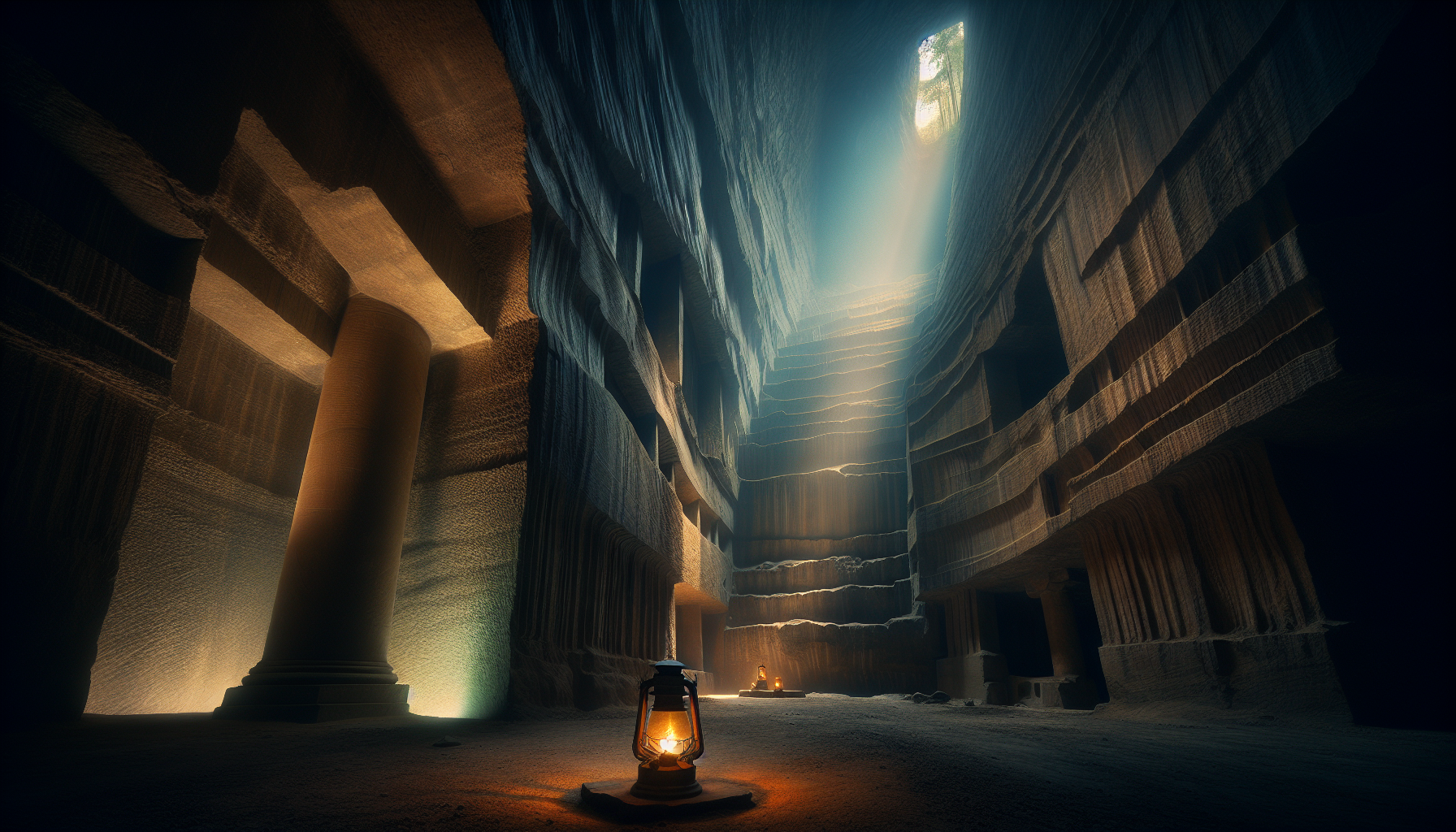
The Longyou Caves are a complex of twenty-four hand-cut sandstone chambers near the village of Shiyan Beicun in Zhejiang Province, eastern China. Workers carved them downward from the ground surface into a low hill, leaving smooth pillars, sloped walls, and parallel chisel marks across thousands of square meters. They are unattributed, undated by inscription, and the subject of an active archaeological argument.
A scholar comes at this site the way a careful editor comes at an unsigned manuscript: for what is said, what is unsaid, and what survived only because it was discarded in a particular way. No founding stele names a patron. No imperial annal records the contract. What we have is the rock itself, the marks left by the chisels that shaped it, and the mud and water that filled the chambers for an undocumented stretch of centuries. The site is best understood as a working puzzle, not a solved one.
This guide reconstructs what is known and what is contested about the Longyou Grottoes, beginning with their accidental discovery in 1992. It gives the chambers their measurements, names the geologists and archaeologists who have studied them, walks through the dominant Han-period quarrying interpretation, and weighs the alternative theories without flattening the open questions. The site sits within the broader landscape of historical and archaeological mysteries that resist tidy summary.
The 1992 Discovery: A Pond That Would Not Empty
The story begins with a villager named Wu Anai, who lived above one of the chambers without knowing it. The hill known locally as Phoenix Hill held a series of small ponds, and folklore insisted they were bottomless. In June 1992, Wu and three neighbors decided to test the claim. They rented a four-inch water pump and ran it into the largest pond.
After seventeen days of continuous pumping, the water level finally fell. What it revealed beneath was not a natural depression but a carved chamber large enough to hold a small temple, with chisel-marked walls falling away into darkness. The villagers had drained the first of what would, over the next several years, prove to be twenty-four interconnected man-made grottoes spread under an area of roughly thirty thousand square meters. Provincial authorities sealed the site, and a survey team from the Zhejiang Provincial Administration of Cultural Heritage began documentation later that decade.
The Scale of the Find
Of the twenty-four chambers, five are open to visitors as of recent reporting. The largest, Cave No. 2, measures approximately thirty meters wide, twenty meters deep, and almost ten meters tall, with a single rock pillar and three carefully proportioned columns supporting a sloped ceiling. Total estimated rock volume removed across the complex is close to one million cubic meters, an enormous figure that becomes the central problem of interpretation. Where, the question runs, did all that stone go.
Han-Period Quarrying: The Mainstream Interpretation
The dominant working hypothesis among Chinese archaeologists treats the Longyou Caves as an industrial-scale quarry of the late Western Han or Eastern Han Dynasty, roughly the second century BCE through the second century CE. Geologist Yang Hongxun, who surveyed the site in the late 1990s, argued that the chamber shapes are consistent with extraction work: walls sloping inward to support overhead rock, broad flat floors suited to staging cut blocks, and chisel marks running in the regular diagonal courses associated with structured stone removal [1].
Local Quxian sandstone is soft enough to chisel with iron tools but firm enough to hold a stable ceiling once the gallery is shaped. Han-period engineers would have known the material from the river embankment work and tomb construction documented elsewhere in Zhejiang. The construction of Han imperial tombs and city walls in the lower Yangtze region drew on quarried sandstone in quantities that matched, at the regional level, what the Longyou complex appears to have produced. Under this reading, the parallel chisel courses are not a riddle but a signature: the marks of a regulated workshop where teams cut according to a shared method.
The Evidence Ladder for Han-Era Origin
The case for a Han date rests on several converging lines. Pottery sherds recovered from sediment near the chamber mouths fit Han typology, although the find contexts have been disturbed by water and silt. Tool-mark analysis by Yang and his colleagues matched the chisel widths to iron implements known from second-century-BCE workshops. Comparisons with the documented Longshan and Yanshan quarries, both well-studied in mainland Chinese archaeology and surveyed in the peer-reviewed journal Antiquity, show similar sloped-wall geometry. According to entries in the Encyclopaedia Britannica overview of Zhejiang’s heritage sites, the Longyou Caves are conventionally placed within this Han-quarry framework, with the qualifier that no inscription or dated artifact has yet confirmed it.
The Missing-Stone Problem
Here the interpretation hits its hardest obstacle. If the complex was a quarry, roughly a million cubic meters of cut stone left the site, yet no major Han construction project in the immediate Longyou region accounts for that volume. The nearest documented Han structures are too small to have absorbed the output. Some archaeologists propose that the stone was floated downstream on the Quzhou River system to construction sites farther east, or that it was used in water-control infrastructure now buried under later silt. Others find this explanation strained without a confirmed downstream depot. The missing-stone question remains the cleanest reason a careful reader does not consider the quarry hypothesis closed.
Alternative Theories and What Would Distinguish Them
When the dominant interpretation has a soft seam, alternative hypotheses gather around it. Several have been advanced for the Longyou Caves in academic and popular forums. A scholar’s job is not to choose between them rhetorically but to specify what evidence would tilt the balance.
Underground Storage or Granary
The chambers’ broad floors, sloped walls, and consistent height could fit a system of cool, climate-stable storage spaces. Han and post-Han China built large grain reserves at provincial scale, and the Quxian sandstone holds a fairly steady internal temperature. The objection is that a storage facility this large would normally leave residue: charred grain, ceramic vessels in primary deposit, post holes for dividing screens. The Longyou floors are conspicuously clean. Either the chambers were emptied with great care, or storage is the wrong frame.
Military Garrison or Refuge
Another reading proposes the caves as a hidden military barracks or population refuge during a period of regional conflict. The local terrain favors concealment, and the chambers are connected by narrow passageways that could be defended. The objection is the absence of weapons fragments, hearth deposits, or burial layers, all of which a long-occupied refuge tends to leave behind. The smoothness of the surfaces argues for a single-purpose construction, not generations of inhabitation.
Multi-Period Reuse
A more interesting hypothesis combines elements of the others: the caves were originally cut for one purpose, perhaps quarrying, and later adapted for storage, ritual, or refuge before being abandoned and flooded. Multi-period reuse would explain why the floors are clean of any single material culture; each successive use cleared the previous one. It would also explain why the structure feels overbuilt for any one function. The site can plausibly be read as a palimpsest of human work rather than the trace of a single project.
Sensational Claims to Set Aside
Popular media outside specialist circles have proposed extraterrestrial construction, lost civilization origins, or pre-Neolithic high technology. None of these survives a serious encounter with the geology and tool-mark evidence. The chisel courses are unambiguously made by hand-held iron tools, the rock is local Quxian sandstone with no exotic provenance, and the chamber proportions are within the engineering reach of Han-period workshops. The strangeness of the site is enough on its own; it does not require speculative additions to remain genuinely interesting.
The Chisel Marks and What They Encode
The most striking feature for visitors is the chisel courses themselves. Across every chamber, parallel diagonal lines run with such regularity that they read at first glance as a decorative pattern. Closer inspection shows them to be the working marks of teams of stoneworkers cutting in coordinated stripes, each striking a fixed angle and depth before moving to the next.
Reading the Workshop
Tool-mark archaeology, developed in part by scholars working on Egyptian and Mediterranean quarries, treats these patterns as a behavioral record. Stripe spacing reflects body height and the standard reach of a working stance. Stripe angle reflects the chisel’s rake. Course depth reflects the rhythm of strike and reset. Read together, the Longyou marks suggest a workforce of trained adults operating on coordinated shifts, with quality oversight strict enough to keep the courses parallel across chambers cut hundreds of meters apart [2]. This is not improvised work; it is a regulated craft.
Why the Pattern Looks “Decorative”
The aesthetic effect is partly accidental. When a quarry’s work is hidden, the marks of cutting are stripped from the final block, and only the negative space, the chamber, retains them. At Longyou, because the chambers themselves were the artifact, the chisel courses became visible at architectural scale. What looks like ornament is the inside of the labor. This is a useful reminder for any reader who finds the patterning evocative: the maker’s intent and the modern viewer’s response are not the same thing.
Geology, Hydrology, and the Long Silence
The caves’ preservation owes as much to local hydrogeology as to their construction. The Quxian sandstone is fine-grained and slow to weather. Once the chambers filled with groundwater, the standing water sealed the surfaces against the seasonal humidity that would otherwise have eroded them. The site became, in effect, a wet vault.
The Flooded Centuries
Sediment cores from chamber floors suggest the caves filled gradually with mineral-rich water over an unknown but long interval. Pollen analysis from these cores, examined in regional environmental archaeology studies cited by the JSTOR-archived Asian Perspectives journal, points to vegetation profiles consistent with pre-modern lowland Zhejiang [3]. The flooding cannot be dated narrowly, but it predates the local agricultural memory, since by the time villagers arrived in recent centuries they treated the surface ponds as natural features.
What the Water Took and Kept
Standing water removed organic remains: any wood, rope, leather, or grain originally inside dissolved or rotted to invisibility. It preserved the rock surfaces in remarkable condition, including the chisel marks, which would otherwise have softened under freeze-thaw and biological weathering. The caves are thus an artifact of two unequal forces: human labor in the cutting, and millennia of slow groundwater in the keeping.
What Future Work Could Resolve
Several lines of investigation could narrow the date and use of the Longyou Caves without speculating beyond the evidence. Targeted radiocarbon dating of any organic residue trapped in sealed cracks remains the most direct route. Optically stimulated luminescence on quartz grains in the original chamber floors, where they survive untouched, could give a terminus ante quem for the most recent exposure to sunlight. Provenance studies of any cut sandstone identified in regional Han structures could finally test the missing-stone problem against the archaeological record [4].
Until that work is done and published, the honest summary is the one historians of contested sites tend to settle on. The Longyou Caves are most likely a large Han-period quarrying complex that may have been adapted to other uses before its abandonment. The single-purpose quarry reading and the multi-period reuse reading both fit the evidence currently in hand. The decision between them waits on the next round of fieldwork.
Key Facts About the Longyou Caves
- Location: Shiyan Beicun, Longyou County, Quzhou prefecture, Zhejiang Province, eastern China.
- Discovery: June 1992, after villagers led by Wu Anai pumped a small pond dry over seventeen days.
- Number of chambers: Twenty-four documented; five currently open to visitors.
- Total area: Approximately thirty thousand square meters under the surface of Phoenix Hill.
- Estimated rock removed: Roughly one million cubic meters of Quxian sandstone.
- Working date hypothesis: Western to Eastern Han, approximately second century BCE through second century CE, unconfirmed by inscription.
- Lead investigator: Geologist Yang Hongxun and the Zhejiang provincial archaeology bureau.
Frequently Asked Questions
When were the Longyou Caves discovered?
The caves were discovered in June 1992, when a villager named Wu Anai and three neighbors pumped a pond dry over seventeen days and found a carved chamber beneath. Subsequent surveys revealed a network of twenty-four interconnected grottoes under Phoenix Hill in Zhejiang Province.
How old are the Longyou Caves?
No inscription dates the caves directly. The current archaeological consensus places their construction in the Western to Eastern Han Dynasty, approximately the second century BCE through the second century CE. This rests on tool-mark analysis, pottery sherds in adjacent sediment, and comparison with documented Han-period quarries.
Who built the Longyou Caves?
No patron, contractor, or architect is named in surviving texts. The chisel marks indicate a coordinated workforce of trained stoneworkers operating under shared standards, consistent with a regulated Han-period workshop. The absence of a founding inscription is itself one of the site’s open questions.
What were the Longyou Caves used for?
The dominant interpretation is industrial-scale stone quarrying, with the chambers as the negative space left by extraction. Alternative theories propose underground storage, military refuge, or multi-period reuse beginning as a quarry. The evidence currently in hand does not decisively settle the question.
Where did the quarried stone go?
This is the central unsolved problem. Roughly one million cubic meters of Quxian sandstone left the site, but no Han construction project in the immediate region accounts for that volume. Proposals include downstream river transport to larger Han building sites and use in now-buried water-control infrastructure, neither yet confirmed by provenance studies.
Are the Longyou Caves natural or man-made?
They are unambiguously man-made. The walls carry parallel chisel courses produced by iron hand tools, the chamber geometry follows engineering proportions rather than natural fracture patterns, and the support pillars are dressed and squared. No serious geological or archaeological survey has proposed a natural origin.
Why are the chisel marks so regular?
The parallel diagonal courses reflect a regulated workshop in which teams of stoneworkers cut at a fixed angle, depth, and rhythm. Tool-mark archaeology reads the spacing as a record of standard body posture and chisel rake. The visual regularity is the inside of the labor, normally hidden when cut blocks leave a quarry but here preserved in the chamber walls.
Were the Longyou Caves built by aliens or a lost civilization?
No. The chisel marks come from iron tools known in Han-period workshops, the rock is local Quxian sandstone, and the chamber proportions are within the engineering capacity of regulated Han labor. Sensational claims of extraterrestrial or pre-Neolithic origin do not survive contact with the tool-mark and geological evidence.
How did the caves stay hidden for so long?
After their abandonment, groundwater filled the chambers and sealed the surfaces from weathering. The flooded chambers appeared at ground level only as small ponds, which villagers treated as natural features. The hill above gave no surface indication of the carved spaces beneath until the ponds were finally pumped in 1992.
Can visitors see the Longyou Caves today?
Yes. Five of the twenty-four chambers are open to the public as part of the Longyou Grottoes scenic area, managed in coordination with the Zhejiang provincial heritage authorities. Lighting, walkways, and viewing platforms have been installed. The remaining chambers are reserved for research access and conservation.