By Emilia Wellesley · Published May 6, 2026 · Updated May 13, 2026
What Are the Sacsayhuamán Walls?
The Sacsayhuamán walls are three tiered terraces of cyclopean polygonal masonry on a hill above Cusco, Peru, built by Inca masons in the fifteenth century. The largest blocks weigh more than one hundred tonnes. They were quarried, dressed, and fitted dry without mortar, and they have stood through five centuries of earthquakes and active demolition.
Sacsayhuamán sits 230 metres above the colonial street grid of Cusco, on a ridge that the Inca planners read as the head of a puma whose body was the city below. The first Spanish chroniclers who saw the walls already disagreed about who built them. Popular accounts still imply that the technique used to shape and fit those stones is unknown. The professional record tells a quieter story, and this article reads the walls the way an archaeologist reads a primary source. The wider context sits within historical and archaeological mysteries from the Andes and beyond.
The Site: Three Terraces, Zigzag Walls, and Vanished Towers
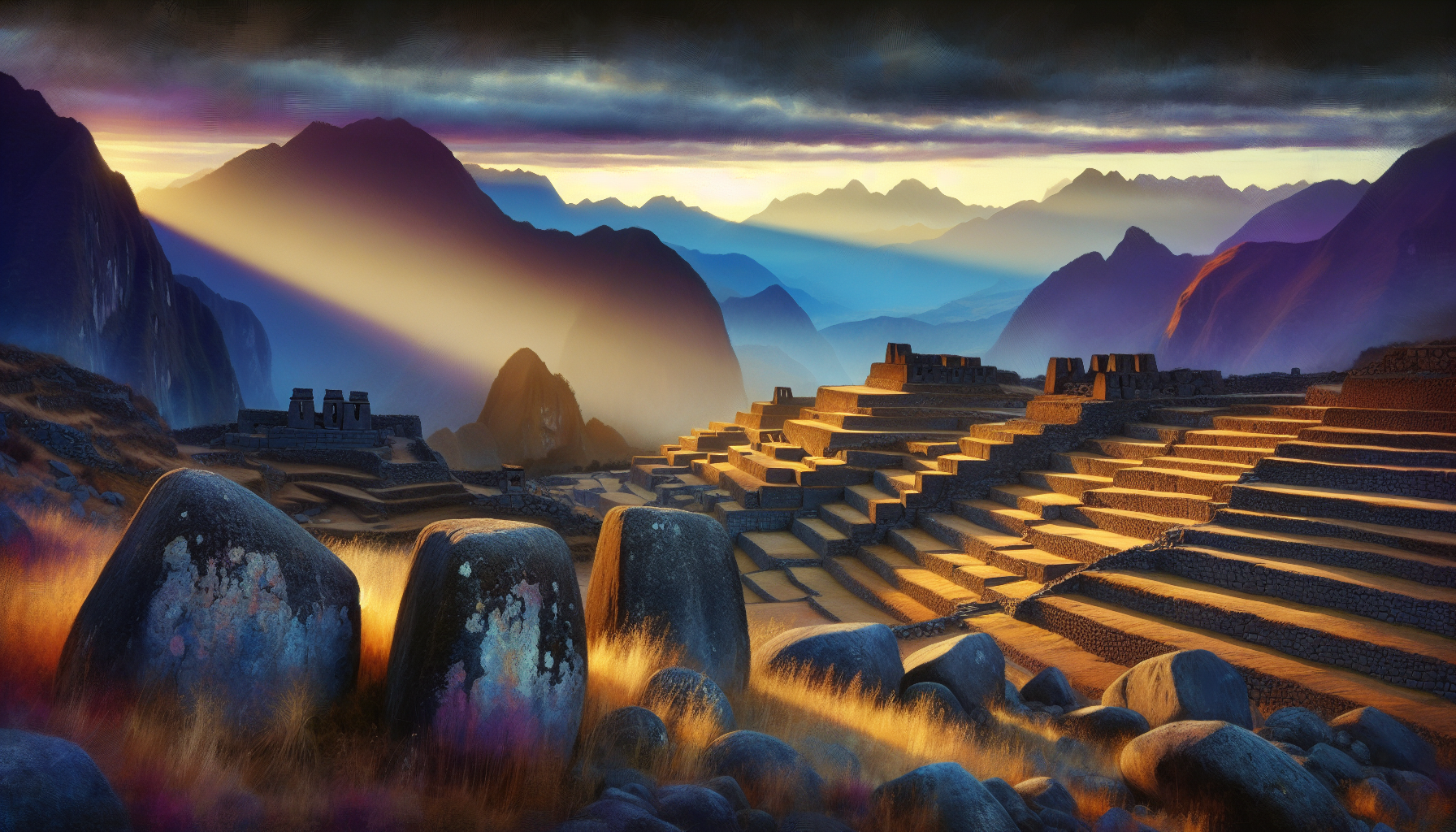
The visible monument today is the lower portion of what was once a much larger complex. Three parallel terraces step up the hillside, each retained by a wall built of irregular polygonal blocks fitted with what the British architect Graziano Gasparini called “elastic precision.” The walls run in a zigzag plan more than 540 metres along the ridge, with up to forty salients per terrace. Block heights along the lowest course can exceed five metres, and Britannica records individual stones standing more than 8.2 metres tall. According to Encyclopaedia Britannica, the heaviest blocks remained in place because the colonial demolition crews, who used most of the rest to build Spanish Cusco after 1536, found them impossible to move.
Towers, Plaza, and Function
Above the terraces stood three round and rectangular towers known from chronicles as Muyuq Marka, Sallaq Marka, and Paukar Marka, of which only the foundations now remain. The Inka chronicler Inca Garcilaso de la Vega (1539-1616), who played in the towers as a boy before they were dismantled, described their cisterns and panelled chambers in his Comentarios Reales (1609-1617). Across the open ground lies Chuquipampa, the ceremonial plaza where the Inti Raymi festival was performed; the complex also held barracks, storerooms, and a temple to Inti, the sun god. Older Spanish accounts called the site a “fortaleza” because of the 1536 siege, when the Inca leader Manco Inca Yupanqui (c. 1515-1545) seized the empty ridge to launch his rebellion. Modern Andean archaeology resists the single label. The American archaeologist John Hyslop (1945-1993) treated the site as one node in an Inca administrative-ceremonial network, and Susan A. Niles, anthropologist at Lafayette College, has shown how royal Inca architecture encoded dynastic narratives in stone, with each ruler claiming the land through his buildings. Sacsayhuamán fits both readings, defensive and ceremonial, the way a medieval cathedral fits both worship and civic display.
The Primary Sources: What the First Chroniclers Reported
Three early texts shape almost everything later writers say about the walls. Each was produced under different conditions of access and political pressure, and a careful reader weighs them against each other before reaching for any modern synthesis.
Pedro Cieza de León, 1553
Pedro Cieza de León (1520-1554), the Spanish soldier-chronicler whose Crónica del Perú appeared at Seville in 1553, is the earliest detailed European witness. He wrote that the labour to build Sacsayhuamán was drawn through the Inca mita system from the provinces of the empire. He noted blocks “of a width of twelve feet and more than twenty long” and described the precision of the joints in language that has been quoted by every writer since. According to the Britannica entry on Cieza de León, he wrote from direct observation between 1547 and 1550, while parts of the upper structure were still standing.
Inca Garcilaso de la Vega, 1609
Inca Garcilaso de la Vega, born in Cusco to an Inca noblewoman and a Spanish captain, returned in his Comentarios Reales (Lisbon, 1609; Córdoba, 1617) to the labyrinths he had explored as a child. His account is partial. He admired the masonry, mourned the demolition, and offered the famous claim that no joint admitted “the point of a knife.” He also recorded oral history from his Inca relatives that placed the design under Pachacuti Inca Yupanqui (c. 1418-1471) and the construction across the reigns of Topa Inca Yupanqui (c. 1441-1493) and Huayna Capac (c. 1467-1527).
Bernabé Cobo and the Mestizo Testimony
A third strand reaches us through the Jesuit Bernabé Cobo (1582-1657), whose Historia del Nuevo Mundo (completed 1653) drew on lost native testimony, including the work of the mestizo writer Blas Valera (c. 1545-1597). Cobo’s description of seasonal festival use is the basis for most reconstructions of the ceremonial calendar. Modern Andeanists weigh the three accounts against one another and read the alignments, not the solo claims, as the most reliable signal.
How the Stones Were Cut: The Experimental Evidence
For most of the twentieth century, popular writers presented the masonry as inexplicable, occasionally invoking lost technologies or non-human builders. The professional view changed in the 1980s, primarily through the work of one Berkeley-trained architect.
Jean-Pierre Protzen at Ollantaytambo
Jean-Pierre Protzen (1934-2018), a Swiss-American professor of architecture at the University of California, Berkeley, conducted decades of fieldwork at Inca quarry sites near Ollantaytambo, Rumiqolqa, and Kachiqhata in the 1980s. His core paper “Inca Quarrying and Stonecutting” appeared in the Journal of the Society of Architectural Historians in 1985, and his fuller account, Inca Architecture and Construction at Ollantaytambo, was published by Oxford University Press in 1993. Protzen documented the impact dimples left by hammerstones on hundreds of finished and abandoned blocks. He then reproduced the technique experimentally. Using only river-cobble hammerstones of three sizes, he could quarry, dress, and fit a polygonal block in a few hours.
The Method Step by Step
Protzen’s reconstruction has four steps that Andean archaeologists now treat as consensus. First, masons used wooden levers and natural rock falls to free a rough block from the parent face. Second, the largest hammerstones, around eight to ten kilograms, split the block to approximate dimensions. Third, progressively smaller hammerstones, down to fist-sized cobbles, dimpled the surface into shape, leaving the characteristic pebbled face still visible on many walls today. Fourth, and most importantly, the irregular block already in place served as the template: masons hoisted the new block, set it on the bed, and pecked away the high spots until the joint closed. The technique is trial and fit, not measurement and cut. It accounts for the polygonal forms, the absence of standard block sizes, and the complex three-dimensional curves of many bedding planes. The key insight, Protzen wrote, is that Inca masons were not cutting blocks to a plan; they were fitting found shapes to one another in sequence.
What Remains Open: Quarry-to-Site Logistics
Settling the cutting question does not settle every question. The honest answer about the largest stones is that the transport problem is partly understood, partly not. The fitting technique scales; the moving of a hundred-tonne block over forested ridges does not, at least not without leaving a labour record that the archaeology is still piecing together.
The Sources of the Stone
Petrographic analysis identifies three main lithic sources. Limestone from the Yuncaypata formation, a few kilometres from the site, supplied the lighter and most numerous blocks. Andesite from the Rumiqolqa quarries, about 35 kilometres south-east near Lucre, supplied harder facing stones. Diorite from Cerro Picol contributed especially massive blocks. The most-cited single source for the giant lower-course stones is Sisicancha, on a ridge roughly three kilometres from the site, where unfinished and abandoned blocks still lie along the ancient haul-route.
Moving the Megaliths
Spanish chroniclers describe ramps, cordage of plaited reed, log rollers, and labour gangs rotated through the Inca mita corvée. Protzen documented surviving haul-roads at Kachiqhata where the natural slope provided gravity assist. The British archaeologist Ann Kendall (1939-2024), founder of the Cusichaca Trust in 1977, surveyed Inca infrastructure across the Cusco region for five decades and showed how road, terrace, and quarry systems were planned together as a single logistical landscape, as detailed in Smithsonian’s coverage of her Cusichaca fieldwork. Her work makes Inca large-block transport intelligible without exotic explanations. The transport of the absolutely largest blocks, those above one hundred tonnes, has not been replicated experimentally at full scale, and so the experimental ladder still has a top rung that has not been climbed.
The Earthquake Behaviour of the Walls
The polygonal masonry has another quiet virtue: it survives earthquakes that have destroyed mortared colonial structures built directly on top of it. The 1650 and 1950 Cusco earthquakes both flattened Spanish-era buildings while leaving the Inca walls underneath largely intact. A 2024 study published in Engineering Failure Analysis applied finite-element rigid-body dynamics to a Sacsayhuamán section and showed that the irregular block geometry, the inward batter of the courses, and the absence of mortar combine to absorb seismic energy by allowing micro-displacements. Blocks reportedly settle back after a quake, and Inca trapezoidal door and window frames contribute to the same damping behaviour at the structural-element scale.
The Long Demolition and the Persistent Mystery
Most of what was once Sacsayhuamán is now in the walls of central Cusco. After the siege ended in March 1537 with Hernando Pizarro’s storming of the towers, Spanish colonial authorities began a quarrying campaign that lasted decades. The cathedral of Cusco, the church of La Compañía, and dozens of patrician houses contain reused Inca stones. Roughly twenty per cent of the original complex survives in situ by some estimates. The site was rediscovered as an archaeological priority by Peruvian researchers in 1934, and the modern Inti Raymi festival, revived in 1944, performs at the Chuquipampa plaza each southern solstice.
If the technique is settled, why does the popular framing of lost technology still circulate? Three reasons. The experimental literature is technical and lives in journals lay readers do not encounter. The dimpled surfaces and irregular joints look impossible to anyone who has not seen Protzen’s hammerstones in hand. And the transport question is genuinely open at the upper end, a single open thread that popular accounts sometimes treat as if it discredited the whole consensus on cutting and fitting. The discipline of holding the open question accurately means naming it, sizing it, and not letting it carry weight it cannot bear.
Frequently Asked Questions
How old are the Sacsayhuamán walls?
The walls were built between roughly 1440 and 1530 CE during the reigns of Pachacuti Inca Yupanqui, Topa Inca Yupanqui, and Huayna Capac. Construction continued for almost a century until the Spanish conquest interrupted it in 1532-1533.
How much do the largest stones weigh?
The largest blocks at Sacsayhuamán weigh between 100 and 200 tonnes. The single largest stones, in the lowest course of the main zigzag wall, are estimated by some engineers at close to 200 tonnes. Most of the polygonal blocks are far smaller, in the 8 to 30 tonne range.
How did the Inca cut the stones without iron tools?
Inca masons used hammerstones of progressively smaller size to dimple, dress, and shape the blocks. The architect Jean-Pierre Protzen demonstrated experimentally in the 1980s that any of the polygonal joints at Sacsayhuamán can be reproduced using only river-cobble hammerstones and the trial-and-fit technique. No iron tools were needed.
Was Sacsayhuamán a fortress or a temple?
Both. The site combined defensive walls and gates with a temple to the sun god Inti, royal storerooms, and the Chuquipampa ceremonial plaza. The Spanish chroniclers emphasized the fortress role because of the 1536 siege, but the modern archaeological view is that it was always a hybrid civic-religious-military complex.
Did Garcilaso de la Vega see Sacsayhuamán intact?
He saw the towers and inner chambers as a boy in Cusco between roughly 1539 and 1560, before the systematic colonial dismantling reduced the upper structure to foundations. His Comentarios Reales of 1609 records details from that childhood firsthand experience, supplemented by oral testimony from his Inca relatives.
What is the zigzag wall design for?
The salients of the zigzag plan let defenders flank an attacker on three sides at once. Some scholars also read the form ritually as the lightning-bolt of the Inca thunder god Illapa, an interpretation supported by Garcilaso’s lightning iconography. The two readings are compatible.
Why are the colonial buildings around Cusco less earthquake-resistant?
Spanish colonial buildings used mortar, brick, and rectilinear stones laid in regular courses. Mortared joints concentrate seismic stresses at fixed points and crack. The Inca dry-fitted polygonal walls allow micro-displacements between blocks; the irregular geometry locks the wall together while permitting flex. Cusco’s 1650 and 1950 earthquakes confirmed the difference dramatically.
Are the largest blocks transport methods fully understood?
Partially. Documented Inca techniques included plaited-reed cordage, wooden rollers, ramp construction, and large mita labour gangs. Surviving haul-roads with abandoned blocks at Kachiqhata and Sisicancha confirm the basic methods. The transport of the very largest stones, above one hundred tonnes, has not been reproduced at full scale and remains an active question among Andeanist engineers.
What does “Sacsayhuamán” mean?
The name is Quechua and is most commonly translated as “satisfied falcon” or “royal eagle,” from saqsa (speckled, satisfied) and waman (falcon). Other readings derive it from saqsay (to satiate) and uma (head), reading the site as the puma’s head in Cusco’s animal plan. Quechua etymologies for sacred sites often allow more than one valid reading.
Where can a serious reader study the masonry technique further?
Begin with Jean-Pierre Protzen’s Inca Architecture and Construction at Ollantaytambo (Oxford, 1993). For the wider Andean and ceremonial context, John Hyslop’s The Inka Road System (Academic Press, 1984) and Susan Niles’s The Shape of Inca History (University of Iowa Press, 1999) are the standard works. Inca Garcilaso de la Vega’s Comentarios Reales is available in the Harold Livermore translation (University of Texas Press, 1966).