By Emilia Wellesley · Published May 6, 2026 · Updated September 10, 2026
Last updated: September 10, 2026.
The Great Sphinx of Giza is, by overwhelming Egyptological consensus, an Old Kingdom royal monument carved from the limestone bedrock of the Giza plateau as part of the pyramid complex of the pharaoh Khafre, around 2500 BCE. That sentence does most of the work the rest of this article will defend. It also leaves intact the smaller, more interesting questions a careful reader is right to ask: why a heterodox geological hypothesis still circulates, what an inscription erected fourteen centuries after the carving can and cannot prove, and what the limestone itself reveals when read like a manuscript.
Direct Answer: When and Why the Sphinx Was Carved
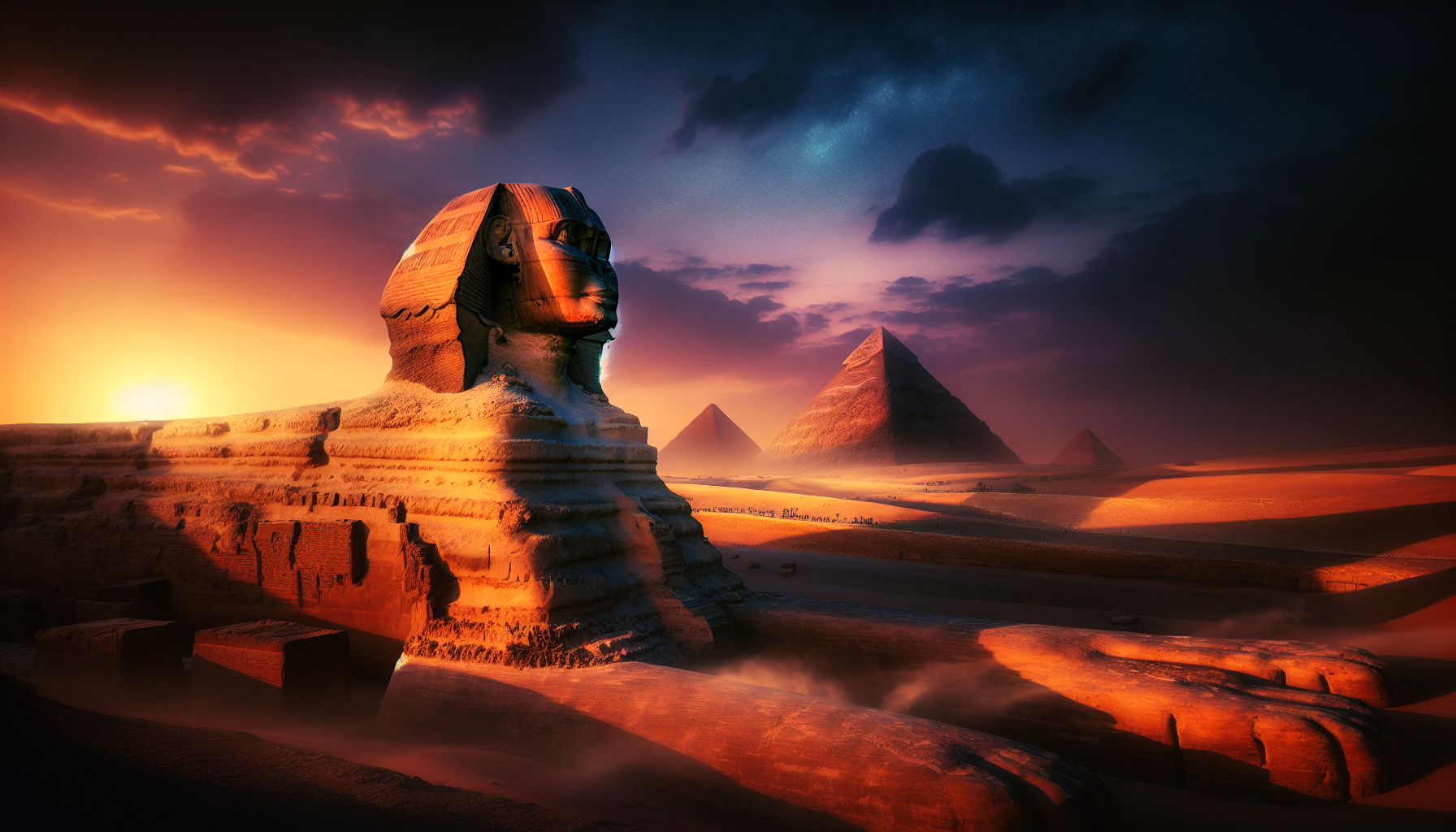
The Great Sphinx is a colossal limestone statue with the body of a recumbent lion and the head of a king, carved from a single mass of bedrock at Giza, Egypt, around 2500 BCE. Mainstream Egyptology attributes its carving to the reign of Khafre (c. 2558-2532 BCE) of the Fourth Dynasty as part of his pyramid complex. The body measures 73 meters long and 20 meters high [1].
What the Monument Actually Is
The Sphinx faces almost exactly due east, on the same axis as the second of the three Giza pyramids. Its body is carved from the plateau’s natural limestone: quarrymen cut a U-shaped ditch around a knoll of bedrock and shaped what was left. The result is an integral monument and enclosure in one operation, with the floor of the ditch dropping roughly nine meters below the original surface [1]. The head is carved from harder, denser stone than the body, which has had operational consequences for forty-six centuries: the body weathers fast, the face slowly.
At 73 meters from paw to tail and 20 meters from base to crown, the Sphinx is the largest monolithic statue in the world; its width across the rear haunches is 19 meters [1]. The face wears the nemes royal headdress and was originally painted; traces of red pigment survive on the cheek. There was once a beard, fragments of which were recovered by Selim Hassan (1886-1961) and are now divided between the Egyptian Museum in Cairo and the British Museum [2]. The nose is missing; the fifteenth-century Egyptian historian al-Maqrizi attributes its destruction to a Sufi iconoclast in 1378 CE who was reportedly executed for the act.
The Orthodox Frame: An Old Kingdom Royal Monument
The dominant interpretation places the Sphinx within the architectural program of Khafre’s funerary complex. Three lines of evidence converge on this reading.
First, position. The Sphinx sits at the eastern end of the causeway that links Khafre’s valley temple to the offering temple at the foot of his pyramid. The whole alignment, valley temple to causeway to pyramid temple to pyramid, is a Fourth Dynasty mortuary template. The Sphinx and the temple immediately in front of it (the so-called Sphinx Temple) sit inside that program rather than on its margins.
Second, stratigraphy. Between 1979 and 1983, the archaeologist Mark Lehner (b. 1950) and the geologist Tom Aigner mapped the Sphinx Temple block by block. They classified its core blocks into types A through G by stone quality and embedded fossils, then traced each type to a specific stratum of the Giza plateau bedrock. The decisive finding: the core blocks of the Sphinx Temple match, layer for layer, the strata exposed in the U-shaped ditch around the Sphinx itself. Many individual blocks weigh up to a hundred tons and span three geological layers, and those layers run continuously through the Sphinx’s body. The temple stones, in other words, came out of the Sphinx ditch as the Sphinx was being carved [3]. The Khafre Valley Temple’s core blocks correspond to the head-equivalent strata, suggesting an integrated Khafre-period quarry sequence rather than three separate building phases.
Third, the workforce. Beginning in the 1990s, Lehner and the late Zahi Hawass (then director of the Giza pyramids) excavated a substantial settlement and laborers’ cemetery roughly 400 meters south of the Sphinx. The pottery, the bread moulds, the fish bone middens, and the inscribed seal impressions all date to the mid-Fourth Dynasty (Khafre’s era). The site, sometimes called the Lost City of the Pyramid Builders, has produced housing for an organized seasonal workforce alongside bakeries, breweries, and copper-tool repair shops [4]. A monument the size of the Sphinx requires that kind of organized labor base. Such a base is documented for Khafre’s reign on the same plateau.
The Heterodox Alternative: Schoch, West, and Water Erosion
A recurring counter-claim, popular outside academic Egyptology, holds that the Sphinx is much older. The author John Anthony West (1932-2018), drawing on the French esotericist R.A. Schwaller de Lubicz, argued in the 1970s that the weathering on the Sphinx body and enclosure could not have been produced by wind and sand alone. In 1990 West traveled to Giza with Robert Schoch (b. 1957), an associate professor at Boston University trained in geology. Schoch concluded that the deeply rounded vertical fissures on the enclosure walls were consistent with prolonged exposure to running water, and that since the Sahara has been arid for at least the last five thousand years the carving must predate that aridity. He proposed an initial date of at least 5000 BCE and later pushed the date back to roughly 7000-5000 BCE; in some popular treatments the date drifts as far as 9700 BCE [5].
The mainstream rebuttal works on three levels. Geologically, the geologist James Harrell of the University of Toledo and the geomorphologist Lal Gauri argued that the weathering pattern is consistent with salt-crystal disaggregation of the soft Member II limestone in the Sphinx’s body, accelerated by the high water table and capillary action; rainfall is not required as a primary driver [6]. Archaeologically, no material culture, no settlement, no ceramics, and no organized labor base of the scale required to carve a 73-meter statue exists in Egypt for the proposed dates. The Predynastic and Early Dynastic record is well surveyed; a civilization capable of the Sphinx and then vanishing without a trace would be a discovery roughly equivalent in scale to all of Egyptian archaeology combined. Lehner’s response was direct: “You don’t overthrow Egyptian history based on one phenomenon like a weathering profile.” The American Research Center in Egypt and the Egyptian Supreme Council of Antiquities have rejected the redating [7].
What would distinguish the two readings? An undisturbed stratigraphic deposit beneath the enclosure dating to the proposed older period, contemporary inscriptions, or a labor base in the archaeological record between 9000 and 5000 BCE that is currently absent. None has been produced. The orthodox account, by contrast, predicts the lost city, the seasonal labor camps, the typed core blocks of the temple, the alignment of the entire Khafre complex, and the late Fourth Dynasty workforce. All of those have been recovered.
The Dream Stele: A Fourteenth-Century BCE Document About an Already-Ancient Monument
Around 1401 BCE, the New Kingdom pharaoh Thutmose IV erected a granite stele between the front paws of the Sphinx. It stands 3.6 meters tall, weighs about fifteen tons, and tells a story that is a small marvel of Egyptian self-presentation. The young prince, hunting south of Memphis, falls asleep at midday in the shadow of the monument. The god, addressed as Horemakhet-Khepri-Ra-Atum (the Sphinx as solar deity in three of his manifestations), speaks to him in a dream: “Look at me, see me, my son Thutmose. I am your father… I shall give you the kingship on earth, in front of all the living ones.” In return, the prince is asked to clear the sand burying the Sphinx’s body. He does so; he becomes pharaoh; the stele records the bargain and the cult restoration that followed [8].
Two things follow from the Dream Stele that often get muddled in popular accounts. The first is that the stele is a New Kingdom text, written about a monument that by 1400 BCE had been there long enough to be buried, ritually significant, and theologically reread as a solar deity. It does not date the carving; it dates one of its later restorations. The second is that the surviving text is fragmentary. The stele cracked at its twelfth line and lost roughly half its inscription, and one damaged line near the bottom contains a single sign group, often transliterated “Khaf,” that was once read as a possible reference to Khafre. The reading is uncertain; the sign group may belong to a different word, and Selim Hassan, who excavated the stele to bedrock in 1936-1937, called the link to Khafre circumstantial rather than proven [2]. The orthodox dating does not rest on the Dream Stele. It rests on the stratigraphy and on the workforce evidence.
The Sphinx Temple, the Restorations, and the Long Twentieth Century of Excavation
Immediately east of the Sphinx and lower than its paws sits the Sphinx Temple, a Fourth Dynasty granite-faced offering structure with two sanctuaries and twenty-four pillars in its central court. It was almost certainly never finished. Its core blocks, as noted above, came out of the Sphinx ditch; its layout is a thoroughgoing Old Kingdom temple plan; and the alignment of its sanctuaries onto the equinoctial sunrise places it within the same solar program as the Sphinx itself.
The Sphinx has been buried, dug out, and repaired many times. Thutmose IV cleared it in the fifteenth century BCE. Ramesses II (r. c. 1279-1213 BCE) is associated with restoration courses on the body. By the medieval period most of the body was again under sand. The first thorough modern clearance was undertaken by the French archaeologist Émile Baraize between 1925 and 1936, who used what is now considered overzealous concrete reinforcement on the head. The most consequential single excavation was Selim Hassan’s clearance of 1936-1937, which removed roughly 250,000 cubic meters of sand and exposed the Sphinx Temple, the mud-brick enclosure walls of Thutmose IV, and over eighty stelae bearing hymns to Horemakhet [2]. The ARCE Sphinx Project under Lehner produced the first scale maps and the stratigraphic block analysis in the 1970s and 1980s. From the 1990s onward Hawass directed conservation and consolidation, swapping the cement of earlier restorations for sympathetic limestone facing.
What Lies Beneath: Cavities, Anomalies, and the Discipline of Saying “We Don’t Know Yet”
Since the 1970s, geophysical surveys around the Sphinx have repeatedly suggested subsurface anomalies. Seismic work by Thomas Dobecki and Schoch in 1991 reported a possible cavity beneath the left front paw. Ground-penetrating radar surveys in 2001, sponsored by the Schor Foundation, identified linear features that some interpreters read as walls or corridors. More recent surveys using muon tomography and additional GPR campaigns have continued to register anomalies [9]. The honest reading of these results is that limestone bedrock is not perfectly uniform; natural cavities, fissures, and dissolution voids are exactly what one expects under and around a karst-prone monolith. Some anomalies may reflect ancient cuttings or repair shafts. None to date have been excavated to the point of confirming a constructed chamber. The popular Edgar Cayce-derived “Hall of Records” claim has no archaeological standing; the more cautious geophysical question is open.
What the Face Says, and What It Does Not
A persistent strand in the popular literature argues that the Sphinx face does not resemble the surviving statuary of Khafre and was therefore recarved later. The argument was made most colorfully by the New York forensic detective Frank Domingo in 1993, comparing the face to the diorite Khafre statue in the Egyptian Museum and finding the proportions divergent. Egyptologists read the same evidence differently. The head is small relative to the lion body, which most attribute to ancient recutting of an originally larger head and to erosion of the softer surrounding stone. Royal portraiture of the Old Kingdom is not photographic; it is conventional. The face’s slight asymmetries are consistent with weathering of soft limestone over forty-six centuries rather than with a different sculptor in a different period [10]. The argument from style is suggestive but does not, on its own, displace the stratigraphic case.
Reading the Sphinx Slowly
The Sphinx rewards careful reading. Its scale is Old Kingdom; its alignment is Old Kingdom; its quarry stones are demonstrably Old Kingdom; its labor base is Old Kingdom. The Dream Stele is a New Kingdom voice talking about a monument already ancient enough to be buried in sand and theologically reborn as a solar deity. The water-erosion hypothesis remains a position one can hold; it does not, as currently argued, have the predictive purchase that the orthodox reading does. The geophysical anomalies beneath the enclosure are real and worth investigating, and they are not yet evidence of constructed chambers.
For the curious reader who wants to go further, three doors are open. Mark Lehner‘s The Complete Pyramids (1997) for the Old Kingdom architectural program. The proceedings of the AERA Sphinx Project, available through the Ancient Egypt Research Associates, for the stratigraphic block analysis in detail. Selim Hassan’s The Great Sphinx and Its Secrets (Cairo, 1953) for the foundational excavation report, and the Smithsonian and Britannica overviews for orientation. Read these alongside the broader landscape of historical and archaeological mysteries, and the Sphinx becomes less a riddle than a long, patient archive — one that survives because each generation of priests, pharaohs, archaeologists, and travelers chose to clear the sand from it again.