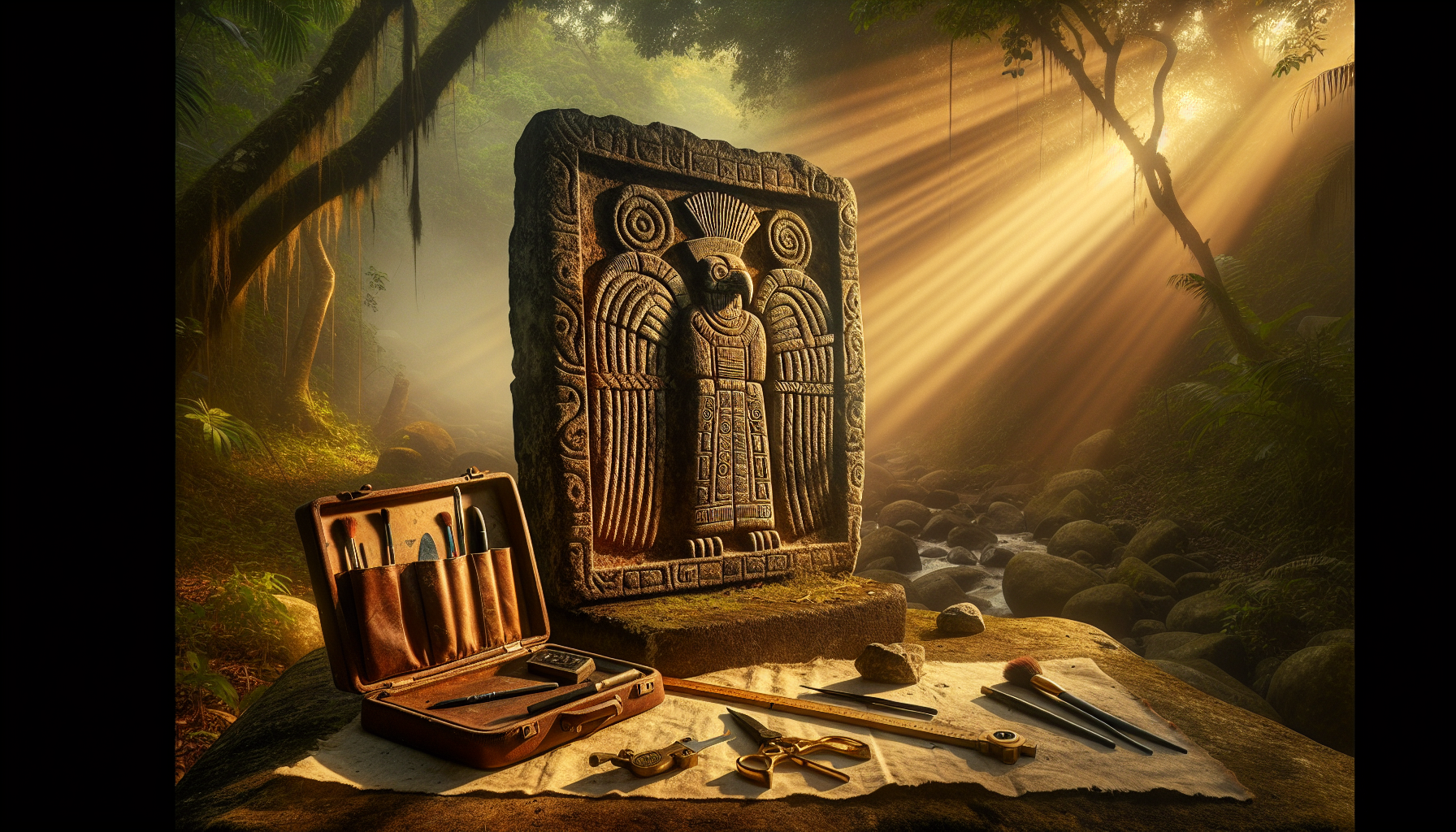
By Emilia Wellesley · Published May 6, 2026 · Updated September 10, 2026
Last reviewed: September 10, 2026.
In 1902, a farmer named Pedro Mimendi was breaking ground in a tobacco field in the Tuxtla foothills of Veracruz when his plow turned up a hand-sized lump of jadeite shaped like a shaman with a duck’s bill. Around the figure ran two columns of incised glyphs no scholar then living could read [1]. The carving was smuggled, by some accounts inside a shipment of tobacco leaf, into New York and onward to the Smithsonian’s National Museum of Natural History, where it remains [1]. Charles Pickering Bowditch, the Boston merchant-turned-Mayanist who first studied it, determined the writing was not Maya. It was something older, something the Mexican earth had not yet been asked to explain.
That something is now called the Isthmian script, also Epi-Olmec, the writing of the late Olmec successor cultures who lived along the Isthmus of Tehuantepec between roughly 500 BCE and 500 CE [2]. Eighty-four years after Mimendi’s plow struck jadeite, a far heavier monument surfaced in the same region: La Mojarra Stela 1, four tons of inscribed limestone pulled from the bed of the Acula River in 1986, carrying a Long Count date that converts to July of 156 CE and roughly five hundred glyphs of the same little-known script [3]. The Stela appeared to offer the corpus the field had lacked. In 1993, two scholars announced that they had read it. Other scholars, working from a third inscribed object found shortly after, said they had not.
A direct answer for the impatient reader
The Isthmian script, also called Epi-Olmec, is a Mesoamerican writing system used between about 500 BCE and 500 CE in the Isthmus of Tehuantepec. John Justeson and Terrence Kaufman published a partial decipherment in 1993, identifying the language as pre-proto-Zoquean. Stephen Houston and Michael Coe, in 2004, tested the system against a new mask inscription and rejected the result. The script is still considered undeciphered.
What the script looks like, and where it survives
The Isthmian corpus is small. Stephen Houston (born 1958), the Brown University archaeologist who has worked through it most carefully, has noted that only five to ten significant Isthmian texts are known, against roughly ten thousand surviving Maya inscriptions [4]. The corpus disparity matters. A script with ten thousand attestations gives a decipherer hundreds of contexts in which a glyph appears; a script with ten holds the same glyph hostage to whichever reading the first scholar proposes. The Isthmian texts known today fall into a handful of monuments and portable objects: the Tuxtla Statuette, La Mojarra Stela 1, Tres Zapotes Stela C, the so-called Teotihuacan-style mask first studied by Houston and Coe, the O’Boyle mask with its twenty-three glyphs, four weathered stelae from Cerro de las Mesas, and a pottery sherd from Chiapa de Corzo dated by some researchers to 450 to 300 BCE, the oldest Isthmian-script artifact yet identified [2].
The glyphs themselves are squared, blocky, and arranged in vertical columns read top to bottom and left to right. They share the Mesoamerican Long Count calendar with the Maya, the Zapotec, and other regional traditions, which is why even before any phonetic reading was attempted, scholars could date several inscriptions to the second century CE on internal evidence alone [2]. They are not Maya glyphs. They are not Zapotec glyphs. They are visibly cousins to both, but the family resemblance has not been enough to crack the language.
The 1986 stela and the 1993 announcement
La Mojarra Stela 1 changed the conversation because it was long. The slab measures roughly 1.4 meters wide by 2 meters tall and weighs about four tons; it carries a full-length portrait of a ruler in a hook-billed bird headdress on its right side and approximately 535 glyphs across the rest of its surface [3]. Two Long Count dates appear in the text: one corresponding to May 143 CE, another to July 156 CE [3]. Scholars now read the monument as a dynastic statement, though what it says depends entirely on which decipherment one accepts.
In March of 1993, John Justeson, a linguist then at the State University of New York at Albany, and Terrence Kaufman (born 1937), a Mesoamericanist at the University of Pittsburgh, published an article in Science arguing that the language behind the Isthmian glyphs was an early form of the Mixe-Zoquean family, specifically a pre-proto-Zoquean ancestor still spoken in modified descendant forms in southern Mexico today [5]. They proposed a structural similarity to Maya: one set of signs functioning as logograms, another as syllables. Their reading of La Mojarra named its protagonist Harvester Mountain Lord and reconstructed a narrative of royal accession, a solar eclipse, Venus appearances, warfare, an attempted usurpation, human sacrifice, and the king’s own bloodletting [3]. The reception in some quarters was rapturous; the Encyclopaedia Britannica still describes the proposal as one of the major intellectual achievements of modern times [2].
In 1997, Justeson and Kaufman returned to Science with a follow-up paper reporting that a newly cleaned section of La Mojarra, a column of glyphs not visible in earlier photographs, had yielded readily to the system they had proposed four years before. Kaufman and Justeson received a Guggenheim Fellowship in 2003 in recognition of the work [2]. By that point, however, a second test was already in motion.
The mask, the test case, and the rejection
The test was a Teotihuacan-style mask of unknown provenance, its back incised with about two dozen Isthmian glyphs nobody had seen before [6]. Stephen Houston, then at Brigham Young University and now at Brown, and Michael Coe (1929 to 2019), the Yale Mesoamericanist whose Breaking the Maya Code remains the standard popular history of New World decipherment, took the mask as a falsification opportunity. If the Justeson-Kaufman readings were correct, applying their syllabary and logogram inventory to the mask should produce coherent Mixe-Zoquean prose. Houston and Coe published their results in the journal Mexicon in 2004 [6].
The result, in their reading, was incoherent. Coe described the output as gobbledygook; the example translations they extracted ran along the lines of “take he take cloth sun?” and “your cloth he your take throne bludgeon” [6]. Houston was blunter in interview: every fiber, he said, told him this was not a credible decipherment, and the script’s apparent obsession with cloth and folding cloth was nothing that would make linguistic sense in a royal monumental inscription [6]. Their formal verdict, published with the artifact’s full glyph table, was that the Justeson-Kaufman system had failed its first independent test and that the Isthmian script remained undeciphered [6]. Justeson and Kaufman did not engage in extended public rebuttal; they replied that the criticisms were easily answered and that they would answer them in a scientific outlet of their choosing, but no comparably comprehensive defense has appeared since [6].
What is at stake in the disagreement
An untrained eye reading the back-and-forth might assume the dispute is about ancient kings. It is not, or not only. It is about what counts as a decipherment.
A working Mesoamerican decipherment in the Maya tradition, the model Houston and Coe inherit, requires three things: a sufficient corpus to test repeated patterns, a plausible language identification, and a productive system that yields coherent readings on inscriptions the decipherer has not yet seen. Maya passed all three over decades of work by Yuri Knorozov (1922 to 1999), Tatiana Proskouriakoff (1909 to 1985), David Stuart (born 1965), and others. The Isthmian corpus, in Houston and Coe’s view, satisfies the first criterion only marginally and the third not at all. Justeson and Kaufman, working in the rival tradition that emphasizes structural and historical-linguistic argument, reply that the patterns they have identified are robust and that the failure to produce a fluent narrative on a tiny new mask is unsurprising given how much of the sign inventory is still unattested [4][6].
Andrew Robinson, the historian of writing whose Lost Languages remains the most balanced English-language survey of the question, summarized the field’s caution in 2008: the case for the Justeson-Kaufman decipherment was, in his judgment, decidedly unproven and resting on shaky foundations, and what was wanted before the question could be settled was the discovery of a new text or texts as substantial as La Mojarra itself [2].
What evidence would resolve it
The discipline knows what it would take to settle the question, and the items are all archaeological luck. The first is more inscriptions, longer ones, found in stratified excavation rather than purchased through the antiquities trade. A new La Mojarra-scale stela, recovered in situ at a known Epi-Olmec site, would give the corpus a second long anchor and let either decipherment system be tested against fresh narrative material.
The second is a parallel bilingual, a Rosetta-style monument in which the same content appears in Isthmian script alongside a script already read. Such a find is not impossible. The Isthmus of Tehuantepec sat at the cultural crossroads where Olmec successor states, the early Maya, and Oaxacan polities all left material traces. A bilingual pairing Isthmian with early Maya, or with the Zapotec script of Monte Albán, would force the question to a conclusion within a generation of its discovery. The third, less glamorous but possibly more decisive, is a sustained stratigraphic survey of the lower Papaloapan and Coatzacoalcos basins, the heartland of the script’s known distribution. Most of the Isthmian inscriptions known today were found by accident, in farm fields and riverbeds. A program of deliberate survey, of the sort that transformed Maya epigraphy in the 1960s and 1970s, has not yet been mounted at comparable scale for the Epi-Olmec horizon.
The figure on the stone
The figure on La Mojarra stands almost two meters tall in profile, a hook-billed bird supernatural rising from his head, shark imagery and deity masks knotted into his belt [3]. Whether his name was Harvester Mountain Lord, as Justeson and Kaufman read, or some other lord whose syllables we have not yet recovered, he was real, his accession was real, the Long Count dates carved beside him are astronomically verifiable, and the language his scribes wrote is in some attenuated form still spoken in southern Veracruz and Oaxaca by speakers of Sayula Popoluca, Texistepec Popoluca, and the other surviving Mixe-Zoquean tongues [2]. The honest answer in 2026 is that the field does not know which reading he wanted us to see.
Frequently asked questions
Has the Isthmian script been deciphered?
No, not by the standards the field generally applies. A 1993 partial decipherment by John Justeson and Terrence Kaufman is widely cited but was challenged in 2004 by Stephen Houston and Michael Coe, who applied it to a new inscription and found the output incoherent. Most current surveys describe the script as undeciphered.
What does Epi-Olmec mean?
Epi-Olmec is the term archaeologists use for the late and post-Olmec cultures of the Isthmus of Tehuantepec roughly 400 BCE to 500 CE. The script is named after the period and region rather than after a single ancient kingdom, since the political organization of the era is itself imperfectly known.
What language was being written?
Justeson and Kaufman argue it was a pre-proto-Zoquean ancestor of the Mixe-Zoquean languages still spoken in southern Mexico. Houston and Coe consider that identification not yet demonstrated. A 2020 alternative proposal by the linguist Vonk suggested proto-Huastecan, but this view has not gained wide traction.
How many Isthmian inscriptions exist?
Five to ten substantial texts, depending on how one counts very weathered stelae and short potsherds. The corpus is dwarfed by the roughly ten thousand surviving Maya inscriptions, which is part of why decipherment has been so much harder.
Where is La Mojarra Stela 1 today?
It is held by the Museum of Anthropology in Xalapa, Veracruz. The Tuxtla Statuette is at the Smithsonian’s National Museum of Natural History in Washington, where it has been since 1903.
Could chemistry settle the question?
Not directly. Chemical testing dates the stone, not the carving. Resolution will come from epigraphy, comparative linguistics, and the discovery of new inscribed monuments.
What would a Rosetta Stone for Isthmian look like?
A monument inscribed in Isthmian script alongside a script already read, most plausibly early Maya or Zapotec, ideally recording the same content in both. Such a parallel bilingual would let scholars confirm or refute candidate readings within a few years.
Who were the principal scholars on each side?
For the decipherment: John Justeson of the State University of New York at Albany and Terrence Kaufman (born 1937) of Pittsburgh, awarded a Guggenheim in 2003. Against: Stephen Houston of Brown and Michael Coe (1929 to 2019) of Yale, whose 2004 Mexicon article remains the principal published challenge.
Why does the disagreement matter?
Because how a culture is read shapes how it is understood. If Harvester Mountain Lord existed as Justeson and Kaufman describe, the Isthmian world had a developed literate kingship by 156 CE. If the reading is wrong, the same monument awaits a quite different story, and the field’s chronology of Mesoamerican literacy needs revisiting.
The Isthmian script sits in the hold-open category alongside Linear A, the Indus Valley script, Rongorongo, and a handful of other partially known systems. It is not unreadable in principle. It is unread in fact, and the next decade of fieldwork along the Veracruz coast may yet supply the stone or the bilingual that closes the case. Until that happens, what we have is the back-and-forth itself, two careful readings of the same monument, neither of which the discipline has been willing to call settled. The further reading list at our Historical and Archaeological Mysteries pillar places the Isthmian question alongside the other scripts and languages whose silence has not yet been broken.