By Wren Ashby · Published June 17, 2026 · Updated September 2, 2026
Across at least five civilizations, a single pigment accident has been read as a message from the divine. A bison, an elephant, a whale, a stag, and a snake all turned up the wrong color, and the people who met them built ceremonies, dynasties, and novels around what they saw. Albino animal legends recur because rarity plus visibility is a combination human cultures rarely leave uninterpreted. For the wider niche, see the Animal Anomaly Mysteries pillar.
Published: 2026-06-05. Last reviewed: 2026-06-05.
Direct Answer: What Albino Animal Legends Are
Albino animal legends are cultural traditions built around individual white animals whose pale coloring comes from albinism or leucism. Named cases include the Lakota white buffalo, Thailand’s sacred white elephants, the albino sperm whale Mocha Dick behind Moby-Dick, the European white hart, and the white serpents of Chinese and Japanese folklore.
| Tradition | Animal | Named legend or case | Pigment reality |
|---|---|---|---|
| Lakota and Plains nations | American bison | White Buffalo Calf Woman; calf “Miracle” (1994) | Usually not true albino |
| Thai and Burmese Buddhist | Asian elephant | Sacred white elephant; Queen Maya’s dream | Pale or leucistic, not albino |
| 19th-century Pacific whaling | Sperm whale | Mocha Dick, the model for Moby-Dick (1851) | Albino or leucistic |
| Medieval and Eurasian Europe | Red deer (hart) | White hart of Richard II; the csodaszarvas | Leucistic |
| China and Japan | Snakes | Legend of the White Snake; Iwakuni serpents | Iwakuni population is true albino |
The White Buffalo and the Lakota Prophecy
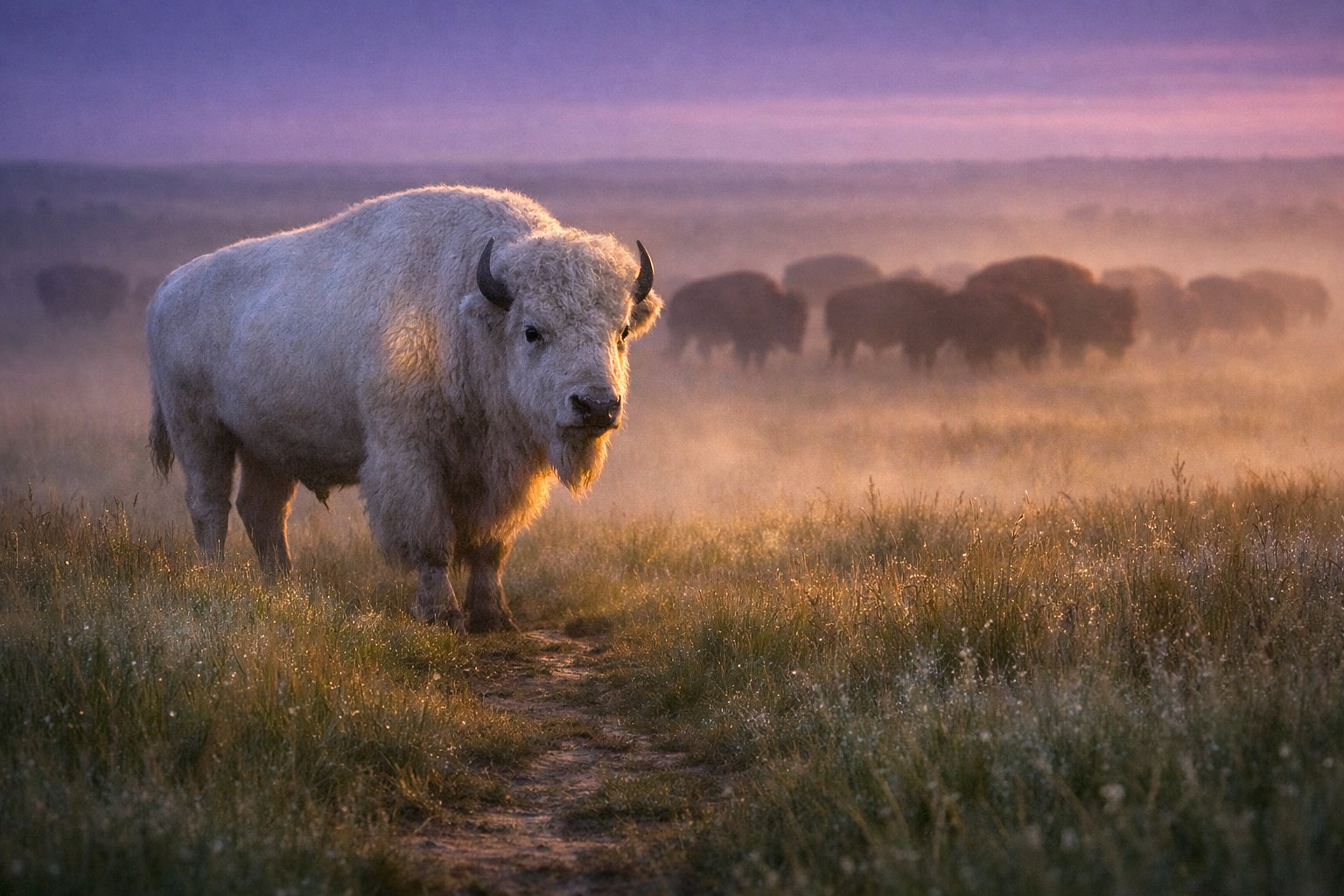
Lakota tradition holds that White Buffalo Calf Woman, Ptesanwi, brought the sacred pipe and the core ceremonies to the Oceti Sakowin roughly two thousand years ago, and promised that the birth of a white buffalo calf would announce her return [1][11]. The animal is a covenant, not a curiosity.
A female white calf named “Miracle” was born on the Heider family farm near Janesville, Wisconsin, on 20 August 1994, reportedly the first white bison since 1933, a birth chronicled by the U.S. National Park Service [1]. Elders from many nations traveled to see her, reading the birth as a sign that prophesied times were arriving. The National Buffalo Association has put the historical odds of a pure white bison at roughly one in ten million [1]. A second widely reported calf, Lightning Medicine Cloud, was born in Texas in 2011. The load-bearing fact: most sacred white buffalo are not true albinos. Miracle changed coat color through her life, and the sacredness rides on the prophecy rather than on the genetics [1]. The sacred pipe that anchors the tradition is still kept by Arvol Looking Horse of the Cheyenne River Sioux, which is why a white bison reads, to the Lakota, as scripture arriving on four legs rather than as a veterinary oddity [11].
Sacred White Elephants and the Lords of Buddhist Kingship
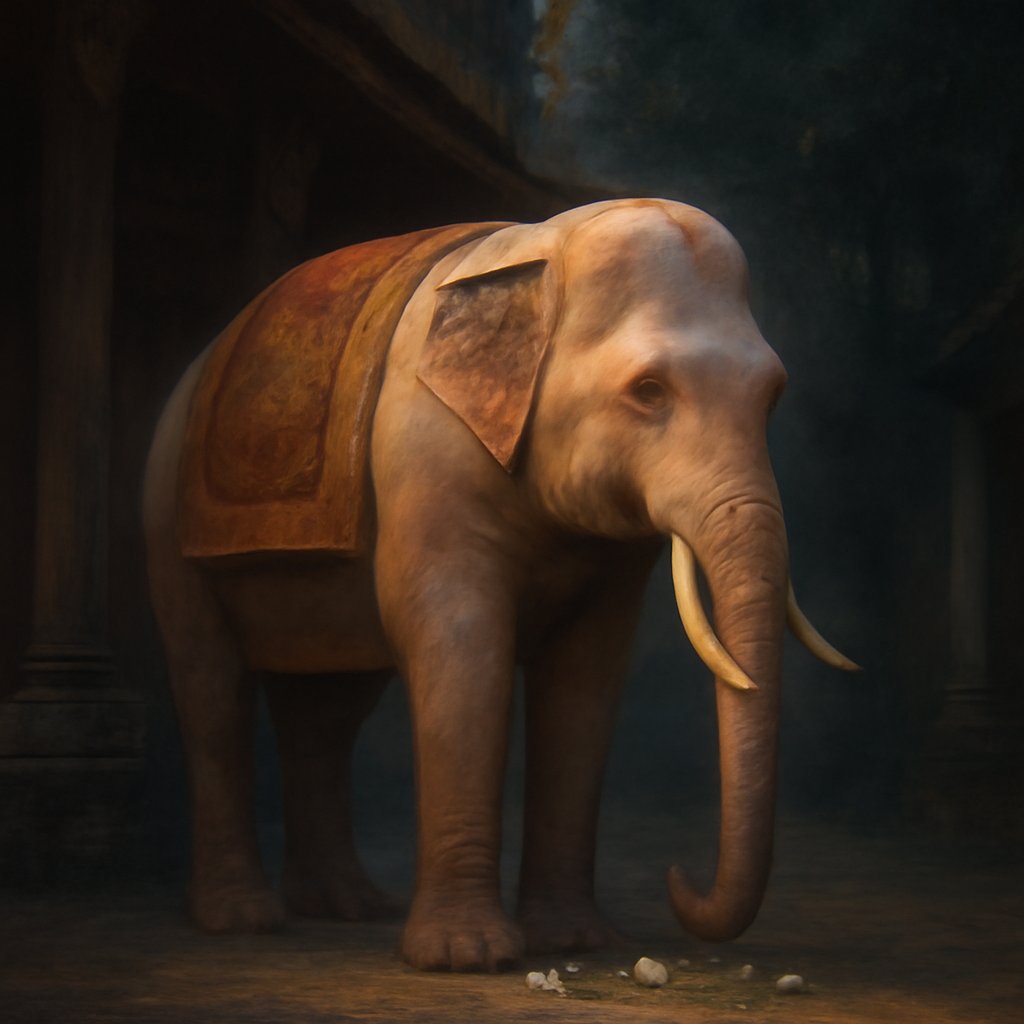
Possession of a sacred white elephant signified rightful kingship across Thailand, Myanmar, Cambodia, and Laos, where rulers carried the title Lords of the White Elephant and counted part of their divine legitimacy in how many they kept [4]. The animal was a throne in living form.
The Thai term is chang samkhan, an auspicious elephant rather than a literally white one. These animals are not albinos; their skin runs a soft reddish-brown that turns pink when wet, and they carry fair eyelashes and toenails that true albinism would not produce [4]. The reverence reaches back to the Buddha’s own birth story, in which Queen Maya dreams that a six-tusked white elephant enters her side, an image carved on the Bharhut Stupa by the second century BCE. The same creature lives in Hindu cosmology as Airavata, the white elephant that emerged from the churning of the ocean to become the mount of the god Indra, and is still venerated as Erawan at a busy Bangkok shrine. A white elephant stood on the flag of Siam from 1855 to 1916, and the Royal Order of the White Elephant has honored service since 1861 [4]. The modern English idiom comes from the same court: lesser white elephants were handed to nobles a king wished to ruin, since the sacred beast could not be worked yet demanded costly care [4].
Mocha Dick and the Albino Whale That Became Moby-Dick
Mocha Dick was a real pale sperm whale that ranged the southeastern Pacific near Mocha Island off Chile in the early nineteenth century, surviving dozens of whaleboat encounters before the explorer Jeremiah N. Reynolds published an account of him in 1839 [2][5]. The legend grew from a logbook, not a campfire.
Reynolds printed “Mocha Dick: or The White Whale of the Pacific” in the magazine The Knickerbocker in May 1839, describing a bull near seventy feet long that yielded about a hundred barrels of oil and carried old harpoons rusting in his hide from earlier fights [5]. Herman Melville drew on that report, recounted by Smithsonian magazine, and on the 1820 sinking of the Nantucket whaleship Essex by a sperm whale, to write Moby-Dick in 1851 [2]. The popular telling versus the actual record: Melville’s white whale is a deliberate, malevolent force, while the documented Mocha Dick was an unusually old, unusually pale animal defending itself, in one Reynolds anecdote even charging after a cow whose calf the whalers had killed [5][2]. As a working observation, an aged dominant bull with conspicuous coloring and a long memory of being hunted is exactly the profile that would generate a reputation for vengeance without requiring any.
The White Stag of European and Eurasian Legend
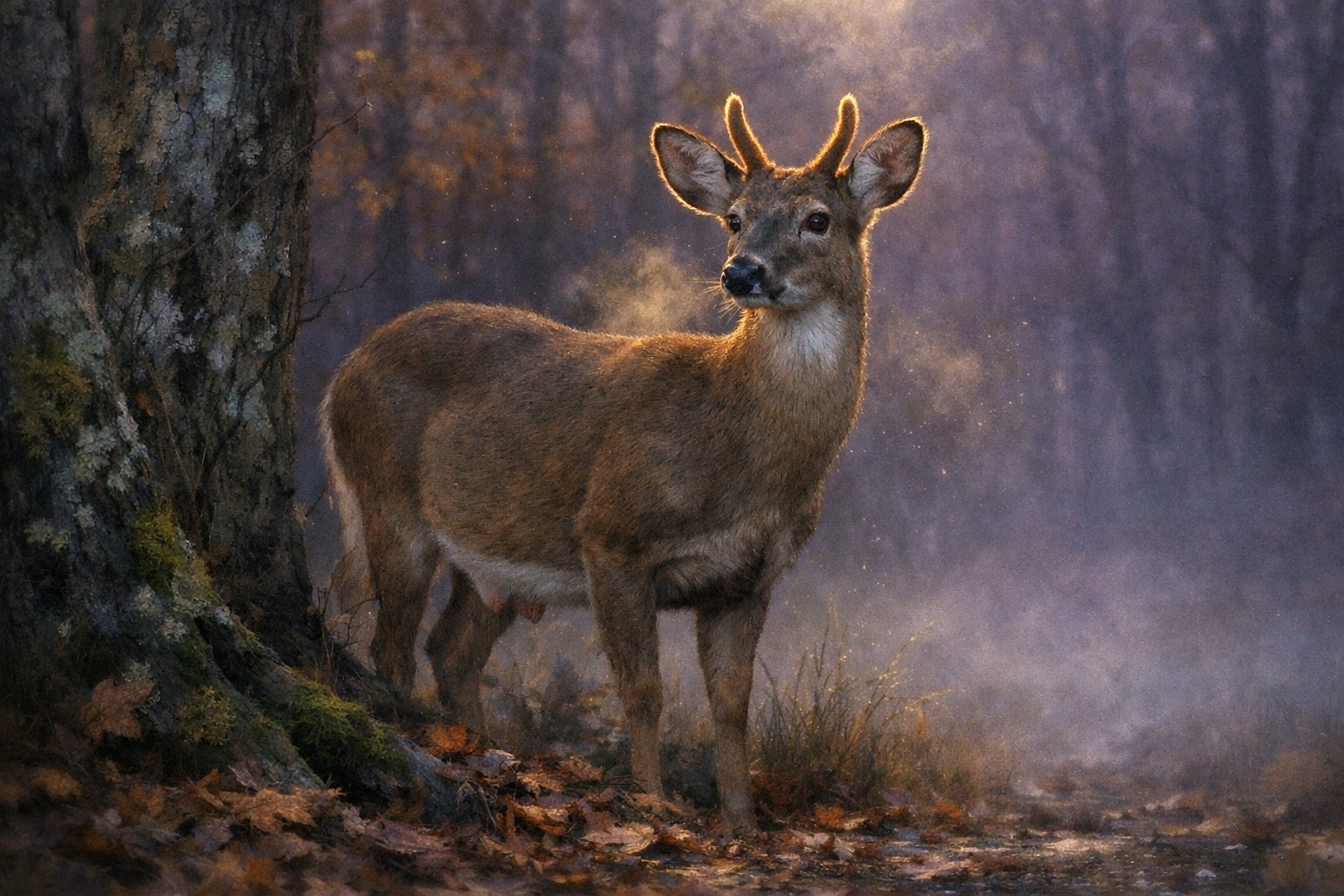
The white hart served as the personal heraldic badge of King Richard II of England, who reigned from 1377 to 1399 and had himself painted kneeling before a livery of white harts in the Wilton Diptych around 1395 [6]. A pale deer marked the boundary between the visible world and the other one.
In medieval hunting lore the white hart was the quarry that could not be caught, a creature of the otherworld that lured riders past the edge of the known map. Christian conversion stories sharpened the symbol: both Saint Hubert and the earlier Saint Eustace are said to have seen a glowing crucifix between a stag’s antlers, an image that survives today on bottles of Jagermeister [6]. The motif runs east as well. In Hungarian origin myth the csodaszarvas, the miracle stag, leads the brothers Hunor and Magor across rivers into new country, and the two are named as ancestors of the Huns and the Magyars [12]. Across these traditions the white deer never behaves like prey to be eaten; it behaves like a guide, drawing a king, a saint, or a whole migrating people toward a destination they did not know they were seeking.
White Serpents in Chinese and Japanese Tradition
The Legend of the White Snake, counted among China’s Four Great Folktales, centers on Bai Suzhen, a white-serpent spirit who takes human form, marries the young scholar Xu Xian, and is finally imprisoned beneath Hangzhou’s Leifeng Pagoda by the monk Fahai [7]. The snake here is a heroine, not a monster.
Across the sea, white snakes carry a different but related charge. In Japan a shirohebi, a white snake, is read as a messenger of Benzaiten, the goddess of water, music, and fortune, and a white serpent found in a grain store was welcomed as a guardian that ate the mice [3]. The albino Japanese rat snakes of Iwakuni became the most famous case: the local population was declared a National Monument in 1924 and is honored at its own shrine [13]. These Iwakuni serpents are, biologically, a genuinely albino lineage, and a 2018 genetic study traced their coloring to a nonsense mutation in the tyrosinase gene, the same enzyme failure that produces albinism across vertebrates [10]. The animal worshipped as an avatar of a goddess is, at the level of a single broken gene, a snake that cannot manufacture pigment.
The Biology Behind the Sacred
Albinism and leucism are two distinct pigment failures, and most famous white animals are leucistic rather than albino, which is why a white buffalo or a spirit bear can still have dark eyes [9]. The folklore rarely cares about the difference; the biology always does.
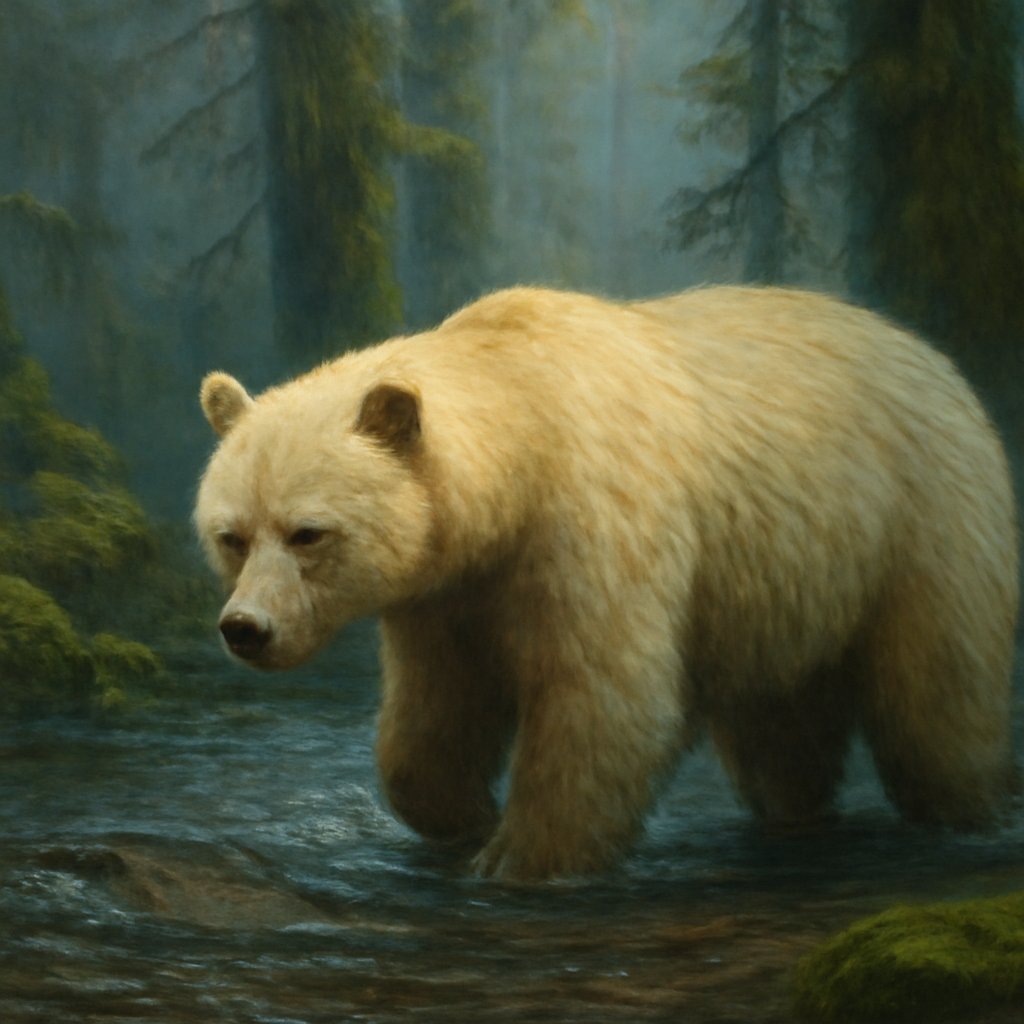
In albinism the pigment cells are present but the enzyme tyrosinase is missing or broken, so no melanin is made and the eyes show the pink of underlying blood vessels [9]. Leucism is a partial loss of pigment cells that leaves the coat white or patchy while the eyes keep their normal color [9]. The Kermode bear, or spirit bear, of coastal British Columbia is leucistic, not albino: a single recessive substitution in the MC1R gene, carried by ordinary black bears, occasionally pairs up to produce a cream-colored cub [8]. Fewer than four hundred white individuals exist, concentrated on a few islands sacred to the Gitga’at and Kitasoo nations of the Great Bear Rainforest, and a 2009 study by Klinka and Reimchen found the white bears were about thirty-five percent more successful at catching salmon by day, because fish evade a pale shape less readily than a dark one [8]. Two things get conflated here: the symbol and the survival cost. In open habitat an albino loses camouflage and ultraviolet protection, so the rare white animal a culture exalts is usually the same one natural selection quietly penalizes. That tension between assigned meaning and biological cost runs through every case here, and it is the lens a working ethologist’s field bio brings to the wider albino animal phenomena and legends archive.
Frequently Asked Questions
What is the difference between albinism and leucism in these legends?
Albinism is a failure of the enzyme tyrosinase that stops melanin production and leaves the eyes pink or red. Leucism is a partial loss of pigment cells that whitens the coat while the eyes stay normally colored. Many legendary white animals, including most white buffalo and the spirit bear, are leucistic rather than true albinos [9][8].
Was Miracle the white buffalo a true albino?
No. Miracle, born near Janesville, Wisconsin, on 20 August 1994, was a rare white bison rather than an albino, and she changed coat color over her life. In Lakota tradition her significance came from the prophecy of White Buffalo Calf Woman, not from her genetics [1].
Are sacred white elephants actually white?
Not literally. The Thai term chang samkhan means “auspicious elephant.” These animals have soft reddish-brown skin that turns pink when wet, along with fair eyelashes and toenails, and are not albinos. Their value lay in signaling the legitimacy of a Buddhist king [4].
Was Mocha Dick a real whale?
Yes. Mocha Dick was a pale sperm whale documented near Mocha Island off Chile in the early 1800s. Explorer Jeremiah N. Reynolds described him in The Knickerbocker in 1839, and Herman Melville used that account, with the 1820 sinking of the whaleship Essex, to create Moby-Dick in 1851 [2][5].
What did the white hart symbolize in medieval Europe?
The white hart symbolized purity, the soul’s pursuit of the divine, and a quest into the otherworld. King Richard II adopted it as his heraldic badge, and conversion legends of Saint Hubert and Saint Eustace described a crucifix appearing between a stag’s antlers [6].
Why are white snakes sacred in Japan?
In Japanese belief a white snake, or shirohebi, is a messenger of Benzaiten, the goddess of fortune and water, and a protector of granaries. The albino Japanese rat snakes of Iwakuni were named a National Monument in 1924 and are honored at a dedicated shrine [3][13].
What is the spirit bear, and is it albino?
The spirit bear, or Kermode bear, is a white-coated American black bear of coastal British Columbia. It is leucistic, not albino, caused by a recessive MC1R gene variant. Fewer than four hundred exist, and they are sacred to the Gitga’at and Kitasoo First Nations [8].
Why do so many cultures treat white animals as sacred?
White animals are rare and highly visible, a combination that reads as meaningful. Because a pale individual stands out sharply against its habitat and appears perhaps once in a generation, many cultures interpreted the sighting as an omen, a divine messenger, or proof of a ruler’s legitimacy [1][4].
Do these legends share a common pattern across civilizations?
Yes. From the Lakota white buffalo to Thai white elephants, the European white hart, and East Asian white snakes, the same rare pale animal is read as a messenger, a guide, or a mark of legitimate power. The biology is ordinary albinism or leucism; the meaning is assigned by the culture that sees it.