What Are the Anasazi Cliff Dwellings?
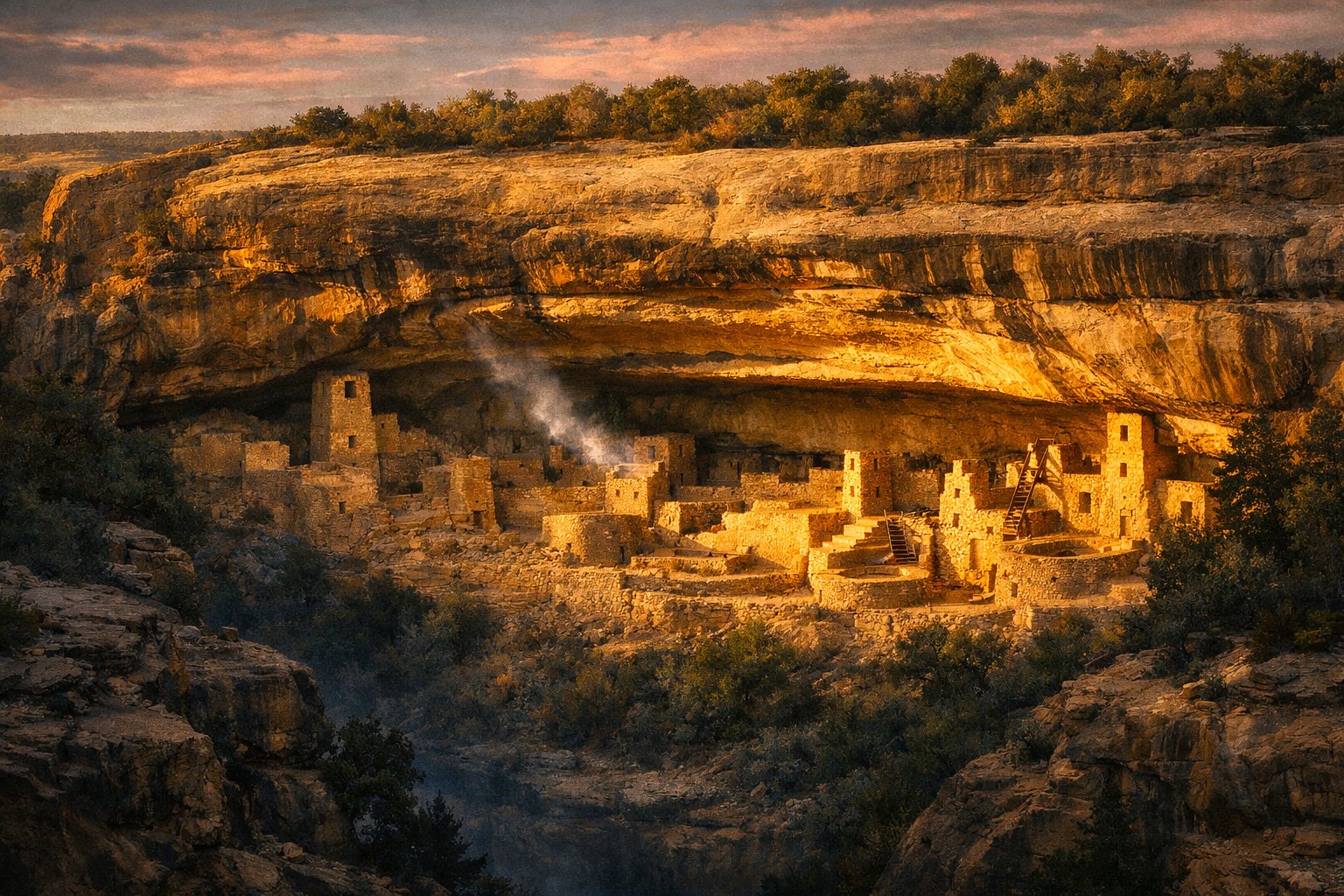
The Anasazi cliff dwellings are stone villages the Ancestral Puebloans built inside natural sandstone alcoves across the Four Corners region between roughly 1190 and 1300 CE. The largest, Cliff Palace at Mesa Verde, holds about 150 rooms and 23 kivas beneath a single overhanging cliff [1][3].
Published: 2026-06-05. Last reviewed: 2026-06-05.
You come up onto the green tableland of southwestern Colorado expecting a ruin and find instead a town. The first time I walked the rim trail above Cliff Palace, the light was doing the thing that low desert light does in late afternoon, raking sideways across the canyon and turning the sandstone the colour of weak tea, and the village below sat in its alcove the way a swallow’s nest sits under an eave: tucked, deliberate, sheltered from the weather by a hundred feet of rock overhead. A word on the name before we go further. Archaeologists and, more importantly, the descendant communities themselves now prefer Ancestral Puebloans to the older Navajo loanword Anasazi, which carries the freight of “enemy ancestors” and which the living Pueblo peoples find inaccurate at best [7]. I use both terms here because the search-term and the scholarship have not yet finished changing places, but the people who built these walls are not a vanished mystery. Their grandchildren run the visitor desks.
Why the Ancestral Puebloans Moved Into the Cliffs
Around 1190 CE the Ancestral Puebloans abandoned their open mesa-top villages and rebuilt their towns inside the sandstone alcoves below the rim, a relocation that unfolded across most of a generation throughout the Mesa Verde region [1][4]. They had farmed the flat green mesas for roughly six centuries before this, living in pit houses and then in above-ground masonry pueblos out in the open, where the corn was. The move down into the cliffs reversed that logic. Suddenly the houses were hard to reach and the fields were a climb away, up hand-and-toe holds pecked into vertical rock.
Two things get conflated here, and the site itself helps separate them. The alcoves offered defence, certainly: a village reached only by a ladder you can pull up behind you is a village an enemy cannot rush. But the rock was also doing quieter work. The great south-facing and southwest-facing alcoves act as passive solar machines, catching the low winter sun deep under the overhang to warm the stone through the cold months, while the high summer sun stays off the dwellings and keeps them shaded and cool [4]. Springs seep from the contact line at the back of many alcoves, where porous sandstone meets impermeable shale, so the people who moved in were trading easy field-access for shelter, climate control, and water that came out of the wall. The fields stayed up top. The home moved into the cliff.
Cliff Palace and the Stone Towns of Mesa Verde
Cliff Palace, the largest cliff dwelling in North America, contains roughly 150 rooms and 23 kivas and once housed about 100 to 120 people beneath a single Mesa Verde alcove [3]. It came back to wider notice on 18 December 1888, when two ranchers, Richard Wetherill and his brother-in-law Charlie Mason, looking for stray cattle in a December snow, reined up at the canyon rim and saw the towers across the gap; a Ute man named Acowitz had spoken to Wetherill of a great house in the cliffs before that [3]. The Wetherills’ subsequent pot-hunting is a complicated inheritance, and the modern park exists partly as a correction to it.
Cliff Palace is the headline, but the green table holds more than 600 cliff dwellings, most of them small, a few of them famous [1]. Spruce Tree House, the third largest and the best preserved, was raised between about 1211 and 1278 and carried sixty to eighty residents in roughly 130 rooms and eight kivas, though rockfall risk has kept it closed to visitors since 2015. Balcony House, the adventurous one, asks you up a thirty-two-foot ladder and through a crawl tunnel for its thirty-eight rooms. Long House, out on the quieter Wetherill Mesa, rivals Cliff Palace in scale.
| Dwelling | Location | Built (CE) | Rooms | Kivas |
|---|---|---|---|---|
| Cliff Palace | Mesa Verde, CO | c. 1200 to 1280 | ~150 | 23 |
| Long House | Wetherill Mesa, CO | c. 1200 to 1275 | ~150 | 21 |
| Spruce Tree House | Mesa Verde, CO | c. 1211 to 1278 | ~130 | 8 |
| Balcony House | Mesa Verde, CO | c. 1250 to 1275 | 38 | 2 |
| Keet Seel | Tsegi Canyon, AZ | c. 1250 to 1286 | ~150 | 6 |
| Montezuma Castle | Verde Valley, AZ | after c. 1100 | ~20 | 0 |
How the Cliff Dwellings Were Built
Ancestral Puebloan masons built their cliff towns from hand-shaped sandstone blocks set in mud-and-ash mortar, roofed with timber beams, and entered through distinctive T-shaped doorways cut wide at the shoulders so a person carrying a load could pass [4]. The standard wall was core-and-veneer: a rubble heart faced with carefully dressed stone, the joints chinked with small spalls and then plastered, sometimes painted. Roofs and upper floors rode on vigas, the heavy primary beams of Douglas fir or ponderosa pine carried in from higher forests, crossed by latillas of split juniper and finished with brush and packed adobe.
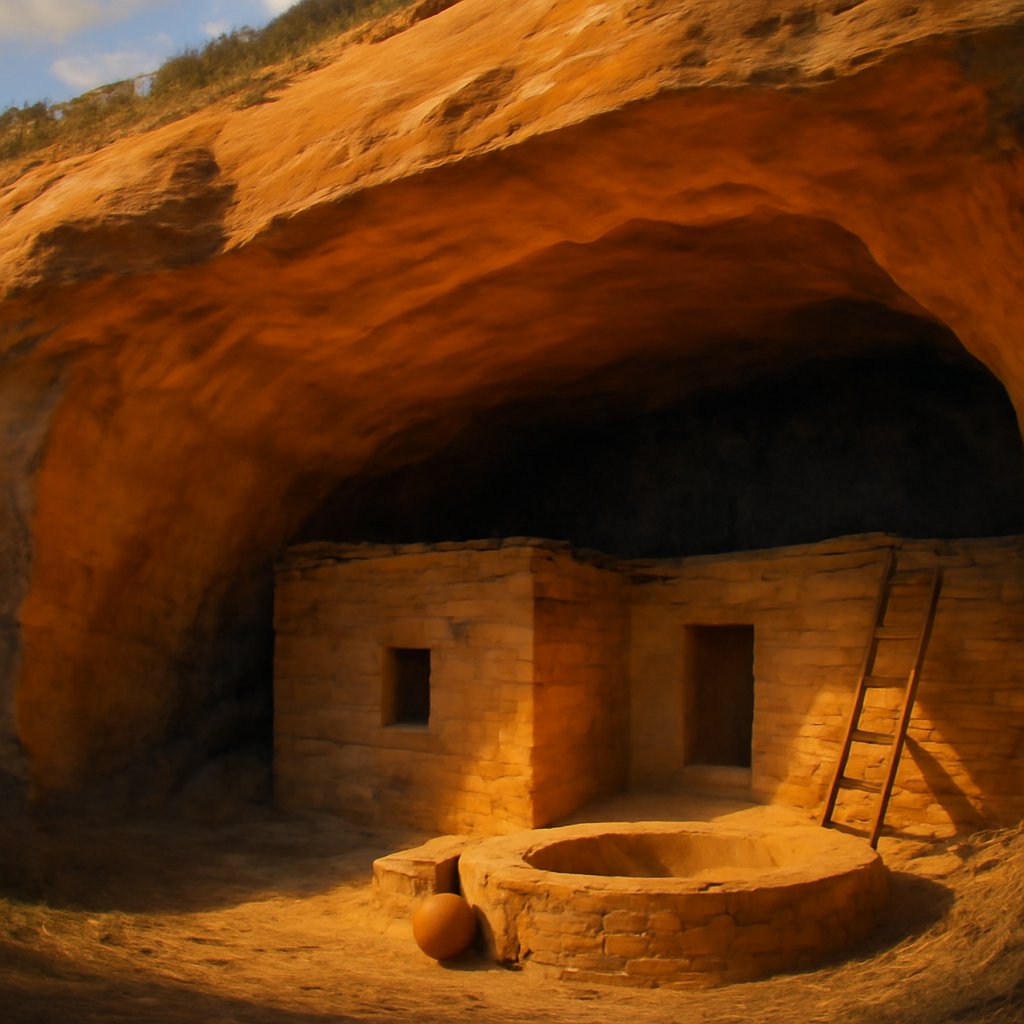
The round, sunken rooms are kivas, and they are the clue that these were not merely shelters but communities. A Mesa Verde kiva is a subterranean ceremonial and social chamber, ringed by six masonry pilasters that carried a cribbed roof, with a central firepit, a ventilator shaft, a deflector slab, and a small floor hole called a sipapu that stands for the place of emergence in Pueblo origin accounts [3]. Around the living rooms you find mealing bins set with graded grinding stones for processing maize, the storage rooms that held beans and squash and dried corn, and the bones of domesticated turkeys. The people farmed the mesa above, ground their corn in the alcove below, fired black-on-white pottery, and traded for shell from the Pacific and, occasionally, scarlet macaws carried up the long road from Mesoamerica.
Reading the Dates in the Rings
The reason we can date a wall at Mesa Verde to a particular decade, rather than guessing across centuries, is a quiet revolution worked out by the astronomer Andrew Ellicott Douglass between 1901 and 1929 [5]. Douglass noticed that trees in an arid climate write the same sequence of fat and thin rings, year for year, and that a master calendar built from living trees could be walked backward through ever-older beams. What the 1929 beam actually establishes is the link itself: on 22 June 1929 a charred timber catalogued as HH-39, pulled from the Show Low site in Arizona, bridged the gap between the living-tree chronology and the floating prehistoric one, and the cliff dwellings acquired exact construction dates overnight [5]. Douglass announced the result that December in National Geographic and published felling dates for six Mesa Verde dwellings. A roof beam became a signature, and the buildings stopped being timeless.
Montezuma Castle and the Wider Cliff-Dwelling World
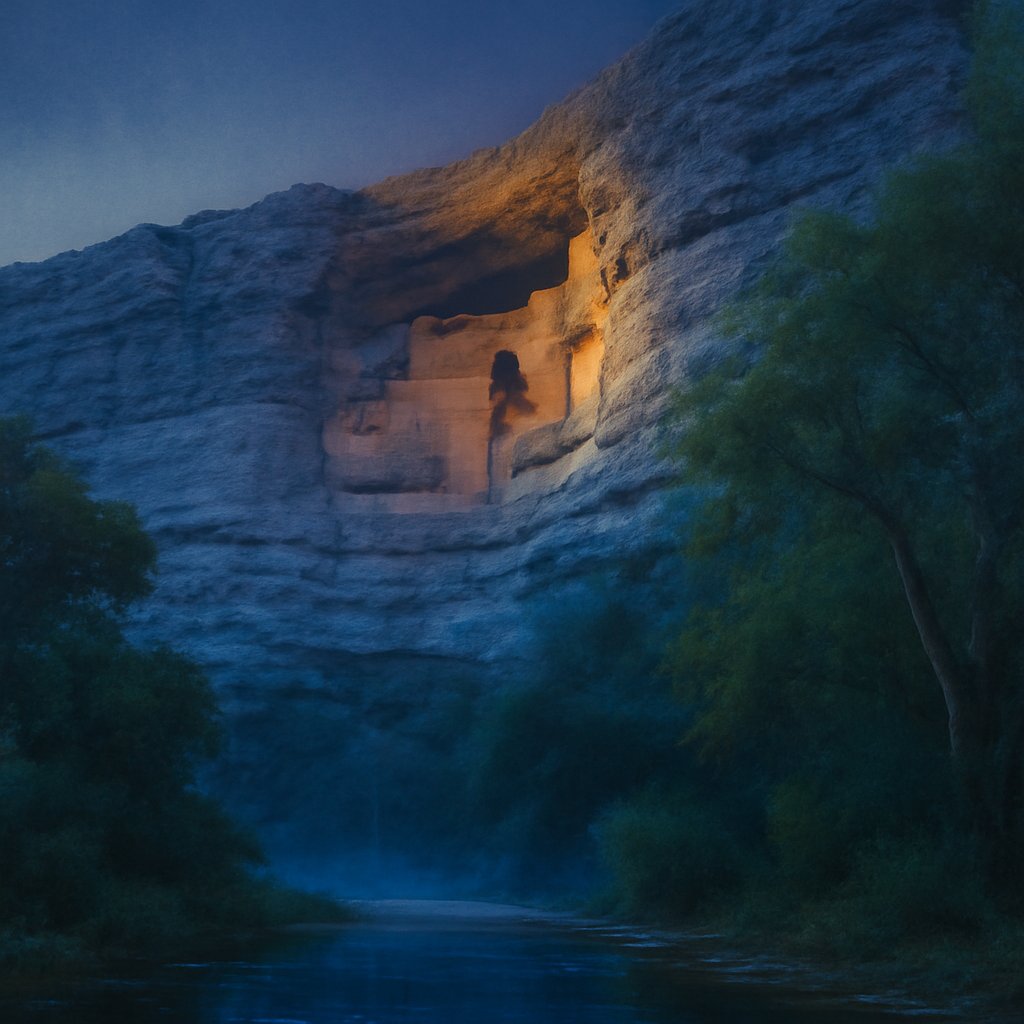
Montezuma Castle, a five-story, roughly twenty-room dwelling set about ninety feet up a limestone cliff above Beaver Creek in Arizona’s Verde Valley, was raised not by the Ancestral Puebloans but by the neighbouring Southern Sinagua, beginning sometime after 1100 CE [6]. The name is a double error left behind by nineteenth-century settlers, who assumed both that the ruin was a castle and that the Aztec emperor Moctezuma had a hand in it; neither is true, and the building predates Moctezuma by centuries. What is true is that the alcove protected the masonry so completely that it remains one of the best-preserved cliff dwellings on the continent, which is also why visitors have not been allowed to climb into it since 1951.
The cliff-dwelling habit spread across the whole Colorado Plateau in these centuries, built by related but distinct peoples. In Canyon de Chelly, on Navajo land in northeastern Arizona, the White House Ruin tucks a pale-plastered Ancestral Puebloan village under a streaked sandstone wall, begun around 1060 CE and grown to perhaps eighty rooms [8]. North of there, at Navajo National Monument, the enormous alcoves of Betatakin and Keet Seel hold villages built in a single tight burst between about 1250 and 1286, Keet Seel carrying some 150 rooms and Betatakin tucked into a void 450 feet tall [8]. To stand under any of them is to read the same argument in different dialects of stone: water, defence, sun, and the gathering of scattered farms into one defensible roof.
Why the Alcoves Emptied
By 1300 CE the cliff dwellings of Mesa Verde stood empty, their builders having migrated south toward the Rio Grande and the Hopi mesas during a severe, tree-ring-documented drought that ran from 1276 to 1299 [4][5]. The conflation worth resolving is the one the older guidebooks built their drama on: the Ancestral Puebloans did not vanish. The Great Drought of 1276 to 1299 stacked onto soil exhaustion, deforestation, and social strain, and the people did what farmers under pressure have always done, which is leave for better ground. Their descendants are the living Pueblo nations of today, the Hopi, Zuni, Acoma, Laguna, and the Rio Grande pueblos, who trace their clans back to these very canyons [7]. The architecture stayed; the families walked. The full story of that departure, with its competing theories of violence, climate, and pilgrimage, is one I have told separately in the companion account of the Anasazi disappearance, and it deserves its own long look.
Standing at the Sites: Visiting and Visitor Ethics
Mesa Verde National Park protects more than 600 cliff dwellings and over 5,000 archaeological sites across the green tableland of southwestern Colorado, and the major dwellings can be entered only on a ranger-guided tour, by ticket, in season [1][2]. The park was the first in the United States set aside to protect the works of human hands rather than a landscape, established by Congress in 1906, and it carries UNESCO World Heritage status granted in 1978 [2]. Buy the timed ticket for Cliff Palace early; the tour involves uneven steps and short ladders, and the rangers, several of them Puebloan, are the local guides worth listening to.
A note on conduct, because these are not empty monuments. The cliff dwellings are ancestral homes to living people, and Canyon de Chelly in particular can be entered below the rim only with a Navajo guide, both by law and by courtesy. Do not climb on walls, do not pocket a potsherd, and do not treat a kiva as a photo backdrop. The ethic that serves a visitor best at any of these sites is the one the dwellings themselves model: arrive quietly, look long, and leave the place able to keep teaching the next person who climbs up to it. For the wider context of how preserved sacred landscapes carry meaning across cultures, see the guide to mystical places and lost worlds, and for more of this kind of on-the-ground reporting, the field notes of travel-historian Theodora Marsh gather the rest of the route.
Frequently Asked Questions
Who built the Anasazi cliff dwellings? The Ancestral Puebloans, long called the Anasazi, built the cliff dwellings of the Four Corners region. They are the ancestors of today’s Pueblo peoples, including the Hopi, Zuni, and Acoma, and the term Anasazi is a Navajo word now considered inaccurate by those descendant communities [3][7].
When were the cliff dwellings built? Most of the large cliff dwellings were built and occupied during the Pueblo III period, roughly 1190 to 1300 CE. Cliff Palace itself was constructed mainly between about 1200 and 1280, dated precisely by tree-ring analysis of its roof beams [3][5].
Why did the Ancestral Puebloans build into cliffs? They moved into alcoves around 1190 CE for a combination of reasons: defence behind retractable ladders, the passive-solar warmth of south-facing overhangs in winter, and access to springs that seep from the back of the alcoves, while keeping their farm fields on the mesa tops above [4].
How big is Cliff Palace? Cliff Palace is the largest cliff dwelling in North America, with about 150 rooms and 23 kivas. Archaeologists estimate it housed roughly 100 to 120 people at its height in the thirteenth century [3].
What is a kiva? A kiva is a round, usually subterranean ceremonial and social chamber. Mesa Verde kivas have six roof-supporting pilasters, a central firepit, a ventilation system, and a small floor hole called a sipapu symbolising the place of emergence in Pueblo tradition [3].
How were the cliff dwellings constructed? Builders shaped sandstone blocks with stone tools and set them in mud-and-ash mortar, building core-and-veneer walls finished with plaster. Roofs rested on heavy timber beams called vigas, crossed by smaller latillas and packed with adobe [4].
Who discovered Cliff Palace? Ranchers Richard Wetherill and Charlie Mason came upon Cliff Palace on 18 December 1888 while searching for cattle, guided in part by prior knowledge from a Ute man named Acowitz. Indigenous people, of course, had always known the canyons [3].
Is Montezuma Castle an Anasazi cliff dwelling? No. Montezuma Castle in Arizona’s Verde Valley was built by the Southern Sinagua, a related but distinct culture, after about 1100 CE. Its name is a settler-era error: it is neither a castle nor connected to the Aztec emperor Moctezuma [6].
Why were the cliff dwellings abandoned? The cliff dwellings emptied by about 1300 CE as a severe drought from 1276 to 1299, combined with depleted soils and social pressures, drove the people to migrate south to the Rio Grande and Hopi mesas. They did not disappear; their descendants are the modern Pueblo nations [4][7].
Can you visit the Anasazi cliff dwellings today? Yes. Mesa Verde National Park in Colorado opens its major dwellings on ranger-guided tours, and sites such as Montezuma Castle, Canyon de Chelly, and Navajo National Monument are protected and open to respectful visitors, some only with a Native guide [1][8].
Sources
- National Park Service. “Cliff Dwellings” and park overview, Mesa Verde National Park. nps.gov/meve.
- UNESCO World Heritage Centre. “Mesa Verde National Park.” Inscribed 1978, List ref. 27. whc.unesco.org/en/list/27.
- “Cliff Palace.” Colorado Encyclopedia and Wikipedia. Rooms, kivas, population, and the 18 December 1888 sighting by Richard Wetherill and Charlie Mason. coloradoencyclopedia.org/article/cliff-palace.
- Encyclopaedia Britannica. “Cliff dwelling” and “Ancestral Pueblo culture.” Construction, passive-solar siting, and the 1276 to 1299 drought. britannica.com/technology/cliff-dwelling.
- Laboratory of Tree-Ring Research, University of Arizona, and A. E. Douglass biography. Beam HH-39, Show Low, 22 June 1929; National Geographic, December 1929. en.wikipedia.org/wiki/A._E._Douglass.
- National Park Service and Wikipedia. “Montezuma Castle National Monument.” Southern Sinagua builders, five stories, c. 1100 CE onward, naming error. nps.gov/moca.
- Indian Pueblo Cultural Center and National Park Service, “Ancestral Pueblo People and Their World.” Etymology of “Anasazi,” preferred terminology, and living descendant nations. indianpueblo.org.
- National Park Service and World History Encyclopedia. Canyon de Chelly White House Ruin; Navajo National Monument, Betatakin and Keet Seel. nps.gov/nava.