By Sloane Reeve · Published May 13, 2026 · Updated May 13, 2026
Last reviewed: May 13, 2026.
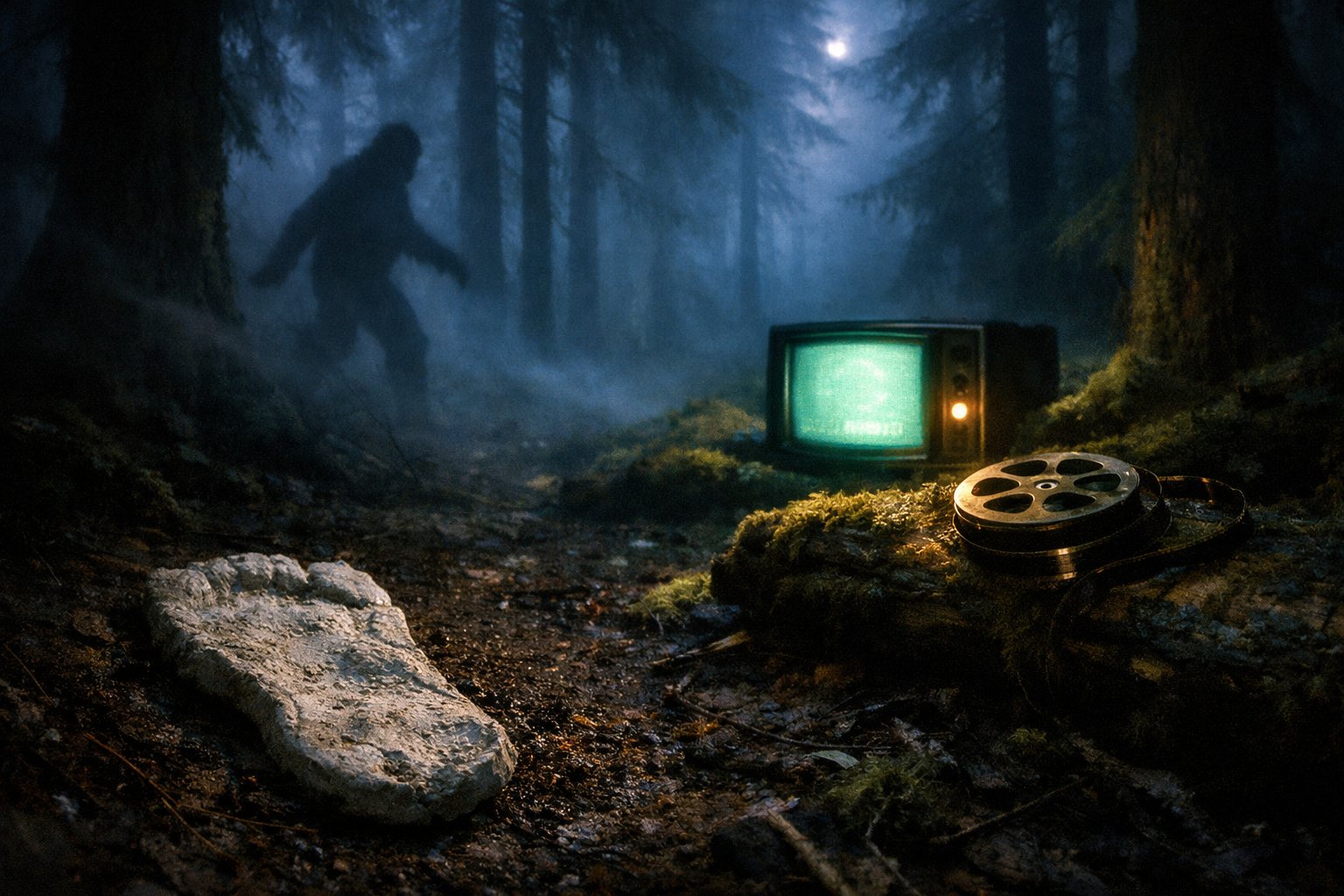
If you want to study Bigfoot as a biological question, go read the track casts and the eDNA papers. If you want to study Bigfoot as a cultural phenomenon, watch the films. Almost everything most people know about Sasquatch, including what they think a sighting looks like, was authored on screen. The creature, as a popular image, is largely a product of cinema and television.
That image has a documented genealogy. It runs from a single shaky 16mm clip filmed in 1967 to a 2024 indie release in which two performers in fur suits never speak a word. Across nearly sixty years, the same forest, the same gait, and the same shoulder roll keep recurring. The question this article takes seriously is not whether Bigfoot is real. It is how the visual conventions of Bigfoot were built, who built them, and what those conventions now do to the testimony of people who say they have seen one.
Direct Answer
Bigfoot in film and television is a media tradition founded by the 1967 Patterson-Gimlin footage and standardized by The Legend of Boggy Creek (1972). The genre runs through family comedies like Harry and the Hendersons (1987), reality series including Finding Bigfoot (2011-2018) and MonsterQuest (2007-2010), and indie features such as Sasquatch Sunset (2024) [1][2][3].
Patterson-Gimlin and the Birth of Bigfoot Cinema
On 20 October 1967, Roger Patterson and Bob Gimlin filmed roughly 59.5 seconds of 16mm Kodachrome II near Bluff Creek in northern California [1]. The figure walking through frame, later designated Subject or “Patty,” has been studied, redrawn, and re-edited in nearly every Bigfoot media product since. From a zoological standpoint the footage is contested. From a media standpoint it is the most consequential cryptid document ever recorded.
What the film established was a visual vocabulary. The bipedal gait with a slight forward lean, the long-arm swing, the over-the-shoulder glance back toward the camera at roughly frame 352, the dense conifer backdrop. Every later filmmaker who put a Sasquatch on screen had to either replicate this template or deliberately reject it. Historian Joshua Blu Buhs argues in Bigfoot: The Life and Times of a Legend that Patterson, a rodeo rider with cinematic ambitions, was already trying to produce a movie and treated the footage as a proof-of-concept reel [2]. The footage was, in other words, never neutral evidence. It was authored.
Field-note observation: the footprint cast Patterson recovered at the scene shows a midtarsal break, a feature later researchers including Jeff Meldrum have argued is anatomically unusual for a hoax [3]. That claim is separate from whether the film is genuine. The film, as cinema, did its work regardless.
Why the footage keeps recurring
Almost every documentary about Bigfoot uses the Patterson-Gimlin clip, often within the first three minutes, frequently in slow motion with frame numbers superimposed. It functions in the way the Zapruder film functions in JFK documentaries. It is the founding visual quote, the thing the audience already knows, the touchstone the show needs to credential itself before showing anything new.
The Mockumentary Template: Boggy Creek to Sasquatch Sunset
In 1972 Charles B. Pierce released The Legend of Boggy Creek, a docudrama about the Fouke Monster of Arkansas shot on a reported budget under $160,000 and grossing roughly $20 million in theatrical release [4]. The film is not strictly about Sasquatch, but its formal vocabulary became the template for almost every Bigfoot feature that followed: pseudo-documentary narration, dramatized re-enactments of “real” witness accounts, the creature glimpsed at the edges of long takes, and a forest soundscape doing most of the affective work.
The mold proved durable. Low-budget Bigfoot features that adopted some version of the Boggy Creek template include Sasquatch: The Legend of Bigfoot (1977), the more recent Exists (2014) and Willow Creek (2013), and Bobcat Goldthwait’s found-footage Willow Creek in particular returns the form to its origin point by setting the climactic encounter at the actual Patterson-Gimlin filming site.
The 2024 Zellner brothers film Sasquatch Sunset represents the most formally ambitious entry in this lineage. The film tracks a family of four Sasquatches across one year in the Pacific Northwest, performed by Jesse Eisenberg, Riley Keough, Christophe Zajac-Denek, and Nathan Zellner in full-body prosthetic costume, with no human dialogue [5]. The film treats its subjects as a vertebrate species with seasonal behavior, mating, and mortality. It is closer to a wildlife documentary about a fictional ape than to a horror film. The shift signals that, at least in arthouse cinema, Bigfoot has been domesticated.
Bigfoot on Mainstream Television: From The Six Million Dollar Man to Harry and the Hendersons
Bigfoot’s first sustained network television run came in a 1976 two-part episode of The Six Million Dollar Man titled “The Secret of Bigfoot,” in which Andre the Giant played Sasquatch as a cybernetic alien guardian [6]. The episode introduced Bigfoot to a Friday-night family audience and, critically, decoupled the creature from the cryptozoological literature. Bigfoot here was a network-TV character, not a candidate species.
The defining mainstream Bigfoot text remains Harry and the Hendersons (1987), produced by Steven Spielberg’s Amblin Entertainment, directed by William Dear, and starring John Lithgow [7]. Rick Baker’s animatronic and prosthetic creature design won the Academy Award for Best Makeup. The film recasts Bigfoot as a gentle, sentient family member, a move that in retrospect did several things at once: it locked in a non-threatening visual register that competed with the slasher-adjacent treatment of earlier Bigfoot films, it created a generation of viewers whose first mental image of Sasquatch was a hugger rather than a stalker, and it provided a commercial proof that the figure could carry a PG-rated feature.
In short: by 1987 there were two Bigfoots on screen. There was the menacing Boggy Creek creature seen only in flashes, and there was Harry, who slept on the couch.
Animated and ancillary appearances
Bigfoot’s television footprint expanded laterally through animation and procedural cameo. The Secret of Sasquatch (1991), Disney’s Bigfoot Presents: Meteor and the Mighty Monster Trucks (2006), and The X-Files all gave the creature appearances of varying seriousness. Sasquatch Sunset aside, the late-2010s saw the figure most often appearing in animated children’s media, including the 2018 feature Smallfoot, which inverted the premise by making yeti the protagonists searching for the legendary humans.
The Reality-TV Era: Finding Bigfoot, MonsterQuest, and Mountain Monsters
The cable-television cryptid documentary subgenre, often referred to within the community as “Squatch TV,” emerged in the late 2000s. MonsterQuest ran on History from 2007 to 2010 across four seasons and 56 episodes [8]. Finding Bigfoot followed on Animal Planet from January 2011 to December 2018, running nine seasons and over 100 episodes built around the four-person Bigfoot Field Researchers Organization investigation team led by Matt Moneymaker [9]. Mountain Monsters on Destination America launched in 2013 and continues to produce episodes.
These series share a remarkably consistent grammar. A field team arrives in a wooded region, interviews local witnesses on porches at dusk, deploys thermal cameras and parabolic microphones, conducts a night investigation, captures ambiguous audio or thermal hits, and concludes with a guarded “we believe this area has Bigfoot activity.” The format is not investigative journalism. It is reality television built around a search whose finding would invalidate the show. A working zoologist watching this material would note immediately that the protocols are not designed to falsify the hypothesis. They are designed to sustain it across renewal cycles.
That said, the cultural footprint is significant. By a 2012 audience estimate, Finding Bigfoot was Animal Planet’s most-watched series, drawing in the range of 1.4 million viewers per episode at its peak [9]. Whatever its evidentiary value, the show normalized the practice of treating Bigfoot as a candidate species rather than a folk figure.
The Feedback Loop: How Media Shapes Witness Testimony
From a field-research standpoint, the most interesting effect of sixty years of Bigfoot screen media is what it does to the witnesses. Studies of cryptid eyewitness reports have noted that witness descriptions of Sasquatch have grown more visually consistent over time, even as sightings increased across geographically diverse regions. The standard report now includes the upright gait, the dark conical head shape, the over-the-shoulder turn, the long arms, the absence of a clearly visible neck. That descriptive cluster is the Patterson-Gimlin figure. It is also the Boggy Creek silhouette. It is also Harry.
This is not an accusation of fabrication. It is a methodological observation. When the cultural archive contains a vivid, repeatedly broadcast template for what the creature looks like, witnesses who experience ambiguous forest stimuli at twilight, with imperfect light and high adrenaline, will tend to map that stimulus onto the available template. Folklorists call this process narrative compression. Cryptozoologists call it template contamination. Either way, the modern witness report cannot be treated as independent of the media tradition it draws on.
There is a useful counter-case in the older record. Theodore Roosevelt, in The Wilderness Hunter (1893), reports a story he was told by a frontiersman named Bauman about a creature that killed his trapping partner near the Wisdom River in Idaho [10]. The Bauman creature is bipedal but is described without the by-now-canonical Patterson-Gimlin features. It is, in folkloric terms, a more loosely figured being. Reports from before the 1958 Jerry Crew Humboldt County track castings and the 1967 footage tend to share that looseness. The descriptive narrowing came in only after the screen tradition had work to do.
What the genre will do next
The next decade of Bigfoot media will likely run in two directions at once. Arthouse and prestige features will continue the trajectory Sasquatch Sunset opened, treating the creature as an ecological subject and using zoological grammar instead of horror grammar. Reality television will likely consolidate around fewer surviving franchises, with the unsold premise being any show whose conceit is that the answer arrives in the season finale. Across both registers, the Patterson-Gimlin footage will keep showing up, because it remains the only image the genre genuinely needs.
Sources
- Patterson, R. and Gimlin, B. (1967). 16mm film footage, Bluff Creek, California, 20 October 1967. Held in private and institutional collections; widely available in Britannica’s overview of Bigfoot.
- Buhs, J. B. (2009). Bigfoot: The Life and Times of a Legend. University of Chicago Press.
- Meldrum, J. (2006). Sasquatch: Legend Meets Science. Forge Books.
- Pierce, C. B. (dir.) (1972). The Legend of Boggy Creek. Howco International Pictures.
- Zellner, D. and Zellner, N. (dirs.) (2024). Sasquatch Sunset. Bleecker Street. Premiered Sundance Film Festival, January 2024.
- “The Secret of Bigfoot,” The Six Million Dollar Man, Season 3, Episodes 16-17. ABC, originally aired February 1-22, 1976.
- Dear, W. (dir.) (1987). Harry and the Hendersons. Universal Pictures / Amblin Entertainment. Academy Award for Best Makeup, 1988.
- MonsterQuest. (2007-2010). History Channel. Four seasons, 56 episodes.
- Finding Bigfoot. (2011-2018). Animal Planet. Nine seasons; cast led by Matt Moneymaker, Cliff Barackman, James “Bobo” Fay, and Ranae Holland. See Smithsonian Magazine coverage.
- Roosevelt, T. (1893). The Wilderness Hunter. G. P. Putnam’s Sons. The Bauman story appears in Chapter XIV.
Internal Link
For the broader context of cryptid media coverage on this site, see the parent pillar at Cryptids and Mythical Creatures.
Related reading from the cryptids and mythical creatures archive: The Cardiff Giant: A Famous Hoax and North American Sasquatch: Tribal Tales.