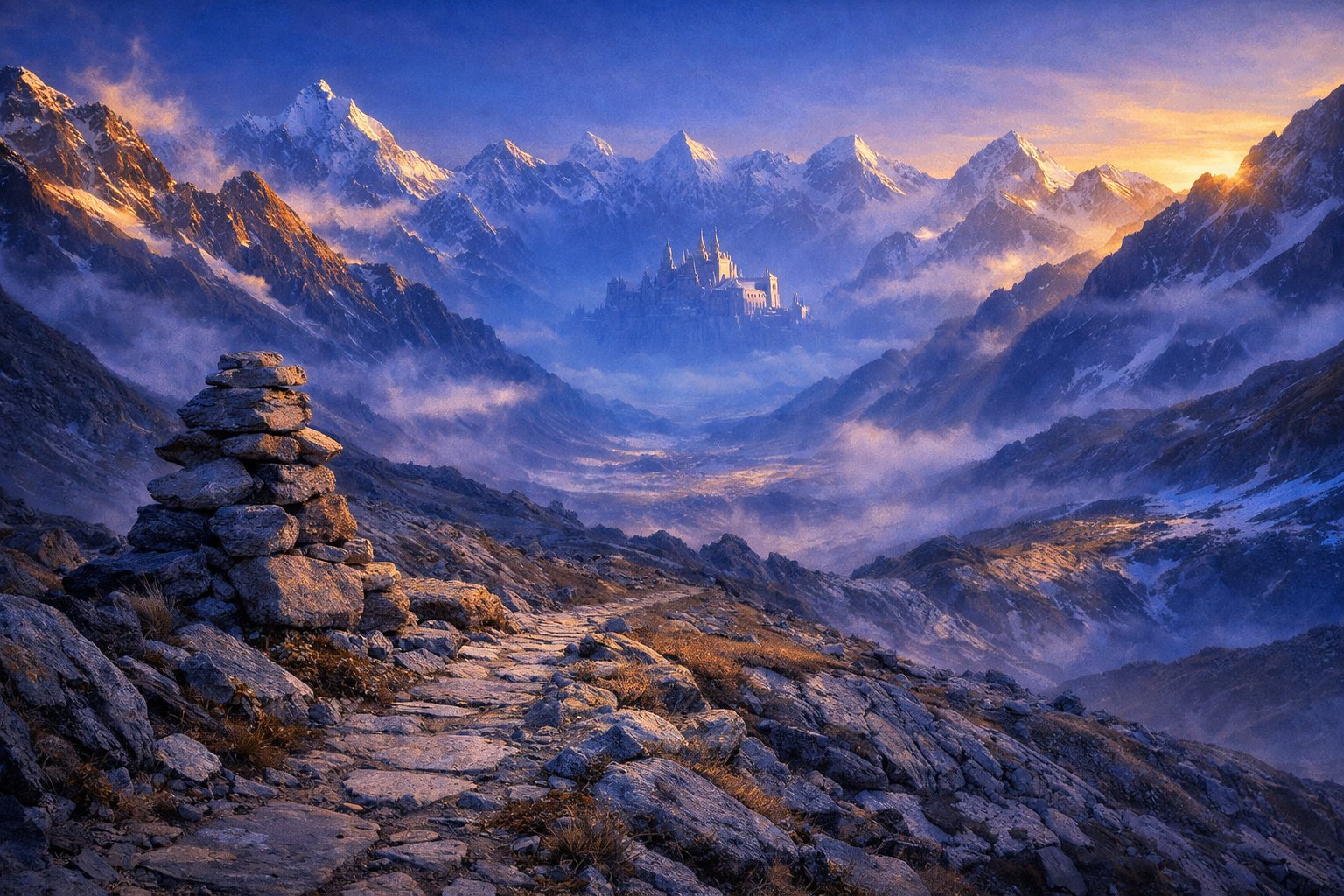
Shambhala is a hidden kingdom from Tibetan Buddhist tradition, described in the Kalachakra Tantra as a lotus-shaped land ringed by snow mountains and ruled by a line of enlightened kings. Part scripture, part sacred geography, it became the West’s Shangri-La and a lasting symbol of an awaited golden age.
I have spent enough time at the foot of the Himalaya to understand why people keep looking north for a kingdom that the texts insist cannot be reached on foot. The light up there does strange things at altitude. Ridge lines stack into haze until the horizon stops being a line and becomes a rumor. Shambhala lives in that rumor, and it has lived there for a thousand years, surviving translation, empire, occult enthusiasm, and a famous Hollywood-adjacent rebrand, without ever yielding a road sign.
What follows treats the kingdom the way I treat any place I cannot stand inside: I read the survey, I name the guides, and I try to separate what the documents say from what later visitors wished they said. The kingdom belongs first to the Buddhist tradition that imagined it, and that is where any honest map of the wider family of mystical places and lost worlds has to begin.
Published: June 5, 2026. Last reviewed: June 5, 2026.
Where the Idea of Shambhala Began
Shambhala first appears in the Kalachakra Tantra, a Buddhist text whose surviving Sanskrit version was composed in the early eleventh century CE and which reached Tibet around 1027, the year that still anchors the sixty-year Tibetan calendar cycle. The kingdom is the frame story for one of the most elaborate teaching systems in the tradition.
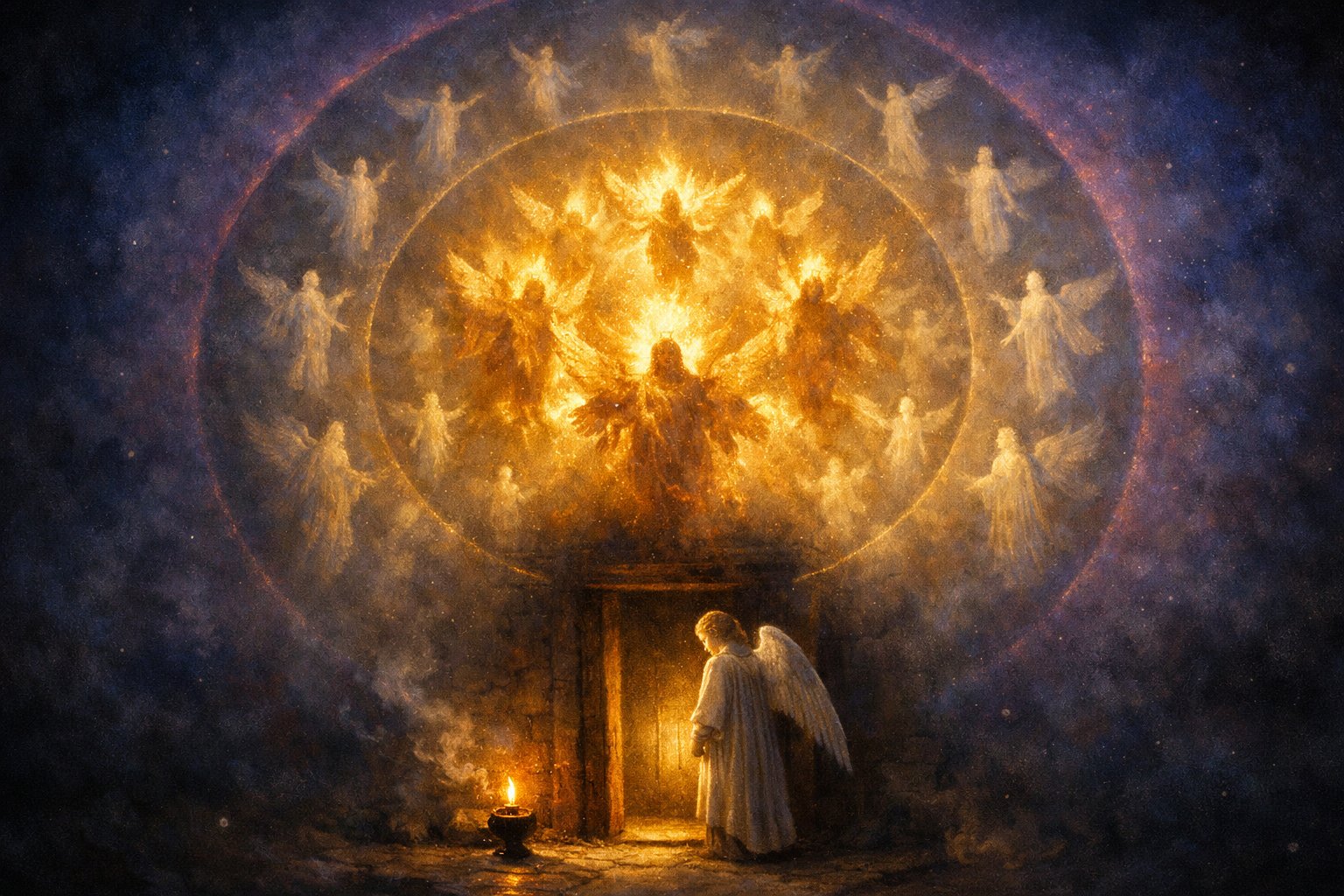
According to the tradition itself, the chain runs much deeper into the past. The Buddha is said to have taught the Kalachakra, the “Wheel of Time,” to King Sucandra of Shambhala at the stupa of Dhanyakataka, near present-day Amaravati in Andhra Pradesh, with ninety-six minor kings in attendance. Sucandra carried the teaching home, set it down in writing, and Shambhala became its vault, keeping the doctrine safe through ages when the wider world had forgotten it, according to the Kalachakra cosmology essays of the Rubin Museum of Himalayan Art.
Legend Time and Documented Time
Two clocks run through this story, and it helps to keep them apart. The popular telling versus the actual record splits here: the tradition places Sucandra’s audience with the Buddha in deep antiquity, while modern Buddhist studies date the composition of the Sri Kalachakra and its Vimalaprabha commentary to roughly 1025 to 1040 CE. Both the survey work of Edwin Bernbaum’s The Way to Shambhala and the Rubin Museum’s art-historical scholarship treat the kingdom as a religious idea with a documented eleventh-century arrival, whatever its legendary prehistory. The Sanskrit name, meanwhile, points back to Sambhal in Uttar Pradesh, a town the Hindu Puranas already named as the birthplace of Kalki, the final avatar of Vishnu.
The Thirty-Two Kings and the Final Battle
Shambhala is governed by a lineage of thirty-two kings, divided into seven Dharmarajas, the founding dharma kings, and twenty-five Kulika or Kalki rulers who preserve the Kalachakra through the long centuries of spiritual decline. The lineage is not decoration. It is the spine of the whole myth.
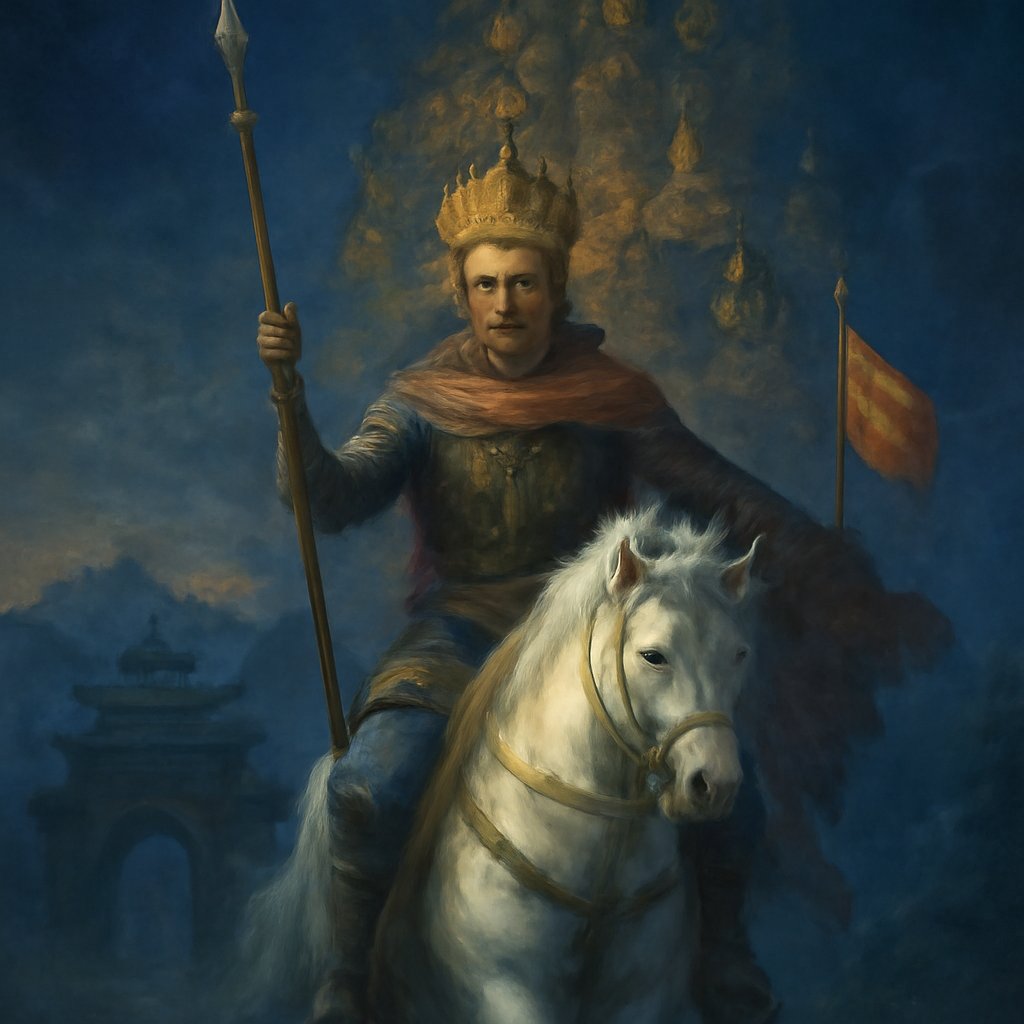
The pivot figure is Manjushrikirti, the eighth king and first of the Kalki line, who unified Shambhala under a single teaching and absorbed or expelled the sun-worshippers who refused it. From him the count runs forward to the twenty-fifth Kalki, Rudra Chakrin, the “wrathful wheel-holder.” It is foretold that when greed and violence have swallowed the outer world, Rudra Chakrin will ride out from Shambhala on a white horse, spear in hand, defeat the forces arrayed against the dharma, and open a worldwide golden age. The Rubin Museum’s study of the Shambhala kings mural at Rebkong identifies that final king at the center of the painted prophecy, and most commentaries place the battle in 2424 or 2425 CE.
The stratigraphy reads, if I can borrow a field term for a textual layer, as warning before reward. The Kalachakra prophecy is unusual among Buddhist scriptures for ending in an army rather than a quiet enlightenment, and serious readers have argued for centuries over whether the barbarian invasion it describes is a literal future event, a coded reference to historical conquest, or an allegory for the war each practitioner wages inside.
Reading the Map: Where Seekers Have Placed Shambhala
Seekers have nominated almost every blank space between Kashmir and the Arctic as the true site of Shambhala, and the tradition itself insists the kingdom lies somewhere north of the Himalaya, behind a double ring of snow peaks shaped like the petals of a lotus. The descriptions are precise enough to map and vague enough to never confirm.
The most quietly persuasive candidate is the Tarim Basin of Central Asia, which matches the Tibetan accounts in size and shape and, tellingly, sits on a river system that flows east, exactly as the texts say the kingdom’s protecting river should. Other readers have looked elsewhere. The explorer Alexandra David-Neel tied Shambhala to Balkh in Afghanistan, and the writer J.G. Bennett proposed that the name itself preserved Shams-i-Balkh, a Bactrian sun temple, which would fold the expelled sun-worshippers back into real geography. Here is where I have to check my own romanticism, because a place that fits this many maps may simply be a place built to fit them.
| Proposed location | Associated with | Basis for the claim |
|---|---|---|
| Tarim Basin, Central Asia | Modern geographic scholarship | Matches the size, shape, and east-flowing river of the texts |
| North of the Himalaya | Tibetan guidebook tradition | The scriptures locate the kingdom beyond the snow ranges |
| Balkh / Bactria, Afghanistan | Alexandra David-Neel, J.G. Bennett | Linguistic link to “Shams-i-Balkh,” a sun temple |
| Altai Mountains, Siberia | Nicholas Roerich | Expedition-era theosophical mapping toward Belukha |
| Sambhal, Uttar Pradesh, India | Sanskrit etymology, Kalki tradition | The name and the Kalki birthplace in the Puranas |
| A purely inner realm | Tibetan commentarial tradition | Accessible only through Kalachakra initiation, not travel |
The earliest European on record reaching for the kingdom was the Portuguese Jesuit Estevao Cacella, who noted the name “Xembala” in 1627 and guessed, wrongly, that it might be Cathay. He set the pattern every later Western seeker would follow: hear the name, assume it points to a findable country, and march.
The Tibetan Guidebooks to a Place You Cannot Drive To
Tibetan literature contains an entire genre of route-guides to Shambhala, the lam-yig or neyig, which read like trekking itineraries until the trail turns into something only a practiced meditator can cross. These texts are the closest thing the tradition offers to a paper map.
The most celebrated was composed by the Panchen Lama Lobsang Palden Yeshe (1738-1780), whose guide to Shambhala stitches together real mountains, rivers, and named landmarks before lifting off into terrain guarded by mantra and merit. Edwin Bernbaum, whose 1980 study remains the standard English account, translated the related Kalapavatara guidebook and others, and read them not as deception but as a deliberate dual map: a journey across physical Asia that is also a journey across the practitioner’s own mind. What the site teaches, in his reading, is that the road and the traveler change together, and that the final passes cannot be walked by someone who has not already done the inner work.
I find this the most honest part of the whole tradition. A guidebook that admits its destination is partly internal is more trustworthy, in its way, than the confident Western expeditions that packed mules and assumed the kingdom would hold still to be found. My own notes on visitor ethics in sacred geography, collected across years of field travel in mystical places, keep returning to that humility.
How Shambhala Became Shangri-La
Shambhala left the monastery and entered the Western imagination in the late nineteenth century, when occult writers recast the Buddhist kingdom as the secret headquarters of hidden spiritual masters. The transformation was fast, and it was thorough.
Theosophy and the Roerich Expeditions
Helena Blavatsky folded Shambhala into Theosophy in Isis Unveiled (1877) and The Secret Doctrine (1888), relocating its enlightened rulers into a network of hidden Masters she placed somewhere beyond the Gobi. A generation later the painter Nicholas Roerich, steeped in that same theosophy, crossed Central Asia between 1925 and 1928 and again in the mid-1930s, carrying the search toward Belukha in the Altai and turning the kingdom into a banner for a coming age of peace. The myth had picked up a new function: no longer just a vault for the dharma, it was now a promised utopia for a war-tired century.
Hilton’s Shangri-La and the Agartha Confusion
In 1933 the novelist James Hilton borrowed the kingdom’s contours for Shangri-La, the serene Himalayan valley of his bestseller Lost Horizon, and gave the secular world a permanent shorthand for paradise behind the mountains. Around the same time the Polish-Russian writer Ferdinand Ossendowski described a subterranean realm called Agharti in Beasts, Men and Gods (1922), and Western readers promptly tangled the two together, so that Shambhala the northern kingdom and Agartha the underground one are still routinely confused. The framing versus fact distinction matters here: Agartha is a separate, largely European invention, and grafting it onto Shambhala obscures what the Buddhist sources actually claim.
What the Myth Still Asks of Us
Shambhala survives most visibly today as a secular ideal, reshaped in 1984 when the Tibetan teacher Chogyam Trungpa published Shambhala: The Sacred Path of the Warrior and offered the kingdom as a model of “enlightened society” open to people of any faith or none. The book sold steadily and launched a worldwide network.
Trungpa’s reading drained the prophecy of its army and kept its aspiration, presenting the warrior not as a soldier but as a person brave enough to face their own mind, a move the Encyclopaedia Britannica’s account of Chogyam Trungpa traces directly into the founding of Shambhala International. The place’s actual claim on us, after all this, is not a set of coordinates. It is a question the tradition has asked in every register, from the Kalachakra initiation to the meditation cushion: what would it take to build a society worth protecting, and are you willing to become the kind of person who could live in it.
That is why I keep looking north into the haze without expecting to find a gate. The kingdom that cannot be driven to is doing exactly what a sacred place is supposed to do. It holds a standard just out of reach and asks the traveler to grow toward it, which is more than most findable countries ever manage, and reason enough to keep it on the map of legendary locations worth understanding.
Frequently Asked Questions
What is Shambhala?
Shambhala is a hidden kingdom in Tibetan Buddhist tradition, described in the Kalachakra Tantra as a lotus-shaped land ringed by snow mountains and ruled by a lineage of enlightened kings who preserve sacred teachings until a prophesied golden age.
Is Shambhala a real place?
No verified physical kingdom matching the descriptions has ever been found. The Tibetan commentarial tradition increasingly treats Shambhala as a realm reachable only through Kalachakra initiation and inner practice, while geographers who look for a literal site most often point to the Tarim Basin of Central Asia.
What is the Kalachakra Tantra?
The Kalachakra, or “Wheel of Time,” is a Buddhist tantra in which Shambhala is the frame story. Its surviving Sanskrit text was composed in the early eleventh century CE and reached Tibet around 1027, where it still anchors the traditional calendar.
How many kings does Shambhala have?
The tradition counts thirty-two kings: seven founding Dharmarajas followed by twenty-five Kulika or Kalki rulers. The twenty-fifth Kalki, Rudra Chakrin, is the figure prophesied to lead the final battle.
Who is Rudra Chakrin?
Rudra Chakrin, the “wrathful wheel-holder,” is the twenty-fifth and final Kalki king of Shambhala. Prophecy holds that he will ride out on a white horse to defeat the enemies of the dharma and inaugurate a golden age, an event most commentaries place around 2424 or 2425 CE.
Is Shambhala the same as Shangri-La?
Not exactly. Shangri-La is a fictional valley invented by James Hilton in his 1933 novel Lost Horizon, modeled loosely on Shambhala and on Tibetan landscapes. Shambhala is the older Buddhist tradition that inspired it.
Is Shambhala the same as Agartha?
No. Agartha is a separate legend of a subterranean kingdom, popularized in the West by Ferdinand Ossendowski’s Beasts, Men and Gods (1922). It is frequently confused with Shambhala, but the two come from different sources and describe different places.
Who first searched the West for Shambhala?
The Portuguese Jesuit Estevao Cacella recorded the name “Xembala” in 1627, the first European known to do so. Later seekers included the Theosophist Helena Blavatsky and the painter-explorer Nicholas Roerich, who searched Central Asia in the 1920s.
Are there guidebooks to Shambhala?
Yes. Tibetan literature includes a genre of route-guides called lam-yig or neyig. The Panchen Lama Lobsang Palden Yeshe wrote a famous one in the eighteenth century, and Edwin Bernbaum translated several in his 1980 study The Way to Shambhala.
Does anyone still follow Shambhala teachings today?
Yes. Chogyam Trungpa recast Shambhala as a secular path in his 1984 book Shambhala: The Sacred Path of the Warrior and founded Shambhala International, which teaches meditation and “enlightened society” as a nonreligious framework drawn from the older myth.