By Theodora “Theo” Marsh · Published May 7, 2026 · Updated May 13, 2026
Last reviewed: May 7, 2026.
Standing on Salisbury Plain at the Hour the Sun Comes Back
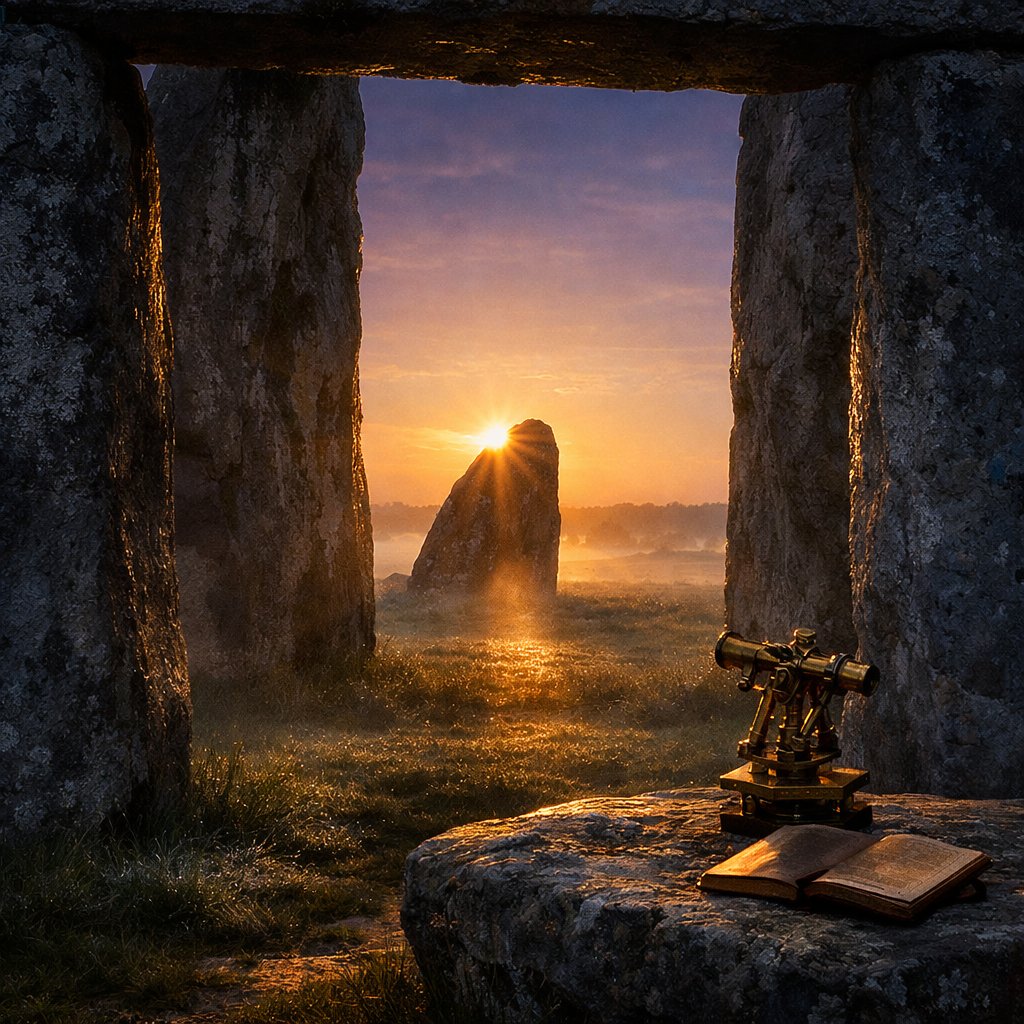
The first thing the place does, when you arrive on Salisbury Plain in the dark before midsummer dawn, is take the noise out of you. The wind off the chalk downland is steady; the sheep are awake before the people are; and the stones, when the visitor path bends and they appear in silhouette against a paling eastern sky, are smaller and more weather-pocked than you have been led to expect. The local guide that morning, Susan Greaney, an English Heritage senior properties historian who has worked the Stonehenge landscape for two decades, points away from the circle, out across the avenue, to a single leaning monolith on the northeast horizon. The Heel Stone. The sun, she says quietly, will come up just past its tip in about forty minutes, and we will talk about what that does and does not mean.
For two and a half centuries, the question of whether Stonehenge is an astronomical computer has driven a small library of books, a famous IBM-7090 calculation, and a generation of fierce academic argument. The current consensus, after the Stonehenge Riverside Project’s decade of fieldwork and Mike Parker Pearson’s synthesis in Stonehenge: A New Understanding (2012), is more careful and, in its way, more interesting than either the literal-computer claim or the dismissive shrug. Stonehenge is solstice-aligned. It is not, in the predictive sense Gerald Hawkins meant in 1965, a computer. The alignment serves a ceremonial function older than astronomy as we practice it, and the place earns its standing in the broader landscape of mystical places and lost worlds by being exactly what it appears to be: a Neolithic monument built by people who watched the sky carefully because the sky and the dead and the seasons were a single fabric.
The Direct Answer: Stonehenge in Forty-Eight Words
Stonehenge is a Late Neolithic and Early Bronze Age monument on Salisbury Plain, built in five stages between roughly 3000 and 1600 BCE, and aligned to the summer-solstice sunrise and winter-solstice sunset. It is not a computational instrument. The astronomical orientation served ceremonial and ancestral purposes, not eclipse prediction or calendrical calculation.
The Five Stages, Read Slowly From the Chalk Up
Mike Parker Pearson’s synthesis of the Stonehenge Riverside Project’s 2003-2009 fieldwork organised the site’s chronology into five overlapping construction stages, refined by Bayesian modelling of more than two hundred radiocarbon dates [1]. Stage 1, around 3000 BCE, established a circular ditch and bank some 110 metres across, with fifty-six pits known as the Aubrey Holes set just inside the bank. Cremated human bone was placed in many of these pits over the following five centuries, making Stonehenge in its first incarnation a cemetery and a place of ancestor cult before it was a stone circle [2]. Stage 2, around 2620-2480 BCE, brought the bluestones from the Preseli Hills of southwest Wales, more than 220 kilometres away, and arranged them in a double arc inside the earthwork. The 2015 quarry-source identifications by Mike Parker Pearson and his collaborators at Carn Goedog and Craig Rhos-y-felin closed a question that had stood since H. H. Thomas’s petrological work in the 1920s.
Stage 3, around 2500 BCE, raised the great sarsens. The thirty uprights and thirty lintels of the outer Sarsen Circle, the five inner trilithons of the horseshoe, the Heel Stone, the Slaughter Stone, and the Station Stones were quarried from the Marlborough Downs, roughly 25 kilometres north, and dressed with stone mauls into rectangular sections that lock together with mortise-and-tenon and tongue-and-groove joints whose carpentry-derived precision still surprises engineers. Stage 4, around 2280 BCE, rearranged the bluestones into the inner horseshoe and circle that you walk past on the modern visitor route. Stage 5, with use continuing into the Early Bronze Age and a final reorganisation around 1600 BCE, saw the addition of the so-called Y and Z holes, a pair of incomplete concentric pit-rings outside the sarsens that were never filled with standing stones [3]. Each stage rebuilt rather than abandoned the place. The monument the late twentieth century visited was the cumulative work of forty generations.
The Solstice Geometry, in Plain English
The astronomical claim is narrower than popular accounts suggest, and the narrowness is the point. From a viewer standing in the centre of the Sarsen Circle on the morning of the summer solstice, the sun rises directly over the Heel Stone, which sits 75 metres to the northeast along the line of the ceremonial avenue that leads from Stonehenge down to the River Avon. The same axis, run in the opposite direction, frames the winter-solstice sunset, the moment in late December when the sun drops behind the southwest trilithon and the great gap of the Great Trilithon’s broken upright. The Slaughter Stone, a recumbent sarsen now lying just inside the avenue entrance, was probably one of two paired uprights flanking that solstice axis. Aubrey Burl’s lifelong work on British stone circles, summarised in the Antiquaries Journal editions of his survey, places this northeast-southwest solstice line as the single most consistent orientation across the British Neolithic stone-circle tradition [4].
English Heritage and the UNESCO World Heritage dossier, which inscribed Stonehenge and Avebury together in 1986, treat the solstice alignment as the monument’s central architectural fact, defended in fieldwork from the late nineteenth century forward. Sir Norman Lockyer, the founding editor of Nature, measured the avenue azimuth in 1901 and concluded that the orientation was deliberate; modern photogrammetry of the standing and fallen stones has refined his reading without overturning it. The geometry is real. What it was used for is the harder question, and the place where the twentieth century made its most famous wrong turn.
The Astronomical-Computer Claim, From IBM-7090 to Today
The phrase astronomical computer entered the public conversation through a single book. Stonehenge Decoded, published in 1965 by the Boston University astronomer Gerald S. Hawkins (1928-2003) with co-author John B. White, ran a series of sight-line calculations on the Smithsonian Astrophysical Observatory’s IBM 7090 mainframe and reported that the alignments at Stonehenge predicted not only the solstice sunrises but a wide range of solar and lunar extremes, including the major and minor lunar standstills [5]. Hawkins called the monument a Neolithic computer, a phrase he meant literally. The 56 Aubrey Holes, in his model, formed a counter that could be advanced one position per year to predict eclipse seasons in a 56-year Saros-derived cycle.
The astrophysicist Sir Fred Hoyle followed in 1966 with a paper in Nature arguing that the 56-pole hypothesis could in fact track the precession of the lunar nodes and so warn of impending eclipses. The argument was elegant in print. It was also, the archaeologist Richard J. C. Atkinson (1920-1994) replied in his 1966 Antiquity review titled “Moonshine on Stonehenge,” statistically loose, archaeologically unsupported, and dependent on selecting the alignments that worked while ignoring those that did not [6]. Atkinson, who had directed major excavations at the monument from 1950, pointed out that the Aubrey Holes were dug in Stage 1, when the bluestones and sarsens whose sight-lines Hawkins’s machine had measured did not yet exist; the Aubrey Holes could not have functioned as a 56-position counter referenced to alignments that were a thousand years in the future. The methodological objection has held. The 56-pole eclipse-prediction hypothesis is now treated, in the Cambridge handbook tradition and in Parker Pearson’s synthesis alike, as a debunked hypothesis preserved mainly as a teaching example of how cherry-picked sight-lines can simulate intent.
Alexander Thom and the Megalithic Yard
A parallel argument came from the Oxford engineer Alexander Thom (1894-1985), whose Megalithic Sites in Britain (1967) and Megalithic Lunar Observatories (1971) reported a recurring unit of length, 0.829 metres, across hundreds of British and Irish stone-circle surveys. Thom called it the megalithic yard and argued for sophisticated lunar observatories at sites including Brogar, Callanish, and Stonehenge itself. Statistical reanalysis of his data by P. R. Freeman in 1976 and the close re-survey work of Clive Ruggles from the 1980s onward concluded that the megalithic-yard claim does not survive proper testing; the apparent uniformity is an artefact of the human pace and rod-length range used to lay out circles by eye. Ruggles’s Astronomy in Prehistoric Britain and Ireland (1999) is the standard treatment, and it is firm without being dismissive: the British Neolithic was attentive to celestial cycles, but it did not run an instrument-grade observatory programme.
What Parker Pearson and the Riverside Project Actually Concluded
The Stonehenge Riverside Project, led by Mike Parker Pearson with Joshua Pollard, Colin Richards, Julian Thomas, Kate Welham, and Christopher Tilley between 2003 and 2009, was the largest concerted excavation in the wider Stonehenge landscape since Atkinson. Its central finding, set out in Stonehenge: A New Understanding (2012), reframes the alignment question. Stonehenge is half of a paired monument; the other half is Durrington Walls, two miles to the northeast, a vast late Neolithic henge with timber circles whose own solstice axes mirror Stonehenge’s in inverse [7]. Durrington was for the living: middens of feasting debris, houses, the hum of large gatherings. Stonehenge was for the dead: cremation deposits in the Aubrey Holes, ancestor stones brought across centuries from Wales. The avenue between them, oriented along the solstice axis, traced a ceremonial passage from the timber world of the living to the stone world of the ancestors. The summer-solstice sunrise and the winter-solstice sunset, in this reading, were not data points to be measured but thresholds to be crossed.
This conclusion does not strip the monument of astronomical sophistication. It places that sophistication where the evidence puts it: in a Neolithic worldview that did not separate the celestial, the seasonal, and the ancestral into the categories a modern observatory takes for granted. To call the place a computer is to import a twentieth-century metaphor onto an architecture that was doing something different and, on its own terms, more demanding. To call it merely a calendar is to underestimate the cremated bone, the Welsh bluestones, and the avenue. The monument is what its builders made it: a piece of sacred geography in which the return of the sun and the residence of the dead occupied the same axis.
The Ceremonial-Versus-Computational Distinction
The most useful way to hold the question is to keep two facts in your head at once. Stonehenge IS solstice-aligned, in a way that survived four reorganisations of the stones across fourteen centuries; the alignment is not coincidence and not a Victorian projection. Stonehenge is NOT a predictive instrument, in the sense of a device that tells its operators when an eclipse will fall or which day of the lunar month it is. The first fact is the architectural and ritual achievement. The second is the methodological brake on importing later technologies into earlier minds. The careful reader holds both. The lazy reading collapses one into the other.
Susan Greaney’s word for the monument, the morning we walked it, was theatre. The stones frame the sun the way a proscenium frames an actor. The audience, ancient and modern, gathers to watch the return of the light. The ceremonial achievement does not require, and was not, a computational one. The astronomical alignment is the discipline of attention applied to what mattered: the dead, the ancestors, the year that comes back. Sir Christopher Frayling’s commentary in the Encyclopaedia Britannica overview puts the wider point as cleanly as anyone has: the question is not whether the builders were clever, but what kind of cleverness they were practising.
Frequently Asked Questions
When was Stonehenge built, and in how many stages?
Stonehenge was built in five overlapping stages between roughly 3000 BCE and 1600 BCE. Stage 1 (c. 3000 BCE) cut the ditch, bank, and the fifty-six Aubrey Holes. Stage 2 (c. 2620-2480 BCE) imported the Welsh bluestones. Stage 3 (c. 2500 BCE) raised the great sarsens. Stage 4 (c. 2280 BCE) rearranged the bluestones. Stage 5, into the Early Bronze Age and ending around 1600 BCE, added the Y and Z holes and saw the monument’s continuing ceremonial use.
Is Stonehenge actually aligned to the summer solstice?
Yes, with care. The principal axis of the monument runs northeast to southwest along the avenue, and the summer-solstice sunrise breaks just past the tip of the Heel Stone as seen from the centre of the Sarsen Circle. The same axis frames the winter-solstice sunset in the opposite direction. Norman Lockyer measured the avenue azimuth in 1901, and modern photogrammetry has refined the figure without overturning it. The alignment is not coincidence.
Was Stonehenge an astronomical computer?
No, in the predictive sense Gerald Hawkins meant in Stonehenge Decoded (1965). Hawkins’s IBM-7090 calculations selected sight-lines that fit lunar and solar extremes and ignored those that did not, and Richard Atkinson’s 1966 critique demonstrated the methodological circularity. The 56-pole Aubrey Holes eclipse-prediction hypothesis (Hoyle 1966) is debunked; the holes were dug a thousand years before the stones whose sight-lines they would supposedly index. The modern consensus is that Stonehenge is solstice-aligned but not a computational instrument.
What did Mike Parker Pearson and the Stonehenge Riverside Project conclude?
The Stonehenge Riverside Project (2003-2009), summarised in Mike Parker Pearson’s Stonehenge: A New Understanding (2012), reframed the monument as half of a paired ceremonial complex with Durrington Walls. Durrington was a place of the living and feasting; Stonehenge was a place of the ancestors and cremation deposits. The avenue and solstice axis traced a passage between them. The astronomical alignment served this ceremonial function rather than a calendrical or predictive one.
Where do the bluestones come from?
From the Preseli Hills of Pembrokeshire in southwest Wales, more than 220 kilometres from Salisbury Plain. Mike Parker Pearson and collaborators identified the specific quarry sources at Carn Goedog (spotted dolerite) and Craig Rhos-y-felin (rhyolite) in 2015, closing a question that had stood since H. H. Thomas’s petrological identification of the Preseli source in 1923. How the stones were transported (overland, by sea, or some combination) remains debated.
What was the megalithic yard?
A 0.829-metre unit of length proposed by the Oxford engineer Alexander Thom in Megalithic Sites in Britain (1967), based on his statistical analysis of hundreds of British and Irish stone-circle surveys. Statistical reanalysis by P. R. Freeman in 1976 and the close re-survey work of Clive Ruggles concluded the apparent uniformity is an artefact of the human pace and rod-length range used to lay out circles by eye. The megalithic-yard claim is not currently supported.
Who were the people who built Stonehenge?
Late Neolithic and Early Bronze Age communities native to and migrating into Britain across roughly fourteen centuries. Recent ancient-DNA work by David Reich’s laboratory at Harvard and Ian Armit’s team at the University of York indicates significant population turnover during the Beaker period (c. 2400-2000 BCE), with continental Beaker migrants largely replacing the earlier Neolithic population whose ancestors had built the first phase of the monument. Stonehenge thus belongs to two genetically distinct populations who shared the same sacred site.
Is Stonehenge a UNESCO World Heritage Site?
Yes. Stonehenge, Avebury, and the wider associated landscape were inscribed as a single property on the UNESCO World Heritage List in 1986. The official designation cites the monument’s “outstanding design, position and interrelationship of the monuments and sites” and treats the solstice alignment of Stonehenge as a defining feature of the property’s universal value.
Did Stonehenge predict eclipses?
Almost certainly not. Fred Hoyle’s 1966 Nature paper argued that the 56 Aubrey Holes could function as a counter for the precession of the lunar nodes and so anticipate eclipses, but the chronology rules this out: the Aubrey Holes are Stage-1 cuts (c. 3000 BCE), and the alignments Hoyle’s model required involve stones that did not arrive on site for another five hundred to a thousand years. The eclipse-prediction hypothesis is debunked.
What is the Heel Stone, and why does it matter?
The Heel Stone is a single weathered sarsen monolith, leaning slightly outward, that stands about 75 metres northeast of the Sarsen Circle along the line of the ceremonial avenue. From the centre of the circle, the summer-solstice sunrise breaks immediately past the tip of the Heel Stone. It is the visible anchor of the solstice axis and the first feature any morning-of-the-solstice visitor turns toward when the eastern sky begins to pale.
Can I visit Stonehenge for the solstice sunrise?
Yes. English Heritage opens the inner stone circle for managed access at the summer solstice each June and at the winter solstice each December, with practical guidance published on the official site. Standard year-round visitor access is from the perimeter path; the visitor centre at Airman’s Corner has the principal interpretative material, and a complimentary shuttle runs to the monument itself.
Sources
[1] Mike Parker Pearson, Stonehenge: A New Understanding: Solving the Mysteries of the Greatest Stone Age Monument (London: Simon & Schuster, 2012), chapters 5-8 on the five-stage chronology and Bayesian dating. [2] Christie Willis, Peter Marshall, Jacqueline McKinley, Mike Pitts, Joshua Pollard, Colin Richards, Julian Thomas, Tony Waldron, Kate Welham, and Mike Parker Pearson, “The dead of Stonehenge,” Antiquity 90, no. 350 (2016): 337-356. [3] English Heritage, “Stonehenge: History and Stories.” https://www.english-heritage.org.uk/visit/places/stonehenge/history-and-stories/stonehenge/ [4] Aubrey Burl, The Stone Circles of Britain, Ireland and Brittany (New Haven: Yale University Press, 2000), chapters on Stonehenge and the British solstice tradition. [5] Gerald S. Hawkins with John B. White, Stonehenge Decoded (Garden City: Doubleday, 1965). [6] R. J. C. Atkinson, “Moonshine on Stonehenge,” Antiquity 40, no. 159 (1966): 212-216. [7] UNESCO World Heritage Centre, “Stonehenge, Avebury and Associated Sites” (inscribed 1986). https://whc.unesco.org/en/list/373/
For broader exploration of mystical places and lost worlds, see The Quest for Atlantis: The Lost Civilization and Mount Everest: The Third Pole’s Mystical Aspects.