By Marcus Halloway · Published May 8, 2026 · Updated September 10, 2026
Last updated: September 10, 2026.
Direct Answer
The Betty and Barney Hill case is the September 19, 1961 incident on US Route 3 near Lancaster, New Hampshire, in which an interracial couple from Portsmouth reported a low, structured craft, roughly two hours of unaccounted travel time, and — under hypnosis with Boston psychiatrist Dr. Benjamin Simon between 1963 and 1964 — described being taken aboard. It is the first widely documented American alien-abduction account.
What Happened on US Route 3
Betty Hill, 42, a New Hampshire welfare social worker, and Barney Hill, 39, a postal worker and member of the New Hampshire NAACP, were driving home from a short vacation in Niagara Falls and Montreal on the night of September 19, 1961 [1]. They were south of Lancaster on US Route 3, working their way back to Portsmouth, when Betty noticed a bright object near the moon. It moved. It changed course. Then it appeared to follow the car.
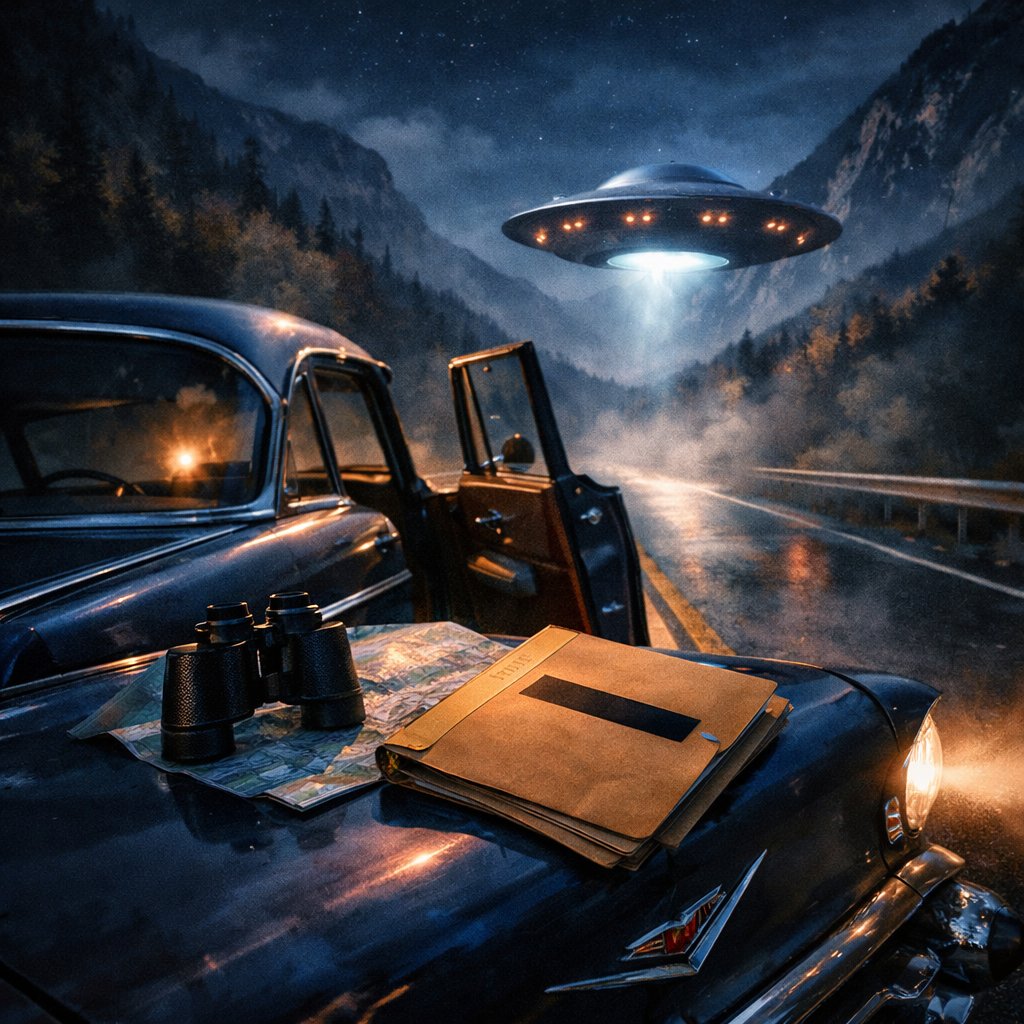
Barney pulled over near Indian Head, a granite outcrop in Franconia Notch. He stepped onto the highway with a pair of bird-watching binoculars and saw what he later described as a structured disc-shaped craft with a row of windows and figures inside. Then a buzzing or beeping sound. Then a vibration through the car. The next clear memory placed them roughly thirty-five miles further south, with about two hours unaccounted for [2].
The Witnesses
Barney was a World War II-era Army veteran who sat on a local civil rights board. Betty volunteered with the Unitarian congregation. They were active in their community and active in the NAACP at a moment when an interracial marriage in northern New England drew quiet attention on its own. Neither matched the profile of a hoaxer, and no investigator who interviewed them, friendly or hostile, came away calling them one [1][3].
The Documentary Trail Begins at Pease AFB
Two days after the drive, on September 21, 1961, Betty Hill telephoned Pease Air Force Base in Portsmouth and reported the encounter. Major Paul W. Henderson, the base intelligence officer, took the call, then visited the Hills at home. Henderson filed Air Force Information Report No. 100-1-61, which logged the object’s lights, fin-like protrusions, and erratic maneuvers, and the observation window between roughly midnight and 1 a.m. local time [4].
The report moved up the Air Defense Command chain to Project Blue Book, the Air Force’s UFO desk at Wright-Patterson AFB. Blue Book’s eventual classification of the case shifted over the next two years. An early notation suggested misidentification of Jupiter. A later disposition listed it as “insufficient data” — a holding category for sightings the desk could neither close out nor explain [5]. The record is the record. It does not say “weather balloon,” and it does not say “alien.”
The NICAP Investigation
The civilian investigation came faster than the military one. The National Investigations Committee on Aerial Phenomena (NICAP) sent Walter N. Webb, a Boston astronomer affiliated with the Hayden Planetarium, to interview the couple. Webb drove to Portsmouth on October 21, 1961, and sat with the Hills for six hours [6]. His memo to NICAP concluded the witnesses were intelligent, sincere, and that the encounter “occurred exactly as reported,” allowing for the ordinary uncertainties of nighttime observation. Webb expanded that early memo into a sixty-page final report submitted in 1965 — ten times the length of the original, and the closest thing to a primary investigative document the case has [6].
The Hypnosis Sessions With Dr. Benjamin Simon
Both Hills suffered after the drive. Barney developed an ulcer, anxiety, and high blood pressure. Betty had recurring nightmares whose details — small humanoid figures, an examination room, a star chart on a wall — she committed to a typewritten dream record at her physician’s suggestion. Their general practitioner referred them to Dr. Benjamin Simon, a Boston psychiatrist with combat-amnesia experience from his Army service in World War II [3][7].
The Hills first met Simon at his Back Bay office on December 14, 1963. From January to June 1964 they drove from Portsmouth to Boston roughly once a week. Simon hypnotized each separately. Each session was tape-recorded; Simon kept the recordings under his control. Critically, Simon reactivated the amnesia at the end of each trance, so the spouse waiting in the next room did not hear what the other had recovered [7].
What the Tapes Recorded
Under hypnosis, Barney and Betty produced narratives that converged on the central event: the buzzing sound, an interception on a side road, small figures, a medical-style examination. Differences appeared in detail. Betty’s account was longer, more linear, and contained the now-famous moment in which a “leader” figure showed her a three-dimensional star map. Barney’s account ran shorter and more anxious; he described being led up a ramp with his eyes mostly closed [8].
Simon’s own clinical conclusion was important and is often misquoted. He treated the recovered material as a shared psychological phenomenon — a “dream” or fantasy Betty had after the September drive that Barney later absorbed through proximity [3]. Simon did not call the abduction literally true. He also did not call it a hoax. He called it sincere, traumatic, and clinically real, and he separated those judgments from the question of what physically happened on Route 3.
The Star Map: Marjorie Fish, Sagan, and Hipparcos
The star map is the case’s hardest test of the documentary method. In 1968, Marjorie Fish, an Ohio elementary-school teacher and amateur astronomer, read John G. Fuller’s 1966 book The Interrupted Journey, the first popular account of the case. Fish wondered whether Betty’s hypnotic sketch could be matched to real nearby Sun-like stars. She built a three-dimensional thread-and-bead model of stellar neighbors using the 1969 Gliese Catalogue of Nearby Stars, then searched it for a viewing angle that resembled the sketch [9].
After several years and thousands of vantage points, Fish settled on a viewpoint anchored on Zeta Reticuli — a binary system roughly 39 light-years from Earth in the southern-hemisphere constellation Reticulum. Her result, published as The Zeta Reticuli Incident in Astronomy magazine in December 1974, became the case’s most arresting downstream claim [9][10].
The Sagan-Soter Critique
Carl Sagan and Steven Soter responded in Astronomy the same year. Their argument was statistical: with fifteen-or-so points on a sketch and the freedom to draw connecting lines and pick a viewing angle, an observer can find apparent patterns in random data without difficulty [10]. Sagan returned to the point on his 1980 Cosmos series, displaying the Hill map and a real star map without lines and arguing the resemblance dissolves once the lines come off [10].
What Hipparcos Did to the Model
The harder problem arrived in the 1990s with the European Space Agency’s Hipparcos satellite, the first space-based stellar parallax mission. Hipparcos measured precise distances to more than 100,000 nearby stars and revised many earlier values. Several of the stars Fish had positioned in her 3-D model turned out to be far more distant than the 1969 Gliese values had indicated. Gl 86.1, for example, was a 42-light-year star in 1969 and a 184-light-year star after Hipparcos — well outside Fish’s selection radius [10][11].
Fish accepted the result. She publicly stated that the fit no longer held under the corrected distances and effectively withdrew the Zeta Reticuli identification as a positive claim. The retraction is part of the documentary record and rarely makes the case’s pop-culture summary [10][11].
What the Record Will Not Settle
A clean accounting separates four claim layers. The first is the sighting on Route 3 — a structured craft, lights, erratic motion. That layer has multiple-witness testimony, a same-week Air Force report, and a NICAP investigator’s six-hour interview. The second is the missing time and the buzzing sound, also testified to during the unhypnotized 1961 interview. The third is the abduction narrative produced under hypnosis. The fourth is the cosmographic claim — Zeta Reticuli — that depends on a sketch interpreted decades after the fact [1][6][9].
Layers one and two are the strongest documentary record. Layer three carries the weight of clinical hypnosis with all of that method’s known limits, including suggestibility and confabulation; Simon himself flagged this. Layer four has been retracted by its author. Treating the four layers as one claim — collapsing testimony, hypnosis transcript, and cosmographic conjecture into a single yes-or-no — is a category error the case keeps inviting and the record keeps refusing [3][10][11].
Barney Hill died of a cerebral hemorrhage on February 25, 1969, at age 46, the toll of years of media scrutiny visible in his correspondence. Betty Hill continued to research UFO accounts until her death from cancer on October 17, 2004. Their papers — original tapes, transcripts, the dress, correspondence — sit in the Milne Special Collections at the University of New Hampshire, available to researchers willing to read what the public record actually says [12].
Frequently Asked Questions
When and where did the Betty and Barney Hill incident take place?
On the night of September 19, 1961, on US Route 3 in the White Mountains of New Hampshire, between Lancaster and the couple’s home in Portsmouth. The encounter began near Indian Head in Franconia Notch around 10:30 p.m. and ended with about two hours of missing travel time [1][2].
Who were Betty and Barney Hill?
Betty Hill (1919-2004) was a New Hampshire welfare social worker. Barney Hill (1922-1969) worked at the Boston and Portsmouth postal annexes. Both were active NAACP members; Barney sat on a local United States Commission on Civil Rights board. They were an interracial couple in northern New England in the early 1960s [1][12].
What did Project Blue Book conclude about the case?
Major Paul W. Henderson at Pease Air Force Base filed Air Force Information Report No. 100-1-61 on the sighting. Project Blue Book’s disposition shifted between possible Jupiter misidentification and “insufficient data.” The Air Force never officially attributed the encounter to a known craft, weather phenomenon, or hoax [4][5].
Who was Dr. Benjamin Simon and how did he treat the Hills?
Dr. Benjamin Simon was a Boston psychiatrist with a Back Bay practice and prior Army experience treating combat amnesia in World War II veterans. He hypnotized the Hills separately between January and June 1964, recorded each session, and reactivated the amnesia between meetings to prevent cross-feed of recovered material [3][7].
What is the Zeta Reticuli star map, and is it valid?
It is Marjorie Fish’s 1969 attempt to match Betty Hill’s hypnotic sketch to real Sun-like stars using a thread-and-bead 3-D model based on the Gliese catalogue. Fish proposed Zeta Reticuli as the viewpoint. Carl Sagan and Steven Soter rebutted the work statistically in 1974, and Hipparcos parallax data in the 1990s revised several star distances out of Fish’s model. Fish later retracted the identification [9][10][11].
Did NICAP take the case seriously?
Yes. The National Investigations Committee on Aerial Phenomena dispatched astronomer Walter N. Webb to Portsmouth on October 21, 1961, for a six-hour interview. Webb’s eventual sixty-page 1965 final report concluded the witnesses were credible and the incident “occurred exactly as reported” within ordinary observational uncertainty [6].
What was found on Betty Hill’s dress?
Betty’s torn dress was preserved and analyzed multiple times. Laboratory work in the 2000s found a chemically altered pink-magenta staining, with protein and trace ester-type oil in the discolored areas; later DNA testing matched some staining material to Betty herself. The analyses are suggestive but do not, on their own, establish an extraterrestrial origin [3].
What is the most reliable book on the case?
John G. Fuller’s The Interrupted Journey (Dial Press, 1966) is the contemporaneous popular account written with the Hills’ cooperation and with access to Simon’s tapes. It remains the standard primary-narrative source for the case, supplemented by the University of New Hampshire’s Betty and Barney Hill Papers [12].
Where can researchers read the original materials?
The Betty and Barney Hill Papers, 1961-2006, are held in Milne Special Collections at the University of New Hampshire’s Dimond Library in Durham. The collection includes correspondence, hypnosis transcripts, the dress, and Betty Hill’s later research files [12].
How did the case shape later UFO and abduction research?
The Hill case established the abduction template — missing time, hypnotic recovery, small humanoid examiners, a star map — that recurred in later reports. It also became the standing test case for the methodological problem at the heart of the genre: how to treat traumatic, sincere witness testimony recovered through a clinically contested method [1][3].
Further Reading
For the parent overview of UFO and abduction reports across the modern record, see the Alien and Extraterrestrial Mysteries pillar at esovitae.
Sources
- [1] “Barney and Betty Hill incident,” Wikipedia, accessed 2026 — biographical and case-summary cross-reference.
- [2] Boston Public Library, “The Abduction of Betty and Barney Hill,” BPL Blogs.
- [3] Kathleen Marden, kathleen-marden.com — primary-research site by Betty Hill’s niece, including dress-analysis chain of custody.
- [4] Major Paul W. Henderson, Air Force Information Report No. 100-1-61, Pease AFB, September 1961, in NICAP Blue Book document set.
- [5] Project Blue Book disposition, Hill case file, US Air Force, 1961-1963 (Wright-Patterson AFB).
- [6] Walter N. Webb, A Dramatic UFO Encounter in the White Mountains, New Hampshire, NICAP Final Report, 1965.
- [7] John G. Fuller, The Interrupted Journey: Two Lost Hours Aboard a Flying Saucer, Dial Press, 1966.
- [8] “Barney Hill’s 1964 Hypnosis Tapes Remastered,” archival audio, Black Cat Report podcast.
- [9] Marjorie Fish, “Journey into the Hill Star Map,” MUFON UFO Symposium Proceedings, 1974.
- [10] Carl Sagan and Steven Soter, “Pattern Recognition and Zeta Reticuli,” Astronomy, December 1974; rebutted further on Cosmos, PBS, 1980.
- [11] European Space Agency, Hipparcos Catalogue, 1997 release; “Goodbye, Zeta Reticuli,” Airminded, November 2008.
- [12] Betty and Barney Hill Papers, 1961-2006, Milne Special Collections, University of New Hampshire.
For wider context on alien and extraterrestrial mysteries, see also our investigations of The Drake Equation and Alien Life and The Phoenix Lights Mystery.