By Wren Ashby · Published May 8, 2026 · Updated May 13, 2026
Last reviewed: May 8, 2026.
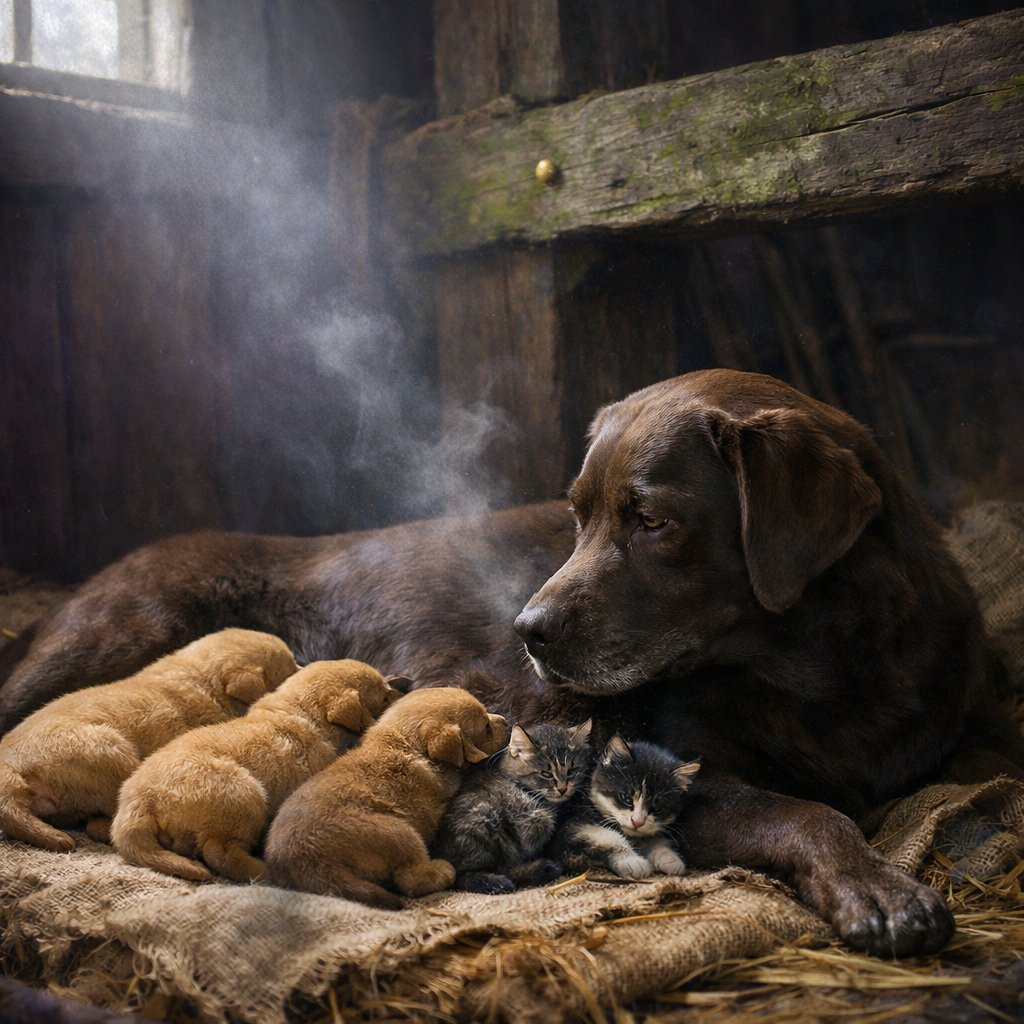
A lactating dog will sometimes accept orphaned kittens, groom them, and let them latch and feed. The behavior is reliable enough that shelters use it, and odd enough that the internet rediscovers it every spring. The animal-behavior literature treats it as a special case of allonursing, the cross-fostering response, and pseudopregnancy-driven maternal arousal. None of those terms are mystical, and all of them are testable.
Direct Answer
A nursing or pseudopregnant female dog can accept and nurse kittens because the same hormones that drive maternal care in canids, prolactin and oxytocin, are not species-specific in their target. A neonate of roughly the right size, with a roughly correct cry and rooting reflex, can release the full caregiving sequence. The behavior is documented in shelters, on farms, and in peer-reviewed ethology, where it is called heterospecific allonursing or cross-fostering [1][2][3].
What the Behavior Actually Looks Like
In a shelter intake, the sequence is mundane. A bitch in late lactation, often three to six weeks post-whelping, is presented with a litter of kittens whose dam has died, abandoned the litter, or cannot produce milk. A staff member rubs the kittens with a cloth that smells of the dog’s puppies, places them at the dog’s flank, and watches. If the dog turns her head, sniffs each kitten, then resumes the side-lying nursing posture, the introduction has worked. The kittens latch. The dog sleeps.
It is not always that clean. Some bitches reject; some accept the kittens but only after an interval of restless circling and licking; some accept the litter but redirect attention back to the puppies whenever a kitten cries off-platform. The variation matters. It tells the working ethologist that the response is not an automatic switch. It is a probabilistic outcome of a cluster of internal states, scent matching, and the kitten’s own behavior at the latch.
The Specific Cues That Open the Behavior
Three cues, taken together, do most of the work. First, neonatal size. A two-week-old kitten weighs about 200 grams, comparable to a small puppy of the same age, and triggers the dam’s posture-and-pressure expectations. Second, the rooting reflex. Kittens search for the nipple by head-bobbing and pawing, a motor pattern that overlaps the puppy’s. Third, scent. The dam’s licking transfers her saliva and the puppy-litter scent onto the kitten within minutes, after which the kitten registers as litter-positive to the dam’s olfactory system [4].
The Hormonal Substrate
Maternal behavior in dogs runs on two interlocked endocrine systems. Prolactin, secreted by the anterior pituitary, drives milk production and a substantial fraction of the maternal behavioral repertoire, including nest-building, retrieval of displaced young, and tolerance of suckling. Oxytocin, released by the posterior pituitary, contracts mammary myoepithelium for milk ejection and modulates pair-bonding and affiliative response [5][6].
Neither hormone reads species labels. Prolactin does not interrogate the suckling neonate’s genome before responding to nipple stimulation; oxytocin pulses on the same suckling reflex whether the mouth attached to the nipple is canine, feline, or, in documented agricultural cases, lagomorph. This is why the response is recoverable across species: the mechanism is upstream of taxonomic recognition.
Pseudopregnancy adds a second route. Most intact female dogs show some signs of false pregnancy after estrus, beginning four to nine weeks after the previous heat, driven by a rapid decrease in progesterone and an increase in prolactin. The dog is not pregnant, but her endocrine state mimics late gestation closely enough to produce mammary enlargement, milk, nest-building, and a strong response to neonatal cues [7]. A pseudopregnant bitch presented with kittens is, hormonally, already a mother looking for a litter.
What the Ethology Literature Says
Allonursing, the nursing of young not the female’s own offspring, is not rare. A 1982 review by Marcy Riedman in the Quarterly Review of Biology cataloged alloparental care and adoption across more than 120 mammalian and 150 avian species, framing the behavior as a function of inclusive fitness, parental experience, and ecological constraint rather than misfiring instinct [3]. More recent comparative work continues to find allonursing concentrated in cooperatively breeding lineages, including canids.
When the recipient is a different species, the term shifts to heterospecific allonursing or cross-fostering. The domestic dog is unusually prone to it, for two reasons documented in the behavioral biology of the species: a long human-mediated selection history that softened aggression toward unfamiliar small mammals, and a cooperative pup-rearing legacy from the wolf, where multiple females in a pack contribute milk and care to a single litter. Cameron-Beaumont, Lowe, and Bradshaw note in their work on small felid behavior that the cat lineage shows weaker pre-adaptation to this kind of social tolerance, which is part of why the kitten-receives-care direction is more often documented than the inverse [8].
Marc Bekoff and Jessica Pierce, in Wild Justice, position cross-species care among the empathic and cooperative behaviors they document across canids and other mammals, including a cat that led a blind elderly dog around obstacles to reach food. Their argument is not that animals are moral in a human sense; it is that the ingredients of cooperation, including caring for young that are not one’s own, are present and measurable in many lineages [9].
The Famous Cases, Read as Behavioral Data
A few cross-species pairings have escaped the ethology journals into popular memory. They are useful as exhibits, provided they are read carefully.
Owen and Mzee
In December 2004, a juvenile hippopotamus was separated from his pod by the Indian Ocean tsunami and stranded near Malindi, Kenya. He was transported to Haller Park sanctuary in Mombasa, where he attached himself to a 130-year-old Aldabra giant tortoise named Mzee. The hippo, Owen, displayed mother-following behavior, slept against the tortoise, and accepted food in proximity to him. Mzee tolerated, then reciprocated, contact. The pairing lasted years and produced a children’s book and a documentary [10]. The behavioral note is that Owen was at an age when filial imprinting on a mother-shaped, mother-textured object is biologically open; the tortoise filled a niche normally occupied by an adult hippo.
Kasi and Mtani
At Busch Gardens Tampa in 2011, an eight-week-old male cheetah cub named Kasi was paired with a sixteen-week-old female yellow Labrador puppy named Mtani. The pairing was deliberate, designed by the park’s animal-care staff to give the cheetah a social companion through development. Male cheetahs in the wild form coalitions, often with brothers, and the dog-puppy substitute exploited that need. The two animals lived together at the Cheetah Run habitat and traveled jointly for educational programming [11]. The behavioral note is that the human framing built around the pair, friendship, was downstream of a curatorial decision; the underlying response was a cheetah’s tolerance of a like-sized, non-threatening, social-mammal companion.
Koko and All Ball
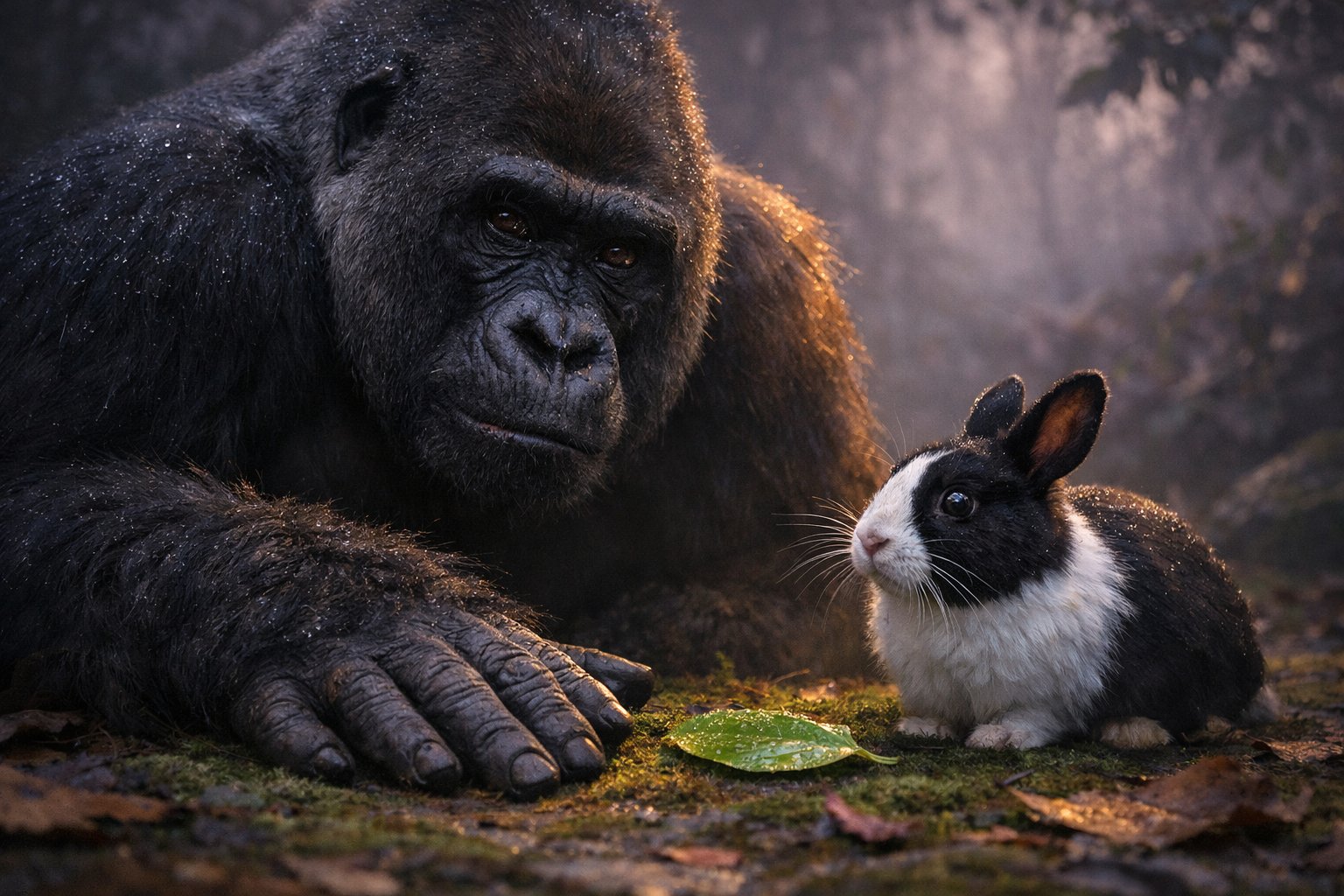
Koko, the western lowland gorilla raised by Francine Patterson under sign-language enrichment at the Gorilla Foundation, selected a tailless gray Manx kitten for her birthday in 1984 and named him All Ball. Koko carried the kitten, groomed him, and reportedly used signs associated with grief after the kitten was struck by a car. She raised additional kittens in subsequent years [12]. The behavioral note is that allomaternal care toward small heterospecific mammals is documented in great apes; the linguistic enrichment around Koko amplified public perception but did not invent the underlying behavior.
Where the Story Gets Mis-Told
The cases above are real. The framing around them often is not. A working ethologist reads three failure modes in popular coverage of cross-species adoption.
The first is anthropomorphic substitution: the dog is described as having decided to mother the kittens, when the available evidence supports a hormonal-behavioral cascade that the kittens themselves help complete. The decision frame implies a deliberation that has not been demonstrated. The second is novelty inflation: the framing treats each case as an unprecedented mystery, when the same behavior has been catalogued across more than 120 mammalian species since the 1980s. The third is reverse-anthropomorphism, the move that says since the behavior is hormonal it is not real care. That move misreads what hormones are; oxytocin and prolactin are how care is built, not a substitute for it.
The clean reading sits between those failures. A dog nursing kittens is not deciding in a human sense, and she is not running a meaningless reflex. She is a mammal in a hormonal state that opens the caregiving program, presented with a stimulus configuration that fits inside that program’s tolerance window, and the program runs.
What the Behavior Tells Us About the Animal
There is a quiet implication here. If a domestic dog can extend the maternal program across the canid-felid line, the program was never as narrow as the species boundary. Cooperative care of young is older than the split between dogs and cats; it is older than the split between the carnivoran lineages those species belong to. What we are watching, when we watch a Labrador feeding a kitten, is an ancient mammalian behavioral system holding its shape under a stimulus it was not specifically built for, and still doing the work [3][8].
For the curious lay reader, the practical takeaway is small and useful. If you find a litter of orphaned kittens and a friend has a lactating bitch, the introduction is worth attempting under supervision. The success rate is meaningful but not absolute, and the kittens will still need feline-appropriate weaning food once they are old enough to take it. Treat the dog as a working biological system, not a story. The story takes care of itself.
Frequently Asked Questions
Can a dog actually produce milk for kittens, or just keep them warm?
A lactating bitch produces real milk, and kittens can latch and feed from it. Canine milk is not nutritionally identical to queen milk, particularly in taurine and arachidonic acid content, so kittens raised on dog milk for extended periods need supplementation. For short-term emergency fostering through the first weeks, the milk supports survival reliably enough that veterinary protocols treat it as a viable option [1][7].
Why does this happen with dogs more often than other species?
Domestic dogs combine three traits that favor cross-species nursing: a strong cooperative-breeding inheritance from their wolf ancestry, a high rate of pseudopregnancy in intact females, and a long history of human-mediated selection for tolerance of unfamiliar small mammals. Other cooperatively breeding mammals, including some canid wild species, show similar behavior in field studies, but the domestic dog encounters the situation most often because shelters and farms regularly produce the conditions [8].
Is the dog confused about what species the kittens are?
No. Olfactory and visual evidence indicates the dam recognizes the kittens as not-her-puppies, but accepts them anyway. The recognition system and the caregiving system are partly independent; recognition does not gate care once the maternal program is active and the kittens fit the size and behavior window the program tolerates [4][5].
Does the kitten imprint on the dog as its mother?
To a partial extent, yes. Kittens raised by a dog often show comfort responses to canine vocalizations and reduced fear of dogs in adulthood, an effect documented in the early-socialization literature on cats. The imprint is not total; kittens still develop species-typical predatory and social behavior, especially if exposed to other cats during the standard 2-to-7-week feline socialization window [4][8].
What about cats nursing puppies, the reverse direction?
Documented but rarer. Domestic cats have a shorter cooperative-breeding history and a more solitary ancestral social structure, which puts the threshold for accepting heterospecific young higher. The cases that occur, a queen with a small puppy or with kittens of another queen’s litter, follow the same hormonal logic in the reverse direction [8].
Does this prove animals have empathy?
It is consistent with the empathy framework Bekoff and Pierce develop in Wild Justice, but a single behavior does not prove the larger claim. The careful position is that the components of empathic behavior, including caring for young not one’s own, are present in many mammals and measurable in their hormones and actions. Whether to call the assembled package empathy is partly a definitional choice [9].
Why do shelters use lactating dogs to foster kittens?
Because hand-rearing neonatal kittens is labor-intensive, expensive, and produces lower survival than maternal rearing. A receptive bitch provides milk, warmth, grooming, and the tactile and olfactory environment kittens need for normal development. Shelter veterinary teams use a standard introduction protocol, scent-matching, supervised first contact, monitored first nursing, that converts the behavior from anecdote to operational procedure [1][2].
Is this behavior found in wild canids too?
Yes, in modified form. Wolves and African wild dogs allonurse within the pack, with subordinate females sometimes producing milk in response to the alpha female’s litter. Cross-species fostering is rarer in the wild because the species do not cohabit, but adoption of unrelated conspecific pups is well documented and runs on the same hormonal substrate [3][9].
Can a male dog show paternal behavior toward kittens?
Some can. Male canids in cooperatively breeding species, including wolves, contribute to pup care, and individual male domestic dogs occasionally extend that response to kittens through play, grooming, and protective behavior. Lactation is, of course, off the table; but the rest of the maternal program is partially available to males, supported by similar oxytocin pathways [9].
Sources
- National Geographic, “Why Animals Adopt Others, Including Different Species” (overview of cross-species adoption documentation).
- Bradshaw, J. W. S. (2018). The Behaviour of the Domestic Cat, 3rd ed. CABI Publishing.
- Riedman, M. L. (1982). The evolution of alloparental care and adoption in mammals and birds. Quarterly Review of Biology, 57(4), 405-435.
- Bradshaw, J. W. S., Casey, R. A., and Brown, S. L. (2012). The Behaviour of the Domestic Cat, 2nd ed. CABI Publishing (chapter on early socialization windows).
- Mota-Rojas, D. et al. (2023). The Role of Oxytocin in Domestic Animals’ Maternal Care: Parturition, Bonding, and Lactation. Animals, 13(7), 1207.
- Lonstein, J. S., et al. (2021). The Prolactin Family of Hormones as Regulators of Maternal Mood and Behavior. Frontiers in Global Women’s Health.
- VCA Animal Hospitals, “False Pregnancy or Pseudopregnancy in Dogs” (clinical reference on canine pseudocyesis and prolactin).
- Cameron-Beaumont, C., Lowe, S. E., and Bradshaw, J. W. S. (2002). Evidence suggesting preadaptation to domestication throughout the small Felidae. Biological Journal of the Linnean Society, 75(3), 361-366.
- Bekoff, M., and Pierce, J. (2009). Wild Justice: The Moral Lives of Animals. University of Chicago Press.
- Hatkoff, I., Hatkoff, C., and Kahumbu, P. (2006). Owen and Mzee: The True Story of a Remarkable Friendship. Scholastic. See also NPR, “A Hippo and Tortoise Tale” (2005).
- Busch Gardens Tampa media archive and TODAY, “Labrador Pup and Cheetah Cub Celebrate a Year of Friendship” (2012). Pairing initiated April 2011.
- Patterson, F., and Cohn, R. H. (1985). Koko’s Kitten. Scholastic. See also The Gorilla Foundation, “Koko’s Kitten” (foundation archive).
For the parent niche overview, see Animal Anomaly Mysteries.
More from the animal anomaly mysteries archive: The Sudden Vanishing of Bees: CCD and Elephant and Rhino Odd Friendship.