By Emilia Wellesley · Published May 4, 2026 · Updated May 13, 2026
Last reviewed: May 4, 2026.
Crystal Skulls captivate the imagination with their mysterious origins and supposed mystical properties. Ideal for scholars and enthusiasts alike, this detailed examination delves into the origins, authenticity, and cultural impact of these artifacts.
Origins and Historical Context
The legend of the crystal skulls is steeped in the mystical and supernatural lore of Mesoamerica, primarily associated with the ancient Maya and, to a lesser extent, the Aztecs. These cultures, renowned for their sophisticated artistry and deep spiritual beliefs, are often cited as the original creators of these enigmatic artifacts.
The Legend of Crystal Skulls
The stories surrounding crystal skulls often begin in the dense jungles of Central America, where they are said to have been discovered within the ruins of ancient civilizations.
- Imagery and Discovery: This theme of discovery often conjures images of intrepid explorers uncovering secreted relics of past cultures.
Despite the romanticized scenario, little evidence supports the existence of crystal skulls during the times of the Maya or Aztecs. Rather:
- Emergence of Legends: Legends often surfaced significantly later, suggesting a retrofitted place within Mesoamerican lore.
- Mystical Attributes: The mystique is compounded by frequent attributions to these skulls possessing supernatural powers, and even being products of extraterrestrial craftsmanship.
Provenance and Dating
Among the most riveting and contested discoveries is the Mitchell-Hedges Skull, allegedly found in the ruins of Lubaantun, Belize, in the early 20th century by adventurer F.A. Mitchell-Hedges.
- Anna Mitchell-Hedges: His daughter claimed to have discovered the skull amongst rubble during an excavation.
- However, this tale of discovery is mired in controversy.
- Lack of Evidence: Records and photographs from the time do not corroborate her story.
- Timing of Revelation: The skull’s entry into public awareness coincided with the rising popularity of spiritualism and the New Age movements, which embraced such artifacts for both their supposed ancient wisdom and metaphysical properties.
Provenance of other notable skulls, like those housed in the British Museum and the Smithsonian Institution, similarly trace back to rather murky origins:
- Chain of Ownership: Often passed through multiple hands—including art dealers and collectors.
- Ambiguous Histories: The timelines and stories of their discoveries are frequently as carved and sculpted as the artifacts themselves.
This complicates efforts to authenticate them and blurs the lines between genuine archaeological artifacts and masterful forgeries crafted in the 19th and early 20th centuries.
This section of the article sheds light on the ambiguous origins and the fascinating paths crystal skulls have taken from purported ancient relics to captivating museum exhibits. By dissecting the blend of fact, assumption, and folklore that shrouds these artifacts, readers are guided through a narrative as intricate and debated as the carvings on the skulls themselves. Echoes of ancient voices seem to permeate the legend of the crystal skulls, offering a mysterious allure that continues to challenge both scholarly research and popular imagination.
Scientific Analysis and Authenticity
Modern Scientific Perspectives
Delving deep into the realm of empirical evidence, institutions like the British Museum and the Smithsonian have conducted rigorous analyses on crystal skulls to pinpoint their origins and construction techniques. Contrary to popular lore, the findings often paint a different picture. For instance, advanced microscopy and radiographic studies carried out by these venerable institutions have consistently indicated that tools and techniques used in the carving process align more closely with 19th-century methods, rather than pre-Columbian or ancient ones. For example, the Smithsonian's tests on their crystal skull, which was anonymously donated in 1992, revealed tell-tale signs of modern rotary tools, which dismissed any authentic pre-Columbian origin.
Debunking Myths
The allure of crystal skulls often thrives on a bedrock of supernatural attributions and deep-seated myths. However, analytical mindsets in the field adopt a skeptical stance towards such narratives. Historical investigations unveiled that barely any legitimate pre-Columbian examples exist, if at all. The stories of skulls found in ancient temple ruins often crumble under scrutiny, notably with the infamous Mitchell-Hedges Skull. Allegedly discovered in Belize by Anna Mitchell-Hedges in the 1920s, detailed scrutiny later suggested a less mystical origin. This skull became embroiled in controversy not only due to doubts about its ancient provenance but also because it sparked discussions on artifact authenticity, rife within the archaeological corridors. Skepticism mounted when tests conducted by reputable institutions like the British Museum deduced their 'ancient' artifacts were likely crafted in the more recent, rather than ancient, past, employing techniques developed long after the fall of the once-flourishing Mesoamerican civilizations.
Engaging in this analytical discourse, enthusiasts and scholars alike are beckoned to look beyond fabled tales, urging a reevaluation of what might truly be historical transparency versus appealing mythos. This reevaluation not only enriches the factual tapestry surrounding these artifacts but also reinforces the necessity for rigorous scientific methods in authenticating historical artifacts, weaving a narrative that’s both intellectually satisfying and grounded in reality.
Cultural and Mythological Significance
The allure of crystal skulls stretches far beyond their shimmering quartz surfaces, threading through layers of both cultural ethos and mystical narratives. These artifacts, often attributed to ancient Mesoamerican civilizations, resonate deeply within various spiritual communities and the broader sphere of paranormal enthusiasts.
An Intersection of Ancient Beliefs and Modern Mysticism
Crystal skulls have often been spotlighted within New Age spirituality, revered not only as antiques but as conduits for psychic phenomena. Advocates claim that these skulls possess metaphysical properties that can facilitate communication with higher realms, enhance clairvoyance, and even serve as vessels for ancient wisdom. Such spiritual attributes align with the historical reverence ancient civilizations like the Maya and Aztecs had for quartz and human skulls, which they considered sacred and imbued with supernatural powers.
This blend of ancient craftsmanship and alleged mystical capacity makes crystal skulls fascinating subjects for both devout spiritual followers and skeptics alike. Their ties to ancient esoteric practices, along with claims of their involvement in healing rituals and energy work, underscore a rich tableau of cultural and spiritual intrigue.
From Relics to Pop Culture Icons
The dramatic allure of crystal skulls has not been confined to the shelves of museums or the sanctuaries of crystal healers; it has also pulsated through the veins of popular culture. A vivid illustration of this can be seen in the adventures of the fictional archaeologist Indiana Jones in the 2008 film "Indiana Jones and the Kingdom of the Crystal Skull". Here, the crystal skulls are depicted as alien artifacts with profound psychic and paranormal powers, capturing public imagination and reigniting interest in their real-world counterparts.
The portrayal of crystal skulls in such a blockbuster hit has not only cemented their status as iconic symbols of mystery and adventure but has also stirred up renewed interest and debate about their origins and authenticity. This mélange of fact and fiction blurs the lines even further, inviting more to question and speculate about the true nature and powers of these enigmatic artifacts.
Engaging the Skeptics and the Faithful
Whether as tools for ancient seers or as modern metaphysical instruments, the narrative of crystal skulls encompasses a spectrum of beliefs that continues to grow and diversify. This ongoing dialogue not only fuels their mystique but also encourages a deeper exploration into the intersection of archaeology, spirituality, and cultural heritage. As they continue to be subjects of both scrutiny and reverence, crystal skulls remain potent symbols in the quest to understand the past and its connection to the present’s spiritual landscape.
Embodying much more than their crystalline forms suggest, these artifacts weave a fascinating narrative of human belief, culture, and longing for connection to the mystical. This dynamic blend of history, spirituality, and cultural impact ensures that crystal skulls will captivate the curiosity of generations to come, remaining icons of the ancient, the mystical, and the mysterious.
Archaeological Perspectives
The community of professional archaeologists holds a complex and often skeptical view of the crystal skulls. These artifacts sit at a contentious intersection of genuine archaeological inquiry and more sensationalist pursuits. Most academically affiliated archaeologists lean heavily towards the conclusion that crystal skulls are not ancient Mesoamerican artifacts but rather originate from the 19th century. This perspective is rooted in thorough examinations and analyses conducted by leading institutions.
Foremost among the skeptical arguments is the lack of congruence between the known tooling capabilities of pre-Columbian civilizations and the high degree of craftsmanship evident in crystal skulls. The flawless polish and intricately detailed features of these skulls suggest the use of modern tools not available to ancient artisans. Archaeological perspectives are further bolstered by scientific investigations, such as those carried out by the British Museum and the Smithsonian Institution, which have generally failed to find any trace of pre-Columbian tool marks typically left on genuine ancient artifacts.
Issues of Ethical Archaeology
The intrigue surrounding crystal skulls extends beyond mere historical curiosity into serious ethical issues within the field of archaeology. The most glaring concern revolves around the authenticity and provenance of these objects. Foregeries and fraudulent claims about archaeological finds can severely damage the credibility of cultural artifacts and lead to mistrust between the public and the professional archaeological community. The propagation of such hoaxes undermines genuine research and skews historical understanding.
Moreover, these controversies can harm cultural heritage, especially when they encourage the looting of genuine archaeological sites or the illegal trade of artifacts. The crystal skulls have, at times, been caught up in debates over artifact repatriation and the ethical responsibilities of museums in acquiring and displaying objects with dubious origins.
For instance, the story of the Mitchell-Hedges Skull, often claimed to have been discovered in Belize by Anna Mitchell-Hedges, has been a particular focus of scrutiny. Many experts now believe that it may have been crafted in Europe and later misrepresented as an ancient Mesoamerican artifact. Such cases highlight the necessity for rigorous standards of documentation and transparency in the acquisition and study of archaeological materials.
Conclusively, while crystal skulls continue to captivate the public imagination, within professional circles, they serve as a cautionary tale of the pitfalls that can beset the field of archaeology when the allure of mystery overrides the rigor of science. This has been an essential point of contention and dialogue at various conferences and discussions across archaeological communities worldwide, urging a reevaluation of practices and a reinforced commitment to ethical standards in archaeological research and curatorship.
Museum Exhibitions and Public Fascination
Skulls on Display
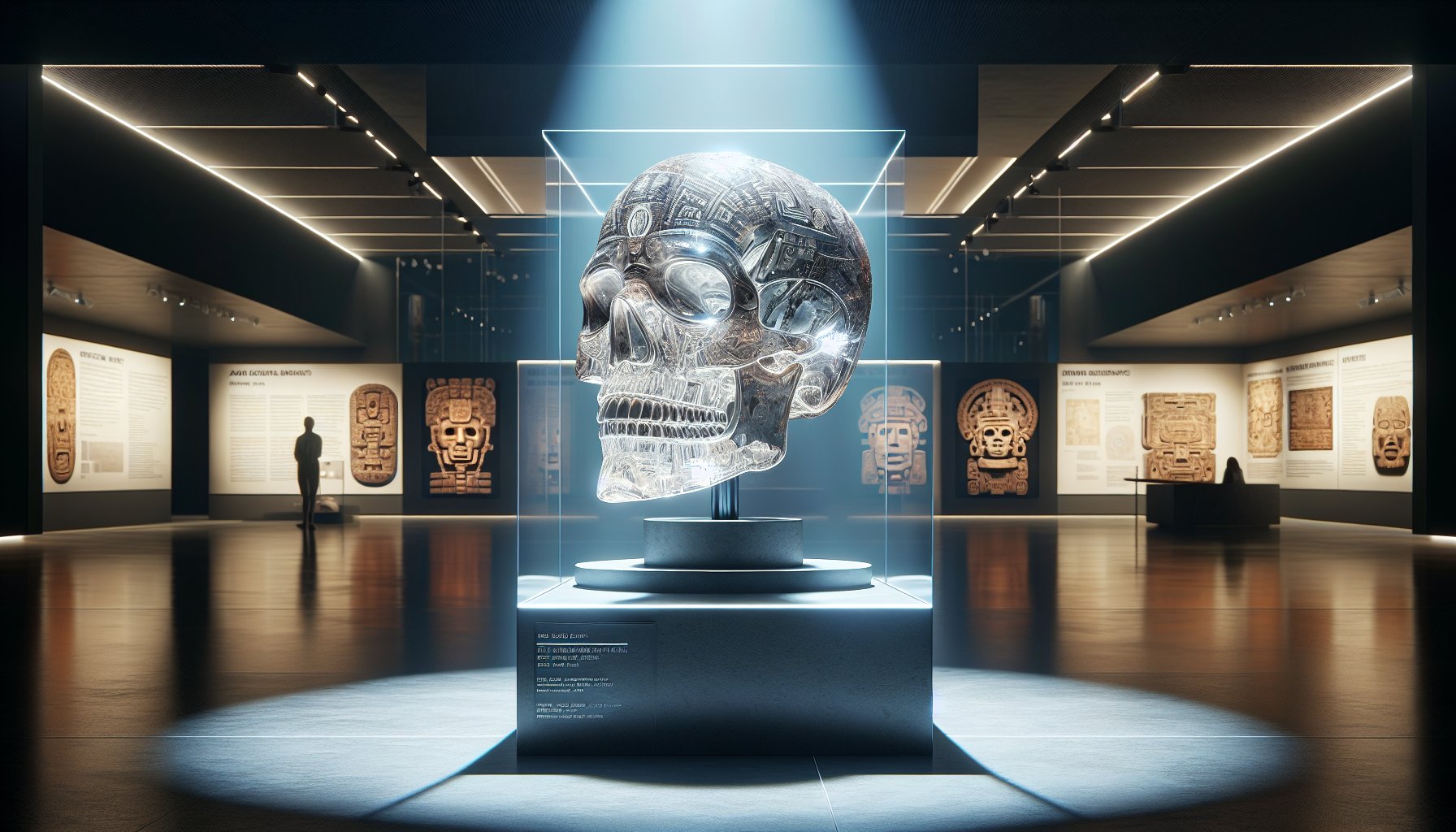
Museums worldwide, attracted by the intrigue and mystery of the crystal skulls, have positioned these exotic artifacts as central pieces in their exhibitions. The Smithsonian in Washington D.C. and the British Museum in London prominently feature crystal skulls, which they acquired under varied, sometimes controversial, circumstances. These institutions play a vital role by furnishing a platform where the public can engage directly with the artifacts, thus elevating both interest and debate concerning their origins and authenticity.
In particular, the Smithsonian’s crystal skull, received anonymously in 1992, and the British Museum's skull, acquired from Tiffany and Co. in the late 19th century, serve as focal points in their respective displays on Mesoamerican civilizations. They are encompassed in narratives that explore their purported Pre-Columbian origins and the later debunking of these claims through rigorous scientific examinations. These exhibitions do not merely showcase the skulls but contextualize them within the broader tapestry of Mesoamerican history and culture, providing a foundational understanding for both the layperson and scholar.
Public Reception and Interest
The allure of the crystal skulls extends well beyond academic and enthusiast circles to captivate the general public. Their mysterious backstory and supposed mystical properties generate a broad appeal, fueled by their prominent display in high-profile museums and their dramatization in popular media, notably the Indiana Jones series. As visitors flock to these exhibitions, they are often greeted with a mixture of historical data and cultural narratives, blending scientific facts with engaging storytelling.
Furthermore, the exhibitions provoke public discourse on the legitimacy of such artifacts, ultimately shaping societal perspectives on historical authenticity and cultural heritage. They become more than mere objects; they transform into symbols of the ongoing tension between myth and science, past knowledge and present interpretation.
In effect, through strategic museum exhibitions, the crystal skulls maintain their position at the forefront of public fascination, continually sparking curiosity and debate. These exhibits not only preserve interest in the skulls themselves but also stimulate broader consideration of archaeological practices and the interpretation of ancient cultures. Through such engagement, the crystal skulls remain relevant, continually re-invigorated by each new visitor and each new discussion they inspire.
Controversies and Debates
Authenticity Debates
The controversy surrounding the authenticity of crystal skulls has piqued the curiosity of both the general public and the academic community. Often claimed to be pre-Columbian Mesoamerican artifacts, many crystal skulls have been examined by institutions such as the British Museum and the Smithsonian Institution. These investigations, however, have often concluded that many famous skulls are likely modern creations, using techniques and tools not available to ancient Mesoamerican artisans. This revelation stems from detailed comparative analysis which reveals the absence of authentic pre-Columbian tool marks typically present on genuine ancient artifacts. Furthermore, testing conducted on the Smithsonian Skull using sophisticated equipment like electron microscopes suggested a 20th-century origin, further fueling the debate over these mystifying objects.
Discussions in academic circles and online forums often revolve around the implications of these findings, leading to heated debates among historians, archaeologists, and enthusiasts. The skepticism has only intensified with the promotion of these skulls in various media, notably the Indiana Jones franchise, which juxtaposes thrilling adventure with mythical historical elements.
Impact on Indigenous Cultures
The misrepresentation of crystal skulls as ancient artifacts has sparked significant debate regarding the impact on perceptions of indigenous cultures. Critics argue that these fabrications contribute to the mystification and misunderstanding of the sophisticated civilizations of the Maya and Aztec, whose real achievements in astronomy, mathematics, and architecture often remain underappreciated in popular culture. This romanticizing of Native history tends to overshadow the genuine artifacts and the true historical significance of these cultures.
Furthermore, the propagation of such myths can affect the cultural heritage of indigenous peoples, as it distorts authentic history and may affect the ways in which their past is perceived globally. Indigenous scholars and community leaders frequently express concerns over the lack of contextual understanding and respect shown toward their cultural artifacts and historical narrative.
Moving Forward in Understanding
As the debates continue, they spark a broader conversation about the responsibility of museums, academics, and media creators in portraying historical artifacts accurately and ethically. The dialogue also emphasizes the need for rigorous scientific scrutiny and cultural sensitivity in handling such potentially misleading artifacts, ensuring that the public receives a well-rounded understanding of world histories and cultures.
This enriching discourse not only elevates academic standards but also enhances public education, encouraging deeper engagement with true historical research and the debunking of long-held myths. By examining these controversies and understanding their implications, we can better appreciate the complexity of human history and the intertwining of fact and fiction in our quest to understand the past.
More on the Crystal Skulls: Overview of the Crystal Skulls
The Crystal Skulls, often encased in mystery and allure, are not merely ornate artifacts; they stand as a testament to a blending of historical curiosity and modern mythmaking. Typically constructed from quartz—a material chosen for its clarity and durability—these skulls evoke a sense of ancient craftsmanship that continues to captivate scholars and enthusiasts alike.
The intrigue begins with the quartz material itself, renowned for its piezoelectric properties which have lent a certain mystical aura to the artifacts. These skulls are boasted to be masterpieces of lapidary art, featuring finely detailed jaws, cheekbones, and eye sockets that reveal a high level of skill in carving hard substances like rock crystal.
But it's the narratives surrounding these skulls that enhance their mystery. Stories tell of their discovery in various exotic locations, from ancient Mayan ruins in Central America to undisclosed sites veiled by time and secrecy. Each skull, be it the Mitchell-Hedges Skull, known for its detachable jaw, or the less ornate but equally controversial British Museum Skull, carries a tale of enigma, often wrapped in the cloaks of paranormal and supernatural lore.
The supreme craftsmanship seen in these artifacts aligns with the tales of their origins from lost civilizations. However, skeptics and scientific scrutiny have painted a complex picture of authenticity and origin, suggesting a less ancient, perhaps Victorian-era genesis, tying them to skilled European artisans rather than to the Pre-Columbian Mesoamerican civilizations commonly mentioned in their legendary histories.
Despite their disputed origins, the Crystal Skulls remain a centerpiece of archaeological enigmas, persisting in public and scholarly debates over their authenticity and the broader implications they hold for our understanding of history, spirituality, and the boundaries of science and pseudoscience. The continued fascination with these artifacts is a clear indicator of their fixed position within the cultural and historical consciousness of societies worldwide, straddling the line between tangible history and the allure of the unknown.
More on the Crystal Skulls: The Mystical and Paranormal Allure
Supernatural Claims and Cultural Impact
In the corridors of mystery and the halls of the mystical, crystal skulls have carved a niche that transcends ordinary artifact status, entering the realms of the supernatural and paranormal. Often connected with ancient Mesoamerican cultures, these skulls are believed to possess supernatural powers, from prophecy and healing to acting as conduits between the physical and spiritual worlds. This cultural mysticism, deeply embedded in New Age beliefs and spiritualism, has not only captivated the imagination of modern adherents but has also sparked a significant cultural impact.
Key aspects of the supernatural allure of these artifacts include:
- Legends and Lore: The allure of crystal skulls is bolstered by legends as rich as they are outlandish. Tales of their origins include Atlantean theories and shamanic rituals suggesting high priests used the skulls to communicate with gods or ward off impending doom.
- Role as Storytellers: The mysterious backgrounds turn these objects into more than art; they are storytellers of a mystical heritage, intriguing those eager to believe in the unseen.
Furthermore, the supernatural claims associated with crystal skulls have led to a vibrant subculture of paranormal research:
- Research Themes: Enthusiasts and scholars explore narratives of energy vortexes, psychic phenomena, and healing properties.
- Physical and Mystical Properties: These attributes are often linked to their translucent and mesmerizing physical appearances.
As mystical icons, these skulls foster a connection among cultures, dreamers, historians, and spiritual seekers, emphasizing a shared human fascination with the unknown.
Influence on Pop Culture and Media
The intrigue surrounding crystal skulls isn't confined to esoteric circles; it has deeply penetrated popular culture, largely thanks to their portrayal in media.
Major influences include:
- Indiana Jones and Media Representation:
- Indiana Jones Film: In "Indiana Jones and the Kingdom of the Crystal Skull," these artifacts are not just part of the story but are central icons imbued with significant power, steering the plot towards legendary discoveries.
- Impact on Public Interest: This portrayal has significantly amplified public interest and curiosity, extending the academic and mystical fascination to the mainstream.
- Expansion into Other Media:
- Thematic Entertainment: The portrayal has sparked a surge in themed entertainment, including documentaries and novels where crystal skulls are depicted as relics of lost civilizations, filled with both historical allure and adventurous intrigue.
- Myth vs. Reality: These narratives often blur the lines between myth and reality, encouraging the audience to ponder the plausibility of paranormal claims.
In summary, the supernatural claims and media representations of crystal skulls have profoundly shaped their cultural impact. By intertwining elements of archaeology, spirituality, and popular culture, these artifacts remain poised at the crossroads of science and mysticism. This dual appeal not only emphasizes their role in modern cultural mysticism but also secures their position in the ongoing dialogue about humanity's historical heritage and its penchant for the mysterious.
More on the Crystal Skulls: Debates on Authenticity
Scientific Analyses and Findings
The authenticity of crystal skulls, often heralded as pre-Columbian relics, has been a subject of contentious debate. Detailed scientific examinations, such as X-ray diffraction and electron microscopy analyses, have played integral roles in these discussions. For instance, studies using these technologies have provided compelling evidence that many of the crystal skulls lack the typical tool marks that would be consistent with pre-Columbian crafting techniques.
A notable investigation involved the use of electron microscopes, which revealed that the grooves and cuts on some skulls were made with modern, high-speed rotary tools available only in the 19th and 20th centuries. This has led experts to question the purported ancient Mesoamerican origins, suggesting that these could be more aptly described as artful forgeries from the late 1800s.
Moreover, X-ray diffraction analyses have been employed to study the crystal lattice of the skulls. This approach has shown differences in the quartz's structural integrity that argue against their supposed ancient lineage. The Smithsonian Institution and British Museum, both holders of these artifacts, have conducted such tests that strongly imply a more modern creation, disputing earlier assertions of their ancient provenance.
Arguments and Perspectives from Scholars
Academic perspectives on the authenticity of the crystal skulls are deeply divided. On one side, there are cultural historians and archaeologists who argue that these artifacts are indeed masterpieces of European craftsmanship from the 19th century, created during a period when fascination with Mesoamerican cultures was rampant among collectors. This viewpoint suggests that the skulls are more reflective of Victorian-era imaginations than of genuine Mesoamerican artifactry.
Conversely, some proponents, often from the corners of pseudoscience and paranormal research, cling to the enchantment of the skulls' supposed origins. They argue that the skulls might be genuine, citing undocumented anecdotes of supernatural phenomena or advanced ancient knowledge. However, these claims often lack the empirical evidence required to gain footing in mainstream archaeological circles.
The scholarly discourse also incorporates the ideological implications of these artifacts within the broader spectrum of cultural heritage and museum ethics. Some scholars emphasize the necessity of rigorous provenance research and ethical considerations in displaying such artifacts, which could potentially perpetuate cultural misunderstandings if misrepresented as authentic pre-Columbian artifacts.
Through this kaleidoscope of scientific scrutiny and scholarly debate, the crystal skulls evoke a powerful discussion on the intersection between archaeology, cultural identity, and modern mythology. Their story invites a broader contemplation of how artifacts are interpreted and imbued with meaning far beyond their physical composition. This ongoing debate not only illuminates the intricacies of artifact authentication but also underscores the profound impact such items can have on cultural and historical narratives.
More on the Crystal Skulls: Archaeological and Ethnographic Studies
Comparative Analysis with Genuine Mesoamerican Artifacts
When stacking the celebrated crystal skulls against undeniably authentic Mesoamerican artifacts, several stark contrasts emerge, particularly in the areas of craftsmanship and stylistic elements. Museo Nacional de Antropología in Mexico City, an institution renowned for housing an extensive collection of genuine pre-Columbian artifacts, provides a perfect benchmark for such comparisons. The intricate carvings of Aztec and Maya artifacts display telltale signs of traditional stone tool usage, which is conspicuously absent in the super smooth surfaces and unnaturally perfect symmetry of the crystal skulls. This discrepancy raises significant doubts about their purported ancient origins, aligning them closer to the sophisticated, albeit not ancient, European craftsmanship of the 19th century.
Scholars, employing ethnographic studies, have also pointed out that none of the indigenous narratives from the Aztec or Maya civilizations incorporate iconography or spiritual lore that prominently features skulls carved from transparent quartz or crystal—material choices that are central to the crystal skulls' allure but alien to pre-Columbian Mesoamerican cultural practices.
Investigations into Carving Techniques and Materials
The investigation into how crystal skulls were crafted involves a blend of art historical scrutiny and modern scientific analysis. Advances in technology such as electron microscopy and X-ray diffraction have been pivotal. These techniques have allowed scientists to examine the microstructure of the skulls’ quartz material, revealing the tell-tale signs of modern rotary tools, which are inconsistent with the abrasion techniques used by ancient Mesoamerican artisans.
Further scrutiny by experts shows that many of the skulls lack the porous surface that characterizes many ancient carved quartz artifacts, indicating that they were likely polished using contemporary methods. Additionally, while the ancient Mesoamericans were indeed adept quartz workers, the specific style and flawless finish of the crystal skulls do not match the textural characteristics observed in confirmed pre-Columbian quartz carvings, suggesting a much more recent origin.
The use of such materials and methods contradicts established knowledge about pre-Columbian cultures and implies that the production of these objects might not just be a matter of historical imitation but also of cultural fabrication. This insight significantly shifts the discussion from one of mere archaeological curiosity to one involving ethics and the implications of creating fraudulent artifacts that blur the lines between genuine heritage and manufactured history.
The crystal skulls, once perhaps naively celebrated as mystical relics of ancient wisdom, are now scrutinized under the discerning lens of science and cultural understanding, unveiling a narrative much more intertwined with modern myth-making than with the ancient spiritual or ritualistic practice. This ongoing investigation not only demystifies the skulls but also enriches our understanding of the intersection between archaeology and ethnography, highlighting the importance of rigorous, interdisciplinary approaches in unmasking the layers of human history—both real and fabricated.
More on the Crystal Skulls: Public Display and Perception
Exhibitions and Public Viewings
Crystal skulls, those enigmatic artifacts often shrouded in mystery, find their homes in some of the world's most renowned museums and occasionally in lesser-known, niche exhibitions.
- Notable Skulls: Among the most famous of these, the Mitchell-Hedges Skull and the British Museum Skull draw particular intrigue due to their detailed craftsmanship and controversial histories.
- Role in Museums: These artifacts are not just static displays; they're dynamic participants in ongoing educational narratives.
Whenever they're showcased, from the Smithsonian to the Musée du Quai Branly, the skulls ignite discussions and debates among viewers, ranging from awe-struck curiosity to skeptical scrutiny.
The reception of these exhibitions often turns into a litmus test for public interest in archaeology versus the supernatural.
- Viewer Reactions: Visitors often split between admiration for the skulls' artistic merit and skepticism over their purported origins and mystical claims.
- Museum Strategies: Museums, aware of this dichotomy, sometimes tailor their presentations to balance educational content with the allure of mystery that surrounds these pieces.
This approach aims not only to enlighten but also to captivate, ensuring that the skulls remain relevant both to cultural historians and to enthusiasts of the paranormal.
Impact on Public Interest and Scientific Research
The presence of crystal skulls in public exhibits does more than just draw crowds. It spurs a deeper, sometimes contentious dialogue between the realms of credible science and enchanting folklore.
- Public Engagement: The intrigue surrounding these artifacts has catalyzed significant public interest in archaeological and ethnographic research, prompting some visitors to delve deeper into the factual histories of the cultures these skulls are mistakenly associated with.
- Impact on Research: This surge in layman interest occasionally funnels additional support and funding towards genuine archaeological endeavors, albeit sometimes in the hopes of validating mystical beliefs rather than academic inquiry.
Furthermore, the scientific community has often responded to this heightened public interest with intensified scrutiny and rigorous analysis of the skulls.
- Scientific Analysis: Research endeavors, incorporating advanced techniques like X-ray diffraction and electron microscopy, seek to demystify the skulls’ origins and debunk pseudoscientific claims.
- Broader Implications: These studies not only broaden our understanding of historic craftsmanship but also reinforce the importance of critical thinking in interpreting cultural artifacts.
In essence, the display of crystal skulls bridles the gap between public allure and scholarly rigor. As they continue to be featured in exhibitions globally, they challenge both the academic community and the general public to reconsider the way we interact with mysterious artifacts, transforming curiosity into a catalyst for educational and scientific advancement.
More on the Crystal Skulls: Controversies and Critiques
One of the most contentious aspects of the crystal skulls saga revolves around the pseudoscientific claims tied to these artifacts. Over the years, various groups, particularly within the New Age movement, have attributed supernatural properties to the crystal skulls, such as healing powers, psychic energy, and connections to ancient wisdom. However, the scientific community largely regards these claims with skepticism. Most scholars and researchers argue that these properties are not verifiable under the scrutiny of rigorous scientific methods, classifying many of the paranormal attributes as a form of modern mythology rather than factual accounts.
Moreover, the crystal skulls serve as a prime example of hoaxes in the field of archaeology. The origins of the skulls, frequently linked to ancient Mesoamerican cultures like the Maya and Aztec, have been debunked by multiple thorough investigations which suggest modern craftsmanship. Notably, studies involving electron microscopy and diffraction analysis have revealed tool marks consistent with modern carving instruments, which are implausible to have been available in pre-Columbian times. This evidence strongly supports the hypothesis that these skulls were likely manufactured in the 19th century European context, possibly intended for the booming market in fabricated antiquities.
Historic controversies such as these shed light on a broader issue within archaeology — the role of forgeries and hoaxes. These deceptive practices not only mislead public understanding but also complicate genuine scholarly research. The debate over the authenticity of the crystal skulls echoes larger discussions about artifact authenticity and the ethical implications of historical hoaxes. They undermine the integrity of genuine artifacts and skew the historiographical records if not critically examined and outed as modern fabrications.
This intersection of pseudoscience, mysticism, and archaeological research highlights the ongoing challenges in separating fact from fiction in the study of past cultures. While the allure of the unknown continues to captivate human imagination, it is imperative for both scholars and the public to foster a discerning approach towards such enigmatic artifacts, ensuring that genuine history is not overshadowed by fanciful but unfounded legends.
More on the Crystal Skulls: The Crystal Skulls in Scholarly and Popular Understanding
Synthesis of Scholarly Opinions on Artifact Authenticity
Though enchanting, the debates over the authenticity of crystal skulls have intensified in academic circles. Researchers primarily question the purported Pre-Columbian origins of these artifacts, particularly with evidence suggesting European manufacturing techniques. A closer look at these skulls through studies using advanced technologies like electron microscopy and X-ray diffraction has revealed marks and traits inconsistent with the craftsmanship of ancient Mesoamerican artisans. For instance, the Mitchell-Hedges Skull, often celebrated for its pristine detail and clarity, has been scrutinized under such tests and shown evidence of modern tool use, casting doubt on its ancient lineage.
Experts like those from the Smithsonian Institution assert that many crystal skulls were likely crafted in the 19th century in Europe, a time when fascination with Mesoamerican cultures was ubiquitous amongst collectors and scholars. This viewpoint is bolstered by the absence of similar artifacts from documented archaeological expeditions in Central America; no Pre-Columbian text or artifact has been unearthed that references or resembles these crystal skulls, thus pushing the consensus towards skepticism of their ancient origins.
Reflections on the Cultural Mysticism and New Age Beliefs
Despite scholarly skepticism, crystal skulls continue to hold a significant place within New Age circles and among fans of paranormal phenomena. These communities often ascribe mystical properties to the skulls, such as healing powers, psychic energy, and connections to the lost civilizations of Atlantis or the Mayans. Such beliefs have been further popularized by media portrayals, notably the "Indiana Jones and the Kingdom of the Crystal Skull" film, which merges adventure fiction with these enigmatic legends, thereby embedding them even deeper into the cultural fabric.
The continuous fascination can be considered a reflection of a broader societal attraction to the mysterious and the unknown, as well as the appeal of having physical connections to the spiritual and supernatural. In this light, the crystal skulls serve not merely as objects of historical contention but as potent symbols in the interplay between science, pseudoarchaeology, and spirituality. They fuel a form of cultural mysticism that underscores a deep yearning for connection to a more enchanted past and serve as a canvas onto which various groups project their beliefs and desires.
In academic and public spheres alike, the narrative of the crystal skulls encapsulates a complex blend of fact and fiction, science and spirituality, history and hoax. This ongoing dialogue not only enriches our understanding of these artifacts themselves but also encourages reflection on how history is interpreted and appropriated across different cultures and communities. As such, crystal skulls remain a fascinating subject of study and discourse, occupying a unique niche at the intersection of archaeology, cultural studies, and mystical speculation. Whether viewed through the lens of skepticism or spirituality, they undeniably contribute to our collective quest for knowledge and meaning.