By Emilia Wellesley · Published May 7, 2026 · Updated September 10, 2026
Last updated: September 10, 2026.
What Makes the Ellora Caves an Architectural Marvel?
The Ellora Caves are a complex of thirty-four rock-cut monasteries and temples carved into a two-kilometer stretch of basalt cliff in the Charanandri Hills of Maharashtra, roughly twenty-nine kilometers northwest of Aurangabad. Excavated between approximately 600 and 1000 CE, they preserve in a single continuous escarpment the sanctuaries of three religions: Buddhist viharas and chaityas (Caves 1 through 12), Hindu temples (Caves 13 through 29), and Jain shrines (Caves 30 through 34). The architectural marvel at the heart of the site is Cave 16, the Kailasanatha (also spelled Kailasa) Temple, a monolithic Hindu temple complex carved from a single basalt cliff face by quarrying downward from the top, removing on the order of two hundred thousand tonnes of stone, and leaving behind a freestanding cathedral of rock that occupies a court roughly fifty meters long, thirty-three meters wide, and thirty meters deep. UNESCO inscribed Ellora on the World Heritage List in 1983, recognizing both the engineering of the carving and the rare religious sequence the site preserves.
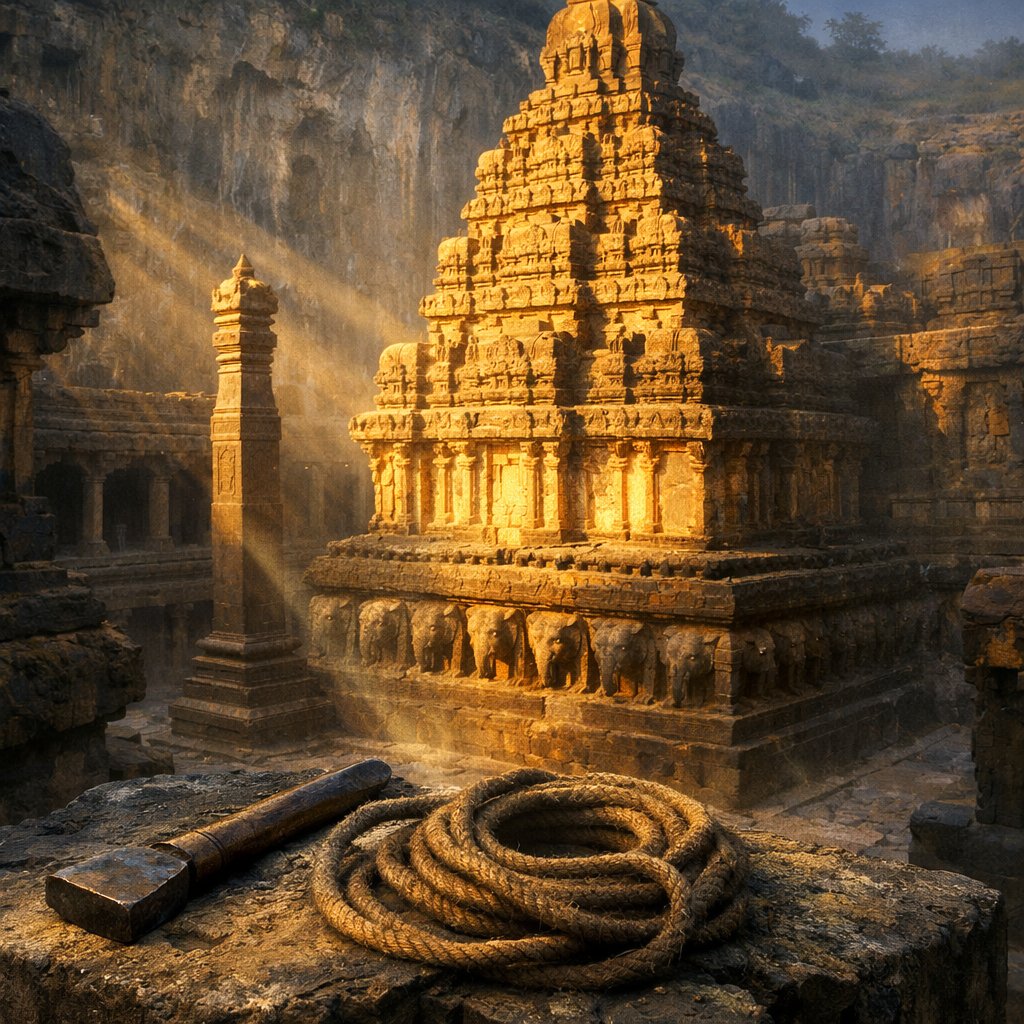
What distinguishes Ellora from the better-known caves at neighboring Ajanta is not depth of carving alone but the discipline of subtraction at scale. At Ajanta the chambers are excavated horizontally into the cliff. At Ellora’s Cave 16, the masons reversed the gravitational logic of building. They began at the summit of the basalt outcrop and cut downward through living rock, freeing the shikhara (the temple’s pyramidal tower) before the floor of the courtyard had been reached, releasing the elephants, lions, and monumental gateways from the matrix one chiselled course at a time. There is no foundation. There are no laid stones. The temple was never built; it was uncovered, the way a sculptor finds a figure already inside a block of marble, except that the block in this case is a hillside.
This guide walks the Ellora complex as the archaeological literature has walked it, from the Buddhist phase under the western Deccan dynasties through the Rashtrakuta achievement at Cave 16 and into the Jain coda of the ninth and tenth centuries, with attention to the engineering, the religious syncretism, and the place Ellora holds within the broader landscape of historical and archaeological mysteries. The aim is to honor what the Rashtrakuta dynasty actually accomplished, to credit the Pallava and Chalukya predecessors who made it possible, and to register accurately the questions that remain open after almost two centuries of fieldwork.
The Site: Charanandri Hills, Basalt Cliff, Three Religions
Ellora sits on a north-south escarpment of the Sahyadri spur known locally as the Charanandri Hills, on the trade route that linked the western coast at Sopara and Kalyan with the upper Godavari basin and the Deccan interior. The basalt is part of the Deccan Traps, a flood-basalt province laid down in the late Cretaceous in successive horizontal flows, and the rock at Ellora carries that layered history: the cliff face exposes alternating bands of harder and softer basalt that the carvers read as a stonemason reads grain in a piece of timber, locating courses where the chisel could be driven cleanly and avoiding the vesicular zones where it would chip out unpredictably.
Buddhist Caves (Caves 1 through 12)
The earliest excavations at Ellora are the Buddhist viharas at the southern end of the cliff, conventionally dated to the period between the late sixth and the early eighth century CE, contemporary with the late phase of nearby Ajanta and the western Deccan court of the Kalachuri and early Chalukya rulers. Cave 10, the Visvakarma chaitya, with its barrel-vaulted ceiling cut to imitate the wooden ribs of a contemporary monastic hall, is the architectural high point of the Buddhist phase. Cave 12, the Tin Thal, is a three-storey vihara whose vertical excavation prefigures, on a smaller scale, the technique that would later be deployed at Cave 16. Walter M. Spink’s chronological reading of these caves, developed in his comparative work on Ajanta and Ellora and summarized for the general reader in Ajanta to Ellora [1], placed the Buddhist phase at Ellora as a continuation of the patronage tradition that had earlier supported Ajanta’s Vakataka-period excavations under Harisena.
Hindu Caves (Caves 13 through 29)
The Hindu phase opens around the seventh century with the Brahmanical caves of the central group, including the Dasavatara (Cave 15) and the Ramesvara (Cave 21), and culminates in the eighth century with the Kailasanatha (Cave 16) carved during the Rashtrakuta dynasty. The seventeen caves in this stretch include sanctuaries to Vishnu, to Shiva in his Lakulisa and Nataraja aspects, and to the Sapta Matrikas, and they record the transition of regional patronage from the late Chalukya to the Rashtrakuta court. M.K. Dhavalikar’s monograph Ellora [2] remains the most useful single-volume guide to the iconographic programs of these caves and to their relation to the wider Deccan architectural tradition.
Jain Caves (Caves 30 through 34)
The Jain group at the northern end of the cliff was excavated between roughly the ninth and the early tenth centuries under the late Rashtrakuta and early Yadava patronage. The Indra Sabha (Cave 32), with its two-storey courtyard temple and its monolithic shrines around the perimeter, is the centerpiece. The iconography here, painstakingly catalogued by José Pereira in Monolithic Jinas: The Iconography of the Jain Temples of Ellora (1977) [3], records the Digambara tradition of Jain image-making at the moment when the religion’s regional influence in the Deccan was at its height. The Jain caves are smaller in scale than the Kailasanatha but no less precise in execution, and their later date confirms that the Ellora workshops did not lose their skill across four centuries of activity.
Cave 16: The Kailasanatha and the Engineering of Subtraction
Cave 16 is the engineering claim that justifies the rest of the article. The temple is conventionally attributed to Krishna I (reigned c. 756 to 773 CE) of the Rashtrakuta dynasty, the successor and uncle of Dantidurga, on the basis of two copperplate land-grant inscriptions, the Vadgaon and Talegaon plates, and on the comparative dating of the sculptural program against the Pattadakal temples of the Chalukyas, which the Kailasanatha self-consciously cites and surpasses. Heinrich Zimmer’s The Art of Indian Asia (1955) [4] read the temple as the architectural translation of Mount Kailasa, the cosmic mountain that is Shiva’s residence in Hindu cosmology, and read the act of carving downward into the rock as a deliberate ritual gesture: the temple was not raised toward the heavens but disclosed inside the earth, a mountain found within a mountain.
The Top-Down Method
The carvers began at the summit of the basalt outcrop. The first cuts were three trenches, each about ten meters wide, opened on the north, south, and east sides of a chosen rectangle of cliff, isolating a freestanding mass of rock from the parent cliff. The trenches were extended downward in stages, each stage descending the working surface by roughly a meter at a time, with the masons removing the spoil through the trench mouths and stockpiling it on the plateau above. As the trenches deepened, the upper portion of the freestanding rock was already being shaped: the shikhara of the main shrine was carved while the courtyard floor was still buried twenty meters below. By the time the floor of the court had been reached, the temple proper, the elephant frieze along the plinth, the freestanding flagstaff columns, and the Nandi pavilion in front of the main shrine were all substantially worked. There was no scaffolding in the conventional sense. The unexcavated rock served as scaffolding until it was, in turn, removed.
Dimensions and the Two Hundred Thousand Tonnes
The court enclosing the Kailasanatha measures about fifty meters from the entrance gopuram to the back wall, thirty-three meters across, and thirty meters from the courtyard floor to the top of the surrounding cliff. The main shrine within the court rises to roughly thirty-three meters above the floor, with the shikhara cut as a four-storey pyramid in the southern Dravidian style. The Archaeological Survey of India and the Britannica entry on Ellora cite a removed-rock estimate of approximately two hundred thousand tonnes (about three million cubic feet, or 85,000 cubic meters), with some sources giving a range from 150,000 to 200,000 tonnes depending on how the peripheral chambers and the access trenches are counted [5]. There is no parallel for monolithic excavation at this scale anywhere in the world.
The Pallava and Chalukya Predecessors
The Kailasanatha did not arise from nothing. The Pallava monolithic rathas at Mahabalipuram, carved in the seventh century under Narasimhavarman I, established the principle that an entire shrine could be excavated from a single block of granite, although at a far smaller scale. The Chalukya Virupaksha Temple at Pattadakal, built around 740 CE under Vikramaditya II, established the Dravidian temple plan and the iconographic program that the Kailasanatha would adopt and amplify. The Rashtrakuta achievement at Ellora was to fuse the Pallava monolithic instinct with the Chalukya temple typology, and to scale them by an order of magnitude that neither predecessor had attempted. Walter Spink’s reading of the Ellora workshop emphasizes this lineage [1]: Cave 16 is not an isolated miracle but the consummation of a regional tradition that had been preparing the technique for two centuries.
Religious Syncretism: Buddhist into Hindu into Jain
The four-century sequence at Ellora is rare in the comparative history of Indian religion. At most rock-cut sites in the Deccan a single tradition dominates: the Vakataka-Buddhist excavations at Ajanta, the Chalukya Hindu temples at Badami and Aihole, the Jain caves at Khandagiri. Ellora preserves all three traditions in a single cliff face, in a continuous workshop tradition, with the same stone-cutters and the same iconographic vocabulary moving between Buddhist, Hindu, and Jain commissions. UNESCO’s 1983 inscription document explicitly cited this religious sequence as one of the criteria for inscription, describing the site as illustrating “the spirit of tolerance that was characteristic of ancient India” [6].
What the Sequence Records
The interpretive frame here matters. The sequence at Ellora is not evidence of formal interfaith collaboration in the modern sense. It is evidence that successive ruling courts (the Kalachuri, the early Chalukya, the Rashtrakuta, the late Rashtrakuta and early Yadava) commissioned major religious projects at the same site, drawing on the same regional pool of master masons and sculptors. The continuity of the workshop tradition is visible in the carving conventions: the way folds of cloth are chiselled, the proportional canon of the figures, the framing of the panel reliefs. Mircea Eliade-style readings that emphasize the cosmological logic of the site (mountain-as-temple, sequence-as-spiritual-progression) are useful as interpretive overlays, but the material continuity is workshop continuity, not theological harmonization.
Conservation: Acid Rain, Vegetation, Foundation Stress
Modern Ellora faces the same conservation pressures that have eroded the rock-cut monuments of the western Deccan over the last century. The Archaeological Survey of India, which has had jurisdiction over the site since the early twentieth century, has published a series of conservation reports identifying three principal threats: chemical weathering of the basalt surface from acid rain (driven by sulphate emissions from the Aurangabad industrial corridor and the wider Maharashtra power-generation grid), biological colonization by vegetation and lichen working into joint planes, and microfracturing of the cliff matrix through differential thermal expansion and groundwater seepage. Cave 16 in particular shows visible salt efflorescence on the inner walls of the court, the result of moisture migrating through the basalt and depositing soluble carbonates as it evaporates at the rock face.
The conservation strategy adopted by the ASI, in consultation with the Indian National Trust for Art and Cultural Heritage and with technical input from international heritage bodies, has emphasized non-intervention wherever possible: stabilizing rather than restoring, removing vegetation rather than coating the rock, and managing visitor flow rather than reconstructing damaged sections. The interpretive principle is the same one that governs serious conservation work at Ajanta and at the rock-cut monasteries of central Asia. The original carvers spoke for themselves; the conservator’s task is to ensure that the speech remains audible.
What Ellora Tells Us About Indian Architecture
The proper relief into which the Ellora Caves throw the architectural history of the subcontinent is not the relief of inexplicable engineering. It is the relief of a particular Rashtrakuta court, working at the height of imperial confidence in the late eighth century, choosing to spend the labor of a generation on a single act of carving that translated a cosmic mountain into a piece of cliff. The achievement was real, the labor was disciplined, and the technique was transmitted: from the Pallavas to the Chalukyas to the Rashtrakutas, each dynasty carrying the rock-cut tradition further, until at Ellora the tradition reached a horizon that no later workshop has surpassed.
The unfinished surfaces inside the upper galleries of Cave 16, where the chisel marks of the eighth-century masons remain legible in the basalt, are perhaps the most eloquent feature of the site. They record a specific human hand, on a specific morning, working at a specific course of rock under a foreman whose name has not survived. Ellora’s mystery is not how the work was done. The methodology is documented and the lineage is clear. The mystery is the ambition that judged this scale of subtraction proportionate to the cosmological claim being made, and the patience that organized four centuries of stone-cutters into a single continuous workshop on a single basalt cliff. The Rashtrakuta dynasty did not invent the rock-cut temple. It pushed the rock-cut temple to the edge of what subtraction could deliver, and stopped only when the cliff itself, at the back of Cave 16, ran out.
Frequently Asked Questions
Where are the Ellora Caves?
The Ellora Caves are in the Charanandri Hills of western Maharashtra, India, roughly twenty-nine to thirty kilometers northwest of the city of Aurangabad (now formally renamed Chhatrapati Sambhajinagar). The caves are excavated into a north-south basalt escarpment that runs for about two kilometers along the cliff face. The site has been a UNESCO World Heritage Site since 1983.
How many caves are there at Ellora?
There are thirty-four caves at Ellora that are conventionally numbered and open to the public, though over a hundred excavations of various sizes are present in the cliff face. The thirty-four numbered caves divide into three religious groups: Buddhist (Caves 1 through 12), Hindu (Caves 13 through 29), and Jain (Caves 30 through 34). The whole sequence was excavated between roughly 600 and 1000 CE.
What is Cave 16 at Ellora?
Cave 16 is the Kailasanatha Temple, also called the Kailasa Temple, a monolithic Hindu temple complex dedicated to Shiva and conceived as an architectural representation of Mount Kailasa, the god’s mountain dwelling. The temple was carved from the top down out of a single basalt cliff under the Rashtrakuta king Krishna I in the late eighth century CE. It is the largest monolithic rock-cut structure in the world.
Who built the Kailasanatha Temple at Ellora?
The Kailasanatha is conventionally attributed to Krishna I (reigned c. 756 to 773 CE) of the Rashtrakuta dynasty, on the basis of two copperplate inscriptions and the comparative dating of the sculptural program. Some recent scholarship attributes the earliest phases of the work to his predecessor Dantidurga, with the bulk of the excavation completed under Krishna I. The carving probably continued under his successors into the late eighth century.
How was the Kailasanatha Temple carved?
The temple was excavated by a top-down technique. Three trenches were opened on the north, south, and east sides of a chosen rectangle of cliff, isolating a freestanding mass of basalt from the parent rock. The trenches were extended downward in stages, with the upper portions of the temple, including the shikhara and the surrounding sculpture, shaped as the working surface descended. Roughly two hundred thousand tonnes of basalt were removed in the process.
How much rock was removed to carve the Kailasa Temple?
Estimates range from approximately 150,000 to 200,000 tonnes, equivalent to about three million cubic feet or eighty-five thousand cubic meters of basalt. The variation in the published figures depends on whether peripheral chambers, access trenches, and the cliff-face shaping outside the main court are included in the calculation.
What are the dimensions of the Kailasanatha Temple?
The temple’s enclosing court measures roughly fifty meters from the entrance gopuram to the back wall, thirty-three meters across, and thirty meters from the courtyard floor to the top of the surrounding cliff. The main shrine itself rises to about thirty-three meters above the courtyard. The complex has four levels in its principal mass.
Why is Ellora a UNESCO World Heritage Site?
Ellora was inscribed on the UNESCO World Heritage List in 1983 under cultural criteria that recognized two values: the architectural and engineering achievement represented by the rock-cut monuments, particularly the Kailasanatha, and the rare religious sequence the site preserves, with Buddhist, Hindu, and Jain sanctuaries in continuous workshop tradition over four centuries. UNESCO’s documentation describes the site as exemplifying ancient India’s spirit of religious tolerance.
How are the Ellora Caves related to the Ajanta Caves?
Ajanta and Ellora are roughly a hundred kilometers apart in Maharashtra and represent successive phases of the rock-cut tradition in the western Deccan. Ajanta is older, with its main phase under the Vakataka king Harisena in the late fifth century CE. Ellora’s earliest Buddhist caves continue the same tradition into the seventh and eighth centuries. Walter M. Spink’s comparative chronology in Ajanta to Ellora (1967) traces the workshop transmission from one site to the other.
Why does the religious sequence at Ellora matter?
The sequence Buddhist into Hindu into Jain at Ellora is rare because it preserves, in a single cliff face and in a continuous workshop tradition, the iconographic vocabularies of three distinct religious systems. Most comparable sites in India are dominated by a single tradition. The continuity at Ellora records the practice of successive ruling dynasties commissioning major religious projects from the same regional pool of master masons across four centuries.
What conservation challenges does Ellora face today?
The Archaeological Survey of India identifies three principal threats: chemical weathering from acid rain driven by regional industrial emissions, biological colonization by vegetation and lichen working into joint planes, and microfracturing of the cliff matrix from differential thermal expansion and groundwater seepage. Salt efflorescence is visible inside Cave 16 where moisture migrating through the basalt deposits soluble carbonates at the rock face.
Did Aurangzeb damage the Ellora Caves?
Mughal-era accounts record that the emperor Aurangzeb, who ruled the Deccan from his capital at nearby Aurangabad in the late seventeenth century, ordered some defacement of the figural sculpture at Ellora. The damage is real but selective and did not affect the architectural fabric or the structural integrity of the carved monuments. The reports of his own court chroniclers note that he was reportedly impressed by the engineering of Cave 16 even as he disapproved of its imagery.
Are the Ellora Caves still active places of worship?
Some of the Hindu and Jain shrines at Ellora continue to receive informal worship, and festivals at the Kailasanatha draw pilgrims at certain points in the calendar. However, the principal status of the site is as a protected archaeological monument under the Archaeological Survey of India, and active liturgical use is limited and controlled to protect the carvings.