
By EsoVitae Editorial · Published · Updated
Drafted with AI assistance from the sources listed; images are AI-generated illustrations. How EsoVitae is made
The Etruscans called themselves Rasenna. Their neighbours, the Greeks, called them Tyrrhenoi; the Romans, Etrusci or Tusci, the root that survives in modern Tuscany. They flourished in west-central Italy from roughly the ninth century BCE through their absorption into the Roman state in the early first century BCE, and they shaped Roman religion, engineering, dress, and political ritual in ways the Romans themselves acknowledged. Yet because the bulk of their literature is lost and their language survives mostly on funerary inscriptions, they remain the most intensely studied half-known civilization of the ancient Mediterranean.
Direct Answer: Who Were the Etruscans?
The Etruscans were an Iron Age civilization of west-central Italy whose earliest phase is the Villanovan culture of around 900 BCE; by the sixth century BCE their independent city-states were joined in a loose league. They were absorbed into Rome between the fourth and first centuries BCE. Their alphabet is fully readable; their language is only partially understood, with just a few hundred words known with any certainty [1].
Chronology: From Villanovan Iron to Roman Province
The Etruscan record begins, on present evidence, with the Villanovan Iron Age culture of the early ninth century BCE. Villanovan settlements at Tarquinia, Vulci, Veii, and Populonia occupy the same hilltop sites that later become the great Etruscan cities, and the cremation cemeteries at the foot of those hills carry forward into the orientalising period without a clean break. Whether one calls Villanovan “early Etruscan” or “ancestral to Etruscan” is a matter of definitional taste; the material continuity is not in serious dispute, and Massimo Pallottino (1909-1995), whose Etruscologia (1942) was translated as The Etruscans (1955; revised English edition 1975), argued that Etruscan civilization formed in Etruria itself [2].
From roughly 700 to 575 BCE the orientalising period brought intense contact with the Greek colonists of Pithekoussai and Cumae and with other Mediterranean traders drawn by Etruria’s metal ores. Etruscan elites adopted the Greek alphabet, ivory and gold work, and a taste for imported Greek pottery so substantial that Etruria became the main export market for Greek vases outside Greece; more Attic vases have been found in the tombs of Vulci than at any other ancient site [3]. The archaic period, roughly 575 to 480 BCE, is the high noon: the great painted tombs of Tarquinia, the bronzes of Vulci, the painted terracotta Apollo of Veii (c. 510-500 BCE, attributed to Vulca, the only Etruscan artist whose name survives), and the political reach into Latium, Campania, and the Po valley.
The classical and Hellenistic periods, from about 480 BCE onward, are the long contraction. Veii falls to Rome in 396 BCE after a ten-year siege. Tarquinia and Caere were forced into long truces in the 350s BCE, and virtually all Etruria was in Roman hands by about 295 BCE. The grant of Roman citizenship in 90 BCE, during the Social War, and Sulla’s repression of Etruria in 82 BCE close the political existence of Etruria as such. Etruscan continued to be written into the first century CE; the emperor Claudius (10 BCE to 54 CE) wrote a now-lost twenty-book Etruscan history in Greek, the Tyrrhenika, and may himself have been able to read the language, but scholars place its extinction in the late first century BCE or the early first century CE [4].
The Twelve-City League and the Political Shape
The Etruscans were never a unified state. Roman sources, above all Livy, describe a Dodecapolis or league of twelve peoples (duodecim populi Etruriae) whose national council met at the sanctuary of Voltumna, the Fanum Voltumnae, now generally identified with the excavated complex at Campo della Fiera below Orvieto, where the twelve peoples annually elected a priest and celebrated shared rites and games. The roster was never fixed; the cities most often counted are Tarquinia, Vulci, Caere (modern Cerveteri), Veii, Volsinii (Orvieto or Bolsena), Clusium (Chiusi), Perusia (Perugia), Cortona, Arretium (Arezzo), Volaterrae (Volterra), Vetulonia, and Populonia. Two further leagues existed: one in the Po valley, including Bologna, Spina, and Adria, and one in Campania headed by Capua [5].
The political character of the league appears to have been ritual coordination rather than military command. Individual cities acted independently and sometimes in opposition. When Rome besieged Veii, the other Etruscan cities did not march to its relief. This city-state autonomy, conventional in the archaic Mediterranean, is one of the structural reasons the absorption into Rome ran piecemeal rather than as a single conquest. Modern historians accordingly read the league as a mostly religious and economic association, a loose confederation on the pattern of the Greek states, whose elected head, the zilath mechl rasnal, functioned largely as a ceremonial leader rather than a federal executive [6].
The Language Question: Partial Reading, Real Progress
Etruscan is the most stubborn linguistic puzzle the early Mediterranean has bequeathed to philology, and its standing in the popular imagination as “undeciphered” understates the actual state of knowledge. The alphabet, adopted around 700 BCE from the Euboean Greek alphabet of the first Greek colonists in Italy and settled into a classical form of twenty letters by about 400 BCE, is fully readable; any literate visitor to a museum case in Tarquinia or Volterra can sound out an inscription. What remains incomplete is the lexicon. Larissa Bonfante (1931-2019), with her father Giuliano Bonfante (1904-2005), published the English-language introduction The Etruscan Language (1983; revised edition 2002), and Helmut Rix’s Etruskische Texte (1991) gathered the inscriptions in a critical edition [7].
Roughly 13,000 inscriptions survive, the great majority funerary and formulaic: names, kinship terms, dedications, ages, magistracies. From this corpus only a few hundred words are understood with any certainty: numerals one through six (thu, zal, ci, sa, mach, huth, with the order of four and six still debated), kinship terms (clan meaning son, sech meaning daughter, ati mother, apa father), the verb “to give” (turuce), and a sober vocabulary of magistracies (zilath, purth, maru) and offerings. Longer texts are rarer and disproportionately important: the Liber Linteus of Zagreb, a ritual calendar of about 1,200 readable words written on linen and reused as Egyptian mummy wrappings; the Pyrgi Tablets, three gold plaques of around 500 BCE, two in Etruscan and one in Phoenician, found in 1964 and prized as the field’s nearest thing to a bilingual key; the Tabula Capuana, a long terracotta ritual calendar from Capua; and the Tabula Cortonensis, a bronze tablet of about forty lines found at Cortona in 1992 that records what appears to be a land transaction, the longest Etruscan text found in the twentieth century and the third longest known [8].
Structurally, Etruscan is non-Indo-European. It is agglutinative, with suffix-stacked grammar quite unlike Latin, Greek, or Celtic. Its closest known relative is Lemnian, attested on a sixth-century BCE stele from the Aegean island of Lemnos; together with the fragmentary Raetic of the Alps, the three appear to form a small Tyrsenian language family that survived from a pre-Indo-European Mediterranean substrate. Beyond that family, no convincing genetic relationship has been established, and serious comparativists have learned to be wary of the long parade of attempted external links [9].
The Origin Debate: Herodotus, Dionysius, and the DNA
Two ancient accounts set the terms of a debate that ran for two and a half millennia. Herodotus, writing in the fifth century BCE, reports a Lydian tradition that in a great famine under King Atys the people were divided by lot and half of them, led by the king’s son Tyrrhenus, built ships at Smyrna and came at last to the Umbrians of Italy, where they founded cities and took the name Tyrrhenians [10]. Dionysius of Halicarnassus, writing in the late first century BCE, dissents at length: the Etruscans, he argues, “migrated from nowhere else” but were native to Italy, a people unlike the Lydians in language, gods, laws, and institutions, who called themselves Rasenna [11]. The dispute structured the field through the nineteenth and twentieth centuries, with scholars taking either an Anatolian or an autochthonous position largely on cultural-typological grounds.
Two genetic studies have recently changed the discussion. The 2007 paper by Achilli and colleagues in the American Journal of Human Genetics on Tuscan mitochondrial DNA reported lineages with apparent Near Eastern affinity in some Etruscan-region populations, and was widely read as supporting Herodotus [12]. The 2021 paper by Posth and colleagues in Science Advances, working from the genomes of 82 ancient individuals from Etruria and southern Italy, among them burials at Tarquinia, Vetulonia, and Casenovole, dated between 800 BCE and 1000 CE, found that Iron Age Etruscans carried a large share of steppe-related ancestry, shared a local genetic profile with their Latin neighbours, and showed no sign of recent admixture from Anatolia. The autochthonous position, in genetic terms, is now better supported [13].
The reconciliation most archaeologists now favour, following Pallottino, treats the question of origins as badly posed: Etruscan civilization formed in Etruria itself out of the Villanovan Iron Age, and the modern consensus holds the Etruscans to be an indigenous population. Dionysius, writing some four centuries after Herodotus, was nearer that conclusion. The genetic record now suggests a population continuous with the broader Italian Iron Age, with cultural innovation drawn from an active Mediterranean exchange network rather than a single migration [14].
Religion: Haruspices, the Books of Tages, and the Disciplina Etrusca
Etruscan religion was a revealed system, distinctive in the ancient Mediterranean for the precision of its written discipline. The disciplina Etrusca, as the Romans called it, comprised three principal books: the libri haruspicini on the reading of animal entrails (especially the liver), the libri fulgurales on the interpretation of thunder and lightning, and the libri rituales on ceremony, which by later accounts included books on fate and the founding of cities. The tradition attributed the system to the prophet Tages, a child with an old man’s wisdom who, Cicero records, sprang from a furrow a ploughman had cut in the territory of Tarquinii and taught the assembled Etruscans the art of divination, and to the prophetess Vegoia, whose revelations concerned boundaries and the holding of land [15].
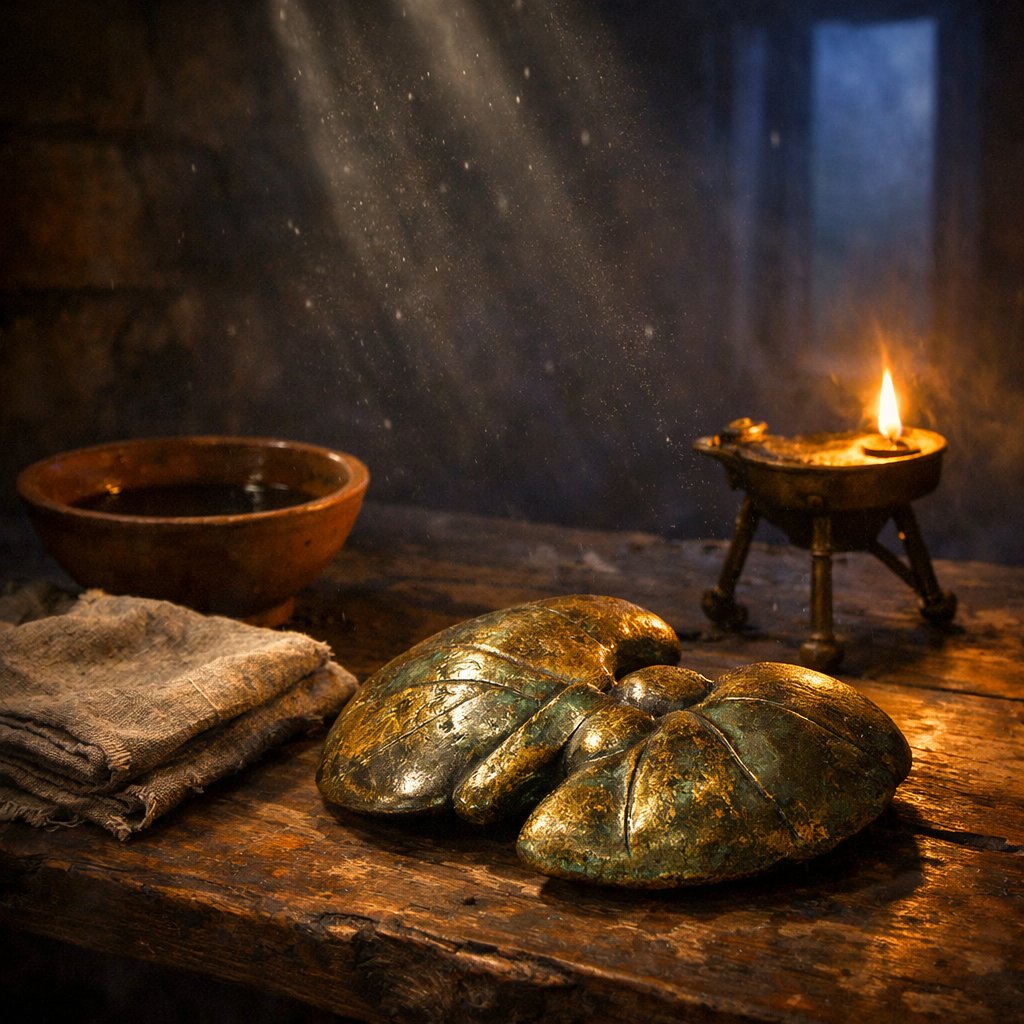
The Piacenza Liver, a bronze model of a sheep’s liver found in a field near Gossolengo, outside Piacenza, in 1877 and inscribed with forty divine names arranged in sections, gives the modern reader a working schematic of the haruspical system. Its sixteen outer compartments are thought to mirror the sixteen regions into which the Etruscans divided the sky, so that the deity of one region of the heavens owned the corresponding region of the liver, and a mark in that region was read as the message of that god. The system outlived its inventors. Tarquinia kept a college of sixty haruspices into imperial times, and as late as Alaric’s siege of Rome in 408 CE, Zosimus records, men from Tuscany offered the city prefect the old rites that, they said, had driven the Goths from a Tuscan town with thunder and lightning; they were sent away when no one dared join the public sacrifices [16].
The Roman Inheritance
Rome inherited from Etruria a long list of practices the Romans themselves did not always credit honestly. The fasces, the bundled rods and axe carried by the lictors as the symbol of magisterial authority, are Etruscan in form and were attributed by Roman antiquarians to the Etruscan kings of Rome. The toga, the curule chair, and the triumphal procession, with the purple toga picta of the general, whose face in some accounts was painted red, derive in whole or in part from Etruscan precedent. Roman writers such as Nicolaus of Damascus traced gladiatorial combat to Etruria, and the bloody funerary games painted in the Tomb of the Augurs at Tarquinia (c. 530-520 BCE) are often read as its ancestor, although many modern scholars prefer a Campanian origin; the first gladiators recorded at Rome fought in 264 BCE at the funeral games for Decimus Junius Brutus Pera. The Roman alphabet itself reaches Latin through an Etruscan intermediary [17].
Engineering inheritance is heavier still. Roman tradition holds that the Cloaca Maxima, Rome’s great drain, was begun around 600 BCE under the Etruscan king Tarquinius Priscus, who set Etruscan workmen and the plebeians to the task, and the Romans learned the semicircular arch from the Etruscans, whose arched gates, such as the Porta all’Arco at Volterra, still stand [18].
Why “Mystery” Is the Wrong Frame
A clarifying note for the reader. The Etruscans are not unknown. Their cities are excavated, their tombs are catalogued, their alphabet is read, their religion is partially reconstructed, their political shape is described in adequate ancient and modern sources, and their genetic continuity with the surrounding Iron Age population is now empirically grounded. What is missing, and the missing part is real, is most of their literature. Of the libraries the Romans inherited, almost nothing survives in original form. What is left is what was written on bronze, gold, linen, or stone, and what was buried with the dead. That is a great deal, and it is not a void. The honest description is a civilization whose record is partial, not one whose existence is enigmatic.
What Remains Open
Several questions remain genuinely live. The relative weight of Anatolian elite migration versus autochthonous development in the formation of the orientalising elite, even after the 2021 ancient DNA results, is a question scholars are still calibrating against the cultural-historical record. The internal political mechanics of the Twelve-City League, including the actual powers of the elected sacerdotal head and the frequency and conduct of the annual meeting at Voltumna, survive only in second-hand Roman summaries. The exact reading of much of the longer ritual texts, including substantial portions of the Liber Linteus, is still being negotiated word by word. New finds, like the Tabula Cortonensis in 1992, occasionally add new words at a stroke, and another such find could rebalance long-held readings. The work continues. The patience the material demands is rewarded slowly, in the manner the material was always going to require.
Sources
- Etruscan civilization, Wikipedia. wikipedia.org; Etruscan language, Wikipedia. wikipedia.org
- Villanovan culture, Wikipedia. wikipedia.org; Massimo Pallottino, Etruscologia, Milan, 1942, translated as The Etruscans, 1955, revised English edition, Indiana University Press, 1975; see Massimo Pallottino, Wikipedia. wikipedia.org and Etruscan origins, Wikipedia. wikipedia.org
- Etruscan art, Wikipedia. wikipedia.org; Vulci, Wikipedia. wikipedia.org; Apollo of Veii, Wikipedia. wikipedia.org
- Veii, Wikipedia. wikipedia.org; Caere, Wikipedia. wikipedia.org; Tarquinia, Wikipedia. wikipedia.org; Suetonius, Life of Claudius 42, trans. J. C. Rolfe, Loeb Classical Library, 1914. penelope.uchicago.edu; Etruscan language, Wikipedia. wikipedia.org
- Livy, History of Rome 5.1 and 5.17, trans. Canon Roberts, 1912. perseus.tufts.edu; Fanum Voltumnae, Wikipedia. wikipedia.org; Etruscan cities, Wikipedia. wikipedia.org; Etruscan civilization, Wikipedia. wikipedia.org
- Etruscan civilization, Wikipedia. wikipedia.org
- Etruscan alphabet, Wikipedia. wikipedia.org; Larissa Bonfante, Wikipedia. wikipedia.org; Giuliano Bonfante, Wikipedia. wikipedia.org; Giuliano Bonfante and Larissa Bonfante, The Etruscan Language: An Introduction, Manchester University Press, 1983, revised edition 2002. openlibrary.org; Helmut Rix, Etruskische Texte: Editio minor, G. Narr, Tübingen, 1991. openlibrary.org
- Etruscan language, Wikipedia. wikipedia.org; Liber Linteus, Wikipedia. wikipedia.org; Pyrgi Tablets, Wikipedia. wikipedia.org; Tabula Capuana, Wikipedia. wikipedia.org; Tabula Cortonensis, Wikipedia. wikipedia.org
- Lemnian language, Wikipedia. wikipedia.org; Etruscan language, Wikipedia. wikipedia.org
- Herodotus, Histories 1.94, trans. A. D. Godley, Loeb Classical Library, 1920. perseus.tufts.edu
- Dionysius of Halicarnassus, Roman Antiquities 1.30, trans. Earnest Cary, Loeb Classical Library, 1937. penelope.uchicago.edu; Dionysius of Halicarnassus, Wikipedia. wikipedia.org
- Alessandro Achilli et al., Mitochondrial DNA Variation of Modern Tuscans Supports the Near Eastern Origin of Etruscans, American Journal of Human Genetics 80(4), April 2007, pp. 759-768. doi.org
- Cosimo Posth et al., The origin and legacy of the Etruscans through a 2000-year archeogenomic time transect, Science Advances 7(39), 24 September 2021, eabi7673. doi.org
- Etruscan origins, Wikipedia. wikipedia.org; Cosimo Posth et al., Science Advances 7(39), 2021. doi.org
- Etruscan religion, Wikipedia. wikipedia.org; Tages, Wikipedia. wikipedia.org (citing Cicero, De divinatione 2.50)
- Liver of Piacenza, Wikipedia. wikipedia.org; Tarquinia, Wikipedia. wikipedia.org; Zosimus, New History, book 5, trans. 1814 (Green and Chaplin). tertullian.org; Sack of Rome (410), Wikipedia. wikipedia.org
- Fasces, Wikipedia. wikipedia.org; Curule seat, Wikipedia. wikipedia.org; Roman triumph, Wikipedia. wikipedia.org; Gladiator, Wikipedia. wikipedia.org; Tomb of the Augurs, Wikipedia. wikipedia.org; Latin alphabet, Wikipedia. wikipedia.org
- Cloaca Maxima, Wikipedia. wikipedia.org; Arch, Wikipedia. wikipedia.org; Volterra, Wikipedia. wikipedia.org