
By EsoVitae Editorial · Published · Updated
Drafted with AI assistance from the sources listed; images are AI-generated illustrations. How EsoVitae is made
What the Georgia Guidestones Were
The Georgia Guidestones were a granite monument that stood in a cow pasture seven miles north of Elberton, Georgia, from March 1980 until July 2022. Six granite slabs, nearly twenty feet tall and weighing about 119 tons in all. Four upright tablets carried ten guides for what the commissioner called an Age of Reason, repeated in eight modern languages. A capstone above carried a single sentence in four ancient scripts. The man who paid for the monument used the pseudonym Robert C. Christian and refused to reveal his real name to almost anyone, including the local press [1].
An archive-historian working a case like this begins, as ever, with the documentary record. The transfer of the land and the monument to Elbert County. The 1986 book Common Sense Renewed, published under the commissioner’s pseudonym. The confidentiality agreement with the Granite City Bank president Wyatt C. Martin, and the letters Martin kept even though he had been asked to destroy them. The surveillance clips the Georgia Bureau of Investigation released after the bombing of 6 July 2022. Together they tell a story that does not need conjecture to be strange. They sit within the wider field of historical and archaeological mysteries as a rare specimen, a deliberately built artifact whose builder went to extraordinary lengths to leave no fingerprints on the design, while leaving the design itself in places visible from the road.
The Commissioner Who Called Himself Robert C. Christian
In June 1979 an elegant, gray-haired man in an expensive suit walked into the offices of Elberton Granite Finishing Company and asked the company president, Joe H. Fendley Sr., for a price quote on a monument larger than anything Fendley’s firm had ever cut. He introduced himself as Robert C. Christian and said he represented a small group of loyal Americans; he later admitted that the name was a pseudonym, chosen because it represented his own beliefs and those of his group. Fendley, who thought he had a nut on his hands, tried to discourage him with a price several times higher than for any project his firm had taken on. The man asked whether there was a banker in town Fendley trusted, and Fendley sent him to Wyatt C. Martin, president of Granite City Bank, the sequence told in Wired’s 2009 account of how the monument was built [2].
Martin agreed to handle the money on one condition. He had to verify the man’s true identity and be assured the job would be paid for. Christian agreed to reveal his real name if Martin served as his sole intermediary, signed a confidentiality agreement pledging never to disclose it, and destroyed the project’s records when the work was done. Martin never publicly named him and died in 2021, at 91, but late in life he may have given the secret away by accident. In February 2024 CNN’s Thomas Lake, drawing on letters Martin had shown on camera to the makers of the little-known 2015 documentary Dark Clouds Over Elberton, set out evidence that Robert C. Christian was Herbert H. Kersten, a physician from Fort Dodge, Iowa, who died in 2005, per the CNN longform feature on the Guidestones identity question [3].
An archive-historian holds a 2024 attribution like that one in suspension. The argument is well-evidenced. The match between a Fort Dodge postmark, the age Christian gave in a 1998 letter, and a return address where Kersten long lived is suggestive. Kersten’s son James, the only family member Lake reached, said he was not familiar with the connection and declined to comment further. The pseudonymous record is what the commissioner intended to leave behind, and on his own terms, the design has worked.
The Ten Guides and the Capstone Sentence
What Robert Christian put on the four upright slabs is not arcane. It reads, on first encounter, like a mid-century rationalist’s commencement address. The full ten, as inscribed in English, ran in this order [4]:
- Maintain humanity under 500,000,000 in perpetual balance with nature. The first and most-cited guide; the one critics seized on as the monument’s smoking gun.
- Guide reproduction wisely, improving fitness and diversity. Phrasing that registers as eugenic to modern ears, deliberate and explicit at the time of inscription.
- Unite humanity with a living new language. A long-running early-twentieth-century universalist project, audible in Esperanto and in mid-century world-government literature.
- Rule passion, faith, tradition, and all things with tempered reason. The guide closest to the capstone’s call for an Age of Reason.
- Protect people and nations with fair laws and just courts. Standard liberal-internationalist phrasing.
- Let all nations rule internally, resolving external disputes in a world court. A direct echo of postwar United Nations charter idealism.
- Avoid petty laws and useless officials. The libertarian register, in one line.
- Balance personal rights with social duties. A communitarian counterweight, immediately following the libertarian one.
- Prize truth, beauty, love, seeking harmony with the infinite. The only guide that reaches beyond civic philosophy into the metaphysical.
- Be not a cancer on the earth, leave room for nature, leave room for nature. The closing repetition is on the stone itself, not a transcription error.
The eight languages chosen for the upright slabs were English, Spanish, Swahili, Hindi, Hebrew, Arabic, traditional Chinese, and Russian. The capstone above the four panels carried a different sentence, sandblasted in four scripts an Iron Age scribe might have recognized: classical Greek, Sanskrit, Egyptian hieroglyphic, and Babylonian cuneiform. Translated, the sentence read: Let these be guidestones to an Age of Reason. The choice of scripts itself argues a position. The commissioner wanted the dedication to be legible to the long survey of literate humanity, not only to the present moment, as cataloged in the Wikipedia entry’s transcription of the inscriptions [5].
The 1980 Dedication and the Astronomical Features
On 22 March 1980, U.S. Representative Doug Barnard Jr. unveiled the Guidestones before a crowd of several hundred people. The stones had been engineered to function, in a small way, as an astronomical instrument. A narrow channel cut through the central column tracked the celestial pole. A horizontal slot in the same column captured the sunrise on the summer and winter solstices and the equinoxes. A seven-eighths-inch hole through the capstone focused a beam of noon sunlight on the center column to mark the day of the year. Christian had set out these features in the ten or so pages of specifications he gave Joe Fendley in 1979, and they were complex enough that Fendley brought in a University of Georgia astronomer to help carry out the design, per the New Georgia Encyclopedia entry on the Guidestones [6].
The unveiling was a community celebration, with a crowd that spilled down the hillside and television news crews from Atlanta. Christian had dealt himself out long before. Once the land was bought, he told Fendley, “You’ll never see me again,” and from then on communicated solely through Martin.
How the Conspiracy Reading Took Hold
For most of its existence, the monument was a regional curiosity and a tourist draw. The hostile reading built up in the 2000s. In 2005 the activist Mark Dice, then writing as “John Conner,” began demanding that the stones be “smashed into a million pieces,” calling them the New World Order’s Ten Commandments. In November 2008 vandals attacked the monument for the first time, spray-painting slogans such as “No one world government.” After the 2022 bombing, Elberton’s residents blamed conspiracy theories for the loss, as documented in NPR’s coverage of the Elberton aftermath [7].
The historian’s first job is to acknowledge what the conspiracy reading correctly identified. The first guide does specify a target population. When the stones were unveiled the world held about 4.5 billion people, so meeting it would have required a reduction of almost 90 percent. In Common Sense Renewed, Christian argued for national population policies and “a few generations of single child families.” The historian’s second job is to register what the conspiracy reading did not engage with: the same book complains of subsidies that encourage “childbearing by the indigent, the lazy, the irresponsible and the inadequate,” and Herbert Kersten, the man CNN’s evidence points to, praised the Klansman David Duke in a 1992 letter to the Des Moines Register [8].
What the 2022 Georgia Republican Primary Did to the Stones
In May 2022 the Georgia gubernatorial candidate Kandiss Taylor made the destruction of the Guidestones an explicit plank of her primary campaign. She called the site satanic, and a campaign video she posted on 2 May proposed an executive order to “DEMOLISH THE GEORGIA GUIDESTONES,” linking the first guide to Covid-19 vaccines. She won barely 3 percent of the vote. The campaign nonetheless renewed attention to the monument among evangelical Christians and fringe conspiracy theorists, and Mart Clamp, who maintained the stones, later said such rhetoric “sets the mood for the crazies to come out” [9].
The Bombing of 6 July 2022
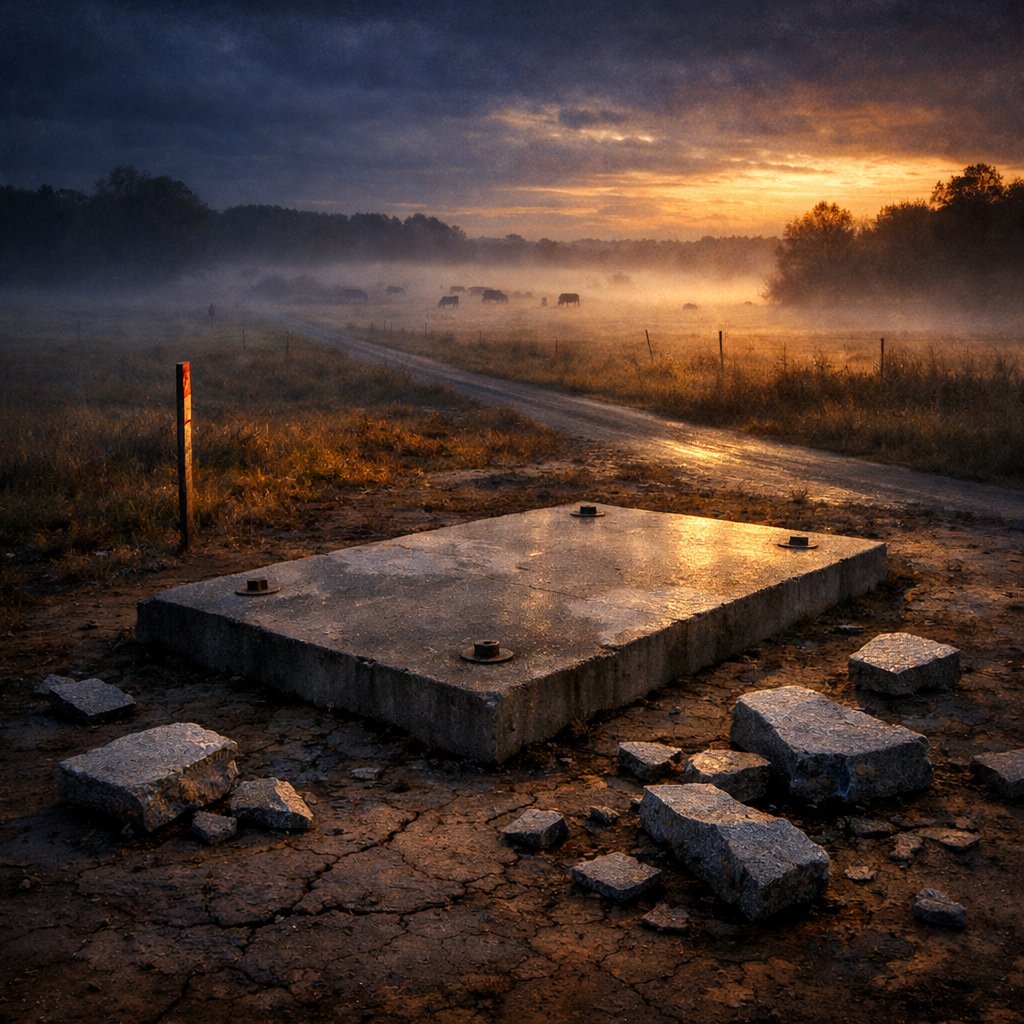
At around 4 a.m. on Wednesday 6 July 2022 someone placed an explosive device at the base of the Guidestones. The blast destroyed one of the upright slabs and sent granite fragments across the field. Elbert County deputies responded and asked the Georgia Bureau of Investigation to assist. Because the weakened structure was unsafe for investigators to search, the authorities demolished the rest of the monument later the same day, per the Georgia Bureau of Investigation’s press release on the explosion [10].
The GBI released surveillance clips within a day. One shows the blast, another a silver car apparently leaving the scene, and a third what the agency called “an unknown person leaving an explosive device,” a figure too small and grainy to identify. In July 2024 the GBI told reporters it had no update, and as of April 2026 no one had been arrested or charged, according to Fox Carolina’s two-year retrospective on the GBI investigation [11].
An archive-historian working the period after the bombing notices what the local response did and did not say. Elberton’s mayor, Daniel Graves, told NPR that his first reaction was “heartbreak and anger, frustration,” and that the community felt the same. Christopher Kubas of the Elberton Granite Association called the loss sad “not just for Elberton and Elbert County,” and the editor of the Elberton Star expected tourism to decline. The people mourning the stones were largely not the people who had wanted them destroyed.
What Survives of the Stones
In August 2022 the Elbert County Board of Commissioners voted to donate the debris to the Elberton Granite Association and its museum, which said it would preserve the remains until a decision was made on whether to rebuild. The county administrator said no board member wanted the county government involved in rebuilding, and by February 2024 the former site was an empty field [12].
Robert Christian’s own written explanation also survives: Common Sense Renewed, a hardcover book he published under his pseudonym in 1986. It is rare. When CNN’s Thomas Lake went looking, a copy listed at Ave Maria University had disappeared, and he found one at the public library in Elberton. Anyone reading it today will hear Cold War dread of an “atomic tinderbox” and, running through it, an insistence that overpopulation lay beneath the world’s problems [13].
How an Archive-Historian Reads the Case
Three frames hold the Guidestones case together, and the historian’s job is to keep all three in the field of view at once. The documentary frame: the land transfer, the confidentiality agreement, the letters, the book, the photographs, the GBI press release, the surveillance footage. None of this is occult. The interpretive frame: the ten guides themselves, read as a postwar liberal-rationalist creed inflected by mid-century eugenic and Malthusian assumptions, neither identical to the conspiratorial reading nor innocent of it. The cultural-historical frame: the long arc by which a 1980 roadside monument became, in 2022, first a campaign target and then the casualty of an unsolved bombing.
The Elberton people who handled the granite are the ones whose memory the historian most wants to preserve. Joe Fendley and Wyatt Martin, the only two men in Elberton known to have met Christian face to face, have both died. The crew that built the monument never knew who was paying for it. Mart Clamp, whose father sandblasted all of the lettering, spent 25 years cleaning graffiti and other damage off the stones [14]. The stone was the part of the work they could vouch for. The rest, by Robert Christian’s design, is the part that will keep the case open.
Sources
- Clay Ouzts, Georgia Guidestones, New Georgia Encyclopedia, 15 April 2005, last edited 11 July 2022. georgiaencyclopedia.org; Randall Sullivan, American Stonehenge: Monumental Instructions for the Post-Apocalypse, Wired, 20 April 2009. wired.com
- Randall Sullivan, American Stonehenge: Monumental Instructions for the Post-Apocalypse, Wired, 20 April 2009. wired.com; Clay Ouzts, Georgia Guidestones, New Georgia Encyclopedia. georgiaencyclopedia.org
- Thomas Lake, Two mysteries surrounded the Georgia Guidestones. One may have finally been solved, CNN, 16 February 2024. cnn.com; Randall Sullivan, American Stonehenge, Wired, 20 April 2009. wired.com
- Clay Ouzts, Georgia Guidestones, New Georgia Encyclopedia, last edited 11 July 2022. georgiaencyclopedia.org
- Matt Smith, Waiting for the end of the world: Georgia’s 30-year stone mystery, CNN, 22 March 2010. cnn.com; Georgia Guidestones, Wikipedia (transcription of the inscriptions and explanatory tablet). wikipedia.org
- Randall Sullivan, American Stonehenge, Wired, 20 April 2009. wired.com; Clay Ouzts, Georgia Guidestones, New Georgia Encyclopedia. georgiaencyclopedia.org
- Randall Sullivan, American Stonehenge, Wired, 20 April 2009. wired.com; Stephen Fowler, A Georgia monument was destroyed. Locals blame conspiracy theories, NPR, 28 July 2022. npr.org
- Thomas Lake, Two mysteries surrounded the Georgia Guidestones. One may have finally been solved, CNN, 16 February 2024. cnn.com
- Thomas Lake, CNN, 16 February 2024. cnn.com; Clay Ouzts, Georgia Guidestones, New Georgia Encyclopedia, last edited 11 July 2022. georgiaencyclopedia.org; Stephen Fowler, NPR, 28 July 2022. npr.org
- Georgia Bureau of Investigation, GBI Investigates Explosion in Elbert County, 6 July 2022, updated 7 July 2022. gbi.georgia.gov; Thomas Lake, CNN, 16 February 2024. cnn.com
- Anisa Snipes, GBI: No update on Georgia Guidestones explosion two years later, Fox Carolina, 1 July 2024. foxcarolina.com; Thad Moore, 5 things we’ve learned so far about the Georgia Guidestones explosion, Atlanta Journal-Constitution, 28 April 2026. ajc.com
- WSB-TV News Staff, Georgia Guidestones explosion happened a year ago today. It’s still a mystery who did it and why, WSB-TV, 6 July 2023. wsbtv.com; Thomas Lake, CNN, 16 February 2024. cnn.com
- Thomas Lake, CNN, 16 February 2024. cnn.com; Matt Smith, Waiting for the end of the world: Georgia’s 30-year stone mystery, CNN, 22 March 2010. cnn.com
- Randall Sullivan, American Stonehenge, Wired, 20 April 2009. wired.com; Matt Smith, CNN, 22 March 2010. cnn.com; Stephen Fowler, NPR, 28 July 2022. npr.org