
By EsoVitae Editorial · Published
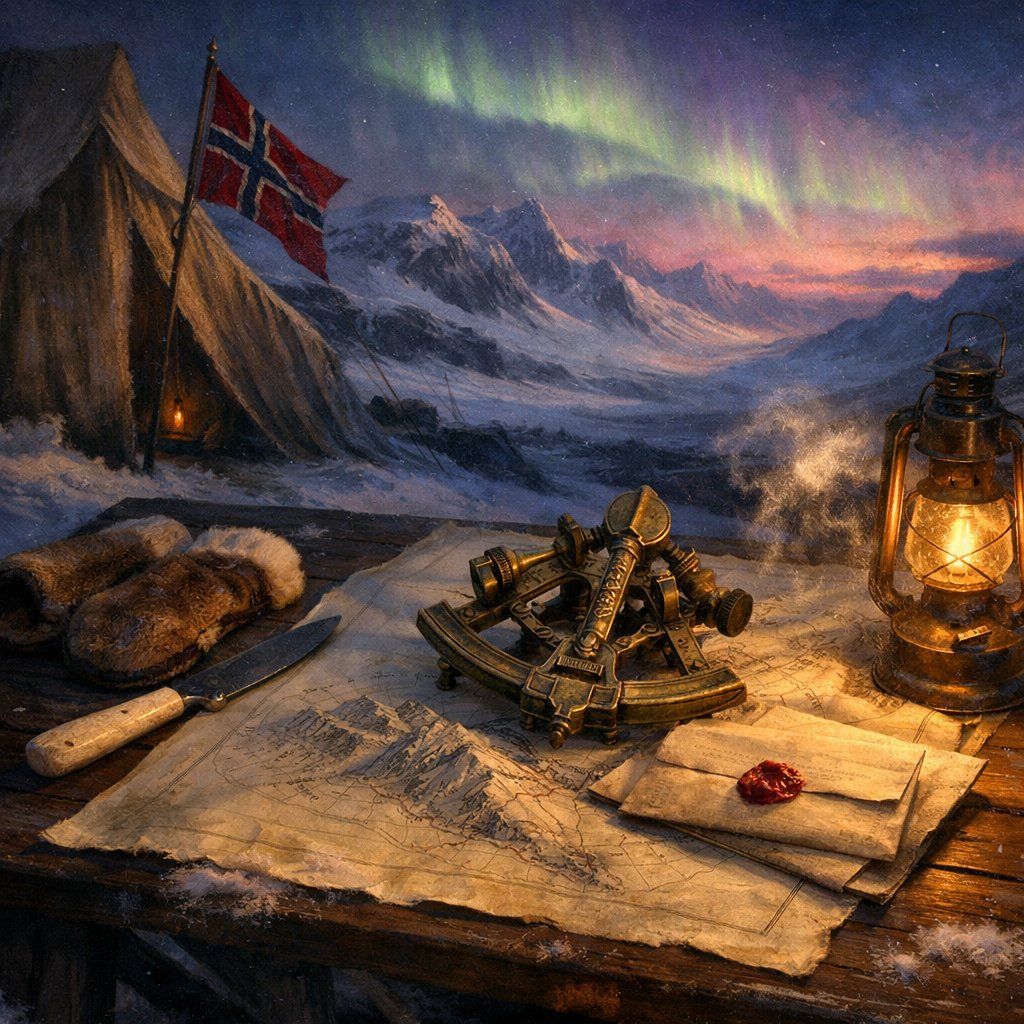
Drafted with AI assistance from the sources listed; images are AI-generated illustrations. How EsoVitae is made
Who Was Roald Amundsen and Why Do His Expeditions Still Matter?
Roald Engelbregt Gravning Amundsen (1872 to 1928) was the Norwegian polar navigator who first sailed the Northwest Passage, first reached the geographic South Pole, and first crossed the Arctic by air. His four signature expeditions, from the Gjoa voyage of 1903 through the Latham 47 disappearance of 1928, mapped the last unwritten coastlines of the planet and ended the heroic age of polar exploration.
No other figure of his generation accumulated so many quiet, methodical firsts. Scott took the British public’s imagination to the South Pole and lost his life there. Shackleton became a legend of survival without ever planting a flag at a pole. Amundsen, by contrast, returned. He returned with sled dogs intact, with logbooks that fed Norwegian science for half a century, and with the unsentimental observation, recorded in his 1912 memoir Sydpolen, that an Arctic expedition is won in the autumn before it sails. His diaries, preserved in the National Library of Norway and the Fram Museum at Bygdoy in Oslo, allow a reconstruction of polar exploration at its most disciplined and least dramatic [1].
This guide follows the four arcs that defined his career: the Northwest Passage of 1903 to 1906, the South Pole of 1911, the Norge airship transit of 1926, and the 1928 flight that ended in his disappearance over the Barents Sea. Read alongside the broader pattern of historical and archaeological mysteries traced across this site, the Amundsen file is the rare case where the silence of the ice is filled, almost completely, by the navigator’s own pen.
The Northwest Passage, 1903 to 1906
For nearly four centuries, European navigators had hunted a sea lane connecting the Atlantic to the Pacific through the Canadian Arctic. The expeditions of Frobisher, Hudson, and Franklin had ended in scurvy, mutiny, abandoned ships, or, in Franklin’s 1845 case, the loss of all 129 men. When Amundsen sailed from Christiania (now Oslo) on the night of 16 June 1903, he did so in deliberate secrecy. His creditors were closing in, his ship the Gjoa displaced only forty-seven tons, and his crew numbered six. He left a letter for his backers and slipped out under cover of rain.
The Gjoa and Her Crew
The Gjoa was a single-masted herring sloop built in 1872, the same year as her commander. Amundsen had bought her cheap. He fitted a thirteen-horsepower paraffin engine, doubled the planking, and provisioned her for five years. The crew of six, including Helmer Hanssen and Godfred Hansen, was chosen for endurance over rank. The plan was to winter at King William Island in the central archipelago and use the ice-bound months to fix the position of the North Magnetic Pole, a prize that would secure scientific legitimacy for an otherwise speculative voyage [2].
Wintering at Gjoahavn
The Gjoa reached a sheltered cove on the southeast corner of King William Island in September 1903. Amundsen named the harbor Gjoahavn, today the Inuit hamlet of Gjoa Haven, Nunavut. The expedition wintered there for two seasons. What followed was less drama than apprenticeship. The Netsilik Inuit, whom Amundsen treated as teachers rather than curiosities, showed the Norwegians how to drive sled dogs in fan harness, cut snow blocks for an iglu, and dress in layered caribou-hide. He filled three notebooks with Netsilik vocabulary and ethnography, catalogued in the National Library of Norway as NB Ms.fol. 4040 [3]. The lesson he carried south to Antarctica eight years later was already being written.
Through the Final Channel
In August 1905, the Gjoa threaded the Simpson Strait and entered waters already charted from the Pacific side. The Northwest Passage was complete. Sea ice trapped the ship at King Point in the Yukon for a third winter. Amundsen sledged 800 kilometers to Eagle, Alaska, to telegraph the news. The cable he sent on 5 December 1905 was the first announcement of a transit that mariners had pursued since the reign of Elizabeth I. The Gjoa reached Nome on 31 August 1906 and sits today on the lawn of the Fram Museum, a small wooden answer to four centuries of question.
The South Pole, 1911
Amundsen had intended to make a bid for the North Pole. When Frederick Cook and Robert Peary both claimed that prize in 1909, he silently switched targets without informing his backers, his crew, or the Norwegian state. From Madeira in September 1910 he sent his brother Leon a single telegram for forwarding to Scott in Melbourne: “Beg leave inform you Fram proceeding Antarctic. Amundsen.” [4] It arrived after Scott had left port. The race was on, and Scott did not know the rules had changed.
Framheim and the Bay of Whales
The Fram reached the Bay of Whales, an inlet on the eastern Ross Ice Shelf, in January 1911. Amundsen’s choice of base, sixty nautical miles closer to the Pole than Scott’s at McMurdo Sound, was deliberate. He erected a prefabricated hut he called Framheim and unloaded 116 Greenland sled dogs. Where Scott placed his trust in motorized sledges, Manchurian ponies, and man-hauling, Amundsen placed his in the Inuit method refined at Gjoahavn: dogs that could pull at a steady fifteen miles a day and could, when necessity demanded, feed the surviving dogs and the men.
The Polar Journey
A first sortie in September 1911 collapsed in temperatures below minus fifty Celsius. The team regrouped and set out again on 19 October with five men, four sledges, and fifty-two dogs. They found a previously unknown route up the Axel Heiberg Glacier and ascended 10,000 feet onto the polar plateau through what Amundsen’s diary of 21 November 1911 called “a chaos of ice blocks the size of houses” [5]. They reached 90 degrees south on 14 December 1911, planted the Norwegian flag at a camp they named Polheim, and left a tent with a letter for Scott to forward to King Haakon VII should Amundsen fail to return. Scott reached the Pole on 17 January 1912 and found the tent still standing [6].
The Return and the Comparison
Amundsen’s party returned to Framheim on 25 January 1912 with eleven dogs and all five men, having covered 1,860 nautical miles in ninety-nine days. Scott’s party of five died on the return march in March and April 1912, sixteen kilometers from a depot. Roland Huntford’s The Last Place on Earth (London: Hodder and Stoughton, 1979) documented the comparison in archival depth and concluded that the difference was not luck or character in the Edwardian sense, but logistics, ski technique, and the willingness to learn from indigenous Arctic peoples [7]. The verdict, controversial in 1979 and now broadly accepted, recasts the heroic narrative as a lesson in epistemology: who you are willing to listen to determines who comes home.
The Norge and the First Confirmed Crossing of the Arctic, 1926
By the early 1920s, the geographic North Pole remained contested. The Cook and Peary claims of 1909 were both shadowed by archival doubt, and Richard E. Byrd’s 9 May 1926 flight from Spitsbergen has since been challenged on the basis of his own diary’s erased sextant figures, recovered by Dennis Rawlins in 1996 [8]. The first uncontested transit of the polar basin was made not by ship or sledge but by a semi-rigid airship.
The Airship and the Italian Engineer
The Norge was a 106-meter Italian-built airship designed by the engineer Umberto Nobile. Amundsen, financing the expedition with the American philanthropist Lincoln Ellsworth, purchased her from the Italian government in 1925. The crew of sixteen included Amundsen as expedition leader, Nobile as pilot, and Ellsworth as navigator and patron. The ship lifted from Kongsfjord at Spitsbergen at 09:55 on 11 May 1926 with three Maybach engines and a hydrogen lift cell that even Nobile considered “a long match in a dry forest.”
Across the Pole and on to Alaska
The Norge passed over the geographic North Pole at 01:25 on 12 May 1926. Amundsen, Ellsworth, and Nobile each dropped a flag from a small hatch in that order, a sequence Nobile would later contest in print. The airship continued south across the Beaufort Sea, suffered ice accretion, and made an unplanned descent at Teller, Alaska, on 14 May. The transit had taken seventy-two hours and covered 5,300 kilometers, and was, as the Royal Geographical Society conceded in July 1926, the first verified passage of a human party across the Arctic Ocean from one continent to the other [9]. The bitter dispute that followed, over whose flag had flown longest and whose name belonged on the official report, soured Amundsen’s last years and severed a friendship that had crossed the Pole intact.
The Latham 47 and the Disappearance, 1928
On 23 May 1928, the airship Italia, a successor to the Norge commanded by Nobile, crashed on the polar pack north of Spitsbergen. Half the crew were killed or carried away with the wreckage. The survivors transmitted distress signals from a red tent on the drifting ice. Despite the recent acrimony, Amundsen volunteered to fly north and search for his estranged collaborator. A polar life, in his view, owed loans that no quarrel could cancel.
The Aircraft and the Crew
The French government loaned Amundsen a Latham 47, a twin-engined flying boat designed for transatlantic mail service and registered F-AKDQ. It was poorly suited to Arctic conditions, with an open cockpit and limited range. The crew of six included Amundsen, the Norwegian pilot Leif Dietrichson, the French pilot Rene Guilbaud, and three French aviators. They lifted from Tromso at 16:00 on 18 June 1928. The last radio contact came at 18:45, a routine position report placing the aircraft over the Barents Sea on a heading for Bear Island [10].
What the Sea Returned
No further signal was received. Search vessels combed the Barents and Greenland seas through the autumn of 1928. On 31 August, the trawler Brodd recovered a damaged port-side wing float; on 14 October, a fuel tank washed ashore on Haroyene, west of Tromso. Both pieces suggested a forced descent on the open sea, possibly followed by capsize in heavy weather. No bodies were ever recovered. Nobile was rescued from the ice by the Swedish aviator Einar Lundborg on 24 June 1928, six days after Amundsen vanished, and survived the man who had flown to save him by half a century [11].
The Search That Continues
In 2003, the Norwegian Royal Navy used side-scan sonar in the area where the wing float had been recovered and found nothing. A 2009 expedition extended the search grid west of Bear Island; a 2018 private attempt deployed an autonomous underwater vehicle at 350 meters. The results remain inconclusive. The disappearance of the Latham 47 is the rare modern mystery in which the broad outline is well documented, the fate is reasonably certain, and the physical evidence is, even after a century, almost entirely missing.
What Amundsen’s Archive Tells Us About Polar Exploration
The Amundsen papers held by the National Library of Norway run to nearly twenty linear meters of diaries, telegrams, equipment lists, and photographic plates. With the Fram Museum’s voyage records and the customs ledgers of the Fram and the Maud, they form the most complete documentary record of any heroic-age polar career. Three patterns emerge that the public legend tends to soften: method over mystique, acknowledgment of teachers, and a constitutional avoidance of romanticism. The diaries are heavy with arithmetic, with caloric calculations, dog-feeding schedules, and ski-wax test results, and the famous polar journey was won in spreadsheets compiled in Norwegian winter evenings. Amundsen named the Netsilik elders who had instructed him at Gjoahavn and credited them in Sydpolen as the architects of his polar method. He records cold, hunger, and grief without ornament. Stephen R. Bown has shown how this prose discipline shaped the modern reporting style of working scientists in the field [12].
Frequently Asked Questions
When was Roald Amundsen born and when did he die?
Amundsen was born on 16 July 1872 at Borge, Ostfold, Norway, and disappeared on 18 June 1928 aboard the Latham 47 flying boat over the Barents Sea. He was officially declared dead by the Norwegian government on 7 December 1928. No body was ever recovered.
Was Amundsen really the first to reach the South Pole?
Yes. He and his four companions reached 90 degrees south on 14 December 1911. Scott arrived at the same point on 17 January 1912, thirty-four days later, and found Amundsen’s tent and letter waiting. No serious historical claim challenges Amundsen’s priority.
Did Amundsen actually reach the North Pole?
He reached it by air aboard the airship Norge on 12 May 1926. Earlier surface claims by Cook (1908) and Peary (1909) are both archivally disputed, and Byrd’s 9 May 1926 flight has been challenged on the basis of his own erased sextant data. The Norge transit is the first uncontested human reaching of the Pole.
What was the role of sled dogs in Amundsen’s success?
Central. Amundsen used 116 Greenland dogs at the start of the South Pole expedition, both as sledge motive power and, where supplies thinned, as a planned food source. The system contrasted sharply with Scott’s mixed motorized-pony-and-man-hauling approach.
What did Amundsen learn from the Netsilik Inuit?
During two winters at Gjoahavn from 1903 to 1905, he learned dog-driving in fan harness, snow-block iglu construction, and caribou-hide layered clothing, all documented in three notebooks now held at the National Library of Norway.
What ship did Amundsen use for the Northwest Passage?
A herring sloop named Gjoa, forty-seven tons, with a paraffin engine and a crew of seven. She is preserved at the Fram Museum in Oslo.
Why did Amundsen quarrel with Umberto Nobile?
After the 1926 Norge transit, the two men disputed the relative prominence of their flags at the Pole and the authorship of the official report. Nobile published a personal account that Amundsen considered self-aggrandizing. The dispute became public in Italian and Norwegian newspapers and was unresolved when Amundsen vanished two years later.
What happened to the Latham 47 in 1928?
The French flying boat carrying Amundsen and five companions vanished over the Barents Sea on 18 June 1928 during a flight to search for Nobile’s crashed Italia. A wing float and a fuel tank were later recovered. No further wreckage and no remains have ever been confirmed found, despite Norwegian Royal Navy searches in 2003 and 2009.
How is Amundsen viewed by polar historians today?
Roland Huntford’s 1979 The Last Place on Earth recast Amundsen as the methodical professional and Scott as the gifted amateur whose preferences cost his men their lives. The judgment is now broadly accepted, though Scott’s literary legacy remains powerful in British memory.
Where can a researcher consult Amundsen’s primary papers?
The principal archive is the Manuscripts Collection of the National Library of Norway in Oslo (Ms.fol. 4040). The Fram Museum at Bygdoy holds the ships Fram and Gjoa, and the Tromso University Museum holds materials relating to the 1928 search.
For deeper context across the historical and archaeological mysteries archive, consider The Tower of Babel: Historical Evidence and Indus Valley: Trade and Communication.