By Emilia Wellesley · Published May 6, 2026 · Updated September 10, 2026
Last updated: September 10, 2026.
What Are the Ica Stones?
The Ica Stones are roughly twenty thousand engraved andesite cobbles assembled from the early 1960s onward in Ica, a coastal-desert province about three hundred kilometres south of Lima, Peru, and exhibited in a private museum opened in 1996 by the physician and amateur antiquarian Javier Cabrera Darquea (1924-2001). The collection is best known for its incised images of human figures riding sauropod dinosaurs, performing open-heart surgery, and observing distant continents through telescopes — claims used in popular and creationist literature as evidence that humans and dinosaurs coexisted.
The professional archaeological position is that almost the entire visible Cabrera collection is a modern fabrication. The principal acknowledged fabricator, the Ocucaje farmer Basilio Uschuya, demonstrated his technique on camera for the BBC documentary Pathway to the Gods in 1977, naming his wife Irma Gutiérrez de Aparcana as a partner in the work and his sources as comic books and popular magazines. Materials analysis carried out in Barcelona in 1993 and 1994 found tool-marks consistent with modern saws, acids, and sandpaper. Peruvian archaeologists distinguish the Cabrera material sharply from a small body of genuinely pre-Columbian engraved stones documented in situ at Paracas and Ica cemeteries.
Cabrera’s collection nonetheless continues to circulate in the popular literature as evidence of an antediluvian civilisation, an extraterrestrial visitation, or a global flood that washed dinosaurs and people through the same Holocene horizon. The persistence of this framing, against the documentary record of a confessed forgery and a published archaeological refutation, is itself the case worth examining. It belongs in the broader landscape of historical and archaeological mysteries as a type-case for how a hoax with a charismatic curator outlives its acknowledgement in the press.
The 1966 Birthday Gift and the Cabrera Collection
By Cabrera’s own account, his interest in the engraved stones began on 13 May 1966, his forty-second birthday, when his friend Felix Llosa Romero gave him a single dark cobble incised with the figure of a fish [1]. The fish was unremarkable; the gift was. Cabrera had grown up in Ica and was at that point a respected physician at the Instituto Peruano de Seguridad Social. The stone caught his attention because it resembled, in its dark patina and andesitic weight, the small body of pre-Columbian engraved stones that an Ica regional archaeologist named Alejandro Pezzia Assereto had begun to publish about during the same decade.
The Soldi Brothers and the Ocucaje Provenance
Within a year Cabrera had purchased a collection of about three hundred and forty stones from the Soldi brothers, two Italo-Peruvian residents of Ocucaje who claimed the stones had been recovered in 1961 from the ravines and cemeteries of the Ocucaje desert. The Soldi material would later be cited by Cabrera as the methodologically clean nucleus of the collection. From there the collection grew rapidly. By the early 1970s Cabrera had acquired several thousand more stones from a single chief supplier, a campesino farmer from the village of Salas named Basilio Uschuya, and by the late 1990s he was claiming a holding of roughly twenty thousand pieces, with estimates of the total Ica-region material in private hands ranging as high as fifty thousand to one hundred thousand stones [1][2].
The Imagery That Made the Collection Famous
What set Cabrera’s stones apart from the small documented corpus of authentic Ica-region engravings was the imagery. Pre-Columbian engraved stones excavated by Pezzia Assereto and published in his 1968 archaeological survey of Ica show fish, llamas, and stylised geometric or floral motifs of the kind one would expect on a Paracas or early-Ica grave good [2]. The Cabrera stones depicted, instead, men riding triceratops, surgeons performing what Cabrera identified as a heart transplant, telescopes trained on a recognisable map of the world that included Atlantis and Lemuria, and figures travelling between the planets. The visual register was simultaneously antique in patina and unmistakably twentieth-century in iconography.
Basilio Uschuya and the Confession of 1973
In 1973 the Swiss writer Erich von Däniken, then at the height of his ancient-astronaut publishing career following the success of Chariots of the Gods? (1968), travelled to Ica to interview Cabrera and his suppliers. Von Däniken later reproduced the encounter in his 1977 book According to the Evidence. During that meeting, and again in subsequent interviews with Peruvian and German journalists, Basilio Uschuya conceded that he had engraved the stones himself. He named his wife Irma Gutiérrez de Aparcana as his partner in the work [1][3].
The Method, As Uschuya Described It
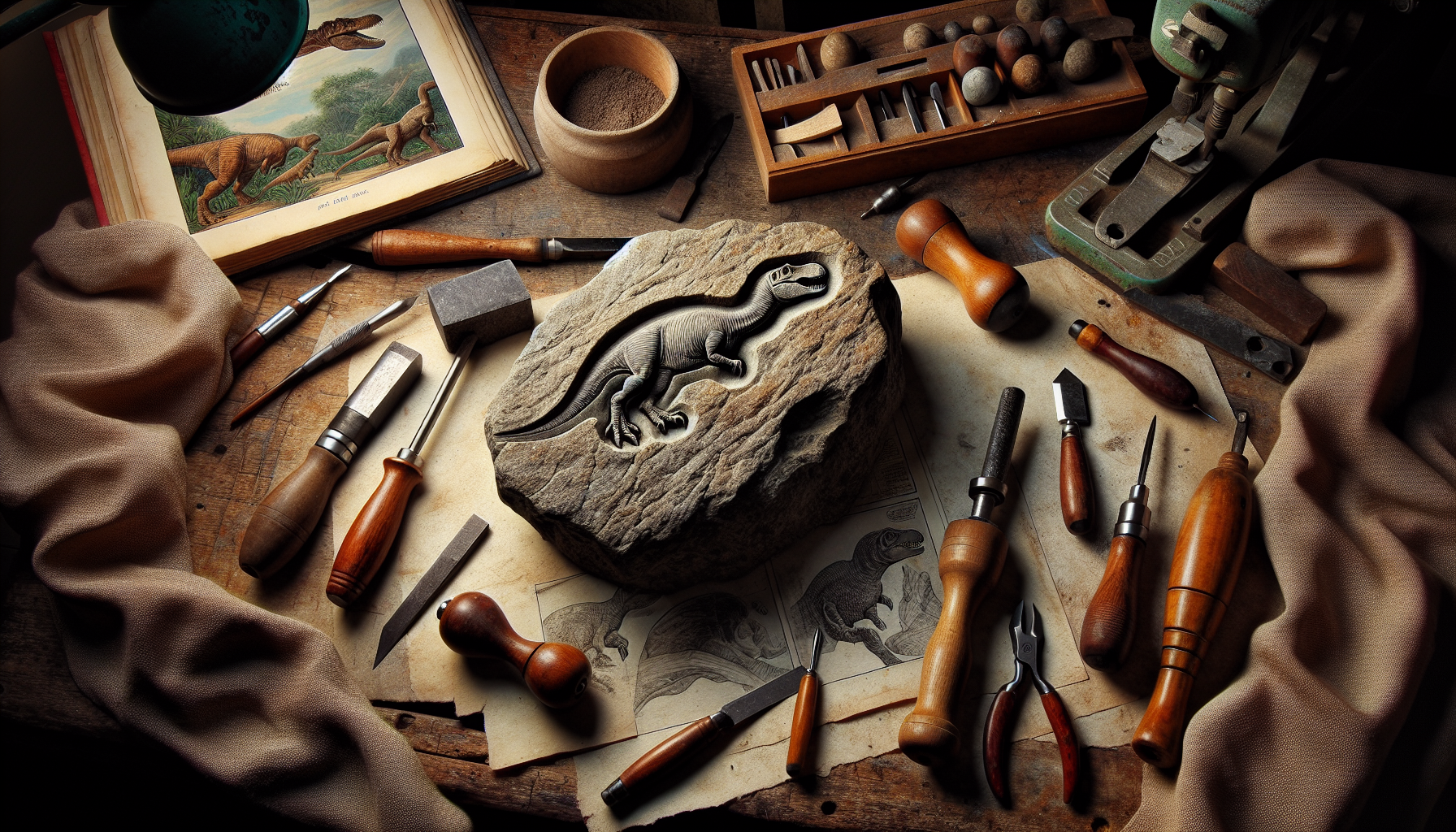
Uschuya was unembarrassed about the technique. He used a dentist’s drill, knives, and chisels to incise the imagery, drawing his subject matter from comic books, school textbooks, and popular magazines on prehistoric life. He aged the cut surfaces by baking the stones in cow and donkey dung, by leaving them in his chicken pen, and by rubbing the cuts with boot polish to seat the dark patina into the freshly exposed andesite. He had been selling the stones to tourists at first and to Cabrera in increasing volume from the late 1960s; he gave the price as roughly the going rate for a day’s farm labour [3]. He recanted the confession at one point during a later interview, saying he had claimed forgery only to evade prosecution under Peruvian laws against trafficking in cultural patrimony, but he restated the forgery account on multiple occasions across the next two decades.
The 1977 BBC Demonstration
The decisive public moment came in 1977 with the BBC documentary Pathway to the Gods, produced as a sceptical examination of the von Däniken phenomenon. The film travelled to Ica, located Uschuya, and asked him to engrave a stone on camera. He produced a stone, ground a sauropod into the surface with a dentist’s drill, and described the cow-dung patination process for the camera [3]. The footage was widely rebroadcast and is the moment most often cited in the secondary literature as the public collapse of the Cabrera authentication argument. Cabrera himself rejected the demonstration, replying that Uschuya had been bribed and that the demonstrated forgery proved only that Uschuya was capable of forgery, not that the bulk of the collection had been forged.
The 1993-1994 Barcelona Analyses
A second wave of evaluation came in the early 1990s. A small set of stones from the Cabrera collection was sent for instrumental analysis at facilities in Barcelona in 1993 and 1994. The reports identified tool-marks consistent with modern steel saws, traces of acid etching, and abrasion patterns consistent with sandpaper or a similar modern abrasive [1]. The patination, which had been one of Cabrera’s principal arguments for antiquity, was described in the analyses as superficial and chemically inconsistent with the long, slow weathering one would expect on a stone exposed to desert conditions for a thousand years or more.
What the Analyses Could and Could Not Say
The Barcelona work was constrained by the same limitation that constrains every materials study of the Cabrera material: the stones have no documented archaeological provenance. None of the imagery-rich pieces was recovered in situ in a Paracas or Ica burial under the supervision of a recording archaeologist. Without context, the analyses could establish that the engravings were modern but could not, on their own, exclude the possibility that an ancient stone had been re-engraved in the twentieth century. The provenance gap is not incidental. It is the centre of the methodological problem the collection presents, and it has been the centre of the sceptical literature for half a century [4].
The Pezzia Assereto Distinction
The Cabrera narrative is often presented as if the entire archaeological record of engraved Ica stones were either fraudulent or genuinely antediluvian. The reality is more interesting and more constrained. Alejandro Pezzia Assereto, a trustee of the Ica Regional Museum and the local representative of Peru’s National Archaeology Department through the 1960s, conducted documented excavations at three Ica-region tombs and recovered engraved stones embedded in the side walls of the mortuary chambers. The dated horizons fell between roughly 400 BCE and 700 CE, in the Paracas and early-Ica cultural sequences [2].
What the Authenticated Stones Actually Show
The Pezzia Assereto stones depict a fish, a llama, and a geometric motif read by the excavator as a stylised flower. They are not in dispute, and they are not what circulates in the popular literature. The genuine pre-Columbian engraved-stone tradition of Ica was modest, iconographically constrained, and consistent with the documented art of the Paracas and Ica cultures. The Cabrera material, with its sauropods and surgical theatres and Lemurian cartography, is iconographically isolated from the documented tradition. The genuine corpus and the popular corpus do not overlap.
Why the Distinction Matters
The Pezzia Assereto distinction matters because it answers a common rhetorical move in the popular literature. Defenders of the Cabrera collection sometimes cite the existence of authenticated pre-Columbian engraved Ica stones as if it conferred plausibility on the collection as a whole. It does not. It establishes that the regional engraving tradition was real and small, that the materials and the patina-grade can be matched, and that a fabricator with access to weathered andesite and a working knowledge of the genuine corpus could produce stones that read, at first glance, as period-consistent until the imagery is examined.
Erich von Däniken and the Amplification of the Story
The Cabrera collection would in all likelihood have remained a regional curiosity were it not for von Däniken’s intervention. Following his 1973 Ica visit, von Däniken devoted a substantial section of According to the Evidence to the stones, citing them as a primary corroborating dataset for his ancient-astronaut hypothesis. He claimed to have been admitted with Cabrera to a hidden cave from which the stones had supposedly been recovered, an account Cabrera himself later contradicted [1]. The von Däniken treatment, translated into a dozen languages and serialised across the European popular-mystery press, lifted the Ica Stones from the local-tourism economy of Cabrera’s museum into the international ancient-mysteries canon.
Von Däniken’s Later Position
Several of the original popularisers, including von Däniken himself in later interviews, conceded that the bulk of the visible Cabrera collection is most plausibly modern. The concession did not travel with the same energy as the original promotion. By the time it was offered, the iconography had migrated into a second-generation literature, into cable documentaries, and into the visual culture of young-earth creationism, where it has been deployed in an entirely different argument from the one von Däniken intended.
The Creationist Repurposing
From the late 1990s onward the Cabrera imagery has been cited extensively in young-earth creationist literature. Writers including the geologist-creationist Don Patton and the apologist-traveller Dennis Swift have presented the dinosaur engravings as visual evidence that humans and non-avian dinosaurs coexisted within the past several thousand years, in support of a Genesis-derived chronology in which the geological column compresses into a Flood event roughly forty-five hundred years ago [5]. The argument depends on the imagery being authentically pre-Columbian, which the documentary record does not support.
The Creationist Internal Critique
A separate strand of creationist scholarship, including work published on Creation Ministries International’s website, has urged its own readership to set the Ica Stones aside on evidentiary grounds. Those internal critiques register Uschuya’s confession, the absence of stratigraphic provenance, and the inconsistency between the Cabrera imagery and the authenticated regional corpus, and they recommend that responsible young-earth argumentation rest on stronger ground. The split within creationist publishing is itself a small piece of evidence about the strength of the case: when proponents of a non-mainstream chronology divide on whether to use a piece of evidence, the methodological gap is usually visible from inside as well as outside the camp.
How the Story Survives Its Own Refutation
The structural shape of the Ica Stones case is recognisable across the wider literature of marginal claims. A charismatic local curator gathers a private collection. A foreign populariser amplifies it into an international audience. A regional fabricator confesses the technique on camera. A laboratory analysis identifies modern tool-marks. A national archaeological establishment publishes its position. None of this stops the popular framing, because the popular framing operates in a different bibliographic stream from the refutation, and because the imagery itself is genuinely arresting. Stones with dinosaurs on them are more memorable than committee reports. The asymmetry of attention favours the claim.
What Would Move the Needle
A reader who is genuinely curious rather than committed to a verdict can name in advance what would constitute strong evidence. A single Cabrera-style imagery stone recovered in situ from a sealed Paracas or early-Ica horizon, under the supervision of an independent recording archaeologist, with documented stratigraphy and an instrumentally dated patina older than the European discovery of the New World, would change the conversation. None of the recoveries to date meets that standard. The continued absence is itself information, and the discipline of holding open questions accurately requires registering it as such.
Where to Read More and What to Read Critically
For readers wishing to engage the case directly, the responsible path is to read the primary sceptical literature alongside Cabrera’s own 1976 monograph El Mensaje de las Piedras Grabadas de Ica. The Skeptic’s Dictionary entry by Robert T. Carroll (1945-2016) summarises the case at compact length. The Skeptical Inquirer archives at the Center for Inquiry collect the longer critical articles. Pezzia Assereto’s 1968 archaeological survey of Ica is the foundational document for the genuine pre-Columbian corpus. Encyclopaedia Britannica supplies neutral context on Paracas and Ica cultural sequences. The Cabrera literature itself, read critically, is best treated as a primary document of the popular-believer tradition rather than as evidentiary support for the claims it advances [1][2][4][5].
Frequently Asked Questions
What are the Ica Stones?
The Ica Stones are roughly twenty thousand engraved andesite cobbles assembled from the early 1960s by Javier Cabrera Darquea (1924-2001) in Ica, Peru, and displayed in his Museo de Piedras Grabadas. The collection is best known for its imagery of humans riding dinosaurs, performing surgery, and observing distant lands through telescopes.
When did the Cabrera collection begin?
By Cabrera’s own account, his interest in engraved stones was triggered on 13 May 1966, his forty-second birthday, when his friend Felix Llosa Romero gave him a single engraved cobble. The collection grew rapidly through the late 1960s and 1970s through purchases from the Soldi brothers and from the farmer Basilio Uschuya.
Who is Basilio Uschuya?
Basilio Uschuya was a campesino farmer from the village of Salas, near Ocucaje in the Ica region, who supplied thousands of engraved stones to Cabrera from the late 1960s onward. He confessed to engraving the stones himself, with his wife Irma Gutiérrez de Aparcana, on multiple occasions from 1973 forward.
How did Uschuya say he made the stones?
He used a dentist’s drill, knives, and chisels to incise imagery copied from comic books, school textbooks, and popular magazines, then aged the cut surfaces by baking the stones in cow and donkey dung, leaving them in his chicken pen, and rubbing the cuts with boot polish to seat the dark patina.
Did Uschuya ever recant his confession?
He recanted once during a later interview, saying he had claimed forgery only to avoid prosecution under Peruvian laws against trafficking in cultural patrimony. He repeated the forgery account, including on camera for the 1977 BBC documentary Pathway to the Gods and during a 1995 NBC documentary, on multiple subsequent occasions.
What did the Barcelona analyses find?
Materials analyses carried out in Barcelona in 1993 and 1994 identified tool-marks consistent with modern steel saws, traces of acid etching, and abrasion patterns consistent with sandpaper, with patination read as superficial rather than as the slow weathering expected on stones exposed to desert conditions for a thousand years or more.
Are there any genuine pre-Columbian engraved Ica stones?
Yes, but they are a small, iconographically constrained corpus. Alejandro Pezzia Assereto’s 1968 archaeological survey of Ica documents engraved stones recovered in situ at three Ica-region tombs dated between roughly 400 BCE and 700 CE. They depict fish, llamas, and geometric or floral motifs, not dinosaurs, surgery, or telescopes.
Why do creationists cite the Ica Stones?
Some young-earth creationist writers, including Don Patton and Dennis Swift, present the Cabrera dinosaur engravings as evidence that humans and non-avian dinosaurs coexisted within the past several thousand years. The argument requires the imagery to be authentically pre-Columbian, which the documentary record does not support. Other creationist publishers have urged their own readers to set the stones aside on evidentiary grounds.
What did Erich von Däniken contribute to the story?
Von Däniken visited Cabrera in 1973 and devoted a substantial section of his 1977 book According to the Evidence to the collection, citing the imagery as corroboration for his ancient-astronaut hypothesis. He later, in subsequent interviews, conceded that the bulk of the visible Cabrera collection is most plausibly modern.
Where are the Cabrera stones now?
The bulk of the collection remains in the Museo Cabrera (Museo de Piedras Grabadas) in Ica, opened by Cabrera in 1996 and continued by his family after his death in 2001. The museum is open to visitors as a regional tourist site; its presentation reflects the Cabrera authentication argument rather than the wider archaeological consensus.
What is the responsible way to discuss the case?
As a type-case in the bibliography of marginal claims rather than as an open archaeological question. The methodologically sound treatment names the documented confessions, registers the Barcelona materials analyses, distinguishes the Cabrera material from the genuine Pezzia Assereto corpus, and treats the persistence of the popular framing as itself the historical-cultural phenomenon worth examining.