
By EsoVitae Editorial · Published
Drafted with AI assistance from the sources listed; images are AI-generated illustrations. How EsoVitae is made
What the Surviving Record Actually Shows
Louis-Charles de Bourbon, second son of King Louis XVI and Queen Marie Antoinette, was born at Versailles on 27 March 1785 and became dauphin in June 1789 on the death of his elder brother. He was eight when the National Convention dissolved the monarchy, ten when he died on 8 June 1795 inside the squalid cell at the Temple Prison where he had been held in legal isolation for nearly three years. The official record, kept by four medical men acting under republican authority, named the death and described the body. The unofficial record, which began circulating before the autopsy ink was dry, refused to believe it.
For two centuries the unofficial record had the better story. More than a hundred men, on three continents, claimed at one point or another to be the surviving dauphin. The naturalist John James Audubon was rumoured to be the boy. An Episcopalian missionary in upstate New York, Eleazar Williams, was confidently identified as Louis XVII by a French prince who had crossed the Atlantic to find him. A Prussian clockmaker named Karl Wilhelm Naundorff persuaded thousands of French legitimists, won a court hearing, and was buried in 1845 under a tombstone that called him Louis XVII of France. The boy who had died in the Temple, the rumours insisted, had not died in the Temple at all.
In 2000 a small piece of preserved tissue, kept in a crystal urn through five regimes and two world wars, was opened to mitochondrial DNA analysis at two independent laboratories. The result settled the historical question. The body in the Temple cell on 8 June 1795 was the dauphin. The hundred pretenders were not. What follows reconstructs the case from the documentary record forward, places the substitution rumour inside the political and folkloric history that fed it, and sets out what the 2000 result did and did not close. The case sits inside the broader landscape of historical and archaeological mysteries where the silence of the official record once allowed an alternative tradition to grow into something resembling testimony.
The Temple Years: A Documented Detention
The royal family was moved into the medieval Tower of the Temple in central Paris on the night of 13 August 1792, three days after the storming of the Tuileries. The Temple was not a prison in the Bastille sense; it was a Knights Templar precinct converted into republican custody. Louis XVI was held in the Great Tower, the queen and her children in adjoining rooms. After the king’s execution on 21 January 1793 and the separation of the family that summer, Louis-Charles was removed from his mother’s care on the night of 3 July 1793 and placed in the keeping of a cobbler named Antoine Simon (1736 to 1794), a Convention member’s appointee, with instructions to give the boy a republican education [1].
Antoine Simon and the Six Months of Abuse
Simon and his wife Marie-Jeanne lived inside the Tower with the eight-year-old boy from July 1793 until the Simons were withdrawn in January 1794. The contemporary record of those six months is patchy, hostile, and partisan on every side; the more credible reconstruction, drawn from Simon’s own accounts of expenses, the 1795 autopsy findings, and the testimony of guards and members of the Commune, describes a regime of forced republicanisation, hard labour for a child, and physical violence sufficient to leave the marks the autopsists later recorded. The boy was made to drink, made to sing the Carmagnole, and beaten when he resisted. After the Simons left, Louis-Charles was kept alone in a sealed second-floor room of the Tower for six further months, food passed through a hatch, no one entering, no one speaking with him. He was nine. By the time the Convention authorised his medical examination in May 1795 he was dying, though contemporary reports differ on the exact date a physician first reached him.
The Death of 8 June 1795
Louis-Charles died at three in the afternoon on 8 June 1795. The autopsy was conducted the following day by four physicians: Philippe-Jean Pelletan (1747 to 1829), then chief surgeon of the Hôtel-Dieu de Paris, Pierre Lassus, Jean-Baptiste Dumangin, and Nicolas Jeanroy. The report identified scrofulous tuberculosis as the proximate cause and noted the body’s wasted condition and the extensive scars that had so visibly shocked Pelletan during the procedure. The autopsy was carried out in the Temple itself with two republican commissioners present. Witnesses to the body before burial included Madame Etienne Lasne, the wife of the boy’s last gaoler, who had known him in life and who later identified the corpse formally. The burial took place on 10 June in a common grave at the cemetery of Sainte-Marguerite, against the church wall on the eastern side, without a marker [2].
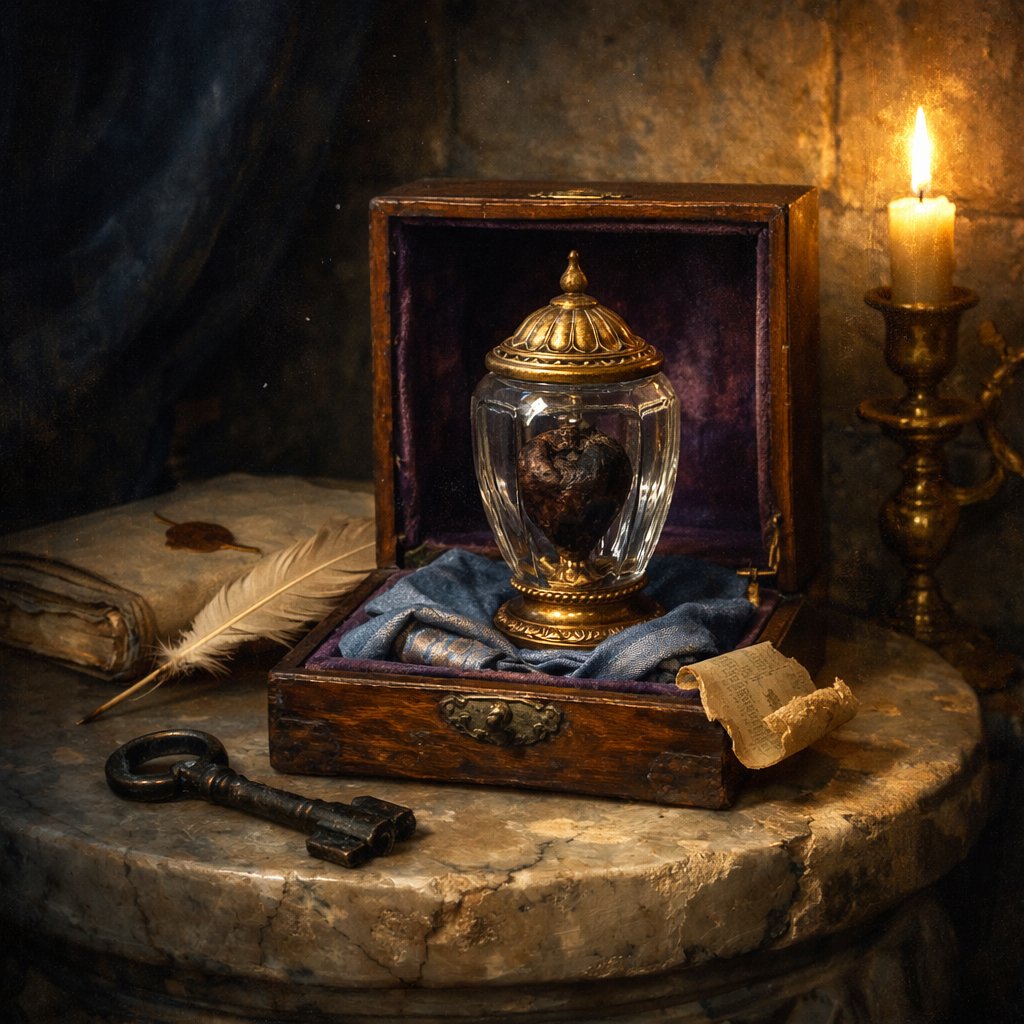
During the autopsy Pelletan removed the heart, following a tradition of preserving royal hearts that had run through the Bourbon line for centuries, and concealed it in a handkerchief soaked in alcohol. He took it out of the Temple, transferred it to a crystal urn filled with distilled spirits, and kept it in his Paris cabinet for the next decades. Through theft, restoration, exile, and return the urn was passed from Pelletan’s heirs to a succession of monarchist custodians and ultimately, in 1975, to Don Jaime Henri de Bourbon-Parme; in 2004 the relic was deposited at the Royal Basilica of Saint-Denis, where it now rests in the necropolis of the kings of France.
The Substitution Rumour and the Hundred Pretenders
The rumour that the boy who died in the Temple was not the dauphin began in Paris within days of the burial. The Convention’s decision to bury without ceremony, in a common grave, with no public viewing of the body and no marker, gave the rumour the silence it needed to grow. Royalist newssheets, smuggled out of France through Switzerland and the Low Countries, asked whether the corpse buried by the Republic had been a swapped child whose function was to cover the real dauphin’s escape, and whether the silence of the official account was concealment by another name [3]. Within a year the rumour had a name for the supposed escapee: Louis XVII, alive and being kept somewhere safe by loyalists, awaiting his moment.
More than a hundred individual men have been documented in pretender claims between 1795 and the late nineteenth century. The historian Philippe Delorme, whose research culminated in the 2000 genetic study, catalogued the principal claimants in a 2000 monograph and identified several dozen further peripheral figures. The most consequential cluster of claims gathered around three names. Karl Wilhelm Naundorff, a Prussian-born clockmaker, arrived in Paris in 1833 with a long story of escape from the Temple, secret residence in various European courts, and royal birthmarks; he attracted the support of former servants of the royal household, won a court hearing in 1836, and died in Delft in 1845 with the inscription “Louis XVII, King of France” cut into his Dutch tomb. The Reverend Eleazar Williams, an Episcopal missionary among the Oneida of upstate New York, was the subject of a famous 1853 Putnam’s Magazine article by John Hanson asserting that Williams was the surviving dauphin; the Prince de Joinville, son of the deposed Louis-Philippe, visited Williams at Green Bay in 1841 and was reported to have come to identify him. The American naturalist John James Audubon, born in Saint-Domingue and raised in France, was rumoured throughout the nineteenth century to be the dauphin in artistic disguise; the rumour rested entirely on his French childhood and his refusal to speak in detail of his early years [4].
Why the Rumour Held
The rumour was sustained by four conditions, each of them political rather than evidentiary. First, the Republic had reasons to want the dauphin dead and so the death notice was treated by royalists as suspect. Second, the burial was conducted in a manner that prevented independent royal verification of the body. Third, the surviving members of the dynasty, restored in 1814, had reasons of their own not to encourage close inquiry. The boy’s elder sister, Marie-Thérèse Charlotte, the only one of the four royal children to survive the Temple, conspicuously declined to engage the question; her silence was read by some legitimists as concealment of a known truth and by others as the discretion of a princess who had buried her brother and could not bear to revisit the room. Fourth, and most powerfully, the dauphin’s story sat inside a much older European folkloric template: the prince in hiding, the lost king who would return, the body in the grave that was not the body the people had loved. The substitution rumour was, among other things, an instance of a folkloric grammar of royal disappearance that long predated 1795 [5].
The Heart, the Laboratories, and the 2000 Result
By the late twentieth century the documentary case for the official death was already strong. Catherine Audebert and a small school of French archival historians had published lineage research in the 1980s and 1990s comparing the Naundorff family’s records, baptismal registers across central Europe, and the surviving Temple administrative ledgers; the cumulative archival weight already pointed toward Naundorff as a man with a documented Prussian past and not a Bourbon prince. What the case lacked, by the canon of late-twentieth-century forensic history, was a biological test capable of falsifying or confirming the central claim independently of the documentary record [6].
How the Test Was Run
In 1999 Philippe Delorme persuaded the heirs of the relic’s last private owner to allow scientific analysis. The heart, by then a small darkened mass preserved in its crystal urn, was opened in a controlled procedure on 15 December 1999. Two small samples were taken. One was sent to the Centre for Human Genetics at the Catholic University of Leuven and analysed under Professor Jean-Jacques Cassiman; the other was sent to the Institute of Legal Medicine at the University of Münster and analysed under Professor Bernd Brinkmann. The two laboratories were instructed not to communicate during the analysis. Mitochondrial DNA, which is inherited matrilineally, was sequenced and compared to reference samples drawn from a lock of Marie Antoinette’s hair preserved at a private collection and from two living matrilineal descendants of her elder sister Maria Carolina, including Queen Anne of Romania (1923 to 2016) and her brother Andre de Bourbon-Parme.
What the Result Said
Both laboratories reported, in April 2000, that the mitochondrial DNA sequence recovered from the heart was identical at every variable position to the maternal Habsburg reference sequence. The two laboratories arrived at the result independently, and the joint report was published in the European Journal of Human Genetics in 2001 by Cassiman, Brinkmann, Delorme, and their teams (Jehaes et al., “Mitochondrial DNA analysis of the putative heart of Louis XVII, son of Louis XVI and Marie-Antoinette,” 9: 185 to 190). The conclusion was unambiguous: the heart had belonged to a person whose mother was either Marie Antoinette or one of her surviving sisters within the maternal line. Combined with the documented chain of custody from Pelletan forward, and the absence of any plausible alternative source for a royal heart in 1795 Paris, the result identified the tissue as that of the dauphin Louis-Charles. The same study had been preceded by a 1998 mitochondrial analysis of bones associated with the Naundorff family by the same Belgian laboratory; that 1998 result had already shown the Naundorff bones did not match the Habsburg maternal sequence, and the 2000 result confirmed the corollary [7].
What the Result Closed and What It Left Open
The historical question, narrowly construed, is closed. The boy who died in the Temple Prison on 8 June 1795 was Louis-Charles de Bourbon, son of Louis XVI and Marie Antoinette, the dauphin from June 1789. The Naundorff claim is falsified at the level of biology. The Audubon and Williams claims, which had only ever rested on circumstantial colour and family rumour, fall as a corollary; there is no surviving claimant whose pretension survives the 2000 result. J. M. Thompson’s older historiographical work on the Convention period, including his 1929 study of Robespierre, had already laid out a documentary reconstruction in which the Temple death was treated as the natural reading of the surviving evidence; the genetic confirmation was, in a sense, an empirical postscript to a documentary case that careful historians of the twentieth century had been making in piecemeal form for decades [8].
What the result did not close is the cultural history of the rumour, and that history deserves its own attention. The substitution claim, the hundred pretenders, the Naundorff trial, the Williams identification at Green Bay, the Audubon murmurings, the legitimist subscriptions to a Bourbon claimant who turned out to have been born in Potsdam: these are not failures of evidence so much as expressions of a particular nineteenth-century European need. They belong to the cultural-historical study of monarchy, of revolutionary trauma, and of the way societies process the death of children at the hands of states. The folklore is worth taking seriously on its own terms even after the biology has spoken. The honest historiographical position is that the Temple boy was the dauphin, that the pretenders were not, and that the persistence of the rumour for two centuries tells us less about what happened in 1795 than about what mid-nineteenth-century Europe could not yet bear to relinquish.
Frequently Asked Questions
Who was the lost dauphin of France?
Louis-Charles de Bourbon (born 27 March 1785, died 8 June 1795), second son of King Louis XVI and Queen Marie Antoinette, became dauphin in June 1789 on the death of his elder brother Louis-Joseph and was titular King Louis XVII to French royalists from his father’s execution in January 1793 until his own death in the Temple Prison.
How and where did he die?
He died at three in the afternoon on 8 June 1795 inside his cell on the second floor of the Tower of the Temple in central Paris. The autopsy of 9 June 1795, performed by Philippe-Jean Pelletan and three colleagues, identified scrofulous tuberculosis as the proximate cause, set against a body covered in scars consistent with prolonged physical mistreatment.
What did Antoine Simon do to him?
Simon, a Paris cobbler appointed by the Convention as the boy’s republican tutor, lived inside the Temple with Louis-Charles from July 1793 to January 1794. Contemporary accounts describe a regime of forced republicanisation, physical violence, and degradation. The autopsy six months after Simon’s removal recorded scars consistent with that regime.
Why did the substitution rumour begin so quickly?
The Republic buried the boy on 10 June 1795 in a common grave at the cemetery of Sainte-Marguerite without a marker, no public viewing, and no royal verification of the corpse. Royalists abroad, who had reason to distrust republican announcements, treated the procedural opacity as concealment, and a substitution narrative entered circulation within weeks.
Who was Karl Wilhelm Naundorff?
A Prussian-born clockmaker who arrived in Paris in 1833 claiming to be the surviving dauphin. He attracted support from former royal household servants, won a court hearing in 1836, and died in Delft in 1845. His tomb was inscribed “Louis XVII, King of France.” A 1998 mitochondrial DNA study of bones associated with his family showed the Naundorff line did not match the Habsburg maternal sequence.
Was John James Audubon the dauphin?
No. The naturalist Audubon, born in Saint-Domingue and raised in revolutionary France, attracted the rumour because of his French childhood and his discretion about his early years. There is no documentary evidence connecting his biography to the Temple Prison, and the 2000 mitochondrial result on the preserved heart eliminated any survival hypothesis.
What was the Eleazar Williams claim?
Eleazar Williams was an Episcopalian missionary among the Oneida in upstate New York. A famous 1853 Putnam’s Magazine article by John Hanson presented him as the surviving dauphin. The Prince de Joinville visited Williams at Green Bay in 1841, a visit later read as an identification attempt. The claim, like all pretender cases, is falsified by the 2000 genetic result.
What did the 2000 mitochondrial DNA test actually show?
Two laboratories, the Centre for Human Genetics at Leuven under Jean-Jacques Cassiman and the Institute of Legal Medicine at Münster under Bernd Brinkmann, independently sequenced mitochondrial DNA from the preserved heart and compared it to a hair sample of Marie Antoinette and to two living matrilineal Habsburg descendants. The sequences matched at every variable position. The joint report appeared in the European Journal of Human Genetics in 2001.
Where is the heart kept now?
In its crystal urn at the Royal Basilica of Saint-Denis on the northern edge of Paris, since 8 June 2004, in the necropolis of the kings of France where his parents Louis XVI and Marie Antoinette were reinterred in 1815. The relic was passed through several private monarchist custodians between 1795 and the 1970s before its scientific examination in 1999.
Who was Catherine Audebert?
A French archival historian whose lineage research on the Naundorff family records, central European baptismal registers, and the Temple administrative documents formed part of the documentary case against the Naundorff claim in the late twentieth century. Her work and that of allied historians had already pointed toward a falsifiable Naundorff identification before the 2000 genetic test.
Did Marie-Thérèse, the surviving sister, ever speak about it?
Conspicuously little. Marie-Thérèse Charlotte, Madame Royale, was the only one of the four royal children to leave the Temple alive; she was exchanged in 1795 and survived to 1851. She declined repeated approaches by Naundorff and other claimants and refused to comment publicly on the substitution rumour. Her silence has been read in incompatible ways by historians and was, in any case, not testimony.
Why does the rumour still matter if the case is settled?
Because the rumour itself is a primary source for the cultural history of revolutionary France, the Bourbon Restoration, and the European folkloric grammar of the lost prince. The biological result settled the historical question of identity. The folklore that persisted for two centuries remains a legitimate object of cultural-historical study on its own terms.
Where can I read the primary sources?
Start with Philippe Delorme’s Louis XVII: La vérité (Pygmalion, 2000) for the documentary reconstruction, then the Jehaes et al. paper in the European Journal of Human Genetics 9 (2001): 185 to 190 for the genetic analysis. For the wider Convention-period context, J. M. Thompson’s Robespierre (Blackwell, 1935) remains a careful documentary baseline. Earlier pretender claims are best approached through Hanson’s 1853 Putnam’s article on Williams and the published proceedings of the Naundorff case.