
By EsoVitae Editorial · Published
Drafted with AI assistance from the sources listed; images are AI-generated illustrations. How EsoVitae is made
What the Maine Penny Is, and Why a Single Coin Carries So Much Weight
The Maine Penny is a small silver Norwegian coin, struck during the reign of King Olaf Kyrre of Norway between 1067 and 1093, recovered in 1957 from a Native American shell midden on the coast of Maine. It is the only widely accepted pre-Columbian Norse artifact ever found in the continental United States, and most scholars now read it as evidence not of a Viking landing in Maine, but of an indigenous trade network that carried European goods south from the Canadian Arctic.
A coin small enough to sit on a fingertip is not the kind of evidence that usually rewrites a continent’s history. The Maine Penny does not quite rewrite it either. What the penny does, and what makes it worth a careful reading, is sit at a quiet hinge between two larger arguments: that Norse seafarers reached North America five centuries before Columbus, which is now beyond serious dispute, and that what they reached, what they traded, and how their objects circulated afterwards remain partly open. The penny is a single thread in that second story. It is also one of the few threads that has survived intact, with a measurable date, a known minting authority, and a stratigraphic context.
This guide walks the artifact slowly. The 1957 discovery, the long road to authentication, the Inuit-trade-network hypothesis that now frames most scholarly readings, and the skeptics who still question whether the find belongs in the canon of historical and archaeological mysteries. Where two reconstructions both fit the evidence, both will be named.
The 1957 Discovery at the Goddard Site
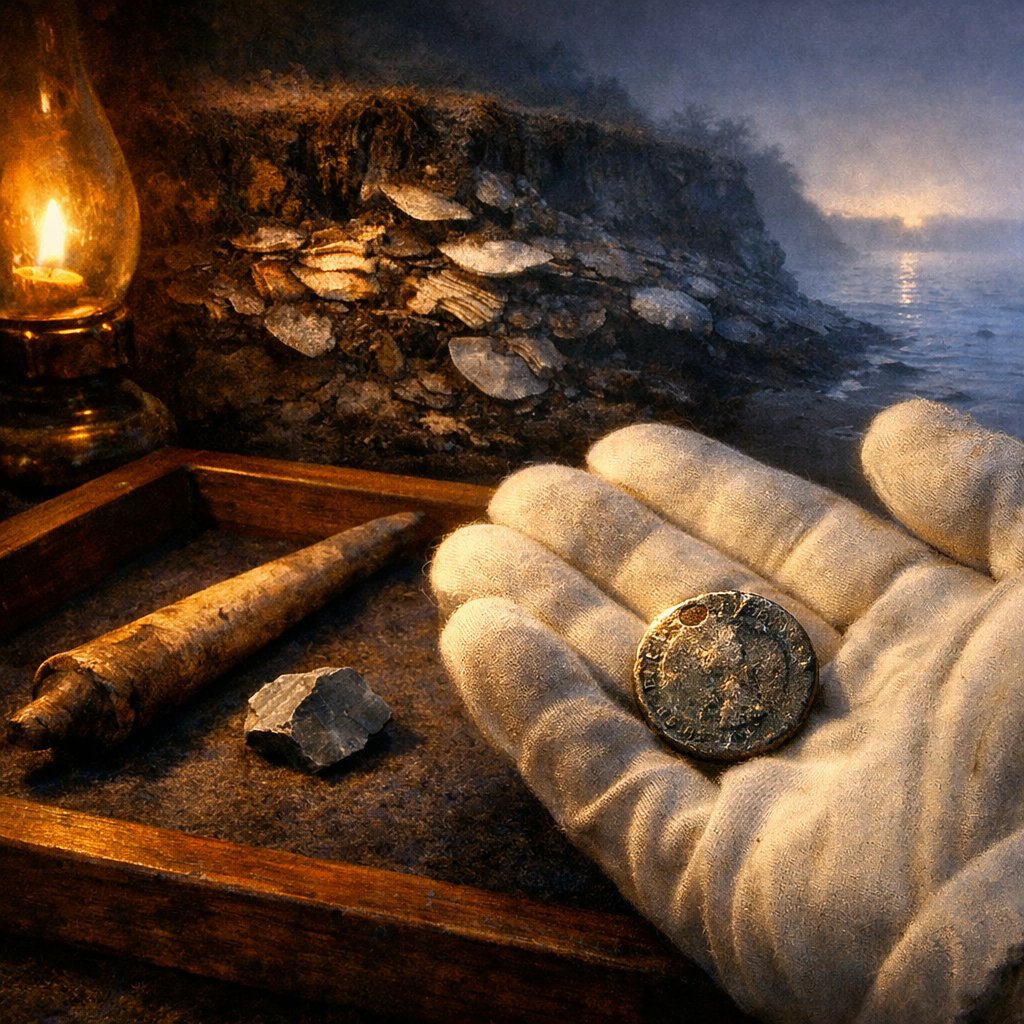
The coin came out of the ground at a place archaeologists call the Goddard Site, on Naskeag Point in Brooklin, Maine, on the western shore of Penobscot Bay. The finder was Guy Mellgren, an amateur archaeologist who had been excavating the shell midden with his colleague Ed Runge over several summers. On 18 August 1957, working through layers of crushed clam and oyster shell mixed with worked stone and bone, Mellgren turned up a small flattened disk of corroded silver. It was about the size of a modern dime and pierced near the rim, as though it had once been worn or strung [1].
Mellgren did not at first know what he had found. The coin sat in his collection for nearly twenty years before it was shown to specialists who recognized the fabric of an early medieval Scandinavian penny. The hole, the corrosion, the thinness of the silver: all of it placed the object outside the familiar inventory of New England colonial finds. By the late 1970s, the artifact had reached the Maine State Museum in Augusta, where it has remained on view ever since [2].
What the Goddard Site Actually Was
The Goddard Site is one of the larger Late Woodland and contact-period coastal villages excavated in northern New England. Its primary occupation falls between roughly 1180 and 1235 CE, with intermittent use before and after [3]. The community there was Penobscot, part of the Wabanaki cultural sphere, drawing on the seasonal abundance of clam flats, salmon runs, and offshore mammal hunting. The midden, a long mound of food refuse, accumulated layer by layer over generations and preserved organic and metal materials that would have rotted away in less protective soils. Archaeologically, it is a rich site even setting the penny aside. More than thirty thousand artifacts have come from its excavations, including a Dorset-culture burin made of Ramah chert from northern Labrador, a key piece of evidence for what came after.
Authentication: How the Coin Was Identified
The road from suspicious silver disk to identified coin ran through Norwegian numismatists. In 1978, the artifact was sent to Kolbjørn Skaare, a leading specialist in medieval Scandinavian coinage at the University of Oslo. Skaare identified the coin as a penny minted under King Olaf Kyrre, who reigned in Norway from 1067 to 1093 [4]. The obverse shows a stylized bust; the reverse carries a cross design typical of late-eleventh-century Norwegian issues. The fabric, weight, and design matched known examples from Norwegian hoards. There was no plausible way for such a coin to enter the post-Columbian numismatic market in a form that would end up buried in a Maine shell midden, and the corrosion patterns were consistent with long burial in a saline coastal environment.
Bruce Bourque, then chief archaeologist at the Maine State Museum, published the principal scholarly examination of the find in 1994, working with Steven Cox of the Smithsonian. Their joint paper in the journal Acta Archaeologica argued that the coin was authentic, was genuinely recovered from a stratified Native American context, and should be read as evidence of contact rather than fraud [5]. The art historian and Arctic ethnographer Edmund Carpenter, who had spent decades studying the movement of materials across northern North America, independently endorsed the find and supplied much of the comparative framework that placed the coin in a wider Arctic-trade context.
Why Forgery Is Implausible
A skeptical reader will reasonably ask whether the coin was planted. The case against forgery rests on several converging facts. Mellgren had no obvious motive: he kept the coin private for years and never sought publicity. The corrosion is internal as well as surface, indicating long burial rather than recent surface exposure. The midden’s stratigraphy was undisturbed in the relevant layer. And the type of coin involved, a relatively obscure Norwegian penny of Olaf Kyrre, was not the kind of artifact a casual hoaxer would have known to choose. A planted Roman or Spanish coin would have been more legible and more dramatic. The Olaf Kyrre penny, by contrast, only becomes meaningful through the very specific trade-network argument that emerged decades after the find.
The Indigenous Trade Network Hypothesis
The most important interpretive shift in the study of the Maine Penny is also the easiest to misread. For a long time, popular accounts assumed the coin proved Norse sailors had landed in Maine. Most archaeologists no longer think so. The current consensus, anchored in Bourque and Cox’s 1994 analysis and developed further by later scholars, is that the coin reached Maine through a multi-stage indigenous trade network that originated in Norse contact with Arctic peoples far to the north [5].
The argument runs roughly as follows. Norse settlers and traders in Greenland, whose presence is documented from the late tenth century into the fifteenth, had recurring contact with the Thule and late Dorset peoples of the eastern Arctic. Norse goods, including iron, woven cloth, and small metal objects, entered Inuit hands through this contact. Those goods then moved south and west along long-established Native American exchange routes, the same routes that carried Ramah chert from Labrador, native copper from Lake Superior, and walrus ivory from the high Arctic deep into the continental interior. A small silver coin, perforated for wear as an ornament, would have been a portable and tradeable object well suited to such a network. The Goddard Site’s Dorset burin made of Ramah chert sits in the same midden as the penny, and that chert traveled exactly the route the trade-network model predicts.
The L’Anse aux Meadows Comparison
The only confirmed Norse settlement in North America outside Greenland is L’Anse aux Meadows, on the northern tip of Newfoundland, excavated by Helge and Anne Stine Ingstad beginning in 1960. Radiocarbon dating places its occupation around the year 1000 CE, and a 2021 study using a solar-storm event in 993 CE refined that dating to 1021 CE for one specific cut timber [6]. L’Anse aux Meadows produced characteristically Norse architecture, ironworking, and domestic debris. It is the kind of site one would expect for a Norse landing.
The Goddard Site, by contrast, looks nothing like L’Anse aux Meadows. There are no Norse buildings, no Norse iron, no Norse domestic materials at all, only the single coin among more than thirty thousand indigenous artifacts. That asymmetry is precisely why most archaeologists now read the penny as the end-point of a long indigenous chain rather than as a marker of Norse presence. A landing leaves a settlement. The penny was not in a settlement. It was in someone else’s village.
What the Indigenous Hypothesis Honors
There is a tendency in popular writing to treat the trade-network reading as a hedge, a polite way of handling an artifact that does not quite fit. The reverse is closer to the truth. The hypothesis treats Wabanaki, Inuit, and Dorset communities as active agents within a continental exchange system, capable of moving goods across thousands of kilometers without European mediation. It restores agency to indigenous polities whose long-distance trade routes the early colonial record largely erased. Edmund Carpenter, working in this tradition, was emphatic that the coin’s presence in Maine demonstrates Native American economic networks at their fullest extent, not Norse range at its furthest [7]. The artifact testifies to indigenous reach as much as to Norse reach. Possibly more.
The Skeptical Counter-Arguments
Not every scholar accepts the find. The principal skeptical line, articulated most fully by historian Birgitta Wallace and others, accepts the coin as genuine but raises questions about the recovery itself. Mellgren was an amateur. The midden, while broadly stratified, was not excavated to modern standards. The interval between discovery and identification was long enough that documentation gaps existed. Some critics have suggested the coin could have been introduced to the site after a colonial-era European visit, though no plausible mechanism for such introduction has been demonstrated.
A more careful skeptical position simply notes that a single object, even a securely identified one, can carry only so much interpretive weight. One coin in one midden does not prove a sustained trade network. It is consistent with the network model. It does not, by itself, demonstrate it. The supporting evidence, namely the Dorset burin, the Ramah chert distribution, and the documented Greenlandic-Inuit contact, does most of the structural work. The penny is a node, not a pillar. That distinction is important and is sometimes blurred in popular writing.
Where the Penny Sits in the Wider Story
Set against the long argument about pre-Columbian transatlantic contact, the Maine Penny is a sober and useful piece of evidence. It does not prove Vikings reached Maine. It does suggest, in concert with other materials, that the Atlantic world of the eleventh and twelfth centuries was less hermetically sealed than nineteenth-century historiography assumed. Goods moved. People moved them. The communities at the receiving end of those movements were active participants, not passive recipients of European discovery.
In short: a single silver coin, minted in Norway nine hundred years ago and worn as an ornament in a Penobscot village, holds the trace of a longer geography than any single empire’s records preserve. The penny is now case number 73-1 at the Maine State Museum, where it sits behind glass beside a small explanatory panel. The story it carries is older than the panel. It is also still partly under negotiation among the people who study it.
Frequently Asked Questions
What is the Maine Penny?
The Maine Penny is a Norwegian silver coin minted between 1067 and 1093 CE under King Olaf Kyrre, recovered in 1957 from a Native American shell midden in Brooklin, Maine. It is the only widely accepted pre-Columbian Norse artifact found in the continental United States.
Who found the Maine Penny and when?
Guy Mellgren, an amateur archaeologist working at the Goddard Site on Naskeag Point in Brooklin, Maine, recovered the coin on 18 August 1957. Mellgren and his colleague Ed Runge had been excavating the shell midden over several seasons. The coin was identified as Norwegian only in 1978.
Does the Maine Penny prove Vikings landed in Maine?
Most archaeologists say no. There is no Norse settlement, building, iron, or domestic debris at the Goddard Site, only a single coin among more than thirty thousand indigenous artifacts. The current consensus reads the coin as evidence of an indigenous trade network that carried Norse goods south from Inuit communities in the Canadian Arctic, not as evidence of a direct Norse landing in Maine.
How was the coin authenticated?
In 1978, Norwegian numismatist Kolbjørn Skaare of the University of Oslo identified the coin as a penny of King Olaf Kyrre based on its design, fabric, weight, and corrosion patterns. Bruce Bourque of the Maine State Museum and Steven Cox of the Smithsonian published the principal authentication paper in 1994. Edmund Carpenter independently endorsed the find.
What is the indigenous trade network hypothesis?
The hypothesis holds that Norse goods entered Inuit hands through documented Norse-Greenlandic contact with Thule and Dorset peoples in the eastern Arctic, then moved south along long-established Native American trade routes that already carried Ramah chert, native copper, and walrus ivory across the continent. The Goddard Site contained a Dorset burin of Labrador-source chert in the same midden as the penny, supporting the route.
How does the Maine Penny compare to L’Anse aux Meadows?
L’Anse aux Meadows in Newfoundland, excavated from 1960, is a confirmed Norse settlement around 1000 CE with characteristically Norse buildings, ironworking, and domestic materials. The Goddard Site has none of those: it is a wholly indigenous Penobscot village with a single Norse coin. The two finds occupy different categories of evidence.
Why do some scholars doubt the find?
Skeptics, including historian Birgitta Wallace, accept the coin as genuine but question recovery standards: Mellgren was an amateur, the midden was not excavated to modern protocols, and the long interval between discovery in 1957 and identification in 1978 left documentation gaps. Most skeptics still accept the artifact as authentic; they argue only that a single coin cannot, by itself, prove a sustained trade network.
Where is the Maine Penny today?
The coin is held by the Maine State Museum in Augusta, Maine, where it has been on display since the late 1970s. It is catalogued as artifact 73-1 and shown beside an explanatory panel describing both the Norse origin of the coin and the indigenous trade-network reading.
Why does the coin have a hole in it?
The penny was perforated near its rim, almost certainly so it could be strung on a cord or sewn onto clothing as an ornament. This is a common pattern for small metal objects entering indigenous exchange networks across northern North America. The perforation is part of why the coin reads as an item of long-distance trade rather than as currency in its original Norwegian sense.
What other evidence supports Norse contact with North America?
The principal confirmed evidence is L’Anse aux Meadows in Newfoundland, dated by recent solar-event analysis to 1021 CE. The medieval Icelandic sagas of Erik the Red and the Greenlanders describe voyages to Vinland, Markland, and Helluland. Smaller finds in the Canadian Arctic show recurring Norse-Inuit material exchange. The Maine Penny adds a southern node to that wider picture.