
By EsoVitae Editorial · Published
Drafted with AI assistance from the sources listed; images are AI-generated illustrations. How EsoVitae is made
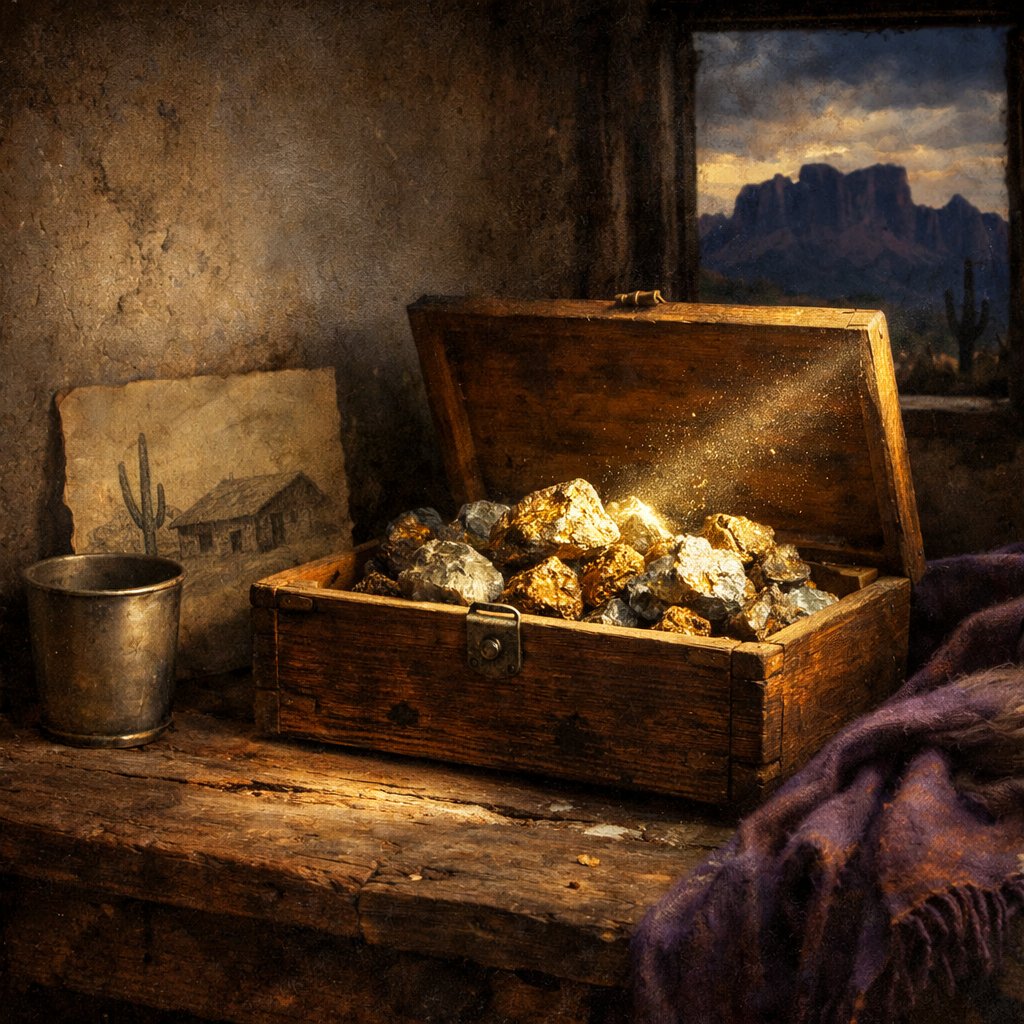
Jacob Waltz, the German-immigrant prospector whose nickname gave the legend its name, died of pneumonia in a Phoenix bedroom on the night of 25 October 1891. He left behind a wooden candle box of high-grade gold ore beneath his bed and, depending on which witness one believes, either a deathbed map or a deathbed silence. In the hundred and thirty-five years since, hundreds of searchers have walked into the Superstition Mountains east of Phoenix looking for the source of that ore. Some have come back empty. A documented number have not come back at all. The Lost Dutchman’s Gold Mine is the rare historical and archaeological mystery in which the documentary record is generous, the geology is hostile, and the deaths are still being added to the file.
Direct answer: what the Lost Dutchman’s Gold Mine actually is
The Lost Dutchman’s Gold Mine is a putative high-grade gold deposit said by Phoenix prospector Jacob Waltz (c. 1810 to 1891) to lie in the Superstition Mountains of central Arizona. Waltz produced documented gold ore in his lifetime; no one has produced his mine. Modern volcanic geology argues that the formation cannot host the kind of vein he is said to have worked. The legend persists because the ore did, and because the deaths along its trail are still being counted.
The man behind the name: Jacob Waltz, 1810 to 1891
The “Dutchman” was not Dutch. Jacob Waltz was born in the Kingdom of Württemberg around 1810 and sailed from Bremen on the ship Obler in October 1839, arriving at New Orleans on 17 November of that year [1]. The misnomer is an Americanism: nineteenth-century English speakers used “Dutch” as a phonetic flattening of Deutsch. Waltz worked his way west through Mississippi and California across the 1840s and 1850s, was naturalised at Los Angeles on 19 July 1861, and entered the Arizona Territory in the early 1860s as one of the small population of solitary German-speaking prospectors then working the placers around Prescott and Wickenburg [1].
By the 1870s Waltz held a homestead on the north bank of the Salt River. Census and homestead records, the kind of documentation that makes Waltz an unusually well-attested figure for a folk-legend protagonist, place him there continuously through the 1880s. He filed a homestead patent in 1872 and grew vegetables for the Phoenix market. He kept his counsel. He showed gold ore to a small number of people. He did not file a mining claim.
The deathbed scene at Julia Thomas’s house, October 1891
In February 1891 the Salt River flooded and ruined Waltz’s homestead. He moved into Phoenix proper to recover, fell ill with pneumonia in the autumn, and was taken in by Julia Thomas, a Black neighbour and bakery owner who had befriended him in the late 1880s [2]. By the night of 25 October Waltz was dying. According to the most consistent version of the testimony, two friends, Dick Holmes and Gideon Roberts, sat with him through his final hours. Under his bed was the candle box of ore.
Two competing accounts of what happened next survive in the contemporary record. Holmes claimed that Waltz bequeathed the box, said to weigh roughly forty-eight pounds, to him directly, and that on the same night he received verbal directions to the mine. Julia Thomas, by contrast, told the Phoenix journalist Pierpont Constable Bicknell in 1892 that Waltz had given the directions to her, that she and her partner Reiney Petrasch had attempted to find the mine that summer of 1892, and that Holmes had taken the box without authorisation while she was out of the room [2]. The two versions are not reconcilable on the documentary evidence. They are reconcilable on the fact that everyone in the room had a financial interest in being believed.
The Peralta map, the Apache curse, and the question of provenance
The framing legend that surrounds Waltz’s deathbed is older than Waltz. In its standard form, the story holds that Don Miguel Peralta of Sonora received a 1748 Spanish land grant covering the Superstition range, that the Peralta family worked an extraordinarily rich gold mine in the area through the 1840s, and that an Apache attack on a Peralta caravan at “Massacre Ground” in 1848 killed all but a few of the miners and sealed the location. Waltz, in this version, is said to have rescued or befriended a Peralta survivor and to have been told the way in.
The provenance of that frame collapses under examination. The 1748 “Peralta grant” is almost certainly a fabrication produced by the swindler James Addison Reavis (1843 to 1914), who in the 1880s attempted to claim 7,500 square miles of Arizona Territory on forged Spanish documents [3]. A federal court declared Reavis’s papers counterfeit in 1895; Reavis was convicted and served two years. The “Peralta stones,” a set of carved tablets that surfaced in the 1940s near Florence Junction, have been treated by every credentialed historian who has examined them as twentieth-century artefacts shaped to fit the legend the public was already buying. The Apache understood the Superstitions as the home of the Thunder God and as ground not to be disturbed; that ethnographic detail is real. The Spanish industrial-scale gold workings the legend hangs from are not.
Adolph Ruth, 1931: the case that made the legend famous
The Lost Dutchman story passed from Arizona folklore into national press in the early summer of 1931, when a Washington-based veterinarian and amateur treasure hunter named Adolph Ruth (1865 to 1931) walked into the Superstitions with a pack mule, a sketch map he had inherited through his son from a Mexican family in California, and a Forest Service campsite at Willow Springs in West Boulder Canyon [4]. Ruth was sixty-six. He had been packed in by the Bark family of the nearby Quarter Circle U Ranch on 14 June 1931. By 20 June, ranch owner Tex Barkley returned to find the camp empty and the searcher gone. A Maricopa County sheriff’s posse and a private search both turned up nothing.
On 10 December 1931, an Arizona Republic-sponsored expedition led by archaeologist Ryder Ririe found a human skull near the three Red Hills [4]. The skull was identified as Ruth’s by the Smithsonian physical anthropologist Aleš Hrdlička (1869 to 1943), who matched it against Ruth’s dental records in early 1932. Hrdlička’s report identified two perforations in the cranium that he interpreted as the entry and exit of a high-velocity rifle round, fired at close range. Ruth’s skeletal remains, found a month later by a separate party in Needle Canyon, contained his coat-pocket notebook and the cryptic line, “Veni, vidi, vici.” The Maricopa County sheriff’s office formally ruled the death due to dehydration and exposure with possible animal disturbance, citing the absence of a recovered round and the time elapsed. Hrdlička’s bullet-hole interpretation was never withdrawn. The case file remains open in the strict bureaucratic sense.
The pattern of disappearances, 1931 to the present
Ruth’s case set the template, and the file kept growing. The disappearances follow no single criminal signature, but the pattern of the searcher who walks in and does not walk out is consistent enough that the Apache Junction Public Library and Superstition Search and Rescue have kept running records since the 1970s. Among the documented cases:
- James A. Kidd (1879 to 1949 or after), a quiet Phoenix-based copper-mine pumpman who left Phoenix on 9 November 1949 for a prospecting trip into Superstition country and was never seen again [5]. Kidd was declared legally dead in 1956. His estate, valued at roughly $174,000, contained a will leaving the bulk of the money “for research or some scientific proof of a soul of the human body which leaves at death,” which produced the long-running “Great Soul Trial” of 1965 to 1967 in Phoenix probate court.
- Glenn Magill, an Oklahoma City private detective who organised multiple expeditions into the Superstitions in the late 1960s and early 1970s, twice claimed to have located the mine, and twice walked the claim back. Magill’s expeditions were chronicled by Curt Gentry in The Killer Mountains (Ballantine, 1968).
- Jesse Capen (1974 to 2009), a Denver hotel bellhop who had accumulated more than a hundred books and maps on the Dutchman in his apartment, drove fifteen hours to Apache Junction in late November 2009, and was last seen there on 4 December [6]. His campsite was found near the Old Tortilla Ranch on 20 December 2009. His daypack, with GPS unit, camera, and driver’s licence, was recovered on Tortilla Mountain by Superstition Search and Rescue volunteers on 24 November 2012, and his skeletal remains were recovered the same day from a narrow crevasse roughly thirty feet below a sheer cliff. The reconstruction is that he slipped while scrambling.
- Curtis Merworth, Ardean Charles, and Malcolm Meeks, three Utah hikers who entered the Superstitions on 11 July 2010 looking for the mine. Heat-related deaths; remains recovered by January 2011.
A fuller running list, kept by the Apache Junction Public Library’s local-history collection, identifies more than a dozen named cases since 1891 tied to a Lost Dutchman search. The mountains are a desert wilderness with summer ground temperatures above 60 degrees Celsius and a topography of narrow, near-vertical canyons; in the strictly accidental column, the figures are unsurprising. In the rifle-round and bullet-perforation column, less so.
What the geology actually says
The geological case against the Lost Dutchman is the part of the file the legend has the least to say about. The Superstition Mountains are the surface remnant of a Tertiary supervolcanic complex, formed between roughly 29 and 15 million years ago, with at least three large overlapping calderas: the Superstition Caldera (about 25 Ma), the Goldfield Caldera (about 15 Ma), and the Tortilla Caldera (about 15 Ma) [7]. The exposed rock is overwhelmingly extrusive volcanic, dominated by welded and non-welded rhyolitic tuff, dacite, and rhyolitic flow units, with subordinate andesite. These are not gold-fertile lithologies in the manner of the epithermal vein systems of, for example, the nearby Goldfield Mining District at the western end of the range, where small-scale workings did historically produce gold from a younger and chemically distinct hydrothermal episode.
Robert Sikorsky, a Tucson journalist and former prospector who wrote the most comprehensive single-volume history of the case, Fool’s Gold: The Facts, Myths, and Legends of the Lost Dutchman Mine and the Superstition Mountains (Golden West, 1991), reached the conclusion that the bulk of the Superstition uplift simply does not contain the geological architecture for the kind of high-grade gold vein the deathbed ore implies [8]. Sikorsky did not argue that Waltz had no source. He argued that the source, if it was real, almost certainly lay outside the Superstition Wilderness as we have come to draw the line, possibly in the Goldfield district or further north in the Mazatzals, and that Waltz allowed the Superstition direction to firm up because it kept casual searchers off the actual ground.
Where the documented Waltz ore came from, if not the Superstitions
The Waltz ore is the documentary anchor of the whole case. Holmes’s son Brownie Holmes preserved the candle box and a portion of the original ore through the twentieth century, and assays at varying dates produced consistent results: high-grade gold quartz, with a matrix and trace mineral signature that geologists examining the surviving specimens have read as inconsistent with the volcanic country rock of the central Superstitions. The Arizona State Library and Archives at Phoenix holds the principal Waltz papers and ore fragments accessioned over the twentieth century, including documentation from the Bicknell interviews of Julia Thomas and Reiney Petrasch [9].
Three reconstructions sit on the table and have done since the 1980s. The first is that Waltz did find a small high-grade pocket inside the Superstition complex, in a place the modern survey has missed. The second, the position Sikorsky’s archival work pointed toward, is that Waltz’s ore came from a working in the Goldfield district or the Bradshaw Mountains and that he projected a Superstition story to deflect attention. The third, less popular but still defended in some treasure-hunting literature, is that Waltz had high-grading access to a working mine and that the candle box ore is provenance-laundered from there. The first two reconstructions agree on a procedural point: Waltz had ore, the ore was real, and the ore is what keeps the legend out of the merely fictional.
What the documentary record now supports, and what it does not
It is a discipline of this kind of case to separate the well-attested from the imagined. On the documentary side, the following claims are supported by contemporary records, accessioned papers in the Arizona State Library and the Sharlot Hall Museum, and post-1970 archival work:
- Jacob Waltz was a real person, born in Württemberg, naturalised in Los Angeles in 1861, and resident in the Salt River Valley from the 1860s until his death on 25 October 1891.
- A box of high-grade gold ore was in Waltz’s possession at the time of his death and passed into the Holmes family through the night of 25 October 1891.
- No mine claim filed by Waltz survives in the territorial mining records.
- Adolph Ruth disappeared in June 1931 and was identified by skull on 10 December 1931; the cause-of-death determination remains in tension between the sheriff’s exposure ruling and Hrdlička’s bullet-hole reading.
- More than a dozen named searchers have died or disappeared in the Superstition Wilderness in connection with Lost Dutchman searches since 1931.
- The Peralta land grant of 1748 was a forgery produced by James Reavis and was rejected by federal courts in 1895.
- The Superstition Mountains are dominantly Tertiary volcanic and not a known gold-producing terrain in the central wilderness, with the Goldfield district at the western edge as a discrete and well-documented exception.
On the speculative side: the source of Waltz’s ore, the meaning of the Peralta stones found near Florence Junction in 1949, the cause of the bullet-hole pattern in Adolph Ruth’s skull, and the reason that more than 600 searchers since 1891 have failed to relocate a deposit rich enough to leave forty-eight pounds of high-grade in a candle box are all open. Researchers who have worked the case longest agree that the legend has accreted enough fabricated evidence to make the genuine evidence harder to see, and that the genuine evidence still points to ore that had a source somewhere on the ground that is now Tonto National Forest. They disagree on where.
The Lost Dutchman’s Gold Mine sits in an unusual category. It has a documented protagonist, a documented body of ore, a documented run of fatal expeditions across nearly a century, and a geology that argues against the simplest version of its own story. The mine is the rare case where the absence of recovery is itself the historical evidence: not of a missing site so much as of a story that has done enough work that the original site, if it existed, may now be unrecoverable through the noise.
Frequently asked questions
Who was the Lost Dutchman?
Jacob Waltz, a German-immigrant prospector born in Württemberg around 1810. He arrived in the United States in November 1839, was naturalised in Los Angeles in 1861, and lived in the Salt River Valley near Phoenix from the 1860s until his death in 1891. “Dutchman” is a nineteenth-century Americanism for a German speaker, derived from Deutsch. Waltz himself was Württemberger, never Dutch.
When and how did Jacob Waltz die?
Waltz died of pneumonia at the home of Julia Thomas in Phoenix on the night of 25 October 1891, having been displaced from his Salt River homestead by the floods of February 1891. His final hours were attended by Dick Holmes and Gideon Roberts. A wooden candle box of high-grade gold ore, said to weigh roughly forty-eight pounds, was beneath his bed at the time of death.
Did Waltz actually leave a deathbed map?
The contemporary record contains two competing accounts. Dick Holmes claimed that Waltz gave him the box and verbal directions on the night of 25 October. Julia Thomas, in 1892, told the Phoenix journalist Pierpont Bicknell that Waltz had given the directions to her and her partner Reiney Petrasch, and that Holmes had taken the ore without authorisation. The two versions cannot be reconciled on the surviving documents.
Is the Peralta land grant real?
No. The 1748 Spanish land grant to Don Miguel Peralta of Sonora is almost certainly a fabrication produced by the swindler James Addison Reavis, who in the 1880s attempted to claim 7,500 square miles of Arizona Territory on forged documents. A federal court declared Reavis’s papers counterfeit in 1895, and he was convicted of conspiracy to defraud. The Peralta frame around the Lost Dutchman story rests on those forgeries.
What are the Peralta stone maps?
A set of carved stone tablets bearing crude maps and Spanish-language inscriptions that surfaced near Florence Junction, Arizona, in the 1940s. Every credentialed historian who has examined them, including the Apache Junction Public Library’s local-history staff and Robert Sikorsky, has treated them as twentieth-century artefacts shaped to fit a legend already in circulation. They are kept on display at the Mesa Historical Museum and are not regarded as authentic Spanish colonial documents.
What happened to Adolph Ruth?
Adolph Ruth, a sixty-six-year-old Washington veterinarian and amateur treasure hunter, was packed into Willow Springs in West Boulder Canyon on 14 June 1931 and was found missing from his camp on 20 June. His skull was found near the three Red Hills on 10 December 1931 and identified by Smithsonian anthropologist Aleš Hrdlička, who reported two perforations consistent with a rifle round. The Maricopa County sheriff ruled the death exposure-related. The interpretive disagreement has never been resolved.
How many people have died searching for the mine?
No exhaustive figure exists, but the Apache Junction Public Library’s running list and the Superstition Search and Rescue records together identify more than a dozen named cases of disappearance, exposure death, or unexplained shooting since 1931, with hundreds of unnamed search-and-rescue calls in the wider file. Researchers including Robert Sikorsky have placed the running total at fifty or more across the legend’s full run, with the strict named-case count notably lower.
Who was Jesse Capen?
Jesse Capen, born 1974, was a Denver hotel bellhop who had collected more than a hundred books and maps on the Lost Dutchman before driving to Apache Junction in late November 2009. He was last seen on 4 December 2009; his campsite near the Old Tortilla Ranch was found on 20 December 2009. His daypack and skeletal remains were recovered by Superstition Search and Rescue volunteers on Tortilla Mountain on 24 November 2012, in a narrow crevasse below a sheer cliff. The reconstructed cause of death is a fall during a scramble.
Are the Superstition Mountains geologically capable of hosting gold?
The central Superstition Wilderness is composed dominantly of Tertiary volcanic rock, principally welded and non-welded rhyolitic tuff, dacite, and rhyolitic flow units, derived from at least three overlapping caldera complexes between roughly 29 and 15 million years ago. These are not the lithologies in which the kind of high-grade quartz vein implied by Waltz’s ore typically forms. The Goldfield district at the western edge of the range is a separate epithermal system that did historically produce small amounts of gold and is the most-discussed candidate for an alternate Waltz source.
Did Waltz have a real gold ore?
Yes. The candle box of ore beneath Waltz’s bed at his death is documented in the immediate post-1891 record, and ore fragments preserved in the Holmes family and accessioned over the twentieth century have been assayed and reported as high-grade gold quartz. The ore is the documentary anchor of the whole case. What is unresolved is its source: whether from a Superstition pocket missed by all subsequent surveys, from the Goldfield district, or from a third source from which Waltz had high-grading access.
Why has the mine never been found?
Three explanations sit on the table. The deposit may exist within the Superstitions in a place the geology and the modern survey have not flagged, and may simply be small. Waltz may have laid a Superstition story over a real working that lay elsewhere, plausibly in the Goldfield district or the Bradshaws, in order to deflect attention. Or the ore may have come from high-grading rather than from an independent claim, in which case there is no separate mine to find. The legend has accreted enough fabricated evidence over a century and a third that the underlying signal is now hard to isolate.
What does the Apache tradition actually say?
The historical Apache understood the Superstition range as the home of the Thunder God and as ground that should not be disturbed. That ethnographic detail is well-attested in the late-nineteenth-century anthropological record. The popular legend’s overlay of an explicit Apache “curse” on Spanish miners and on subsequent treasure seekers, dramatised in twentieth-century pulp accounts, has no clear nineteenth-century Apache source and is most cleanly read as a literary projection onto an authentic but quieter ethnographic substrate.
What sources should a researcher start with?
Robert Sikorsky’s Fool’s Gold (1991, reissued as Quest for the Dutchman’s Gold) is the single most useful overview, archive-grounded and geologically literate. The Apache Junction Public Library’s “Stories of the Superstitions” digital collection holds the principal local-history files. The Arizona State Library and Archives in Phoenix holds the Waltz papers and the Bicknell interview material. Curt Gentry’s The Killer Mountains (1968) is the contemporary record of the Glenn Magill expeditions. The James Reavis case file, held at the University of Arizona, supplies the documentary basis for rejecting the Peralta grant.
Sources
- [1] Apache Junction Public Library, “Jacob Waltz the ‘Lost Dutchman'”: Stories of the Superstitions; immigration record from the ship Obler, 17 November 1839; Los Angeles naturalisation, 19 July 1861.
- [2] Apache Junction Public Library, “Julia Thomas” and “The Origin of the Lost Dutchman Mine Story”; Pierpont Constable Bicknell interviews of Julia Thomas and Reiney Petrasch, Phoenix, 1892.
- [3] James Reavis case file and Peralta Grant collection, University of Arizona Libraries, Special Collections; United States v. Reavis, 1895.
- [4] Apache Junction Public Library, “Legacy of Adolph Ruth”; Aleš Hrdlička, Smithsonian Institution physical anthropology report on the Ruth skull, 1932; Maricopa County Sheriff’s Office case file.
- [5] Apache Junction Public Library, “The Spirit of James Kidd is Missing”; Estate of Kidd, Maricopa County Probate Court, 1965 to 1967.
- [6] Superstition Search and Rescue, recovery report on Jesse Capen, Tortilla Mountain, 24 November 2012; Pinal County Sheriff’s Office case file.
- [7] Apache Junction Public Library, “Geology of the Superstition Wilderness Area,” PDF; University of Arizona Lunar and Planetary Laboratory field-trip notes, “Superstition Mountains and Geology of Central Arizona,” 1993.
- [8] Robert Sikorsky, Fool’s Gold: The Facts, Myths, and Legends of the Lost Dutchman Mine and the Superstition Mountains (Phoenix: Golden West Publishers, 1991); reissued as Quest for the Dutchman’s Gold (1996).
- [9] Arizona State Library, Archives and Public Records, Phoenix: Waltz papers, Holmes family ore-fragment accessions, and Bicknell interview material.