

Drafted with AI assistance from the sources listed; images are AI-generated illustrations. How EsoVitae is made
What Is the Many-Worlds Interpretation of Quantum Mechanics?
The Many-Worlds Interpretation is a 1957 formulation of quantum mechanics by Hugh Everett III that takes the wavefunction as ontologically real and lets it evolve unitarily without collapse, so each measurement outcome corresponds to a real branch of a single universal quantum state. It is one of the most-discussed and least-experimentally-decided readings of the quantum formalism.
Few ideas in physics are as bracing, and as awkward, as the proposal that every quantum measurement happens in every possible way at once and that you only experience one of those ways because there is a copy of you experiencing each of the others. Most readers meet Many-Worlds through a sci-fi novel. The version actually argued in the philosophy-of-physics literature is more disciplined than the cinematic version, and also less optional than the textbook treatment of quantum mechanics suggests. This piece walks through the original Everett relative-state proposal, how decoherence rescued it from one of its main critiques, where it sits next to the Copenhagen and pilot-wave readings, and what, if anything, would constitute experimental evidence for it. The claim throughout is modest: we don’t yet know which interpretation of quantum mechanics is correct, and that uncertainty is itself a legitimate subject of working physics.
For the broader context of frontier-physics anomalies, see the pillar on science and natural anomalies. For background on the larger family of multiverse proposals, see the sub-niche on theories of other dimensions and realities.
Everett’s 1957 Relative-State Formulation
Hugh Everett III submitted his Princeton PhD thesis “The Theory of the Universal Wave Function” in 1956, with a condensed version published in Reviews of Modern Physics as “‘Relative State’ Formulation of Quantum Mechanics” in July 1957 [1]. Everett proposed that the wavefunction never collapses, and that what looks like collapse is the entanglement of an observer with the system being measured.
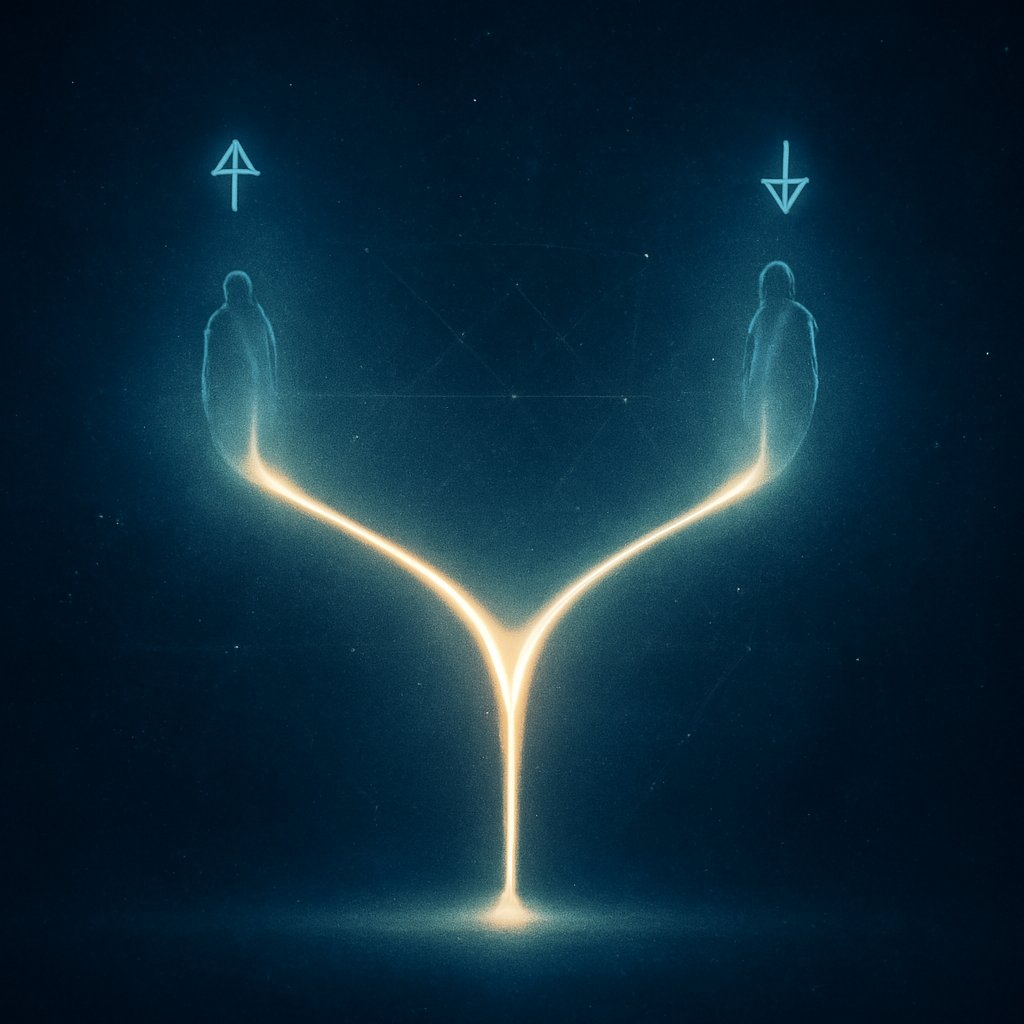
In the orthodox Copenhagen account, an observer who measures the spin of an electron forces the electron’s superposition to “choose” one definite outcome, and the wavefunction discontinuously jumps. Everett’s move was to treat the observer as itself a quantum system. When the observer interacts with the electron, the joint wavefunction becomes a superposition of two correlated branches: spin-up-with-observer-who-saw-up, and spin-down-with-observer-who-saw-down. Both branches persist in the universal state. Each branch contains a fully consistent observer with a fully consistent memory of having seen one outcome.
Everett did not use the phrase “many worlds.” That label came from Bryce DeWitt, who promoted the interpretation in a 1970 Physics Today article and the 1973 anthology The Many-Worlds Interpretation of Quantum Mechanics (Princeton University Press), which collected Everett’s thesis with DeWitt’s commentary [2]. Everett himself spoke of the “relative state” or the “universal wavefunction.” The relabeling stuck, partly because the imagery of branching universes was easier to discuss than the mathematics of relative states.
How Decoherence Repaired the Preferred-Basis Problem
The preferred-basis problem was the most serious technical objection to early Many-Worlds, raised by critics through the 1960s and 1970s: nothing in Everett’s 1957 formalism picked out why branches should split along “spin up” and “spin down” rather than some arbitrary superposition. Decoherence theory, developed primarily by H. Dieter Zeh (1970) and Wojciech Zurek (1981, 1982, 2003), answered this in a way that did not require modifying quantum mechanics itself, as detailed in the Stanford Encyclopedia of Philosophy entry on Everett’s relative-state formulation [3].
Decoherence describes what happens when a quantum system entangles with a large environment of degrees of freedom — air molecules, photons, the thermal bath of a measuring device. The reduced density matrix of the system, traced over the environment, rapidly diagonalizes in a specific “pointer basis” selected by the form of the system-environment interaction. For macroscopic objects, this happens on timescales of roughly 10⁻²³ seconds for a dust grain in air, according to Zurek’s 2003 calculation in Reviews of Modern Physics [3]. The interference terms between branches do not vanish, but they become inaccessible to any practical measurement.
For the Many-Worlds reading, decoherence does two things at once. It picks out a near-classical preferred basis without invoking collapse. It also explains, in operational terms, why branches behave as effectively independent worlds: once decohered, the branches no longer interfere with each other on any humanly accessible timescale. David Wallace, in The Emergent Multiverse (Oxford University Press, 2012), argues that decoherence makes Everettian quantum mechanics the simplest reading of the bare formalism, because it removes the need for any postulate beyond the Schrödinger equation [4].
Comparison with Copenhagen and Pilot-Wave Interpretations
The Many-Worlds Interpretation is one of at least a dozen contending readings of quantum mechanics, but three frameworks dominate serious discussion: the Copenhagen interpretation, the de Broglie-Bohm pilot-wave interpretation, and Everett’s relative-state formulation. They differ in what they take to be ontologically real, what role they assign to the observer, and what extra structure they add to the bare Schrödinger equation.
| Interpretation | Year | What’s real | Collapse? | Extra structure |
|---|---|---|---|---|
| Copenhagen | 1927 | Measurement outcomes; wavefunction is epistemic or instrumental | Yes, on measurement | Collapse postulate; observer-system cut |
| Pilot-wave (de Broglie-Bohm) | 1927, 1952 | Wavefunction and definite particle trajectories | No | Guiding equation; hidden variables (particle positions) |
| Many-Worlds (Everett) | 1957 | Universal wavefunction; all branches | No | None beyond unitary evolution; branching as a derived effect |
| QBism | 2001 | Agent’s degrees of belief about outcomes | Belief update | Bayesian probability framework |
Copenhagen, developed by Niels Bohr and Werner Heisenberg between roughly 1925 and 1927, treats the wavefunction as a tool for computing measurement probabilities. The collapse on measurement is a primitive postulate. Critics — including Everett, John Bell, and David Albert — have argued that Copenhagen is silent on what counts as a “measurement” and where the cut between observer and observed lies, an ambiguity John Bell famously called “unprofessional” in a 1990 paper [5]. The Encyclopaedia Britannica’s overview of quantum mechanics notes that the same ambiguity has driven foundations work since the late 1960s.
The pilot-wave reading, proposed by Louis de Broglie at the 1927 Solvay Conference and revived by David Bohm in 1952, supplements the wavefunction with definite particle positions guided by a separate equation of motion. Pilot-wave is fully deterministic, requires no collapse, and makes the same statistical predictions as standard quantum mechanics for non-relativistic systems. Its principal cost is that the guiding equation is explicitly non-local, and extending it to relativistic quantum field theory remains contested [6]. Pilot-wave and Many-Worlds share the rejection of collapse but split sharply on hidden variables: pilot-wave adds them; Everett removes the need.
The Probability Problem: Born Rule Derivations
The deepest open question in Many-Worlds is why an observer should expect to find herself, upon measurement, in the branch with probability proportional to the squared modulus of the wavefunction coefficient — the standard Born rule, |ψ|². If both branches are equally real and both contain a copy of the observer, the meaning of “probability” inside the formalism is not obvious. This is the probability problem, and it has occupied Everettian philosophers since the 1960s.
David Deutsch, at Oxford, proposed a decision-theoretic derivation in a 1999 Proceedings of the Royal Society A paper, arguing that a rational agent inside a branching universe would bet according to the Born weights even though she cannot identify with any one future branch [7]. Wallace refined this argument in 2003 and again in The Emergent Multiverse, deriving the Born rule from a small set of decision-theoretic axioms plus the structure of branching. Simon Saunders, also at Oxford, developed an alternative “branch-counting” critique and resolution in the 2000s.
Sean Carroll and Charles Sebens, at Caltech, published a 2014 derivation based on self-locating uncertainty: an observer who knows the wavefunction but does not yet know which branch she is in assigns probabilities proportional to the squared amplitudes by a symmetry argument they call “epistemic separability” [8]. The Carroll-Sebens approach connects Many-Worlds probability to broader debates about indexical uncertainty in cosmology. The question of whether any of these derivations is fully successful remains contested — Adrian Kent and others have argued that each rests on additional assumptions that smuggle in something close to the Born rule.
Experimental Implications and the Empirical Underdetermination
Many-Worlds, Copenhagen, and pilot-wave all reproduce the same empirical predictions for any experiment we currently know how to run, which is why the choice between them remains philosophical rather than experimental. On the math: each interpretation generates the standard Born-rule probabilities for measurement outcomes. The wavefunction-coefficient amplitudes are the same. The visible statistics are the same.
A handful of proposed experiments could in principle discriminate among interpretations. Roger Penrose has argued since the 1990s that gravitational self-energy should induce objective wavefunction collapse for sufficiently massive superpositions, a prediction that would falsify Many-Worlds in favor of an objective-collapse reading. Experiments at the Vienna group of Markus Aspelmeyer and at LIGO-affiliated collaborations are pushing the mass scale of interferometric superpositions upward; as of 2024, optomechanical experiments have reached coherent superpositions of objects with masses around 10⁻¹⁷ kg, still well below the threshold where Penrose’s gravitational-collapse model predicts deviation from standard quantum mechanics [9].
A more speculative test, proposed by David Deutsch in 1985 and revisited periodically since, involves a “quantum-suicide” or “reversible-observer” thought experiment in which an artificial intelligence is placed in coherent superposition and then asked, post-measurement, to report whether it remembered being in one branch or in superposition. The thought experiment is unrealizable with present technology. What the data rules out so far is any clear signature of objective collapse at scales below current experimental sensitivity; what it does not rule out is collapse at much larger scales. The interpretive question remains underdetermined by the available evidence — a status quo that has held since roughly 1957.
What’s Actually at Stake
The Many-Worlds Interpretation is, at root, a claim about parsimony of postulates: the bare unitary Schrödinger equation already implies branching, and adding a collapse postulate on top is both unnecessary and ill-defined. Whether the resulting picture — an enormously branching universal wavefunction — is intuitively palatable is a separate question from whether it is mathematically the simplest reading of the formalism. Stripped of folklore, the dispute reduces to which set of philosophical costs one prefers to pay.
For working physicists, the practical importance of the interpretive debate is modest. The same calculations get done regardless. For foundations and quantum information theory, the choice matters: decoherence-based reasoning about quantum computing, the status of entanglement in cosmology, and the formulation of quantum gravity all interact with which interpretation one finds least objectionable. Carroll’s 2019 popular treatment Something Deeply Hidden argues that taking Everett seriously simplifies several long-standing puzzles, including the role of observers in cosmology [10]. (For more on the editorial approach to frontier physics on this site, see the our related coverage.) Critics including Tim Maudlin and Adrian Kent argue that the simplification is illusory and the costs — particularly around probability and personal identity — have been underweighted.
The honest summary is that the interpretation of quantum mechanics is an open problem in physics, that Many-Worlds is a serious contender that has gained ground since decoherence matured in the 1980s and 1990s, and that no current experiment cleanly decides among the leading candidates. We don’t yet know which reading is correct. That uncertainty is not a failure of physics; it is the current state of the question.
Frequently Asked Questions
Who proposed the Many-Worlds Interpretation?
Hugh Everett III, in his 1956 Princeton PhD thesis and a condensed 1957 Reviews of Modern Physics paper titled “‘Relative State’ Formulation of Quantum Mechanics.” Bryce DeWitt later popularized and renamed it.
What is the difference between Many-Worlds and the multiverse?
The Many-Worlds Interpretation is a reading of quantum mechanics; its “worlds” are branches of a single universal wavefunction. Cosmological multiverse proposals — eternal inflation, the string-theory landscape — postulate separate spacetimes for different reasons and are logically independent of Everett’s interpretation.
Does Many-Worlds violate conservation of energy?
No. The branches are not independent universes that double the total energy; they are components of a single universal wavefunction whose total energy is conserved. The norm of each branch decreases as branching proceeds, so the total stays fixed.
Has any experiment confirmed Many-Worlds?
No experiment cleanly distinguishes Many-Worlds from Copenhagen or pilot-wave, because all three reproduce the same Born-rule statistics. Current optomechanical experiments are pushing toward the mass regime where Penrose-style gravitational collapse would predict deviation, but the present data is consistent with all leading interpretations.
What is decoherence?
Decoherence is the rapid loss of interference between quantum branches when a system entangles with a large environment. It picks out a near-classical “pointer basis” without invoking collapse and is central to the modern Everettian argument that branches behave as effectively independent worlds.
What is the probability problem in Many-Worlds?
If both branches of a measurement are equally real, why do experimental statistics follow the Born rule (|ψ|²)? Deutsch, Wallace, Saunders, Carroll, and Sebens have proposed decision-theoretic and self-locating-uncertainty derivations. Whether any derivation is fully successful remains contested.
Do Many-Worlds branches ever recombine?
In principle, yes — unitary evolution is time-reversible. In practice, decoherence with the environment makes recombination of macroscopic branches astronomically improbable on any humanly accessible timescale.
Is Many-Worlds the most popular interpretation among physicists?
Surveys are inconsistent. A 2011 Schlosshauer-Kofler-Zeilinger poll of 33 physicists at a quantum-foundations conference found 18 percent supporting Many-Worlds, behind Copenhagen at 42 percent. A 2016 Sivasundaram and Nielsen poll showed similar plurality patterns. Many-Worlds is a serious minority position, not a fringe one and not the consensus.
What is the pilot-wave interpretation?
Pilot-wave, also called de Broglie-Bohm theory, supplements the wavefunction with definite particle positions guided by a separate equation. Like Many-Worlds, it has no collapse postulate, but it adds hidden variables (particle trajectories) and is explicitly non-local.
Why is the interpretation of quantum mechanics still unsettled?
All leading interpretations reproduce the same empirical predictions for currently feasible experiments. The choice among them depends on which features — collapse postulates, hidden variables, branching ontologies — one finds most acceptable as philosophical assumptions. Pending experiments at the gravitational-collapse threshold may eventually narrow the field.