By Emilia Wellesley · Published May 5, 2026 · Updated September 10, 2026
Last updated: September 10, 2026.
What Is the Saqqara Bird?
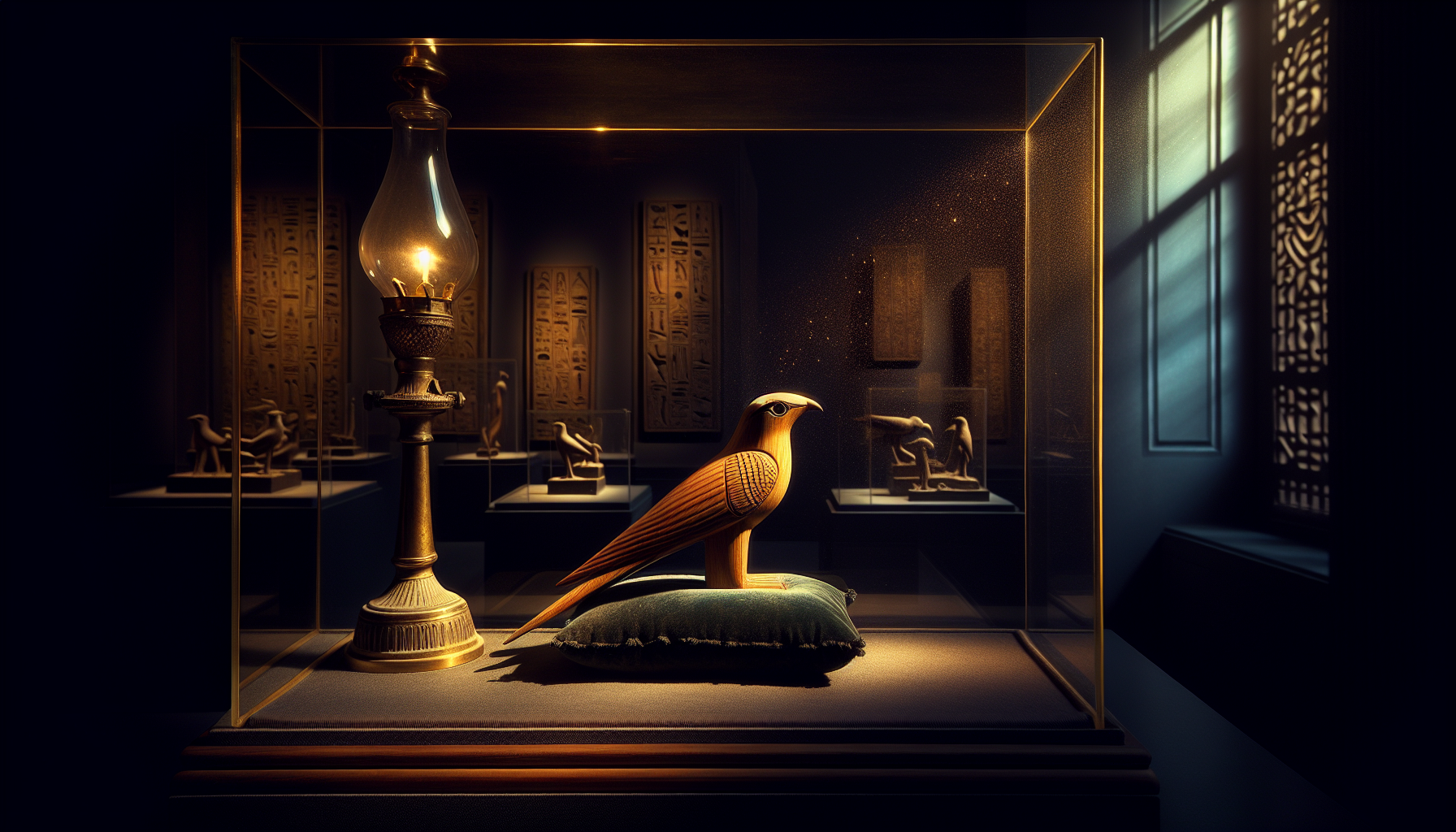
The Saqqara Bird is a small sycamore-wood object, roughly fourteen centimeters long, found in a tomb near Saqqara in 1898 and now held by the Egyptian Museum in Cairo as accession number JE 33109. Egyptologists classify it as a Late Period bird figurine, likely a votive or weather vane. A minority of researchers, beginning with the physician Khalil Messiha in 1969, argue its proportions match a glider.
Few small artifacts in Egyptian collections have generated as much heat as this palm-sized carving. It was excavated during a routine sweep of a tomb shaft above the Saqqara necropolis, catalogued without ceremony, and shelved among hundreds of other wooden bird figures the Egyptians produced for funerary and cultic use. Seven decades later, an aeromodeller noticed something its first cataloguers had not: the wings carry a slight dihedral, the body an unusual hollow, and the tail a small vertical fin reminiscent of an empennage. From that moment, the object split into two careers, one as a museum specimen and one as a candidate piece of evidence for a controversial claim about pharaonic technology.
This guide reconstructs the artifact’s discovery, surveys both the mainstream Egyptological reading and the ancient-aircraft hypothesis, and reports the wind-tunnel tests that have been run on its proportions. The aim is to leave the reader with the evidence ladder intact, not the verdict pre-decided, while remaining clear about where scholarly consensus rests within the broader landscape of historical and archaeological mysteries.
Discovery and the Pa-di-Imen Tomb
The bird was recovered in 1898 during work directed by the Egypt Exploration Fund near the step pyramid complex at Saqqara, the vast cemetery serving Memphis from the Old Kingdom onward. The find context is recorded as a tomb attributed to a person named Pa-di-Imen, a priest dated by inscription style to the late Ptolemaic period, roughly the third or second century BCE [1]. The find was deposited at the Egyptian Museum in Cairo, where it lay essentially unstudied for more than seventy years.
What the Original Excavation Recorded
No formal excavation report singled out the object. Notes describe a wooden bird carved from a single piece of Ficus sycomorus sycamore, painted, with traces of an inscription on the underside that has been read as a dedication to the god Amun. Saqqara tombs of this period regularly contained wooden bird models — falcons, ibises, vultures — produced as votive deposits or as parts of mummified animal cult assemblages. The figure entered the museum’s catalogue under the working description “wooden bird,” and its accession number, JE 33109, is the address by which scholars still locate it today.
Why Saqqara Matters
Saqqara is the largest cemetery of pharaonic Egypt, in continuous funerary use for more than three thousand years. By the Ptolemaic period, when the bird was likely deposited, the area held huge animal necropoleis dedicated to Amun, Thoth, and the Apis bull. Bird mummies and bird figurines numbered in the millions. Any small wooden bird recovered from this stratum has thousands of relatives, which is one reason early curators treated JE 33109 as ordinary.
Khalil Messiha’s 1969 Reinterpretation
In 1969, an Egyptian physician and amateur aeromodeller named Khalil Messiha (1924-1998) noticed the bird while reviewing the museum’s reserve collection. He wrote a brief paper proposing that the object’s proportions were aerodynamic rather than ornithological [2]. His argument circulated first in Egyptian periodicals, was picked up by the popular press, and reached an English-speaking audience through pyramidology and ancient-astronaut writers in the 1970s and 1980s.
What Messiha Claimed
Messiha catalogued five features he considered atypical for a representational bird. The wings, he argued, sit straight out and slightly downward, a low dihedral angle consistent with stability in flight rather than the folded posture an artist usually carves on a perched bird. The body has a hollow chamber along the spine. The tail terminates in a vertical surface, not a horizontal fan of feathers. The eyes are stylized rather than anatomical. The whole object, he calculated, has a center of gravity slightly forward of midpoint, the position a glider needs.
The “Missing Tailplane” Question
Messiha noted what he saw as a missing horizontal stabilizer, hypothesizing that a small wooden tailplane had broken off and been lost. Without that piece, he argued, the object cannot fly stably. With a stabilizer of plausible dimensions added, his replica models behaved like a slow glider when launched by hand. Critics counter that postulating a missing piece to make the artifact behave as the hypothesis requires is not strong inferential ground.
Larry Smith and the Wind-Tunnel Replica
The most thorough technical follow-up came from American aerodynamicist Martin Gregorie and, separately, from researcher Larry Smith and a small team in the early 2000s, who built scaled balsa-wood and resin replicas and tested them in calibrated wind tunnels. Their results are widely cited but not always carefully read.
What the Tests Showed
A faithful replica without an added tailplane is unstable; it stalls quickly and pitches into a dive. Adding a small horizontal stabilizer of the kind Messiha proposed yields a configuration that glides several meters when hand-launched. Gregorie, an experienced free-flight modeller, concluded that the original artifact, while suggestive, lacks the longitudinal stability for sustained flight and would not function as a true glider in its present form [3]. Smith reported similar findings, with the qualifier that the object’s proportions still cluster oddly close to airfoil ratios when compared with the rest of the museum’s bird-figurine corpus.
What the Tests Did Not Show
No experiment has demonstrated that the artifact, as found, was ever launched, ever flew, or was ever intended to fly. The wind-tunnel literature establishes only that a modified replica can glide briefly. That is a far weaker claim than the popular framing — that pharaonic Egyptians built model aircraft — and the gap between the two is where most of the public confusion resides.
The Mainstream Egyptological Reading
Within Egyptology, the consensus position treats the Saqqara Bird as a stylized votive figurine, possibly a weather vane mounted above a funerary boat or temple shrine. This reading is not a rejection of Messiha’s observations so much as a different explanation for them.
Bird Figurines in Egyptian Religion
Wooden and bronze bird figurines were standard furnishings of Late Period and Ptolemaic burials, often associated with the soul concepts of ba (depicted as a bird with a human head) and akh. The Brooklyn Museum and the Metropolitan Museum each hold dozens of comparable wooden birds. The Saqqara Bird’s fixed wings, slightly dihedral posture, and tail fin are paralleled in other carvings of falcons and kites, especially those intended to be mounted on a pole or boat-prow rather than handled.
The Weather-Vane Hypothesis
Egyptologist Cyril Aldred and, more recently, curators at the Egyptian Museum have proposed that the object served as a wind indicator atop a sacred barque. The vertical tail fin would catch the breeze and turn the body to point into the wind, exactly as a weather vane does. The slight dihedral and the stylized eyes fit a sculptural object designed to be read at a distance from below, not a flying model. The dedication to Amun on the underside is consistent with cultic display rather than experimental aeronautics.
Why the Object Will Not Settle the Question Alone
A single artifact cannot carry the weight of the ancient-aircraft hypothesis on its own, and most careful writers on either side acknowledge as much. The interpretive frame matters as much as the measurements.
The Evidence Ladder
For a strong claim that pharaonic Egypt built functional gliders, the evidentiary requirements would include corroborating texts in hieroglyphic or demotic sources, additional artifacts with comparable features, depictions of flight technology in tomb paintings or temple reliefs, and material remains of larger gliders. None of these exist. What exists is one wooden bird with proportions that, in isolation, can be read as suggestive. Egyptologists treat that as a thin foundation; ancient-aircraft theorists treat it as a starting point that warrants further search.
Where Reasonable People Differ
The honest disagreement is not whether the bird could glide if modified — replicas show that a modified replica can — but whether the original artifact was designed to. That question turns on context: the tomb assemblage, the inscription, the broader corpus of Late Period bird figurines, and the absence of supporting textual or iconographic evidence. On those grounds, the weather-vane or votive reading is the conservative interpretation, and it is the one museum signage at Cairo currently presents.
Where to See It and Where to Read More
The Saqqara Bird remains in the collection of the Egyptian Museum in Cairo. It is sometimes on display in the upper-floor galleries devoted to Late Period material, sometimes in storage during reinstallation. Replicas exist in private collections and at the Saqqara visitor center; the mathematical model published by Smith’s team has been reproduced in popular science books on contested artifacts. For serious study, the recommended path is the original Messiha paper, Gregorie’s free-flight analysis, and the Egyptian Museum’s catalogue entry for JE 33109, read alongside one of the recent surveys of Late Period bird-figurine production [4][5].
Frequently Asked Questions
How old is the Saqqara Bird?
The figurine is dated by inscription and tomb context to roughly the third or second century BCE, the late Ptolemaic period. It is not an Old Kingdom or pyramid-era object, despite popular descriptions sometimes implying otherwise.
Where was it found?
It was recovered in 1898 from a tomb attributed to a priest named Pa-di-Imen at Saqqara, the necropolis serving the ancient capital of Memphis, south of modern Cairo.
Who first proposed it was a glider?
Khalil Messiha, an Egyptian physician and amateur aeromodeller, made the case in a 1969 paper after examining the artifact at the Egyptian Museum. His brother Gamal Messiha and several Egyptian engineers later supported the reading.
Have replicas actually flown?
Modified replicas, with an added horizontal tailplane that is not present on the original, can glide several meters when hand-launched. Faithful replicas without the added stabilizer pitch and stall almost immediately. The original artifact has never been flight-tested.
What do most Egyptologists think it is?
The mainstream reading is that the object is a votive bird figurine, possibly serving as a weather vane on a sacred boat or shrine. This reading is consistent with the inscription dedicating the object to Amun and with the vast corpus of similar Late Period wooden birds in Egyptian collections.
Why does it have a vertical tail fin instead of feathers?
The vertical tail is the feature that prompted Messiha’s claim. Mainstream interpreters argue it functions either as a stylized convention of the carver, as a structural feature for mounting, or as the directional surface of a wind indicator. None of these uses requires the object to fly.
Is there hieroglyphic evidence for ancient Egyptian flight?
No. Egyptian texts describe winged deities, soul-birds, and divine flight, but no demotic, hieroglyphic, or hieratic source describes a flying machine, a glider, or any technology consistent with the modern aircraft reading. The interpretive weight rests on the artifact alone.
Where can I see the Saqqara Bird in person?
The artifact is housed at the Egyptian Museum in Cairo under accession number JE 33109. Display rotations vary; visitors interested in seeing it should check current gallery information with the museum before traveling.
What does the inscription on the bird say?
The underside carries a short dedication that has been read as referring to the god Amun. The reading is faint and contested in detail, but the religious framing of the object is broadly accepted by epigraphers who have examined it.