By Emilia Wellesley · Published May 7, 2026 · Updated September 10, 2026
Last updated: September 10, 2026.
What Are the Ulfberht Swords?
The Ulfberht swords are a corpus of roughly one hundred and seventy Viking-Age blades, produced between about 800 and 1000 CE, bearing an iron-inlaid +VLFBERH+T or +VLFBERHT+ inscription along the upper third of the blade. The metallurgically authentic specimens carry a carbon content of roughly one to one-point-two percent in a uniform crucible-steel structure: a quality not otherwise produced in Europe before the eighteenth-century blast furnace. The leading scholarly resolution traces the steel itself to imported Indian wootz or Persian pulad ingots arriving along the Volga trade route through Bulgar and Khazaria, then forged and signed in Frankish workshops along the Rhine.
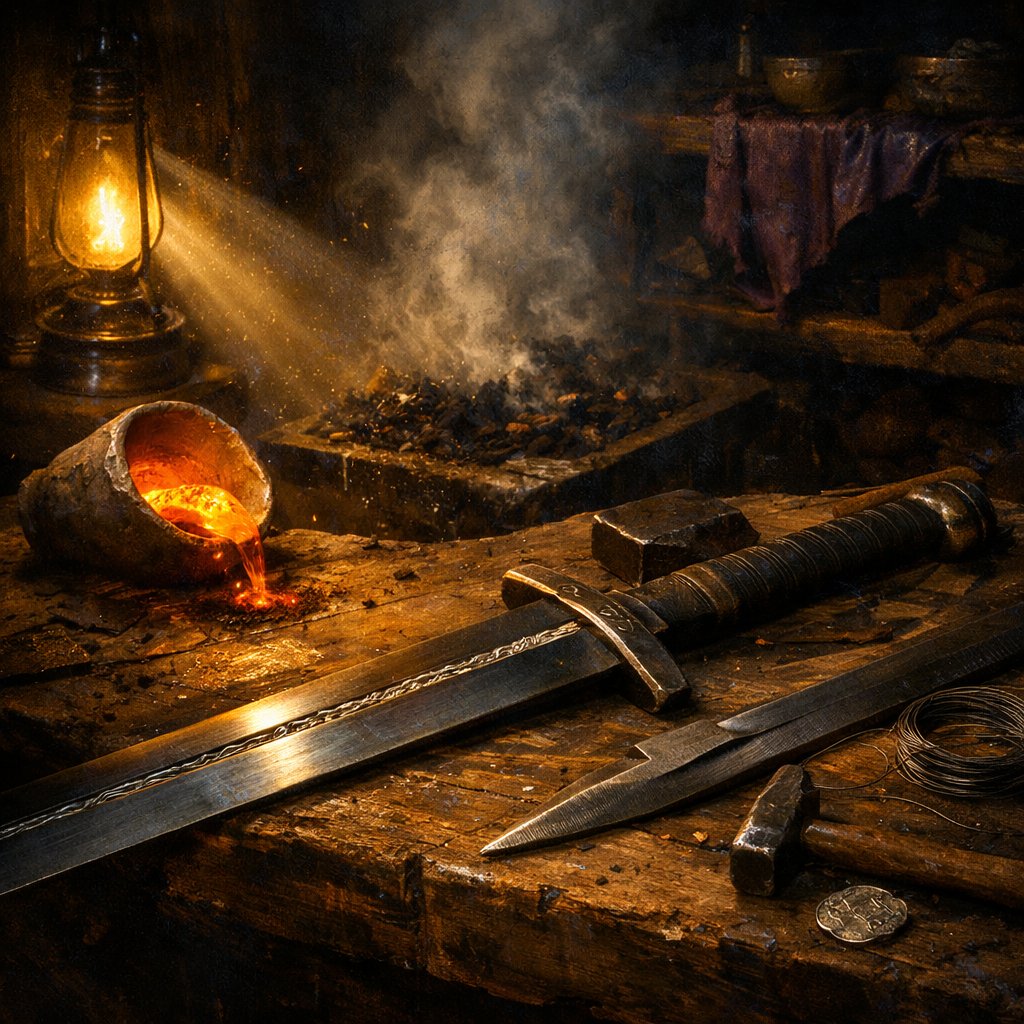
A modern visitor can stand in the Wikingermuseum at Haithabu or in the National Museum of Denmark and look down at one of these blades laid flat on a velvet rest under a low museum lamp. The inscription, when it survives, runs in capital Roman letters from a small forging cross at the edge nearest the hilt: +VLFBERH+T, six letters and two crosses, a name. What the visitor will not see, because the surface gives no clue, is that the metal beneath the inscription belongs to a metallurgical family the period was not supposed to have. The blades occupy an awkward position in the historical record, simultaneously a brand, a metallurgical anomaly, and a problem of long-distance trade.
What follows is a working historian’s account of how a corpus of roughly one hundred and seventy inlaid Viking blades came to register as an anomaly in the technical record, what the metallography actually shows, and how this question fits into the broader landscape of historical and archaeological mysteries.
The Inscription and the Corpus
The first thing to understand about the Ulfberht corpus is that the name on the blades is the only thing the surviving objects unambiguously say in their own voice. Anne Stalsberg‘s 2008 review article in Acta Archaeologica, the standard catalogue and the closest the field has to an exhaustive census, lists about one hundred and seventy known inlaid specimens scattered across Norway, Sweden, Denmark, Finland, Estonia, Latvia, Russia, Ukraine, Germany, Poland, the Netherlands, the British Isles, and Ireland, with a small number from rivers and the Baltic seabed [1]. The geographic spread maps closely onto the Viking world, but the ascending pattern of finds in the eastern river systems, the Volga and the Dnieper above all, is the distinctive feature, not an incidental one.
The Spelling Variants
Stalsberg’s catalogue separates the corpus into two clear orthographic groups. The first group, of which she counts roughly forty-four examples, carries the canonical inscription +VLFBERH+T, with the second cross between the H and the T. The second group, somewhat larger, carries variants: +VLFBERHT+, with the second cross at the end; +VLFBEHT+ and +VLFBET+, with letters dropped or transposed; and a small number of obvious blunders. The orthographic separation is not cosmetic. The blades carrying the canonical +VLFBERH+T inscription, when they have been metallographically tested, almost uniformly show the high-carbon, slag-poor crucible-steel structure that defines the metallurgical anomaly. The blades with the misspelled variants, when tested, frequently show ordinary Frankish bloomery iron with a pattern-welded core: skilled work, but not anomalous, and chronologically consistent with everything else known about ninth- and tenth-century European edged weapons. The orthographic split, in other words, is also a quality split.
The Production Window
Stylistic typology of the hilts, contextual dating from grave goods and runestones, and a small number of dendrochronological dates from sword-bearing burials place the corpus in the two centuries between roughly 800 and 1000 CE, with the production peak in the late ninth and early tenth. The terminus post quem is the late eighth century, when the Carolingian sword-hilt typology that dominates the corpus first appears; the terminus ante quem is the eleventh century, when the inscription disappears from the record and is replaced by the GICELIN, INGELRII, and CEROLT inlay traditions that dominate the high medieval sword. The two-hundred-year window is short. It is the window of a brand, not of a folk practice.
The Metallurgical Anomaly
The historical record is silent on what the swordsmith was actually doing at the forge. The metallurgical record is not. Alan Williams of the Wallace Collection laboratory in London has spent two decades on the Ulfberht corpus, and his definitive study in The Sword and the Crucible (Brill, 2012), drawing on metallographic sectioning and electron-probe microanalysis of more than forty inlaid specimens, established the technical pattern that the field now treats as established [2]. The 2009 paper Williams published in Materials Science and Technology lays out the supporting laboratory work in the form journal readers expect [3].
What the Sections Show
A section through a metallurgically authentic Ulfberht blade reveals a uniform crucible-steel structure with a carbon content of roughly one percent to one-point-two percent, a homogenous distribution of carbon throughout the cross-section, very low slag content, and an absence of the welded-together bloom layers that characterize ordinary Frankish blade steel of the period. The carbon content is the load-bearing observation. European bloomery iron, smelted in a charcoal-fired pit furnace and worked at the forge by repeated folding, doubling, and welding, occupies a carbon range of roughly zero-point-one to zero-point-eight percent, irregular by section, with substantial silicate slag inclusions trapped between welded layers. To produce a homogenous one-percent-carbon steel, the smith needs the iron and the carbon to be brought into a fluid alloy and then solidified together, a process that requires temperatures and crucible technology not available to the European bloomery before the seventeenth century at the earliest, and not consistently before the eighteenth-century blast furnace. The metallurgically authentic Ulfberht blade is, in plain terms, made of a metal that the surrounding craft tradition did not know how to make.
The Doerner Institute Studies
The earlier metallographic ground was prepared by Stefan Mäder and his collaborators at the Doerner Institute in Munich, whose 2002 studies on a sample of Frankish-inscribed blades, including several Ulfberht specimens, demonstrated that the inlay technique itself, the cold-hammered iron-wire letters set into a chiselled groove on the blade, was a Frankish workshop practice well attested across the Carolingian sword corpus, including non-Ulfberht inlays such as INGELRII [4]. The forging and inlay are not, in themselves, the anomaly. The anomaly is what is happening in the bar of metal underneath the inlaid letters. Mäder’s microhardness measurements on his Ulfberht samples produced numbers near the upper end of what hand-forged steel can show, in the range of seven hundred to nine hundred Vickers in quenched-and-tempered specimens, comparable to the modern ASSAB tool steels used in present-day Japanese sword reproductions.
The Indian Wootz Hypothesis
The leading reconstruction of where the steel actually came from rests on the comparative metallurgy of Indian wootz. Wootz is a crucible-melted iron-carbon alloy produced in southern India, primarily in what are now the states of Karnataka, Tamil Nadu, and Andhra Pradesh, and traded out of the southern Indian ports from at least the third century BCE under the Greek and Roman names ferrum indicum and indikos sideros [5]. The technique places small pieces of iron, charcoal, and a vegetable additive in a closed clay crucible, fires the assemblage to roughly thirteen hundred degrees Celsius for several hours, and produces a small ingot of homogenous high-carbon steel. The Persian variant, called pulad in the Iranian sources, follows the same recipe with regional adjustments. Both produce, when forged out, a metal whose internal structure matches the metallurgically authentic Ulfberht blade in carbon content, slag content, and homogeneity.
The Volga Trade Route
The geographic mechanism that brings southern Indian or Persian crucible steel into the hands of a Frankish swordsmith on the Rhine in 875 CE is the Volga trade route. The route is well attested in the period: Arab silver dirhams reach Scandinavia in immense quantities through the ninth and early tenth centuries, with hoards on Gotland alone holding tens of thousands of coins; the Khazar Khaganate on the lower Volga and the Volga Bulgars at modern Kazan operated as the staging entrepots; and the geographer Ibn Fadlan‘s 921 CE embassy to the Volga Bulgars describes the rus’ merchants meeting their Khazar and Bulgar counterparts on the riverbank in terms a modern reader recognizes as a working long-distance trade. Steel ingots, in this picture, travel north along the Volga from the Caspian, through Bulgar and Khazaria, into the network of rivers and portages that connects the Caspian basin to the Baltic. The route is bidirectional: silver and slaves move south, oriental spice, silk, and steel move north. The 2012 BBC/PBS NOVA documentary Secrets of the Viking Sword walked Williams’s argument through to a public audience and identified the closure of the Volga route after the Mongol conquests in the mid-thirteenth century as a candidate for why the metallurgically authentic Ulfberht inscription disappears from the record [6].
The Workshop Attribution
If the steel itself is imported, the swords are not Indian or Persian objects. They are European objects whose blade-bar happens to be of imported metal. The workshop attribution, on the textual and typological evidence, is Frankish or more narrowly Rhenish-Frankish: the Carolingian Capitulary of Aachen of 805 CE explicitly forbids the export of Frankish swords to non-Christian buyers, a prohibition that makes sense only against a background of an established Frankish sword industry whose products were reaching the Vikings; the hilts on the surviving inlaid blades sit firmly within the Carolingian typology of Petersen types K, L, X, S, and T; and the inlay technique itself is, as Mäder established, a Frankish craft practice. Stalsberg, more cautiously, argues for a workshop on the middle Rhine, perhaps Mainz or the Cologne region, on the grounds that the inscription orthography matches Carolingian scribal hands of that area and the early finds cluster on river systems flowing into and out of the middle Rhine [1]. The point is that the Ulfberht blade is, in shorthand, foreign metal worked into a local form by a local hand and signed with a local name.
Who Was Ulfberht?
Ulfberht is a continental Germanic personal name, a hardening of the Old High German Wulfberht, attested in Frankish documents of the eighth and ninth centuries as a moderately common ecclesiastical and aristocratic name, with bishops and abbots of that name in the Mainz and Reims dioceses. The name on the blade is therefore not exotic; it is the kind of name a ninth-century Frankish craftsman or his shop’s founding master would actually have borne. What the name on the blade is not, on the available evidence, is the name of a single individual smith working personally for two hundred years. The corpus’s two-hundred-year production window forecloses that reading, as does the orthographic distribution showing both metallurgically authentic and clearly inferior blades carrying versions of the same inscription. Stalsberg’s preferred reconstruction treats Ulfberht as a workshop trade-name passed through several generations of master smiths, possibly within a single family, possibly through apprenticeship lineage, with the inscription functioning as the brand of the workshop rather than the signature of the individual maker [1].
The trade-name reading also accounts for the misspellings. A workshop branding a product, especially a high-prestige product, attracts imitators; a competing smith, or a less careful apprentice in the same workshop tradition, might inlay the recognizable letters on a blade of ordinary bloomery iron and sell it at a premium to a buyer who cannot, on the surface alone, tell the metallurgical difference. The orthographic distribution and the metallographic distribution are, on this reading, the same fact seen from two angles: the carefully made authentic blade carries the carefully spelled inscription; the careless or counterfeit blade carries the careless or transposed inscription. A Viking buyer at the Hedeby market in 920 CE, looking at two blades, both inlaid, both Frankish-hilted, both with versions of the famous name, faces a problem any modern luxury-goods buyer would recognize.
What the Anomaly Comes To
A historian writing on the Ulfberht corpus has to refuse two equally seductive readings. The first is the heroic-anachronism reading, in which a single Frankish or Rhineland workshop is credited with a metallurgical breakthrough five centuries ahead of its surrounding craft tradition, an isolated genius producing crucible steel in a Carolingian forge through a technique no contemporary text records. That reading flatters the past at the cost of getting it wrong. The metallurgical evidence is consistent with imported crucible-steel ingots, and the trade-route evidence is consistent with their delivery; the parsimonious reconstruction does not require an undocumented metallurgical revolution in the middle Rhine. The second reading is the dismissive deflationary one, in which the metallurgical anomaly is talked down to a quirk of testing or a single outlier blade, and the whole question is folded into the ordinary craft history of the Frankish sword. That reading is also wrong. Williams’s metallographic corpus is too large, too consistent, and too far outside the European bloomery range to be explained as a sampling artifact, and the orthographic and metallographic distributions of Stalsberg’s census track each other too tightly to be coincidence.
The honest reconstruction holds the question open at the right point. The metal in a high-carbon Ulfberht blade is genuinely outside its surrounding European craft tradition. The most defensible explanation, on the available evidence, is that the metal arrived in Europe as imported crucible-steel ingots from the Indian or Persian centres of the wootz and pulad traditions, traveling north through the Volga corridor, and was forged into Carolingian-shaped blades by Frankish smiths who marked the product with a workshop trade-name. The argument has gaps. No surviving Ulfberht blade has been provenanced to a specific southern Indian crucible source by isotope analysis as of 2026; the textual record gives no Frankish or Arabic source explicitly connecting Volga steel to Rhineland sword forges; and the orthographic split, while suggestive, has been tested on only a fraction of the surviving inlaid corpus. The mystery, in other words, has been clarified but not closed. What survived in the ground was a corpus of roughly one hundred and seventy signed blades whose metal does not match its century and whose inscription does not match its individual maker. The historian’s job is to keep both observations in view at once.
Frequently Asked Questions
How many Ulfberht swords are known?
Anne Stalsberg’s 2008 catalogue lists about one hundred and seventy specimens carrying the +VLFBERH+T or a variant inscription. The corpus is dispersed across Northern and Eastern Europe, with the densest concentrations in Norway, Finland, the Baltic states, and the Russian river systems. New examples surface at a rate of roughly one or two a decade, mostly from river dredging and metal-detector finds rather than from formal archaeological excavation, so the working census in 2026 is somewhat above Stalsberg’s 2008 figure but not dramatically so.
When were the Ulfberht swords made?
The corpus dates between roughly 800 and 1000 CE, with the production peak in the late ninth and early tenth century. The dating rests on Carolingian sword-hilt typology, contextual grave-good dates, a small number of dendrochronological dates from sword-bearing burials, and the disappearance of the inscription from the record around the eleventh century in favour of the GICELIN, INGELRII, and CEROLT inlay traditions that dominate the high medieval sword.
What makes the metal anomalous?
A metallurgically authentic Ulfberht blade carries a uniform carbon content of roughly one percent to one-point-two percent in a homogenous, slag-poor crucible-steel structure. European bloomery iron of the period, smelted in charcoal pit furnaces and worked by folding and welding at the forge, occupies a carbon range of roughly zero-point-one to zero-point-eight percent, irregular by section and full of silicate slag inclusions. The Ulfberht steel is comparable in cleanliness and carbon to modern crucible steels and is not technically reproducible by ninth-century European bloomery practice.
Where did the steel come from?
The leading reconstruction, advanced by Alan Williams in The Sword and the Crucible (Brill, 2012), is that the steel was imported as small crucible-melted ingots from the Indian wootz tradition of southern India or the Persian pulad tradition, and shipped north along the Volga trade route through the Khazar Khaganate and the Volga Bulgars into Scandinavian and Frankish hands. The Indian and Persian crucible steels of the period match the Ulfberht steel in carbon content, slag content, and homogeneity, and the Volga trade route is independently attested by Arab silver hoards in Scandinavia, by Ibn Fadlan’s 921 CE embassy account, and by the Khazar and Bulgar entrepots at the lower and middle Volga.
Who made the swords?
On the textual and typological evidence, the swords were forged by Frankish or more narrowly Rhenish-Frankish smiths working within the Carolingian sword-hilt typology, with the inlay set by hand in a chiselled groove on the blade. Anne Stalsberg argues for a workshop somewhere on the middle Rhine, perhaps Mainz or the Cologne region, on the grounds that the orthography of the inlaid letters matches Carolingian scribal hands of that area and the early finds cluster on river systems flowing into and out of the middle Rhine.
Why are some Ulfberht blades inferior?
Stalsberg’s catalogue divides the corpus into a canonical-orthography group, +VLFBERH+T with the cross between the H and the T, and a misspelled-variant group with letters dropped or transposed. Williams’s metallography shows that the canonical-orthography blades almost uniformly carry the high-carbon crucible-steel structure, while the misspelled-variant blades frequently carry ordinary Frankish bloomery iron. The pattern is consistent with a counterfeit market: a workshop with the famous trade-name produced authentic high-quality blades, while competitors and less careful apprentices inlaid imitations of the recognizable letters on ordinary blades and sold them at a premium to buyers who could not, on the surface alone, tell the metallurgical difference.
Was Ulfberht a single person?
Almost certainly not. Ulfberht is a continental Germanic personal name, a hardening of Old High German Wulfberht, attested in Frankish documents of the period as a moderately common ecclesiastical and aristocratic name. The corpus’s two-hundred-year production window forecloses a single-individual reading. The leading reconstruction treats Ulfberht as a workshop trade-name passed through several generations of master smiths, possibly within a single family, possibly through apprenticeship lineage, with the inscription functioning as the brand of the workshop rather than the signature of the individual maker.
How was the inscription applied?
The inscription was inlaid into the blade by hand. The smith chiselled a shallow groove in the surface of the hot blade, hammered a piece of soft iron wire into the groove so that the wire keyed into the steel, and ground the surface flush after cooling. The technique, called pattern-welded inlay or wire inlay, was a standard Frankish workshop practice attested on numerous non-Ulfberht inscribed blades, including the contemporaneous INGELRII corpus. Stefan Mäder’s 2002 work at the Doerner Institute in Munich documented the technique on Ulfberht and INGELRII blades alongside one another.
Did the Ulfberht workshop close?
The metallurgically authentic Ulfberht inscription disappears from the record around the eleventh century. The 2012 NOVA documentary Secrets of the Viking Sword floated the Mongol-era closure of the Volga trade route as a candidate explanation, on the argument that the supply of imported crucible-steel ingots from the south dried up when the Mongol conquests of the mid-thirteenth century reorganized Eurasian trade. The dates are not a perfect fit, since the inscription disappears about a century before the Mongol period proper, but the broader claim that disruption of the Volga route mattered to the supply of high-carbon steel in Northern Europe is consistent with the evidence.
Are the Ulfberht swords forgeries?
The metallurgically authentic blades are genuine ninth- and tenth-century artifacts. The misspelled-variant blades in Stalsberg’s catalogue are also genuine ninth- and tenth-century artifacts, but they are period counterfeits: contemporaneous lower-quality blades passing themselves off as products of the Ulfberht workshop. There is no significant modern-forgery problem in the catalogue, since the iron-wire inlay technique is difficult to fake convincingly and the corpus is well documented in the European museum holdings.
What is wootz steel?
Wootz is a crucible-melted iron-carbon alloy produced in southern India, principally in modern Karnataka, Tamil Nadu, and Andhra Pradesh, from at least the third century BCE. The technique places small pieces of iron, charcoal, and a vegetable additive in a closed clay crucible, fires the assemblage to roughly thirteen hundred degrees Celsius for several hours, and yields a small ingot of homogenous high-carbon steel with a characteristic surface watering when forged out and acid-etched. The Persian variant, pulad, follows the same recipe with regional adjustments. The Indian and Persian crucible-steel traditions, traded out of the southern ports under the Greek and Roman names ferrum indicum and indikos sideros from at least Roman times, are the metallurgical match for the Ulfberht steel.
Where can I see an Ulfberht sword?
The major holdings are at the National Museum of Denmark in Copenhagen, the Wikingermuseum at Haithabu (Schleswig), the Historiska Museet in Stockholm, the State Hermitage Museum in St Petersburg, the National Museum of Ireland in Dublin, and the Wallace Collection in London, which holds the Williams research material. Smaller specimens turn up regularly in the Baltic and Eastern European regional museums. The Royal Armouries at Leeds and the British Museum in London also hold inlaid Frankish swords from the broader Carolingian corpus, including specimens whose inscriptions and dating place them in conversation with the Ulfberht question.