

Drafted with AI assistance from the sources listed; images are AI-generated illustrations. How EsoVitae is made
What Is Tír na nÓg in Irish Mythology?
Tír na nÓg, Old Irish for “Land of the Young,” is the name medieval and early modern Irish texts give to a westerly Otherworld island where time slows, sickness has no purchase, and the Tuatha Dé Danann hold court in perpetual youth. The fullest surviving telling comes from Micheál Coimín’s 1750 poem Laoi Oisín ar Thír na nÓg, translated for the Ossianic Society by Brian O’Looney in 1859 [1].
I went looking for Tír na nÓg twice. The first time was on the Cliffs of Moher in a wind that pulled words out of your mouth before you could finish them, the kind of weather that made you understand why Irish poets put paradise out beyond the visible horizon. The second time was at the National Library of Ireland on Kildare Street, where Coimín’s poem sits as a manuscript and as nineteenth-century print, and where the geography quietly reorganises: the Land of Youth has never been a place on a survey sheet, but it has always been a place on a page. This guide stands at both addresses — the cliff and the archive — and walks the reader through what Tír na nÓg actually meant to the people who first wrote it down, where the literary tradition came from, and how a paradise built out of voyage tales and lay poems still shapes the way Ireland is described within the broader landscape of mystical places and lost worlds.
The Manuscript Witnesses That Built the Land
The textual record for Tír na nÓg is thinner and later than most readers assume: the single Irish poem that gave us the modern story was composed in County Clare around 1750 by Micheál Coimín (c. 1688–1760), nearly seven centuries after the medieval voyage tales that supplied its scenery, according to the Dictionary of Irish Biography [1][2]. The name survives in earlier sources as one Otherworld designation among many — Tír Tairngire (Land of Promise), Tír fo Thuinn (Land under the Wave), Mag Mell (Plain of Delight), Emain Ablach (Isle of Apple Trees) — but the Oisín-and-Niamh story that fixed it in the popular imagination is a late Ossianic lay, not a medieval one [3].
Standing at the manuscript desk: Coimín’s poem reaches us through Brian O’Looney’s literal prose translation in the Transactions of the Ossianic Society volume four (Dublin, 1859), through David Comyn’s 1880 Gaelic Union republication, and through Thomas O’Flannghaile’s later edition [2]. The frame is a dialogue between Oisín, son of Fionn mac Cumhaill, and Saint Patrick, in which the old warrior recalls a youth he can no longer reach. That frame matters: every word we have about Tír na nÓg is filtered through a Christian-era scribal culture explaining the pre-Christian Otherworld to itself.
Earlier Otherworld Voyages
The compositional bones of Coimín’s poem come from the medieval immrama tradition, the genre of Old Irish sea-voyage tales. Immram Brain (“The Voyage of Bran mac Febail”), composed in the late seventh or early eighth century, sends its hero across the sea to an island where a woman with a silver apple branch sings fifty quatrains in praise of a timeless realm called Emain [4]. The Echtra Condla (“The Adventure of Connla”) and Immram Maíle Dúin add further islands of women, of laughter, of apples that never spoil. By the time Coimín wrote, an Irish poet had a thousand-year inventory of paradise islands to draw from; he simply gathered the brightest images under one name.
Where Tír na nÓg Sits on the Map
The geography of Tír na nÓg is consistent across the surviving texts: it lies westward, across the ocean, beyond the visible horizon from the Atlantic coast of Ireland, reachable only by an enchanted horse, a magical boat, or an invitation [3][5]. The west matters. In Old Irish cosmology the souls of the dead were thought to depart westward with the setting sun, the same compass bearing on which Hy-Brasil — the phantom island that drifted on and off Admiralty charts as late as 1865 — was reputed to lie [3].
Modern Irish tourism literature attaches the legend to specific viewpoints, especially the Cliffs of Moher in County Clare (Coimín’s home county), the Aran Islands, the Dingle Peninsula in Kerry, and the headlands of Connemara. None of these placements is medieval. They are nineteenth- and twentieth-century anchorings of a tradition whose original geography was deliberately uncoordinated — the place that is no place, the island beyond the last island.
The Otherworld’s Many Names
The conflation worth resolving: Tír na nÓg in the popular telling is presented as a single fixed location, but in the medieval sources it is one face of a larger Otherworld with many regional names. Mag Mell sometimes appears as the path one crosses to reach the inner realms; Tír na mBan (“Land of Women”) shows up in Immram Brain as a specific island within a chain; Emain Ablach is the Apple-Tree Isle that later medieval writers identified with the Isle of Man and that Arthurian tradition borrowed for Avalon [4]. The map below is a way of holding the inventory in one frame.
| Otherworld Name | Meaning | Earliest Source | Approximate Date |
|---|---|---|---|
| Tír na nÓg | Land of the Young | Laoi Oisín ar Thír na nÓg (Coimín) | c. 1750 |
| Mag Mell | Plain of Delight | Immram Brain | Late 7th c. |
| Tír Tairngire | Land of Promise | Medieval Fenian Cycle texts | 11th–12th c. |
| Tír fo Thuinn | Land under the Wave | Medieval Mythological Cycle | 11th c. |
| Emain Ablach | Isle of Apple Trees | Immram Brain & Mythological Cycle | Late 7th c. |
| Tír na mBan | Land of Women | Immram Brain | Late 7th c. |
| Hy-Brasil | Phantom Atlantic island | Catalan Atlas | 1325 |
The Story of Oisín and Niamh, Read Slowly
Coimín’s 1750 lay opens on the shore of Loch Léin in Killarney, where Oisín and the Fianna are hunting and a white horse rises out of the sea bearing Niamh Cinn Óir (“Niamh of the Golden Hair”), daughter of the sea god Manannán mac Lir [1][6]. She names her love for Oisín, names the wonders of Tír na nÓg, and asks him to ride west with her. He goes. They travel the surface of the Atlantic past islands of marvels, past a captive maiden Oisín rescues from a giant in one of the lay’s interpolated episodes, and arrive at a country where every wish is granted and three centuries pass without an hour’s weight.
Strip away the spectacle, and the residue is a poem about the cost of return. Oisín bears Niamh three children and grows homesick. She lends him the white horse with one prohibition: do not let your foot touch Irish soil. He sees a saddle-girth slip on the strand at Gleann na Smól, dismounts to help two men lift a stone, ages three hundred years in a breath, and lives long enough only to tell Patrick what he saw [1]. The lay’s structural symmetry is exact: an enchantment of the threshold begins the story; a violation of the threshold ends it.
The Patrick Frame and Its Tensions
The dialogue with Saint Patrick is more than narrative scaffolding. It is the moment medieval and early modern Irish writers used to negotiate two incompatible cosmologies — the pre-Christian Otherworld of the Tuatha Dé Danann and the Christian theology of heaven, hell, and the saved soul. Patrick presses Oisín toward conversion; Oisín defends a Fianna code of honour, feast, and the company of his lost companions. The earlier medieval text Acallam na Senórach (“Colloquy of the Old Men”), surviving in five late manuscripts including Oxford’s MS Laud Misc. 610 and MS Rawlinson B 487, frames most of the Fenian cycle through the same Oisín-and-Patrick dialogue [7]. Coimín inherited that structure and simplified it into a single recursive grief.
What the Place Means in the Tradition
Read as a place, Tír na nÓg encodes a specific theory of time: the Otherworld runs at a slower rate than the human world, and a moment of contact is enough to consume a life on the slower scale. The medieval texts treat this slippage as a physical property of the location, not as a metaphor [4][5]. The technical referent: the lay distinguishes aimsir (time as duration) inside Tír na nÓg from aois (age as wear) outside it; only the latter accumulates.
The place’s actual claim on us is therefore not paradise as reward but paradise as a different physics. This is what makes the Otherworld useful to so many later writers — W. B. Yeats’s 1889 long poem The Wanderings of Oisin, drawn directly from O’Looney’s translation, is the most famous reuse, but the imagery threads through Lady Gregory, Standish O’Grady, James Stephens, Flann O’Brien’s At Swim-Two-Birds, and into contemporary children’s literature where the conceit of time-slowed islands is a workhorse [2].
Time Slippage as a Literary Engine
The load-bearing fact: every retelling preserves the asymmetry. A year inside Tír na nÓg corresponds to a century outside it, and the return is always destructive. The same arithmetic appears in the medieval Welsh Branwen ferch Llŷr (the heroes feast for eighty years on the island of Gwales without aging) and in the Japanese Urashima Tarō tradition, suggesting an Indo-European or perhaps cross-cultural narrative pattern in which contact with a sacred or supernatural realm exacts a temporal tariff. Comparative folklorists from Joseph Loth in the 1890s to Tom Peete Cross in the 1930s catalogued these parallels under motif-index entries that classify “supernatural lapse of time” as a stable narrative unit.
The Site Today: Where Visitors Actually Go
No archaeological site is Tír na nÓg, but a small ecology of locations in modern Ireland has accreted around the legend and serves the curious traveller well. The cluster runs along the western seaboard, and a good local guide — I followed John Murray on a half-day from Doolin in County Clare in 2024 — can sequence them in a single afternoon for those willing to drive.
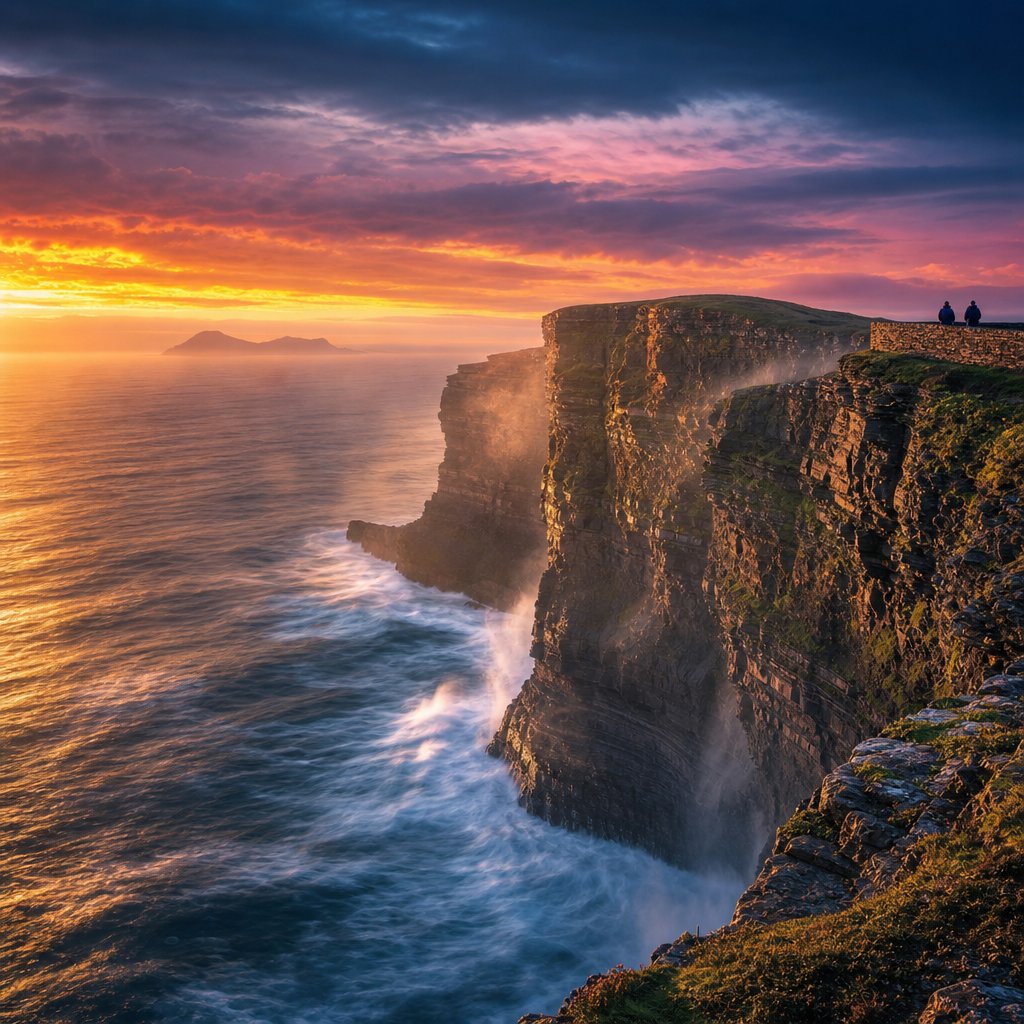
Loch Léin, the lake at Killarney where Coimín opens the lay, is reachable on foot from Ross Castle. The Cliffs of Moher, twenty minutes north of Doolin, supply the literal westward gaze the medieval texts describe. Dunquin Pier on the Dingle Peninsula gives the same horizon at a more intimate scale. The Aran Islands — Inis Mór, Inis Meáin, Inis Oírr — were folk-mapped as way-stations in several local oral traditions recorded by the Irish Folklore Commission in the 1930s. None of these places is the Otherworld. All of them are places from which the Otherworld was imagined.
Visitor Ethics on Folkloric Ground
A note on practice: the Cliffs of Moher operate under a managed visitor scheme through Clare County Council that requires a parking fee and asks visitors to remain on marked paths; the cliff edge collapses periodically and is not a place for romantic ledge photography. The Aran Islands have working communities and Irish-speaking households whose privacy outranks any pilgrim’s wish for atmosphere. The local guides who name themselves, who know which fields the cattle are in this morning, and who carry the place names in correct pronunciation are the right entry point for any serious visit.
Where the Evidence and the Legend Diverge
Where the consensus and the evidence diverge: popular accounts present Tír na nÓg as a pan-Celtic concept stretching unbroken from the Iron Age, but the literary record argues against that age and that continuity. The name Tír na nÓg itself first appears in surviving Irish texts late — Coimín’s 1750 poem is the earliest substantial witness — although the underlying Otherworld geography is medieval [1][2][3]. The 1750 date is not a debunking; it is a clarification.
As of May 2026, the academic consensus, summarised in Mark Williams’s Ireland’s Immortals (Princeton, 2016) and in John Carey’s A Single Ray of the Sun: Religious Speculation in Early Ireland (Celtic Studies Publications, 1999), treats Tír na nÓg as a late codification of a much older paradise-island complex rather than as a freestanding ancient deity-realm. The current scholarly reading respects both the medieval depth and the late literary moment that gave us the name we now use.
What the Legend Survives For
What the site teaches: Tír na nÓg endures because it offers a precise emotional figure — the irrecoverable past as a real place rather than as a state of mind. The Oisín who dismounts at Gleann na Smól and ages three hundred years in a single breath is every reader who has tried to walk back into a childhood landscape and found it under new ownership. The medieval scribes who copied the Otherworld voyages and the County Clare poet who fused them into a single lay were preserving a way to talk about that experience without losing its weight.
Frequently Asked Questions
What does Tír na nÓg mean in Irish?
Tír na nÓg is Old Irish for “Land of the Young” or “Land of Youth.” The phrase identifies an Otherworld island in Irish mythology where time runs more slowly than in the mortal world and where its inhabitants remain perpetually young. Modern Irish pronunciation approximates “cheer na nogue.”
Is Tír na nÓg a real place?
No. Tír na nÓg is a literary and mythological location, not an archaeological site. The medieval texts place it westward of Ireland across the Atlantic, beyond the visible horizon, but no fixed coordinates are given in any source. Modern tourism attaches the legend to viewpoints like the Cliffs of Moher and the Aran Islands as imaginative anchors, not historical sites.
Who wrote the story of Oisín and Niamh?
The standard text is Laoi Oisín ar Thír na nÓg (“The Lay of Oisín in the Land of Youth”), composed around 1750 by Micheál Coimín, a County Clare poet who lived from about 1688 to 1760. Brian O’Looney’s 1859 prose translation, published in the Transactions of the Ossianic Society, brought the poem to a wider English-reading audience and inspired W. B. Yeats’s The Wanderings of Oisin (1889).
How long did Oisín spend in Tír na nÓg?
Three hundred years in human reckoning, although Oisín himself believed he had been there only three years. The asymmetry between Otherworld time and Irish time is the central narrative engine of the lay and the reason Oisín’s return is so swiftly catastrophic.
Is Tír na nÓg the same as the Celtic Otherworld?
It is one name among several. The medieval Irish Otherworld carries many regional designations — Mag Mell, Tír Tairngire, Tír fo Thuinn, Emain Ablach, Tír na mBan — that overlap in attributes but differ in literary context. Tír na nÓg became the dominant popular name only after Coimín’s 1750 lay and the nineteenth-century literary revival.
Who are the Tuatha Dé Danann?
The Tuatha Dé Danann are the gods and divine ancestors of pre-Christian Ireland as preserved in medieval texts like the Lebor Gabála Érenn (“Book of the Taking of Ireland”). After their mythological defeat by the Milesians they were said to have retreated into the sídhe (fairy mounds) and the Otherworld, including Tír na nÓg, where they continue to feast and rule.
What is the connection between Tír na nÓg and Avalon?
Both are western paradise islands in Celtic literary tradition. Emain Ablach (“Isle of Apple Trees”), one of the Irish Otherworld names, is widely understood to share an etymological and thematic root with the Arthurian Avalon, where Arthur is taken to be healed. The two traditions developed in parallel from a shared paradise-island complex rather than from direct borrowing.
How is Tír na nÓg pronounced?
In modern Irish, approximately “TEER na NOAG,” with the ó pronounced like the o in “boat” and the g lightly aspirated. Regional variations exist; Munster Irish, the dialect of Coimín’s County Clare, tends to stress the second word more lightly than Connacht or Ulster speakers.
What did W. B. Yeats do with the Oisín story?
Yeats expanded Coimín’s lay into a three-book narrative poem, The Wanderings of Oisin, published in 1889 as the title piece of his first major collection. He used Brian O’Looney’s 1859 translation as his primary source and reframed the lay’s grief into a meditation on Irish cultural memory and the costs of modern progress.
Are there other Celtic lands of eternal youth?
Welsh tradition preserves Annwn, a paradisal otherworld in the Mabinogion, and the island of Gwales in the second branch where Bran’s companions feast for eighty unaging years. Breton tradition keeps the Île d’Avalon motif. Scottish Gaelic shares the underlying voyage-tale structure through cognate stories of Oisin and the Land of Youth.