
By Wren Ashby · Published June 16, 2026 · Updated September 2, 2026
Whale migrations are growing less predictable: gray, right, and sperm whales increasingly leave long-established routes, arrive off schedule, or strand far outside their range. Researchers link these shifts to warming seas, collapsing prey, and possible disruption of the animals’ magnetic navigation, though no single cause explains every case.
I have spent field seasons in five oceans watching animals do the thing the textbook says they will not do, and a whale migration looks like clockwork until the clock slips. Over the last fifteen years that slippage has become the story, which places these animals squarely inside the wider study of animal anomaly mysteries. The routes are not breaking at random. They are tracking something, and the work is to read what.
Published: 2026-06-05. Last reviewed: 2026-06-05.
What Counts as an Unpredictable Whale Migration
A gray whale (Eschrichtius robustus) normally swims a roughly 10,000-mile round trip each year between Arctic feeding grounds and the warm lagoons of Baja California, one of the longest migrations of any mammal on record. A migration earns the word “unpredictable” when that round trip stops behaving like a round trip.
Migration is predictable because it is both learned and inherited. Gray whales hug the coastline; according to NOAA Fisheries, humpback whales (Megaptera novaeangliae) cross open ocean, and calves learn the corridor by swimming it beside their mothers. From a field biologist’s chair, “unpredictable” takes four measurable shapes: a route abandoned, a schedule missed, an animal resident where it should be migratory, and an animal stranded far outside its range. The Pacific Coast Feeding Group, around 230 gray whales that feed off Oregon every summer instead of pushing north to the Chukchi Sea, shows that even “resident” and “migratory” are not fixed labels. The mothers teach the shortcut; the calves keep it as vertical cultural knowledge. One tagged western gray whale, tracked by the Marine Mammal Institute at Oregon State University, logged 13,988 miles in 172 days, proof that the outer edge of “normal” is wider than any single map.
The Gray Whale Unusual Mortality Event, 2019 to 2023
The eastern North Pacific gray whale population fell roughly 45 percent during an Unusual Mortality Event that NOAA Fisheries ran from December 2018 through November 2023, dropping from about 20,500 animals in 2019 to 14,526 by 2023.
This was not a navigation failure. It was a fuel failure. Necropsies on stranded animals pointed repeatedly to malnutrition, and the UME investigative team traced the cause to localized ecosystem change in the northern Bering and Chukchi seas, where the amphipods these whales rely on had thinned out. On the migratory record: the animals still ran the route, but the route no longer paid. Calf production collapsed alongside the adults, falling from about 950 calves in 2018 to roughly 217 in 2022. The signal has not reversed. Only about 85 calves passed Central California in early 2025, the lowest tally since counts began in 1994, and the winter 2025 abundance estimate of near 13,000 whales is the lowest since the 1970s. The Unusual Mortality Event closed on paper in 2023, yet the population it described is still shrinking.
When Whales Turn Up Where They Shouldn’t
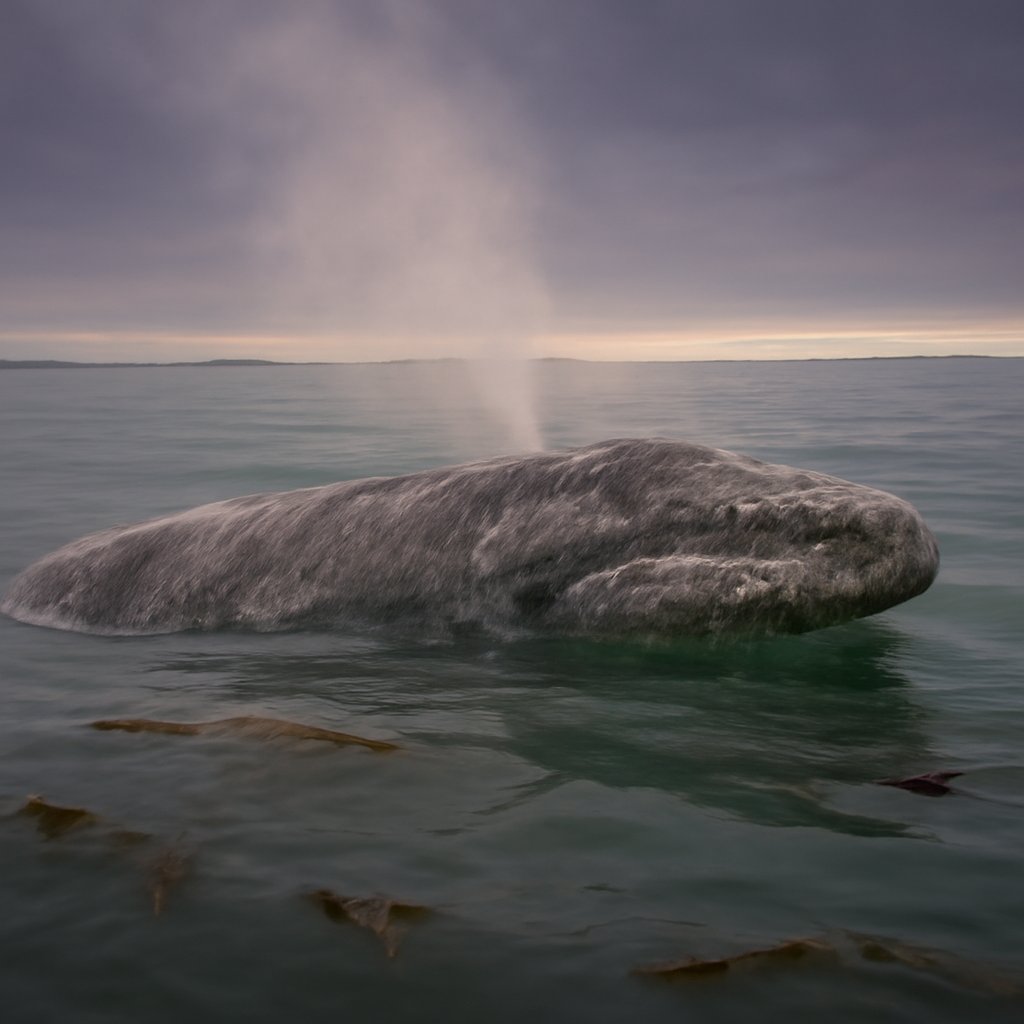
A gray whale photographed off the coast of Turkey on 8 May 2010 was re-identified off Spain three weeks later, the first confirmed record of the species anywhere in the North Atlantic since the eighteenth century. Out-of-range whales are the most legible anomaly a biologist can document, because the animal is simply somewhere it has no business being.
The cases have stacked up. In May 2013 the Namibian Dolphin Project confirmed a gray whale off Walvis Bay, the first record of the species in the Southern Hemisphere. In 2021 an emaciated juvenile nicknamed Wally wandered from Morocco to Italy across the Mediterranean. Per the IUCN classification, the eastern North Pacific gray whale is listed as Least Concern while the western Pacific population remains Endangered, so these strays are not a population in collapse so much as individuals testing reopened ground as Arctic sea ice retreats. Sperm whales (Physeter macrocephalus) and North Atlantic right whales (Eubalaena glacialis) have produced their own displacements, summarized below.
| Species | When | Where it appeared | Why it mattered |
|---|---|---|---|
| Gray whale | May 2010 | Mediterranean (Turkey to Spain) | First North Atlantic record since the 1700s |
| Gray whale | May 2013 | Walvis Bay, Namibia | First record in the Southern Hemisphere |
| Gray whale (“Wally”) | 2021 | Morocco to Italy | Emaciated juvenile lost in the Mediterranean |
| Sperm whale | Early 2016 | North Sea | 29 animals stranded after two solar storms |
| N. Atlantic right whale | Since 2015 | Gulf of St. Lawrence | Mass shift from the Bay of Fundy as prey moved |
Reading the Compass, and How It Fails
A 2020 Duke University study of 186 live gray whale strandings found the animals beached far more often on days of high solar radio-frequency noise, when a whale was 4.3 times as likely to strand as on a magnetically quiet day. The finding put a long-suspected sense, magnetoreception, near the center of the stranding question.
Many migratory animals are thought to read Earth’s magnetic field, and biologists have hunted for the cellular receptor in cetaceans for decades. The Duke team, led by sensory ecologist Jesse Granger, found that sunspot-heavy days more than doubled the odds of a stranding. On the math: the effect tracked the radio-frequency noise that can jam a magnetic sensor, not large swings in the field itself, which suggests the whales were being blinded rather than misdirected. A separate team reached a compatible conclusion from a different species. Klaus Vanselow and colleagues tied the early-2016 stranding of 29 sperm whales in the shallow North Sea to two December solar storms that briefly shifted apparent magnetic latitude by up to 460 km, roughly several days of swimming for an animal that covers about 100 km a day. The honest caveat: these are correlations, and magnetoreception in whales is not yet confirmed at the level of a verified receptor cell.
Warming Water, Moving Food
North Atlantic right whales abandoned their traditional Bay of Fundy feeding grounds for the Gulf of St. Lawrence after about 2010, following their copepod prey north as the Gulf of Maine warmed faster than almost any water body on the planet. The prey hypothesis is the best-supported explanation for unpredictable whale migration, and the right whale is its clearest case.
The mechanism is specific. The lipid-rich copepod Calanus finmarchicus declined in the warming Gulf of Maine, and the whales shifted toward the Gulf of St. Lawrence, where they began feeding more heavily on the Arctic copepod Calanus hyperboreus. The move carried a cost. The Gulf of St. Lawrence had few protections against ship strikes and fishing-gear entanglement, and right whale deaths there spiked to unprecedented numbers after 2017, a hard problem for a species with fewer than 400 individuals left. The gray whale dieoff in the Arctic and the right whale relocation in the Atlantic are the same sentence in two oceans: when the food moves, the migration moves, and the animal pays the difference in body condition or in lives. This is the explanation a biologist reaches for first because it is the one the data keeps confirming.
What the Anomalies Are Actually Measuring
Unpredictable whale migration is not one phenomenon but several stacked together, and the strongest evidence points less to the whales failing than to the ocean reorganizing underneath them. Three threads run through the cases, and they are not mutually exclusive.
The first thread is prey, and it is the sturdiest: warming water moves the copepods and amphipods, and the whales follow or starve. The second is navigation, where solar activity may briefly scramble a magnetic sense we still cannot fully describe. The third is range, where a few gray whales nosing into the Atlantic and Mediterranean may be early scouts of recolonization as the Northwest Passage opens for longer each summer. A pod does not strand at the coordinates a human map predicts; the matriarch turned at a coordinate the field has not finished charting. That is the courtesy the animals are owed here, accurate observation before any tidy conclusion. The migrations are not malfunctioning. They are instruments, and right now they are reading a fast-changing sea. These cases sit alongside other unexplained animal migrations in the same investigative file, and the reading is not finished.
Frequently Asked Questions
Why are whale migration patterns becoming unpredictable?
The leading driver is prey. As oceans warm, the copepods and amphipods whales depend on shift location and abundance, so the whales change route, timing, or feeding ground to follow. Disrupted magnetic navigation and range expansion into newly accessible waters are secondary contributors.
How far do gray whales normally migrate?
Gray whales travel about 10,000 miles round trip each year between Arctic feeding grounds and the breeding lagoons of Baja California. One tracked individual covered 13,988 miles in 172 days, the longest migration ever documented for a mammal.
What was the 2019 to 2023 gray whale Unusual Mortality Event?
It was a NOAA-declared die-off in which the eastern North Pacific gray whale population fell roughly 45 percent, from about 20,500 animals to 14,526. Necropsies pointed to malnutrition caused by reduced prey in the northern Bering and Chukchi seas.
Do solar storms really cause whales to strand?
A 2020 Duke University study found gray whales stranded 4.3 times more often on days of high solar radio-frequency noise, and a 2018 study linked 29 sperm whale strandings in the North Sea to solar storms. The link is statistical, not proven cause, and points to interference with magnetic sensing rather than a distorted magnetic field.
Why did North Atlantic right whales move to the Gulf of St. Lawrence?
Their main prey, the copepod Calanus finmarchicus, declined in the warming Gulf of Maine after about 2010. The whales followed remaining prey north into the Gulf of St. Lawrence, an area with little ship-strike or entanglement protection, where deaths then rose sharply.
What is magnetoreception in whales?
Magnetoreception is the proposed ability to sense Earth’s magnetic field for navigation. Many migratory species appear to use it, but in whales no specific receptor cell has been confirmed, so it remains a strongly supported hypothesis rather than settled fact.
What is the Pacific Coast Feeding Group?
It is a group of around 230 gray whales that end their northbound migration early to feed along the coast from northern California to southeast Alaska, rather than continuing to the Arctic. They tend to be smaller than the main population and pass the habit to their calves.
Are gray whales appearing in the Atlantic a sign of recovery or trouble?
Probably both. Out-of-range individuals like the 2010 Mediterranean whale and the 2021 stray “Wally” were often emaciated and lost, but their presence also suggests gray whales can again reach the Atlantic as Arctic ice retreats, hinting at slow recolonization of a range they lost centuries ago.
How many North Atlantic right whales are left?
Fewer than 400 individuals remain, making it one of the most endangered large whales on Earth. Its recent shift into the Gulf of St. Lawrence has increased exposure to ship strikes and fishing-gear entanglement.
Can climate change alone explain shifting whale migrations?
Climate-driven prey shifts explain most documented cases, including the right whale relocation and the gray whale die-off. But solar-linked strandings and individual range-testing show that navigation and exploration also play roles, so no single cause fits every anomaly.