By Emilia Wellesley · Published May 6, 2026 · Updated May 13, 2026
Last reviewed: May 6, 2026.
The Eruption and the Civilization Are Not the Same Story
The Minoan civilization of Bronze Age Crete did not vanish in a single afternoon when the volcanic island of Thera blew itself apart around the late seventeenth or sixteenth century BCE. The eruption was a generational catastrophe, and its tsunamis reached the northern Cretan coast within hours, but the palaces of Knossos, Phaistos, Malia, and Zakros went on being inhabited and rebuilt afterward. The end of Neopalatial Crete, the destruction horizon now labelled Late Minoan IB, came one or two generations later, and its causes are not the same as the causes of the eruption.
Two events, related but separable: the volcano, and the collapse. Telling them apart is the first thing this account asks the reader to do. What follows traces the original 1939 hypothesis, the long argument over its dating, and the careful reasoning by which a once-tidy story of a civilization drowned by a sea-wave has been replaced by something stranger, slower, and more honest within the broader history of historical and archaeological mysteries.
Marinatos’s 1939 Hypothesis and Its Slow Reception
In 1939, the Greek archaeologist Spyridon Marinatos (1901-1974) published a short article in the British journal Antiquity titled “The Volcanic Destruction of Minoan Crete.” Marinatos had been excavating at Amnisos on the north coast of Crete and had found, packed into the floor levels of a Late Minoan villa, a layer of waterworn volcanic pumice. He argued that the pumice could only have arrived there by sea, that the sea had to have been a tsunami, and that the tsunami had to have been generated by the eruption of Thera roughly 110 kilometres to the north. From this he drew the larger conclusion: that Minoan civilization itself had been destroyed by the eruption (Britannica, “Spyridon Marinatos”) [1].
The reception was cool. The editors of Antiquity appended a postscript noting that the evidence as presented was insufficient to support the destruction claim, and most working excavators on Crete saw little to recommend it. The hypothesis attracted few adherents until the early 1960s, when Nikolaos Platon’s excavations at the eastern Cretan palace of Zakros began to suggest that the LMIB destructions might require a single, dramatic cause. Marinatos returned to the question in the field rather than the archive: in 1967 he opened a trench at Akrotiri on Thera itself and within hours had struck the wall of a Bronze Age building preserved beneath metres of pumice and ash. He worked the site until his death there on 1 October 1974, killed by a fall in one of the trenches he had opened ([Akrotiri Museum, “Excavations of Akrotiri”](https://akrotiri-museum.com/excavations-of-akrotiri/)) [2].
Akrotiri: The Bronze Age Town Beneath the Ash
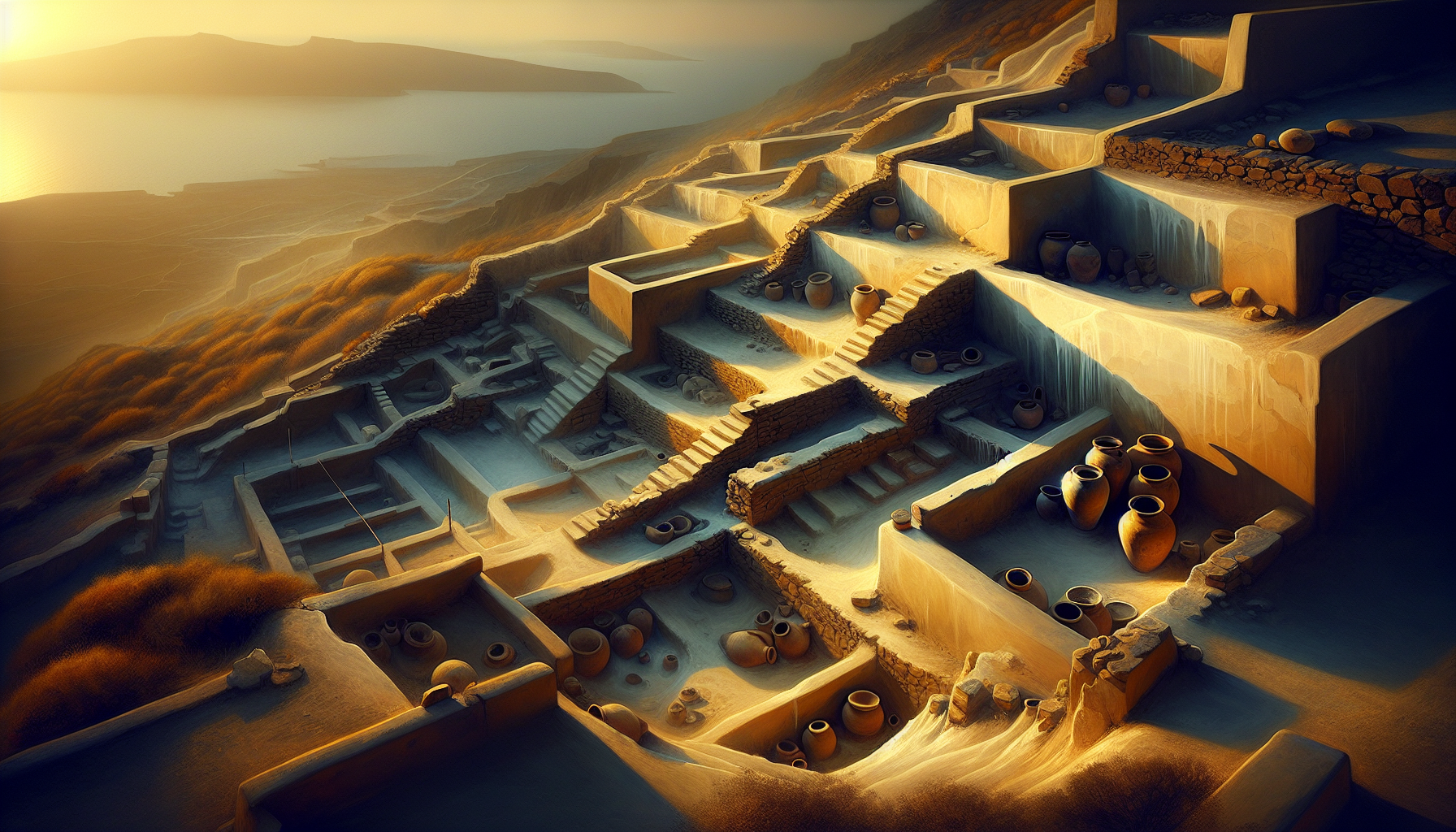
Akrotiri is the kind of site that rearranges a discipline. Buried under several metres of tephra during the Theran eruption, the town survived almost intact: multi-storey houses with their plastered walls, terracotta storage jars still stacked along their interior corridors, painted frescoes preserved in colours that have not been seen on most contemporary sites because the contemporary sites were not entombed. A handful of objects survive in such fine condition that conservators handle them more carefully than their excavators ever needed to.
After Marinatos’s death in 1974, the excavation passed to Christos Doumas, a Cycladic specialist and former Director of Antiquities at the Hellenic Ministry of Culture, who has run Akrotiri continuously since 1975. Doumas’s tenure has been characterized by deliberate restraint: rather than expand the trenches, he concentrated on conservation, on integrating the site under a permanent shelter, and on publishing the existing material at the leisurely pace such material deserves. Akrotiri presents a small archaeological puzzle in itself. Its inscriptions are in Linear A and its frescoes are stylistically Minoan, yet the island was Cycladic in cultural geography, suggesting either heavy Minoan influence or a population that thought of itself as a Cretan periphery (Britannica, “Thera”) [3].
One detail stands out. No human skeletons have been found at Akrotiri, and only a single gold object has been recovered. The town appears to have been evacuated before the final phase of the eruption, the inhabitants taking what they valued and leaving. They had warning: the Theran eruption began with a precursor phase, sometimes weeks of seismic activity and minor ash falls, before the catastrophic outburst that buried the site. Whether they reached safety on Crete or perished in the open sea, the record does not say.
Floyd McCoy and the Tsunami Mechanics
The volcanological case for tsunami damage on Crete has been built largely by Floyd McCoy of the University of Hawaii, working from the eruption’s mechanics rather than its archaeology. McCoy and his collaborators have argued that the Theran eruption was rated VEI 7, expelling between 28 and 41 cubic kilometres of dense-rock equivalent magma in four distinct phases, with eruption columns reaching 30 to 35 kilometres into the stratosphere. Each phase had the potential to displace seawater. McCoy’s modelling places the most severe wave-trains on the northern coast of Crete at heights between 12 and, at coastal pinch-points, perhaps as much as 28 metres, with run-up distances of 250 to 450 metres inland (Springer, Natural Hazards, on the great Minoan eruption tsunami) [4].
Tsunami deposits matching this profile have been recovered from several northern Cretan sites since 2000, including a sealed deposit at Malia published in Scientific Reports in 2021, and a 2021 PNAS paper documenting Theran tsunami debris and a single victim’s skeleton at Çeşme-Bağlararası on the Anatolian coast. The deposits do not show one wave but four, hitting in succession over days or weeks — which fits McCoy’s phased eruption model and rules out a single giant pulse. Scott MacGillivray, the Canadian archaeologist who excavated the eastern Cretan town of Palaikastro under the British School at Athens, has independently documented tsunami debris in coastal Palaikastro contexts, including a marine layer that runs through several houses near the shoreline.
The Dating Disagreement Has Not Closed
When the eruption happened is still under negotiation, and the disagreement is not a small one. Two methods of dating give answers roughly a hundred years apart. Radiocarbon dating, refined by Christopher Bronk Ramsey at Oxford and Sturt Manning at Cornell, places the eruption in the late seventeenth or early sixteenth century BCE. A 2018 paper in Science Advances by Charlotte Pearson and colleagues, using annual tree-ring sequences, narrowed the most probable date to the window 1619-1596 BCE, with a secondary possibility around 1576-1545 BCE [5].
Egyptian historical chronology, anchored to king-lists and synchronisms with datable objects exchanged across the eastern Mediterranean, places the eruption later. Theran pumice in datable Egyptian Eighteenth Dynasty contexts, and the absence of unambiguous Theran ash before the reign of Ahmose I (c. 1550-1525 BCE), suggest a date for the eruption no earlier than about 1550 BCE and possibly as late as 1500 BCE. The two methods have been in disagreement for nearly forty years, and the gap has not closed in either direction. A modest narrowing came from the 2020 Manning et al. paper in Scientific Reports on regional radiocarbon offsets, which showed that the calibration curve for the eastern Mediterranean differs slightly from the international curve, and that this offset pulls the radiocarbon date a few decades later — but not far enough to reconcile the two systems.
The honest position is that nobody knows yet. A working dating of the eruption “in the late seventeenth to mid sixteenth century BCE” covers both methods without privileging either. What this means in practice is that the eruption’s relationship to identifiable Egyptian pharaohs, and to historical events on the Levantine coast, remains under-determined. The argument matters, because synchronisms across the eastern Mediterranean depend on it.
The LMIB Destruction Horizon: A Slower, Stranger Collapse
The Theran eruption occurred during the Late Minoan IA period on Crete. The end of Neopalatial Cretan civilization, by contrast, occurred at the close of LMIB, perhaps fifty to a hundred and fifty years later depending on which dating system is accepted. Recent work, summarized by Cynthia W. Shelmerdine in her edited Cambridge Companion to the Aegean Bronze Age (2008), treats the LMIB destruction horizon not as a single moment but as a generation or more of unsettled time, with successive burnings and lootings spread perhaps over twenty-five to forty years [6].
Three causes are typically named, and the current consensus is that they overlap rather than compete. First, the cumulative damage from the eruption itself: ash falls that reduced agricultural yields for years, tsunami-flooded coastal land, the loss of the island of Thera as a Minoan trading partner, and the disruption of the trans-Aegean networks Cretan elites had relied on. Second, internal pressures: economic strain on a palace economy that depended on continuous redistribution, and signs of unrest in the partial absence of central authority during the recovery period. Third, the arrival of the Mycenaeans, the Greek-speaking mainland power whose material signature begins to appear at Knossos in the LMII period and whose Linear B tablets, written in early Greek, replace Linear A as the administrative script of the island after about 1450 BCE.
A 2008 strontium isotope study of human remains at LMIB destruction sites in Journal of Archaeological Science argued that the immediate destroyers of the palaces were not Mycenaean newcomers but local actors, since the strontium signatures match the Cretan baseline rather than a mainland one. The Mycenaean takeover of Knossos appears to have followed the destructions rather than caused them. The eruption created the conditions; a slow internal failure delivered the blow; the Mycenaeans arrived to administer what was left.
The Atlantis Question
The identification of Plato’s Atlantis with the Theran eruption is older than the modern excavation of Akrotiri. The earliest formulation belongs to the late nineteenth century, but the proposal that achieved popular reach came from the Greek seismologist Angelos Galanopoulos (1910-2001) and the British journalist Edward Bacon, whose 1969 book Atlantis: The Truth Behind the Legend argued that Plato’s account was an inherited Egyptian memory of the Theran catastrophe, with Plato’s numerical exaggerations explained by a tenfold scribal error. Marinatos himself flirted with the connection in the 1960s, and the idea has retained popular momentum despite scholarly disinterest.
Specialists today treat the Atlantis identification as a curiosity rather than a working hypothesis. Plato’s Timaeus and Critias place Atlantis west of the Pillars of Heracles and date its destruction roughly 9,000 years before Solon, neither of which fits Thera under any reasonable adjustment. The dating disagreement above already strains historical credibility; a tenfold scribal correction across multiple independent figures is too convenient. What survives of the link is interpretive rather than evidential: Plato may have heard, indirectly, of an Aegean catastrophe vivid enough to enter Egyptian temple archives and emerge centuries later as a parable. The bridge from that possibility to a recoverable historical kernel is not solid enough to walk on.
What the Sea Took, and What It Did Not
The most accurate sentence about the Minoan collapse is not the dramatic one. It is the careful one: an eruption damaged a civilization that was already complicated, and the damage took two or three generations to work through the system. The volcanological story is loud and the collapse story is quiet, and the two have been confused for nearly a century because the loud one is easier to tell. Akrotiri sits in its volcanic wrap as a town frozen mid-evacuation. Knossos sits as a palace burned, looted, partly rebuilt, and finally administered by a foreign hand. They are not the same kind of evidence and they do not answer the same kind of question.
The work that remains is, as it has been since 1939, the work of pulling apart causes that look continuous and have to be told apart by careful counting. The radiocarbon date will probably win on a technicality the king-lists cannot match. The LMIB horizon will probably continue to defy any single name. And the sea will continue to deliver, every few years, another deposit on a coast we did not know to look at — pumice in a foundation, a bone in a layer of marine sand, a fresco fragment that completes a face. The civilization was not lost to the sea. It was wounded by the sea, weathered the wound, and was lost, slowly, to the difficulty of being itself.
Frequently Asked Questions
Did the Thera eruption destroy Minoan civilization?
Not directly. The eruption, which occurred during Late Minoan IA, caused severe damage on Crete through tsunamis and ash fall, but the Minoan palaces were rebuilt afterward and the civilization persisted. The end of Neopalatial Crete, the LMIB destruction horizon, occurred fifty to a hundred and fifty years later from a combination of long-term economic strain, internal unrest, and eventual Mycenaean intrusion.
When did the Thera eruption happen?
The date is contested. Radiocarbon and tree-ring evidence place it in the window 1619-1545 BCE, with most probability concentrated around 1600 BCE. Egyptian archaeological synchronisms suggest a later date around 1550-1500 BCE. The two methods have not been reconciled, and a working date of “late seventeenth to mid sixteenth century BCE” covers both.
What is the LMIB destruction horizon?
LMIB, the late phase of Late Minoan I, is the archaeological period in which the Cretan palaces other than Knossos were destroyed by burning and looting. The destructions appear to have been spread over a generation or more of unsettled time rather than concentrated in a single event, and the immediate causes were probably internal Cretan rather than the eruption itself or Mycenaean conquest.
Who excavated Akrotiri?
Spyridon Marinatos opened the modern excavation in 1967 and worked the site until his death there in 1974. Christos Doumas, a Cycladic specialist and former Director of Antiquities, has directed the excavation continuously since 1975, focusing on conservation and publication rather than expansion of the trenches.
How tall were the tsunamis on Crete?
Floyd McCoy and collaborators have modelled wave heights on northern Crete between 12 and roughly 28 metres at coastal pinch-points, with inland run-up of 250 to 450 metres. The eruption produced four distinct wave-trains over days or weeks rather than one large wave, which matches the four-phase mechanics of the eruption itself.
Was Akrotiri the same as Atlantis?
Specialists do not endorse the identification. Angelos Galanopoulos and Edward Bacon proposed in 1969 that Plato’s Atlantis preserved an Egyptian memory of the Theran eruption, but Plato’s geography, his stated date, and the scale of his account do not match Thera or Crete without strained corrections. The link, if any, is at best literary rather than historical.
Were people killed at Akrotiri?
No human remains have been found at Akrotiri, and only a single gold object has been recovered. The town appears to have been evacuated before the final eruption phase, with inhabitants leaving in advance after warning seismic activity. Whether they reached Crete or were lost at sea is unknown.
What replaced Linear A on Crete?
After about 1450 BCE, Linear B replaced Linear A as the administrative script at Knossos. Linear B records an early form of Greek, and its appearance is taken as the clearest material signature of Mycenaean political control over the island in the period following the LMIB destructions.
Why does the dating dispute matter?
Synchronisms across the Bronze Age eastern Mediterranean depend on placing Theran ash and pumice in datable contexts. A century-long shift in the eruption’s date pulls every linked event with it, including the relative chronology of Egyptian Eighteenth Dynasty pharaohs, Levantine Middle Bronze Age sites, and Hittite-Egyptian diplomatic exchanges. The argument is not parochial; it touches the spine of the regional chronology.
What does Akrotiri preserve that Crete does not?
Volcanic burial preserved Akrotiri’s organic materials, plaster surfaces, and three-storey building heights to a degree that no surviving Cretan site can match. The frescoes, jar storage, drainage systems, and intact upper floors give a level of architectural and decorative detail that fills in what Cretan palace ruins, eroded over millennia, cannot.