
By EsoVitae Editorial · Published
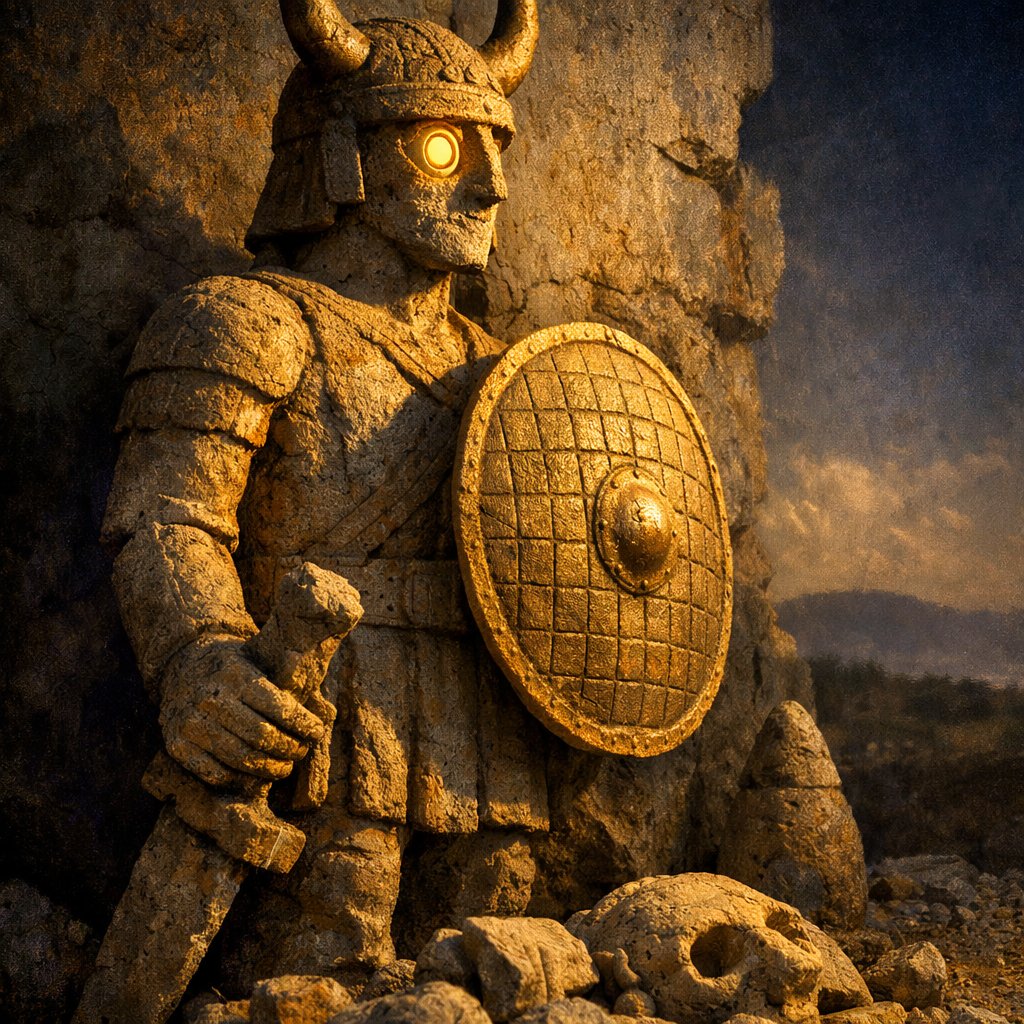
Drafted with AI assistance from the sources listed; images are AI-generated illustrations. How EsoVitae is made
What Are the Giants of Mont’e Prama?
The Giants of Mont’e Prama are a group of large stone statues carved by the Nuragic civilization of Sardinia, dated by most scholars to the late ninth through early eighth centuries BCE. They were unearthed in fragments at a necropolis on the Sinis peninsula near Cabras, in central-western Sardinia, beginning in 1974. The reconstructed figures depict archers, boxers, and warriors, and they remain the earliest known monumental anthropomorphic sculpture of the western Mediterranean.
The artifacts arrived in the modern record almost by accident. A farmer named Sisinnio Poddi was clearing a stony field on the Sinis peninsula in March 1974 when his plough struck a roughly carved sandstone head [1]. Within months, archaeologists had recovered thousands of fragments from the topsoil. The figures sit awkwardly in the standard chronology of European art: they predate Greek monumental sculpture in the Archaic style by roughly a century, they emerge from an island culture better known for its thousands of stone towers, called nuraghi, than for human-scale carving, and they were broken in antiquity for reasons that remain unsettled. This account follows the surviving evidence within the broader landscape of historical and archaeological mysteries and names the interpretive frames where they remain open.
The Discovery and Excavation Sequence
The Mont’e Prama site lies a few kilometers inland from the Gulf of Oristano, on a low ridge above an ancient salt lagoon. Poddi’s 1974 ploughing exposed the first head; that summer the local Soprintendenza archeologica per le province di Cagliari e Oristano opened a systematic survey, and a sequence of campaigns followed across four decades. The statues were never recovered intact. They came up as a rubble field, and every reconstruction has had to argue from broken stone.
1974 to 1979: The Initial Campaigns
Between 1975 and 1979, four field seasons led by Giovanni Lilliu (1914-2012), Alessandro Bedini, and Carlo Tronchetti yielded more than five thousand sandstone fragments and the foundations of a tomb row [2]. The archaeologists also recovered model nuraghi, conical sandstone bases interpreted as betyls, and a shallow burial layout of slab-lined cists running parallel to the ridge. Lilliu, then the senior figure in Nuragic studies, dated the deposit stratigraphically to the early Iron Age and argued that the sculpted figures belonged to the same iconographic family as the Nuragic bronzetti, the small bronze figurines attested across Sardinian sanctuaries. The methodological care of those early seasons is preserved in the reports archived by the Antiquity journal and by the regional Soprintendenza, whose field documentation forms the chronological backbone of every later study.
The Long Pause and the 2014 Return
After 1979 the fragments entered storage at the Museo Archeologico Nazionale in Cagliari and dropped out of public view for nearly thirty years, on conservation grounds and against political questions about island identity that successive administrations preferred not to amplify. A second wave of excavation, led by Alessandro Usai under the same Soprintendenza, ran from 2014 onward and uncovered additional statues and tomb features in a previously unexplored sector [3]. The newer finds allowed a substantial revision of the original reconstructions, and restored figures now stand on permanent display at the Museo Civico Giovanni Marongiu in Cabras and the Museo Archeologico Nazionale di Cagliari.
The Statues Themselves: Form, Iconography, and Type
The reconstructed corpus comprises roughly thirty-eight to forty figures, depending on how scholars count fragmentary individuals, with heights commonly cited between two meters and two and a half meters. Carved from the local Sinis sandstone, they share a strict frontal posture, geometric facial planes, and most arrestingly, a pair of incised concentric circles in place of pupils. Three principal types recur across the group, and the typology is now standard in the literature.
The Archers
Archers are the most numerous group in the surviving sample. Each figure raises a left arm forward, fitted with a long sleeve guard, and grips an arrow against a curved bow held vertically across the chest. The right hand draws back, and the head is helmeted with a horned cap whose form mirrors the bronzetti. The body proportions are stylized rather than naturalistic, with shoulders set square against the line of the bow.
The Warriors
Warriors, sometimes called shield-bearers, hold a round shield against the chest with the left arm and rest the right hand against the hip in a posture that reads as alert rather than active. The helmets again carry horns, and the chest plates show the geometric grid pattern recognizable from the small bronze warriors found in Nuragic sanctuary contexts.
The Boxers
Boxers form the rarest and most discussed type. Each wears a stiff guard wound around the left forearm, an arching shield arc rising above the head, and a short tunic. The protective glove is unique within Iron Age Mediterranean iconography and finds its closest parallels not in mainland Italy but in eastern Mediterranean ritual combat scenes. Mainstream Sardinian scholarship reads the boxers as ritual athletes rather than military fighters, drawing on the parallel bronze figurines that show identical equipment.
Dating the Giants: Iron Age Sardinia and the Bronzetti Connection
Dating monumental sculpture without organic remains is always indirect. For Mont’e Prama, the dating argument rests on three legs: stratigraphic context, iconographic comparison with the well-published Nuragic bronzetti, and a smaller body of associated finds, including pottery sherds and metallic items recovered from the tomb fills. Most scholars converge on a date range running from the eleventh to the eighth centuries BCE, with the cluster of evidence pointing toward the late ninth century [4].
The Bronzetti Parallel
The Nuragic bronzetti, small votive figurines of cast bronze deposited at sanctuaries across Sardinia, are dated by archaeological context and by analogy with mainland Italian Villanovan and Etruscan parallels, with a chronological range running from roughly the tenth century into the seventh century BCE. The shared iconographic vocabulary, in particular the horned helmets, the grid-pattern armor, and the boxer’s wrapped guard, ties the Mont’e Prama figures to the same cultural moment. The statues read, at scale, as the bronzetti enlarged into stone, a parallel discussed in catalog studies indexed at JSTOR.
Competing Chronologies
A minority position places the figures earlier, in the eleventh to tenth centuries BCE, reading them as funerary monuments to a heroic warrior class active when the great nuraghe sites were still inhabited. A second minority view dates the destruction rather than the creation to the later eighth or seventh century, when Phoenician colonial activity along the Sardinian coast intensified. The standard position, set out in the catalog of the joint Sapienza University and Cagliari restoration project, holds the late ninth century date and treats the destruction as a secondary, possibly intentional, episode [5].
The Necropolis: Whom Did the Giants Guard?
The statues did not stand in isolation. They were aligned in a row above a series of slab-lined tombs, each tomb roughly a meter deep, oriented along the ridge crest, and containing a single inhumation. Published estimates put the number of original burials between thirty and forty, a count that brushes intriguingly close to the count of statues. Whether each figure marked a specific grave remains an open question, and the fragmentary state of both burials and statue fragments in antiquity makes a one-to-one mapping difficult to confirm.
The cemetery suggests a community organized enough to commission and quarry the largest stone figures in the contemporary western Mediterranean. The tombs yielded modest grave goods, primarily ceramic vessels and a small number of metal ornaments, and the disproportion between simple burials and monumental markers is itself a datum. According to the heritage essay published by the Encyclopaedia Britannica on the Nuragic civilization, Mont’e Prama is the only Nuragic context in which monumental anthropomorphic sculpture has been recovered in association with a cemetery.
Why Were the Statues Broken?
Every published reconstruction begins from the same uncomfortable observation: the figures were smashed. Heads, torsos, and limbs were detached, the fragments piled across the tomb row in a manner inconsistent with natural collapse. Three reconstructions of this destruction now circulate in the literature, each fitting some of the evidence and none accounting for all of it.
Carthaginian or Phoenician Iconoclasm
The earliest published interpretation, advanced by Carlo Tronchetti and others, attributes the destruction to incoming Phoenician or Carthaginian settlers in the seventh or sixth century BCE [6]. In this reading, the statues were toppled to neutralize the religious power of an indigenous cult that competed with the new colonial order. Phoenician trading posts at Tharros and Othoca lie within walking distance of the Sinis peninsula, lending the argument historical plausibility. It struggles, however, to explain why some fragments show wear surfaces consistent with deliberate dressing of broken stone, suggesting a more curated dismantling.
Internal Ritual Decommissioning
A second interpretation reads the breakage as an internal Nuragic act of ritual closure, performed at the end of the cult phase associated with the cemetery. Comparable practices are well documented in eastern Mediterranean contexts, where votive statuary was buried in pits, often after deliberate damage, to remove its sacred status from circulation. This reading aligns with the careful piling of fragments above the tombs and with the absence of evidence for hostile incursion at the broader site level.
Slow Attrition and Repurposing
A third reading allows that some destruction was incidental, with later inhabitants dismantling the figures over centuries to reuse the workable sandstone in walls and field clearance. Some fragments do show modern plough damage. This reading does not preclude the others; it accepts that what survived was probably altered by several distinct events.
What the Giants Tell Us About Nuragic Sardinia
Before the Mont’e Prama discoveries, the Nuragic civilization was known almost entirely through architecture: the roughly seven thousand nuraghe towers, the giants’ tombs of slab construction, and modest votive bronzes. The figures complicate that picture. They show a society capable of monumental sculpture before either Etruscan or Greek artisans on the mainland, and a cult of warrior commemoration elaborate enough to require multiple statue types and a dedicated cemetery space. Their existence sits alongside metallurgical evidence of long-distance Nuragic trade with Cyprus and the Levant in the late Bronze and early Iron Ages [7], evidence summarized by the Metropolitan Museum of Art’s heritage essay on Sardinia in the prehistoric Mediterranean.
Open Questions That Remain
Several questions remain unresolved despite five decades of work. The total original number of statues is not fixed. The identity of the buried individuals is unknown, since no inscriptions survive and no DNA recovery program has been published. The function of the model nuraghi recovered alongside the figures, miniature replicas of the great towers, is debated between symbolic, cultic, and topographic readings. According to coverage in the Smithsonian Magazine archive, even the precise extent of the original cemetery has not been mapped.
Where to See the Giants Today
The Giants of Mont’e Prama are now divided between two principal venues in Sardinia. Visitors approaching the figures often note their unsettling visual register: the concentric-circle eyes read as both blind and watchful, an effect produced by strict frontality and the absence of modeling around the sockets.
- Museo Civico Giovanni Marongiu, Cabras: The municipal museum on the Sinis peninsula, near the discovery site, holds a major share of the reconstructed figures and a permanent exhibition on the necropolis. It opened its expanded Mont’e Prama gallery in 2014.
- Museo Archeologico Nazionale, Cagliari: The Sardinian regional archaeological museum displays additional figures and the original conservation laboratory materials, including documentary photographs from the 1974 to 1979 campaigns.
- The Mont’e Prama site itself: The original necropolis remains under archaeological protection. Public access is limited; ongoing excavations under the Soprintendenza continue to extend the known site boundaries.
Frequently Asked Questions
How tall are the Giants of Mont’e Prama?
Most reconstructed figures stand between two meters and two and a half meters tall. The variation reflects both the original heights of the different statue types, with warriors generally taller than archers, and the differing degrees of fragmentary preservation across the corpus.
How old are the Giants of Mont’e Prama?
The mainstream scholarly position dates the statues to the late ninth and early eighth centuries BCE, placing them in the early Iron Age of Sardinia and roughly a century before the rise of Greek Archaic monumental sculpture. A minority view dates them earlier, to the eleventh or tenth century BCE.
Who carved the Giants?
The statues are attributed to the Nuragic civilization, the indigenous Iron Age culture of Sardinia known for the nuraghe stone towers. No individual artisan or workshop has been identified, and the shared iconographic vocabulary with Nuragic bronze figurines suggests a coordinated cultural tradition rather than a single sculptor’s output.
Why are the eyes carved as concentric circles?
The concentric-circle eyes are a stylistic feature shared with several Mediterranean and Near Eastern Iron Age traditions, including Cypriot votive sculpture. Within Nuragic art, the device produces a hieratic, non-naturalistic gaze that distances the figures from the human realm. Whether it carries a specific religious meaning or marks a regional carving convention is debated.
Who discovered the Giants of Mont’e Prama?
A farmer named Sisinnio Poddi struck the first sandstone head with his plough in March 1974 while working a field on the Sinis peninsula. Formal excavation began under the Soprintendenza archeologica for Cagliari and Oristano shortly afterward; the principal field directors of the original campaigns were Giovanni Lilliu, Alessandro Bedini, and Carlo Tronchetti.
Why were the statues hidden in storage for so long?
After the 1974-1979 campaigns, the fragments entered the Museo Archeologico Nazionale in Cagliari for conservation. Reassembly of soft sandstone requires careful consolidation work, and the project lacked sustained funding for several decades. Public display only began in earnest in the late 2000s, with the major Cabras gallery opening in 2014.
How many Giants of Mont’e Prama have been found?
Current estimates put the reconstructed corpus between thirty-eight and forty figures, drawn from over five thousand individual fragments. The number is not closed; the 2014 and later excavations added previously unknown figures, and continuing work in unexcavated sectors may extend the catalog further.
What is a betyl, and why are betyls found at Mont’e Prama?
A betyl is an upright stone pillar, often conical, used as a sacred marker in Mediterranean and Near Eastern cult sites. The conical sandstone bases recovered alongside the Mont’e Prama statues are read as betyls and may have served as aniconic ritual markers within the cemetery.
Are the Giants connected to the Nuragic bronzetti?
Yes. The horned helmets, the round shields with grid-pattern armor, and the boxer’s wrapped forearm guard all recur in the small bronze figurines, called bronzetti, deposited at Nuragic sanctuaries across Sardinia. The Mont’e Prama figures read as the bronzetti scaled up into monumental stone.
Can the Giants of Mont’e Prama be visited?
Yes. The reconstructed figures are on permanent display at the Museo Civico Giovanni Marongiu in Cabras, on the Sinis peninsula near the discovery site, and at the Museo Archeologico Nazionale in Cagliari. The original necropolis remains under archaeological protection.
For deeper context across the historical and archaeological mysteries archive, consider The Tower of Babel: Historical Evidence and Indus Valley: Trade and Communication.