By Emilia Wellesley · Published May 7, 2026 · Updated September 10, 2026
Last updated: September 10, 2026.
How Was the Great Pyramid of Giza Actually Built?
The Great Pyramid of Giza was built in roughly 23 years for the Fourth Dynasty pharaoh Khufu, beginning around 2580 BCE and finished by his death around 2560 BCE. It contains an estimated 2.3 million dressed limestone and granite blocks averaging about 2.5 tonnes apiece, drawn from the local Mokattam limestone quarry, a finer Tura limestone casing quarry across the river, and the Aswan granite quarries some 800 kilometers to the south. The workforce was Egyptian: skilled, paid, fed on bread and beef, and housed in a planned pyramid-builders’ town just south of the plateau. The construction methodology rests on a quartet of primary evidence — the workers’ settlement, the Wadi al-Jarf logistics papyri, surviving tool marks, and the unfinished construction ramps and quarry cuts on Giza itself — and the conventional reading of that evidence is what the field has held, with refinements, since the 1990s.
There is no archaeological mystery about who built the pyramid. The mystery, in the proper sense, is the engineering puzzle of how a Fourth Dynasty building yard seated 2.3 million blocks across two and a half decades, with the upper courses landing within a few centimeters of true. The “lost civilization” and “alien construction” readings that recur in popular media survive on cultural fascination, not on the record left in the limestone and the papyri.
This guide reads the pyramid the way the Giza archaeologists have read it: from the workers’ bakeries up, through the construction model that evidence supports, and closing with the ScanPyramids muon-tomography results and Jean-Pierre Houdin’s internal-ramp hypothesis as the two live questions that genuinely remain open. Khufu’s pyramid sits at the head of the broader landscape of historical and archaeological mysteries, but as an engineering achievement, not as a riddle requiring extraordinary causes.
The Primary Evidence: What the Fourth Dynasty Left Behind
The reconstruction of how the Great Pyramid was built does not begin with theorizing. It begins with what the Egyptians themselves left in the ground. Four bodies of primary evidence, none of them speculative, anchor the modern picture: the Heit el-Ghurab workers’ town, the Wadi al-Jarf papyri, the tool-mark and quarry-cut record at Giza itself, and the comparative architectural sequence of the Fourth Dynasty pyramid program.
The Heit el-Ghurab Pyramid Builders’ Town
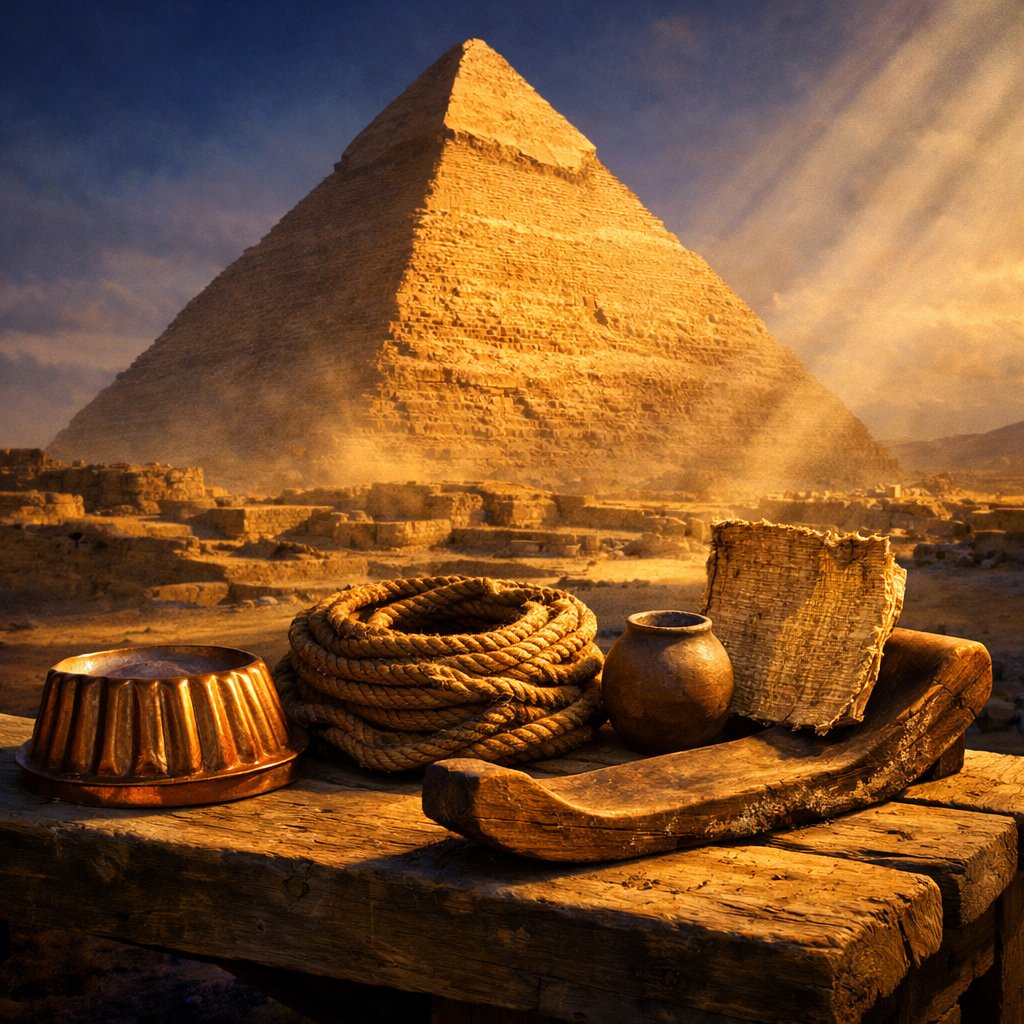
Roughly 400 meters south of the Sphinx lies a planned settlement covering about seven hectares, cleared from beneath a modern soccer field beginning in 1988. Mark Lehner, working with Zahi Hawass through the Ancient Egypt Research Associates project, has excavated the site continuously since 1990 [1]. The town is laid out as a single administrative organism: long galleries that probably housed rotating crews, a royal administrative building with mud sealings stamped from a state office, two large bakeries with copper-bottomed bread molds consistent with feeding several thousand workers daily, a fish-processing yard with cleaned and dried Nile perch, and a sealed-bone deposit dominated by young cattle and sheep slaughtered at peak meat yield.
The cattle bones are diagnostic. Lehner and the AERA zooarchaeologists have shown that the workers were eating prime beef in quantities a peasant village could not sustain — animals delivered from estates across the Nile delta to feed a state-supported labor force [1]. There is no famine assemblage at Heit el-Ghurab, and no sign of slave shackles, mass graves, or coercive infrastructure. The cemetery on the slope above the town, excavated by Hawass in the 1990s, contains skeletons with healed work-related injuries, fractures set with splints, and the household funerary equipment of free workers [2]. This is the diet and burial record of a paid skilled workforce, not of conscripted slaves.
The Wadi al-Jarf Papyri and the Diary of Merer
The most important documentary evidence for the construction came to light in 2013, when Pierre Tallet of the Sorbonne, working a Red Sea harbor site at Wadi al-Jarf, recovered the oldest extensively inscribed papyri yet known from Egypt — fragments of administrative logs from the final years of Khufu’s reign, the twenty-sixth or twenty-seventh year of his cattle-count [3]. The most complete of the rolls, the so-called Diary of Merer, is the personal logbook of an inspector named Merer who led a crew of about forty boatmen ferrying fine Tura limestone casing blocks across the Nile to the Giza pyramid site, which the papyri call Akhet-Khufu, the Horizon of Khufu.
Merer’s logs are administrative, terse, dated by season and day. They describe the round trip from Tura to Giza, the unloading at a harbor at the foot of the plateau, the timber and supply movements, the meals issued to the crew, and the chain of command running up to a vizier named Ankhhaf, Khufu’s half-brother [3]. The Wadi al-Jarf papyri are primary evidence in the strict sense: documents written from inside the construction project, in real time, by a member of the workforce, describing the logistics that fed the upper courses in the pyramid’s final years. There is nothing in the Diary of Merer that requires an extraordinary cause.
Tool Marks, Quarry Cuts, and the Giza Plateau Itself
The plateau is its own primary source. The Mokattam limestone quarry that supplied the bulk of the core masonry lies a few hundred meters southeast of the pyramid; the cuts in the bedrock are still legible, and the abandoned blocks in the quarry floor sit at the sizes recorded in the surviving courses above. Casing-stone tool marks at the base of Khufu’s pyramid, where Cole’s 1925 survey and Petrie’s earlier 1880-83 measurements remain the standard references, show copper-chisel work and abrasive sand-and-water finishing on the Tura limestone.
Two construction ramps survive in unfinished form: one at the southern end of the queens’ pyramid line, and another in the Hatnub alabaster quarry 250 kilometers to the south, where in 2018 a Franco-British team led by Yannis Gourdon documented a steep ramp-and-staircase system equipped with post-holes for haulage gear that pulled blocks up a 20-degree incline using counterweighted sleds [4]. The Hatnub system dates to the reign of Khufu and demonstrates a construction-ramp technology entirely sufficient to deliver 2.5-tonne blocks to the Great Pyramid’s courses with a much smaller surface footprint than the older “huge external ramp” reconstructions assumed.
The Conventional Construction Model
The model the field holds — refined across thirty years of Heit el-Ghurab excavation, the 2013 Wadi al-Jarf publication, the Hatnub ramp documentation, and the granular tool-mark and quarry studies — is straightforward in outline. It is also, on the present evidence, sufficient. The Great Pyramid does not require any technique unknown to Fourth Dynasty Egypt.
Workforce, Schedule, and Logistics
Lehner and Hawass converge on a workforce of roughly 20,000 to 25,000 at peak, organized in two tiers: a permanent skilled core of perhaps 4,000 to 5,000 stoneworkers, masons, surveyors, and overseers housed year-round at Heit el-Ghurab, and a rotating corvée of unskilled laborers who came in seasonally, primarily during the Nile flood when farming was suspended and the river itself carried barges of stone within reach of the plateau [1, 5]. The 23-year figure derives from Manetho’s Ptolemaic-era king list, partially confirmed by inscriptional dates from Khufu’s reign, and is consistent with a moving average of about 100,000 blocks per year. Heit el-Ghurab’s logistical capacity — bread output, cattle deliveries, fish-processing scale — supports a labor pool of this magnitude.
Quarrying, Transport, and Placement
The core blocks were extracted from the local Mokattam limestone using copper chisels, water-swelled wooden wedges, and dolerite hammerstones for the harder seams; transport across the few hundred meters from quarry to pyramid moved on wooden sleds across prepared tracks. The painting in the tomb of Djehutihotep at Deir el-Bersha, two centuries later than Khufu, shows a workman pouring water in front of a sled carrying a 60-tonne statue, and a 2014 University of Amsterdam fluid-mechanics study confirmed that wetting the sand reduces the friction coefficient by roughly half — a finding consistent with traction patterns at Giza and Hatnub [6]. The fine Tura casing limestone arrived by barge across the Nile, as Merer’s diary records. The Aswan granite for the king’s chamber traveled north on the river during the inundation.
The Ramp Question and Houdin’s Internal-Ramp Proposal
The single live engineering controversy concerns how the upper courses were reached. The classical reconstruction of a single straight external ramp, climbing to the apex at a slope shallow enough to drag sleds, would require a mound of fill larger than the pyramid itself — implausible in volume and in disposal at completion. The mainstream alternative since the 1980s has been a wraparound ramp, with the lower courses delivered by a relatively short straight ramp from the quarry side and the upper courses by a spiral ramp built up against the pyramid’s already-faced casing.
The French architect Jean-Pierre Houdin, working with the engineering firm Dassault Systèmes, proposed in 2007 a refinement: an external ramp for the lower third of the pyramid, where the volume of stone is greatest, and an internal corkscrew ramp built into the pyramid’s masonry itself for the upper two-thirds, where a wraparound external ramp becomes both unwieldy and structurally unstable [7]. Houdin’s hypothesis is testable. It does not contradict the external-ramp evidence at the lower courses, where actual ramp remains were excavated in the early twentieth century. It accounts for the surviving notch at the northeast corner of the pyramid, which Houdin reads as the turn of the internal ramp at a higher level, and it predicts a hollow corkscrew that should be visible to gravimetric or muon-tomographic survey.
ScanPyramids and the 2017 Big Void Discovery
The most consequential recent result is the ScanPyramids muon-tomography survey. The international team — Egyptian, French, Japanese, and Canadian, led by Mehdi Tayoubi of HIP Institute and Kunihiro Morishima of Nagoya University — reported in Nature in November 2017 the detection of a previously unknown void inside the Great Pyramid, located above the Grand Gallery and running approximately 30 meters in length [8]. The detection technique uses cosmic-ray muons, which pass through stone at predictable rates depending on the density of the material they cross. Detector plates set inside the pyramid measure the muon flux at every angle, and a deficit of muons from a particular direction marks an empty cavity along that line of sight.
Three independent detector technologies — Japanese nuclear emulsion films, French scintillator hodoscopes, and Canadian gas-filled micromegas detectors — converged on the same anomaly. The Big Void is real. What it contains, the muon data alone cannot say. It may be a structural relieving chamber analogous to the five known chambers above the King’s Chamber, deliberately included to redirect the load above the Grand Gallery. It may be a construction void, an internal access corridor of the kind Houdin’s hypothesis predicts. ScanPyramids’ subsequent work has refined the detection but has not yet entered the void.
What the Void Does Not Mean
The 2017 detection has been read in popular media as evidence for a “secret chamber” or, in the ancient-aliens framing, for a hidden room of advanced technology. Neither reading is supported by the data. A void in masonry is, by itself, an empty space; what fills it, if anything, the muon survey cannot determine. The relieving-chamber hypothesis is the parsimonious reading, given that Khufu’s architects already used relieving chambers above the King’s Chamber, with the same structural function (the relieving chambers are visible today and are documented to contain only graffiti by the workers, no funerary apparatus). The internal-ramp interpretation is the second-most parsimonious, since Houdin’s reconstruction predicts exactly such a void at the upper level. Both readings are within Fourth Dynasty engineering practice.
Why the Alien-Construction Reading Fails the Evidence
The “ancient astronauts built the pyramid” framing recurs in popular culture with a regularity worth taking seriously as a cultural-history phenomenon, even though it collapses under any contact with the actual evidence. Three points are decisive.
The Builders Are Documented
The Wadi al-Jarf papyri name the builders. The Heit el-Ghurab workers’ town houses, feeds, and buries them. The plateau cemetery preserves their bones and their funerary goods. The graffiti on the relieving chambers above the King’s Chamber, painted in red ochre on stones never meant to be seen again after sealing, name the gangs — “Friends of Khufu,” “Drunkards of Menkaure” — in the casual workplace inscription that workers have always left on hidden surfaces [5]. None of this is compatible with a construction project staffed by anyone other than the Egyptian state. Extraterrestrial builders are not a hypothesis the evidence supports; they are a hypothesis the evidence refutes.
The Methodology Is Documented
The construction sequence is not a black box. The Hatnub ramp shows the haulage system. The Djehutihotep tomb painting shows the wetted-sand sled traction. The Wadi al-Jarf papyri describe the limestone-shipping logistics in real time. The unfinished pyramid of Neferefre, the abandoned Aswan obelisk, and the surviving construction ramp at the southern face of Menkaure’s pyramid all preserve interrupted snapshots of the methodology. The Egyptians wrote the manual in the stone; the field has read it.
The Architectural Sequence Is Internal to Egypt
The pyramid type evolves visibly across the Third and Fourth Dynasties. Djoser’s step pyramid at Saqqara (c. 2670 BCE) introduces dressed-stone monumental architecture in stages, with the architect Imhotep’s workshop figuring out a stone vocabulary by stacking mastabas. Sneferu’s three pyramids — the Meidum collapse, the Bent Pyramid’s mid-construction angle change at Dahshur, and the successful Red Pyramid — record the architectural problem-solving of the generation immediately before Khufu. The Great Pyramid is the high point of an indigenous architectural sequence, with each step’s mistakes documented in the surviving structures of Khufu’s father. To explain Khufu by extraterrestrial intervention is to ignore the entire generation of preparatory failures that made his pyramid possible [1, 9].
What the Great Pyramid Tells Us About Egyptian Engineering
The proper relief into which the pyramid throws Egyptian achievement is not the relief of mystery. It is the relief of a particular Old Kingdom state, in the third millennium BCE, organizing labor, food, stone, timber, copper, water, and time at a scale that the modern visitor still struggles to absorb. The pyramid is not extraordinary because no one could explain it. It is extraordinary because, having been explained, it remains the largest stone monument any human society has ever built, raised by people whose names survive in their own handwriting on the relieving-chamber stones above the King’s Chamber.
The two genuinely open questions — the precise ramp geometry that lifted the upper courses, and the function of the 30-meter void detected by ScanPyramids — are technical questions internal to the field, with both Houdin’s reconstruction and the relieving-chamber hypothesis providing testable, parsimonious accounts. As the Britannica entry on the pyramids of Giza sets out at the encyclopedic level, the architectural and chronological framework is settled. What remains is the genuinely interesting work of refining how, within that framework, a Fourth Dynasty building yard met its 23-year deadline. The slave-labor myth is dead, and the alien-builder claim is a category error. The honorable answer is that the Egyptians built it, on their own terms, with the resources and the genius of their own time.
Frequently Asked Questions
Who built the Great Pyramid of Giza?
The Great Pyramid was built by Egyptian workers under the Fourth Dynasty pharaoh Khufu, around 2580-2560 BCE. The workforce was paid, fed, and housed in a planned pyramid-builders’ town at Heit el-Ghurab, just south of the Giza plateau, excavated continuously by Mark Lehner and Zahi Hawass since 1988. The slave-labor claim and the alien-builder claim are both refuted by the archaeological record: workers’ burials with healed injuries and grave goods, the Wadi al-Jarf papyri naming the inspectors and crews, and the gang graffiti above the King’s Chamber.
How long did it take to build the Great Pyramid?
Approximately 23 years, the figure derived from Manetho’s Ptolemaic king list and partially confirmed by inscriptional dates from Khufu’s reign. At an estimated 2.3 million blocks, this represents an average of roughly 100,000 blocks per year, or about 280 per day at a continuous reckoning, well within the logistical capacity of the workforce documented at Heit el-Ghurab.
How many blocks are in the Great Pyramid, and how heavy are they?
An estimated 2.3 million blocks, with an average mass of about 2.5 tonnes per block. The core masonry uses local Mokattam limestone in the 2 to 5 tonne range. The casing stones, originally Tura limestone shipped across the Nile, were dressed to fit. The granite blocks of the King’s Chamber and the relieving chambers above it weigh between 25 and 80 tonnes each and were brought from Aswan, roughly 800 kilometers to the south.
What is the Diary of Merer?
The Diary of Merer is the logbook of an inspector named Merer who led a crew of about forty boatmen ferrying Tura limestone casing blocks across the Nile to the Great Pyramid in the final years of Khufu’s reign. Pierre Tallet of the Sorbonne recovered the papyri at Wadi al-Jarf on the Red Sea coast in 2013. The Merer rolls are the oldest extensively inscribed papyri yet known from Egypt and constitute primary documentary evidence for the pyramid’s construction logistics, written in real time by a member of the workforce.
Did slaves build the Great Pyramid?
No. The slave-labor claim, which derives from Herodotus‘s fifth-century BCE account written more than two thousand years after the construction, is contradicted by the entire body of primary evidence. The Heit el-Ghurab workers’ town shows planned housing, bakeries on a state-fed scale, and a protein-rich diet of beef and fish. The cemetery preserves workers’ burials with healed injuries treated medically and household funerary goods. The relieving-chamber graffiti name the gangs by name. Hawass and Lehner have published the case against the slave-labor reading consistently across three decades of fieldwork.
Did aliens build the Great Pyramid?
No. The Egyptian builders are documented in the workers’ town, the workers’ cemetery, the Wadi al-Jarf logistics papyri, the gang graffiti above the King’s Chamber, and the architectural sequence running from Djoser through Sneferu to Khufu. The construction methodology is documented in the Hatnub ramp, the Djehutihotep sled painting, the abandoned obelisk in the Aswan quarry, and the unfinished pyramid program of the later Old Kingdom. The alien-builder claim is not a hypothesis the evidence supports; it is a claim that requires the evidence to be set aside in order to remain coherent.
What did ScanPyramids discover in 2017?
The international ScanPyramids project, led by Mehdi Tayoubi and Kunihiro Morishima, used three independent muon-tomography technologies to detect a previously unknown void inside the Great Pyramid. The void runs approximately 30 meters in length and lies above the Grand Gallery. The result was published in Nature in November 2017. What the void contains, the muon data alone cannot say. The two parsimonious interpretations are a structural relieving chamber analogous to those above the King’s Chamber, and a construction void of the kind Jean-Pierre Houdin’s internal-ramp reconstruction predicts.
What is Jean-Pierre Houdin’s internal-ramp hypothesis?
The French architect Jean-Pierre Houdin proposed in 2007, in collaboration with Dassault Systèmes, that the Great Pyramid was built using an external ramp for the lower third, where the volume of stone is greatest, and an internal corkscrew ramp built into the pyramid’s masonry itself for the upper two-thirds. The hypothesis does not contradict the surviving external-ramp evidence at the lower courses, accounts for a notch at the pyramid’s northeast corner, and predicts an internal void of the kind that ScanPyramids may, in fact, have detected in 2017.
What is the Heit el-Ghurab workers’ town?
Heit el-Ghurab, sometimes called the Lost City of the Pyramid Builders, is a planned settlement covering about seven hectares roughly 400 meters south of the Sphinx. Mark Lehner’s Ancient Egypt Research Associates project, working with Zahi Hawass, has excavated the site continuously since 1990. The town contains long crew galleries, two large bakeries with copper-bottomed bread molds, a fish-processing yard, a royal administrative building, and a sealed-bone deposit dominated by young cattle, indicating a state-fed workforce eating prime beef in quantities a peasant village could not sustain.
How did the Egyptians move the casing stones across the Nile?
By barge. The Diary of Merer describes the round trip from the Tura quarry on the east bank of the Nile to the harbor at the foot of the Giza plateau on the west bank, a journey of roughly twenty kilometers performed on a recurring schedule by a crew of about forty boatmen. The harbor at the plateau’s foot has been partially located by remote sensing and is consistent with the papyrus account. Limestone barges of this period are also depicted in contemporary tomb art.
How were the upper courses raised without modern machinery?
By a combination of ramps and counterweighted haulage systems. The 2018 Hatnub alabaster-quarry ramp, dated to the reign of Khufu, documents a 20-degree incline equipped with post-holes for haulage gear that pulled blocks up using counterweighted sleds. The same haulage technology applied to the lower courses of the Great Pyramid, with one of the live current-generation reconstructions — Houdin’s — proposing an internal corkscrew ramp for the upper courses. No technique unknown to Fourth Dynasty Egypt is required.
Where can I read the primary sources?
Mark Lehner’s The Complete Pyramids (Thames and Hudson, 2008) remains the standard one-volume scholarly synthesis. The 2017 collaborative volume Giza and the Pyramids by Hawass and Lehner (Thames and Hudson) offers the field’s consolidated picture of the plateau as a whole. Pierre Tallet’s edition of the Wadi al-Jarf papyri, including the Diary of Merer, was published as Les papyrus de la mer Rouge I: Le journal de Merer (Institut français d’archéologie orientale, 2017). Houdin’s reconstruction is detailed in Khufu: The Secrets Behind the Building of the Great Pyramid (Farid Atiya Press, 2007). The ScanPyramids result is Morishima et al., “Discovery of a big void in Khufu’s Pyramid by observation of cosmic-ray muons,” Nature 552 (2017), pages 386-390.