By Emilia Wellesley · Published May 7, 2026 · Updated September 10, 2026
Last updated: September 10, 2026.
Some artifacts are quiet. They sit in storerooms behind tags from a 1929 excavation season, and only the specialists who handle them remember what they are. The ophidian figurines of southern Mesopotamia are quiet objects: ten or fifteen centimeters of low-fired clay, slender bodies, reptilian heads, almond eyes, traces of bitumen still clinging to the crowns of some specimens. They have been read carefully by archaeologists for nearly a century. They have also been read carelessly, in the second half of the twentieth century, as portraits of extraterrestrial visitors. The careful reading and the careless one describe two different objects. Only one of them is in the ground.
Direct Answer
The Ubaid “lizardmen” figurines are small ceramic statuettes, roughly ten to fifteen centimeters tall, recovered from Tell al-‘Ubaid, Ur, Eridu, and Tell el-‘Oueili in southern Iraq, dating to the Ubaid period (c. 6500 to 3800 BCE). Excavated by Henry Hall, Leonard Woolley, and Pinhas Delougaz between 1919 and 1937, they are interpreted by mainstream archaeology as ritual figurines of fertility, protective, or chthonic deities. The “ancient astronaut” reading is a 1968 popular reframing without archaeological standing.
Where the Figurines Were Actually Found
The type-site is Tell al-‘Ubaid, a low mound about six kilometers west of Ur, in what is now Dhi Qar Governorate in southern Iraq. The earliest large excavation of the site was conducted by Henry Reginald Hall (1873-1930) of the British Museum in 1919, then resumed by Sir Charles Leonard Woolley (1880-1960) in the 1922-1923 season as part of the Joint Expedition of the British Museum and the University of Pennsylvania Museum. Pinhas Delougaz (1901-1975) of the Oriental Institute returned to the site in 1937 to recover further material. The deposits these three men described, in their respective publications, gave the period its name: Al-‘Ubaid, “the little one of ‘Ubaid,” after the local pronunciation of the mound [1].
The figurines themselves come from a wider catchment. Woolley recovered Ubaid II clay figurines from the soundings he sank beneath the later Royal Cemetery at Ur during the 1929-1930 season; his stratigraphy is published in Ur Excavations IV: The Early Periods (1956) [2]. The Eridu graves, excavated principally by Fuad Safar and Seton Lloyd between 1946 and 1949 under the Iraq Directorate of Antiquities, contained an Ubaid cemetery of roughly one thousand mud-brick coffin graves oriented southeast, with figurines among the deposits, and a sequence of seventeen superimposed temples to the chthonic god Enki, lord of the abzu (the freshwater aquifer beneath the earth) [3]. A single early example from Tell el-‘Oueili, in the Ubaid 0 levels, has been read as a forerunner of the type, pushing the iconography back into the sixth millennium BCE.
What the Objects Look Like
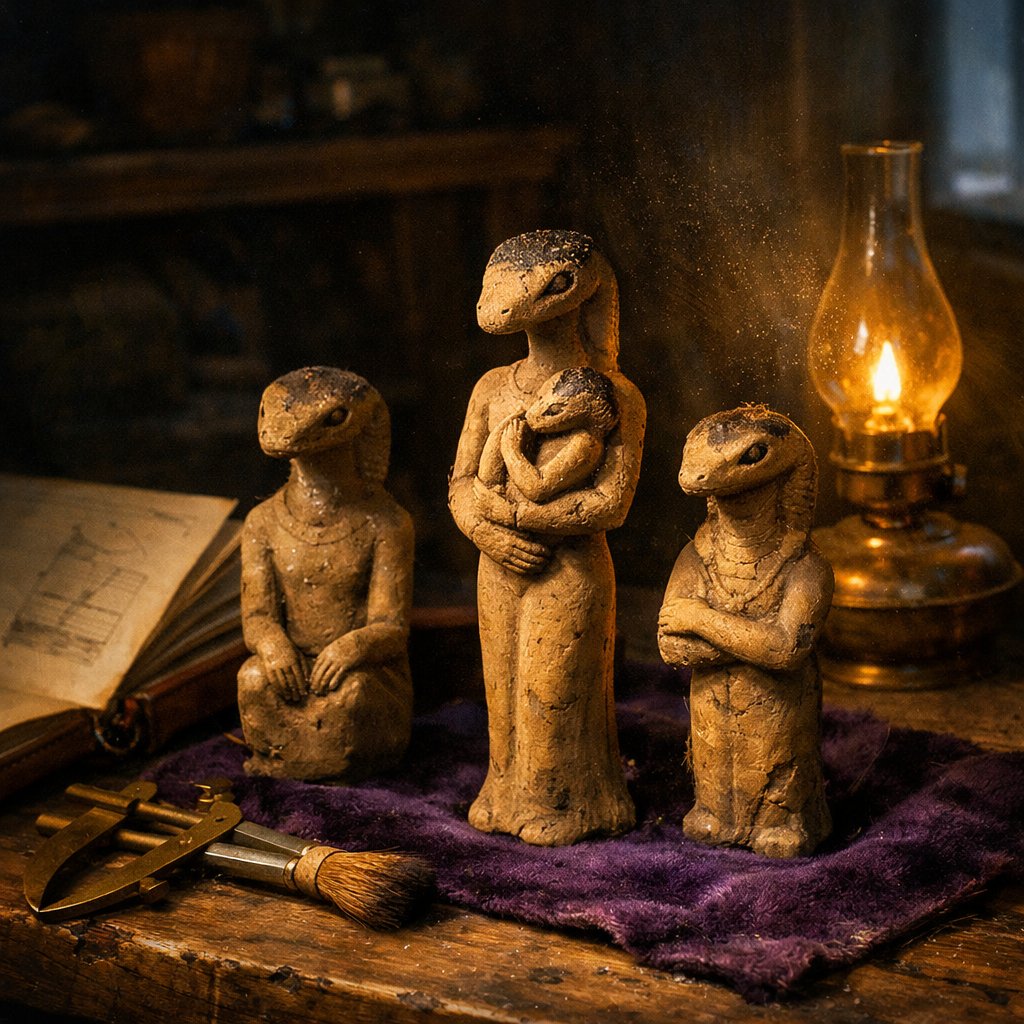
The figurines are small. The largest catalogued examples reach about fifteen centimeters; many sit closer to ten. The clay is the buff-to-pinkish low-fired fabric typical of Ubaid ceramic production. The heads are elongated and tapered, the eyes incised as long, slanting almond shapes, the mouths a single horizontal slit. A small modeled nose projects from the face. Some figurines wear what excavators have described as a flat, padded shoulder cape; others carry incised lines suggesting a helmet or skullcap, on which traces of bitumen survive on a number of specimens, indicating that the headgear was once dark and visually distinct from the body. Female figures, which dominate the corpus, often display small applied pellets at the breast and on the shoulders, and a number of them hold an infant to the breast in a nursing posture. The infants, where rendered, share the same elongated reptilian head as the mother.
A 2013 reassessment by Augusta McMahon and colleagues, published online as “A Snake in the Grass,” catalogued one hundred and twenty-one realistically modeled Ubaid figurines from southern Mesopotamian sites and found that approximately seventy-nine percent of the corpus is female [4]. The functional implication of that gender skew is significant: ophidian figurines are not a generic-deity type but a primarily female iconographic class, weighted toward maternity and the protective domestic sphere.
The “Ophidian” Label and What It Hides
The term ophidian, from the Greek ophis meaning serpent, was applied early in the literature to capture the snake-like quality of the elongated head. The label has stuck. It also misleads. A snake is not, in pre-Sumerian iconography, a single figure; the southern Mesopotamian ritual landscape included reptilian guardians, watery chthonic forces associated with Enki and his abzu, and a much later iconographic family of horned serpents. Calling the figurines “ophidian” or, in popular usage, “lizardmen” collapses several distinct possibilities into one. Some scholars now prefer the more neutral elongated-head figurines or simply Ubaid anthropomorphic figurines.
How Mainstream Archaeology Reads Them
The dominant interpretation places the figurines in the ritual life of small agricultural villages on the alluvium between the Tigris and the Euphrates, before there were cities. The female nursing posture, the dominance of women in the corpus, and the appearance of figurines in domestic floors during early Ubaid suggest a household-level role: protection of mother and child, fertility of field and livestock, perhaps a guardian function over the threshold. The shift from purely domestic deposition in early Ubaid to inclusion in graves during Ubaid 3 and 4 (c. 5100-4350 BCE) marks a development in mortuary practice that mirrors broader changes in southern Mesopotamian social life: the household figurine becomes a grave companion, then disappears as the iconography of the early Sumerian city takes over [5].
A second strand of interpretation reads the figurines as proto-deities of the religious cosmos that would crystallise, a thousand years later, into the Sumerian pantheon. Eridu, where the longest temple sequence stands, is in Sumerian tradition the first city, and Enki its founding god. The chthonic, watery, fertility-bound character of Enki, and the abzu beneath his temple, has been read by some Mesopotamianists as the lineal descendant of an Ubaid-period reptilian or amphibian protector. The argument is suggestive rather than secure; the gap between the Ubaid figurine and the first cuneiform reference to Enki is on the order of fifteen hundred years, and direct iconographic continuity has not been established.
The Cranial-Deformation Hypothesis
A more recent line of analysis, building on skeletal evidence from a number of Near Eastern Neolithic and Chalcolithic sites, has proposed that the elongated heads on the figurines depict a culturally practiced cranial deformation. Infant skulls, bound with cloth or boards before the cranial sutures fuse, can be reshaped to elongated profiles; the practice is documented in many cultures from the Andes to the late-antique Caucasus. If a fraction of the Ubaid population practiced infant head-binding, the figurines would be portraits of an actual human appearance rather than of any non-human being. The hypothesis is plausible but not yet confirmed for the Ubaid sites specifically; it would require a systematic re-examination of preserved Ubaid skulls. It is, however, an honest naturalistic candidate that does not require any extraterrestrial appeal.
The Ancient-Astronaut Reframing
The “lizardmen” reading of the figurines is not a minority archaeological position. It is a popular literary one. Its modern shape comes from the Swiss writer Erich von Däniken (born 1935), whose 1968 book Erinnerungen an die Zukunft, translated into English in 1969 as Chariots of the Gods?, sold more than seventy million copies and seeded the ancient-astronaut genre. Von Däniken’s general method was to take any artifact whose function or iconography was open and offer an extraterrestrial author for it. Anthropologists and archaeologists, including those who reviewed the book on publication and those who have responded to it since, have categorised the work as pseudoarchaeology and pseudohistory; the principal complaints are misrepresentation of source material, selective quotation, and the substitution of speculation for evidence [6].
The Ubaid figurines slid into this genre because they look, to a modern eye unfamiliar with Mesopotamian artistic convention, like recognisable science-fiction creatures. The reading was amplified through the 1970s and 1980s in books and television specials, and resurged on internet video platforms in the 2010s. It also acquired a particular twenty-first-century inflection: the figurines became, in some online accounts, evidence for an ancient race of “reptilian” beings tied to a separate conspiracy literature about contemporary world governance. None of these readings cite the original excavation reports. None of them engage with the corpus as published. None of them account for the dominance of nursing-mother postures or the shift from domestic to funerary deposition.
What the Evidence Actually Permits
A reader entitled to a careful answer is owed a careful one. The Ubaid figurines are small clay statuettes, predominantly female, recovered from domestic floors and graves at a handful of southern Mesopotamian sites between roughly 5500 and 4000 BCE. They are part of a continuous tradition of human figurine production that runs from Neolithic Anatolia through the Chalcolithic Near East and into the early Sumerian period. Their elongated heads and slanted eyes are an artistic convention that persists across hundreds of specimens and several centuries; the convention may encode a cultural practice (cranial deformation), a stylised abstraction (the slim head as a marker of divine or protective being), or a specific iconography of a chthonic protector whose name is lost. The figurines do not encode anything that is decoupled from the world the Ubaid villagers actually lived in.
For readers interested in the broader pattern, see our pillar guide to Historical and Archaeological Mysteries, where the difference between an unsolved question and an unexamined claim is the running theme. The Ubaid figurines belong to the first category. The “lizardmen” of the popular internet belong to the second.
Frequently Asked Questions
What are the Ubaid lizardmen figurines?
They are small ceramic statuettes, roughly ten to fifteen centimeters tall, with slender bodies, elongated reptilian-looking heads, almond-shaped slanted eyes, and a small modeled nose. They were produced in southern Mesopotamia during the Ubaid period (c. 6500-3800 BCE) and have been recovered chiefly from Tell al-‘Ubaid, Ur, Eridu, and Tell el-‘Oueili in modern southern Iraq. Approximately seventy-nine percent of the catalogued corpus is female, with many figures depicted nursing infants whose heads share the same elongated profile.
Who excavated the figurines?
Henry Reginald Hall began work at Tell al-‘Ubaid for the British Museum in 1919. Sir Charles Leonard Woolley directed the joint British Museum and University of Pennsylvania expedition there in 1922-1923 and at Ur from 1922 to 1934, recovering Ubaid II figurines beneath the later Royal Cemetery in his 1929-1930 sounding. Pinhas Delougaz of the Oriental Institute returned to Tell al-‘Ubaid in 1937. Fuad Safar and Seton Lloyd excavated the Eridu cemetery and temple sequence between 1946 and 1949 for the Iraq Directorate of Antiquities.
How old are the figurines?
They date to the Ubaid period, which spans approximately 6500 to 3800 BCE, with the bulk of figurine production concentrated in Ubaid 3 and Ubaid 4 phases, roughly 5100 to 4350 BCE. The earliest known precursor, a single specimen from the Ubaid 0 levels at Tell el-‘Oueili, may push the iconography back into the early sixth millennium BCE.
Why are they called “ophidian” figurines?
The term comes from the Greek ophis, meaning serpent, and was applied by early excavators to capture the snake-like quality of the elongated head. The label is conventional rather than diagnostic; it does not commit the interpreter to reading the figurines as snakes specifically, and some recent literature prefers the more neutral term elongated-head figurines or simply Ubaid anthropomorphic figurines.
Are they evidence of ancient astronauts visiting Earth?
No. The “ancient astronaut” reading derives from Erich von Däniken’s 1968 book Chariots of the Gods? and its successors. Anthropologists and archaeologists categorise that line of argument as pseudoarchaeology because it ignores excavation context, misrepresents the published record, and offers no falsifiable mechanism. The Ubaid corpus is fully consistent with a long tradition of human figurine production in the Neolithic and Chalcolithic Near East.
What do mainstream archaeologists think the figurines represent?
There is no single consensus, but the dominant readings cluster around three options: protective and fertility figurines used in household ritual, given the dominance of nursing-mother postures and domestic find-spots; representations of chthonic or proto-deities ancestral to the later Sumerian Enki and his consort Damkina, given the figurines’ association with the Eridu temple sequence; and possible portraits of humans practicing cranial deformation, given the documented practice elsewhere in the Near East. The interpretations are not mutually exclusive.
What is the cranial-deformation hypothesis?
A naturalistic reading proposing that the elongated heads depict an actual human appearance produced by binding infant skulls before the cranial sutures fuse. The practice is well-documented in many cultures from the Andes to the late-antique Caucasus. For the Ubaid figurines specifically, the hypothesis is plausible but not yet confirmed; it would require systematic re-examination of preserved Ubaid skeletal material to test directly.
Where can I see one in person?
Specimens recovered by the British Museum and University of Pennsylvania joint expedition are held principally at the British Museum in London and the Penn Museum in Philadelphia. The National Museum of Iraq in Baghdad holds material from the Eridu excavations and from later Iraqi-led work. Reproductions and photographs appear in the published expedition reports, particularly Woolley’s Ur Excavations IV: The Early Periods (1956) and Safar, Mustafa, and Lloyd’s Eridu (1981).
Did the Ubaid people leave any writing about these figures?
No. Cuneiform writing emerges in southern Mesopotamia around 3200 BCE, in the late Uruk period, several centuries after the Ubaid figurine tradition has ended. The figurines are therefore prehistoric in the strict sense: they predate any written record from the region, and any name we might give the beings depicted is a modern reconstruction based on iconographic and contextual analysis.
What is the connection to the god Enki?
Eridu, the southernmost Ubaid site, is in Sumerian tradition the first city and the home of the chthonic water-god Enki, whose temple was the E-abzu, “House of the Watery Deep.” The seventeen-temple sequence at Eridu runs continuously from the Ubaid into the early Sumerian period. Some scholars read the Ubaid reptilian figurines as iconographic ancestors of Enki and the watery, chthonic order he represented; the connection is suggestive but not formally proven.
Why do the figurines still appear in popular media as a “mystery”?
Because the ancient-astronaut framing has a longer half-life than its evidence. The figurines look, to a modern eye unfamiliar with Mesopotamian artistic convention, like recognisable science-fiction creatures, and the “lizard people” reading is a more dramatic story than a careful account of household ritual in a Chalcolithic farming village. The unresolved version travels further. The resolved version sits in the publication record, where it has sat since the 1930s.
What is the most reliable scholarly source on these figurines?
For the original excavation context, the primary publications are Hall and Woolley’s Ur Excavations I: Al-‘Ubaid (1927), Woolley’s Ur Excavations IV: The Early Periods (1956), and Safar, Mustafa, and Lloyd’s Eridu (1981). For modern reassessment, the recent paper “A Snake in the Grass: Reassessing the Ever-Intriguing Ophidian Figurines,” circulated through Academia.edu, catalogues the corpus and revisits gender distribution and find-context. The Metropolitan Museum’s heritage essay on the Ubaid period is the most accessible general summary.