
By EsoVitae Editorial · Published · Updated
Drafted with AI assistance from the sources listed; images are AI-generated illustrations. How EsoVitae is made
The 1865 Burial, the Curse List, and the Hollywood Bowl Dig
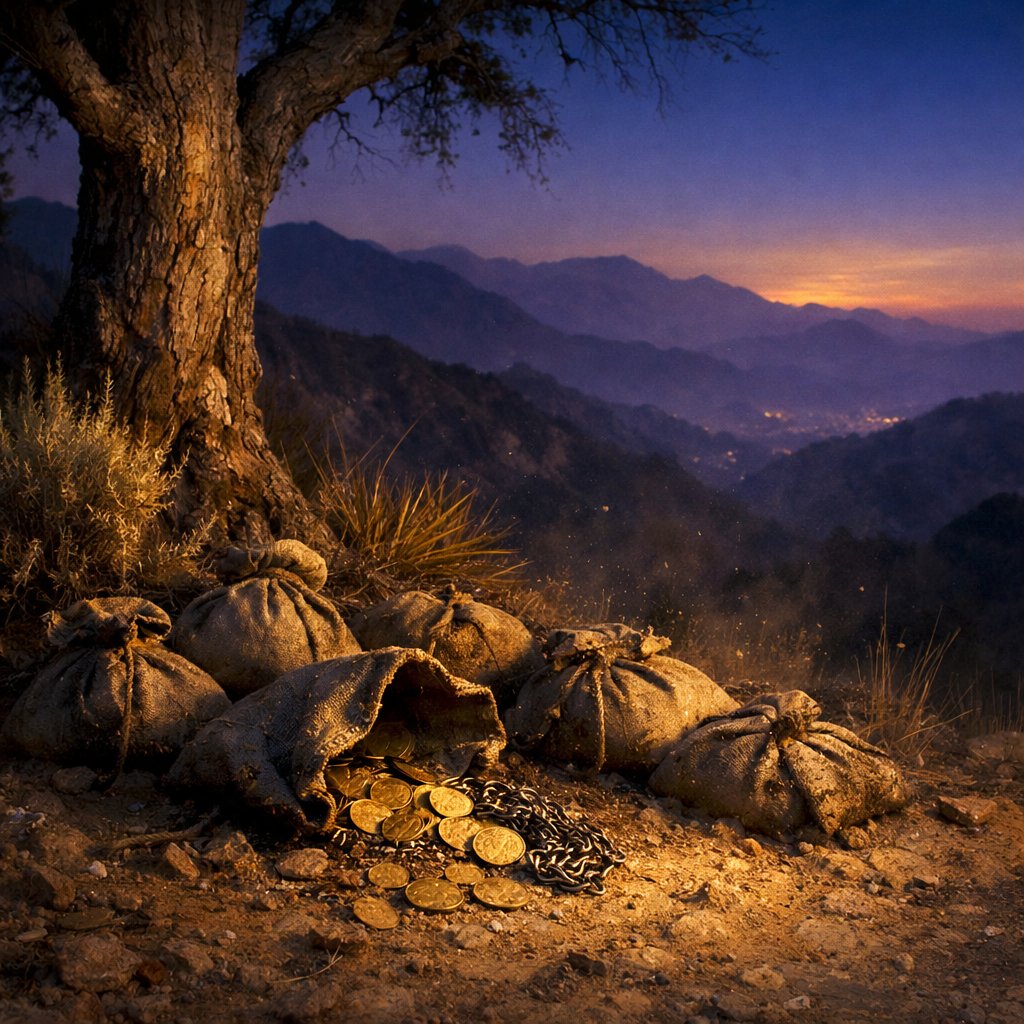
The Cahuenga Pass treasure is a Los Angeles folktale anchored to a real geopolitical moment and a thin documentary record. The legend places, somewhere on a hillside of the Cahuenga Pass north of Los Angeles, six buckskin packages of gold doubloons, watches, and jewelry set with diamonds, emeralds, rubies, and pearls, part of a war fund that the story’s original teller valued at about two hundred thousand dollars. In the version written down by Major Horace Bell, the jewels were donated in Sinaloa in 1865 to buy arms for Benito Juárez’s republic during the French intervention in Mexico, shipped to San Francisco, and buried in the hills by their escorts. A herder named Diego Moreno, who had watched them, dug the packages up, carried them south, and reburied them in the pass after a dream warned him not to take them into Los Angeles. Later retellings often date the story to 1864. In Bell’s telling, nearly everyone who touched the treasure or its secret soon met a sudden or violent end. In November 1939 a treasure-hunting team dug a forty-two-foot pit in the parking lot behind the Hollywood Bowl on the strength of a “doodlebug” reading and found no treasure. The legend, situated within the broader landscape of historical and archaeological mysteries, is folklore the historian can reconstruct cleanly only by separating the verifiable Mexican-war substrate from the unverifiable curse list that grew around it.
The principal documentary source for the burial is Major Horace Bell’s posthumous memoir On the Old West Coast: Being Further Reminiscences of a Ranger, edited by Lanier Bartlett and published by William Morrow in 1930, twelve years after Bell’s death in 1918 [1]. Bell, a Los Angeles lawyer, newspaper editor, and founding member of the Los Angeles Rangers, born in 1830, pieced the story together from several informants: Captain Henry Malcolm, a Maine-born soldier of fortune who had served with Bell in William Walker’s Nicaraguan campaign and came to Los Angeles about 1874; Etchepare, the keeper of a tavern in the pass; and José Gumisindo Correa, the stepson of one of the story’s victims. Everything in the legend that predates the 1939 dig descends from Bell’s chapter. The historian’s first move in any reconstruction is to mark that fact clearly: the documentary substrate of the burial is one memoirist’s recollection of what his informants told him, printed long after the events and after his own death.
The Juarista Context: Real, and Necessary to Get Right
The geopolitical frame the legend places around the burial is historically robust. A French army sent by Napoleon III landed in Mexico in January 1862 and was turned back at Puebla on May 5, 1862, the engagement that gave Mexico the Cinco de Mayo holiday; reinforced, the French occupied Mexico City on June 10, 1863. On April 10, 1864, Maximilian von Habsburg, younger brother of the Austrian emperor Franz Joseph, accepted the Mexican crown at Miramare Castle near Trieste, and he landed at Veracruz at the end of May. The republican government of Benito Juárez, driven from the capital and repeatedly forced to relocate, sent agents north to the United States to find arms, men, and support [2].
California was an important node in that effort. In the spring of 1864 Juárez sent Plácido Vega, a former governor of Sinaloa, to San Francisco as a secret agent charged with procuring arms, ammunition, supplies, funds, and volunteers while working around U.S. neutrality laws. Vega worked with the Mexican patriotic juntas there and sailed home in 1866 with ships carrying arms and volunteers [3]. Bell’s informant tied the treasure directly to Vega: in 1865, Malcolm said, Vega’s appeal for funds in Sinaloa set off a patriotic craze of jewelry donations, and the hoard was sent by sea from Mazatlán to San Francisco to buy supplies. That chronology fits the record poorly, since Vega had already been sent to San Francisco in 1864.
Diego Moreno and the Dream Beneath the Ash Tree
In Bell’s account, the treasure’s three escorts, Malcolm, an Englishman, and a Mexican captain named Davila, landed it safely in San Francisco. Rather than deposit it with a business house, they divided it into six packages wrapped in buckskin, buried them in the hills beyond San Bruno, and built a fire over the spot. Moreno, then a herder on a ranch near San Bruno, watched them from a copse, dug the packages up that night, and some months later quit his job and rode south with the treasure hidden in his pack. Stopping for the night at a roadside tavern on the southern slope of the Cahuenga Pass, the defile through the Santa Monica Mountains that connects the Los Angeles basin to the San Fernando Valley, he dreamed that if he took the treasure into Los Angeles he would never leave the town alive. One quiet night he carried it to a spot on the hillside opposite the main road, about halfway from the tavern to the summit, and buried it in six holes measured from the only fresno, or Western ash, in that locality. A footnote in the book places the spot roughly opposite the Hollywood Bowl.
The death sequence in Bell’s text begins almost immediately. In 1866, ill and apparently destitute, Moreno was taken in by Don Jesús Martínez, a fellow Sonoran long settled in Los Angeles. While convalescing he told his host the story and promised him half, but a sudden relapse killed him in the middle of the telling, before he could lead Martínez to the spot. Martínez went to the pass with his stepson, Gumisindo Correa, then fourteen or fifteen, and just as they located the ash tree he fell down in a fit and died; the terrified boy fled. Meanwhile the escorts had returned to their burial site near San Bruno and found it empty. Davila accused the Englishman, and the two killed each other with knife and revolver. Malcolm, Bell writes, later went to the Tombstone gold strike in Arizona and was shot dead in a dispute over a waterhole. Around 1885 or 1886 a Basque sheepherder, led to the spot by his dog, dug up one buckskin package holding a hundred gold doubloons and a large amount of jewelry. He left for his ancestral home in the Pyrenees with the treasure quilted into a garment and, waving from the steamer’s rail on arrival at Barcelona, fell into the sea and sank. The pattern, in Bell’s hands, is a curse narrative assembled from the memories his informants passed on to him.
Correa’s Search in the 1890s
Bell was well placed to collect the story. In the 1880s he was editing The Porcupine (1882 to 1888), a newspaper he had created to fight municipal corruption, and he knew several of the people involved. By his account the tavernkeeper Etchepare, who had received a share of the Basque’s find, later let the secret out; but since everyone assumed the sheepherder had cleaned out the cache, treasure hunting in the pass was dropped for a time.
The 1890s brought the next death. Gumisindo Correa, the boy who had fled the ash tree, grew up to become, in Bell’s words, “an honorable and substantial citizen of Los Angeles” who held several public offices and at one time served on the police force. As an adult he searched for the tree again but could not find it; Bell guessed that a woodchopper had felled it. Around 1891 or 1892, Bell writes, he told Correa about the Basque’s find and Malcolm’s story, and the two agreed to rent the land and plow it deep enough to turn up the buried packages. While Bell was still negotiating with the owners, Correa “was shot down in the streets of Los Angeles by an assassin,” and, Bell adds, the murderer and his motive were never known. As with the other deaths, Bell’s chapter is the source both for the killing and for its link to the treasure.
The 1939 Hollywood Bowl Dig
The best-documented episode in the case is the November 1939 excavation in the parking lot behind the Hollywood Bowl. The Bowl opened in 1922, and its land was deeded to Los Angeles County in 1924. According to the Bowl’s own centennial history, an amateur archaeologist named Henry Jones convinced the County Board of Supervisors that he had found the definitive location of the treasure, under what is now the Bowl’s Parking Lot B. Jones teamed up with Frank Hoekstra Jr., an inventor who had developed a sensitive metal detector he called “the doodlebug,” and with an aging vaudeville actor named Ray Johnson [4].
Digging began on November 27, 1939, with three film crews, CBS radio, a slew of reporters, and hundreds of onlookers on hand; a vendor sold popcorn, and the crowd went wild whenever the needle on Hoekstra’s “electrochemical recorder” moved. After twenty-four days and more than one hundred tons of earth, the team had dug a pit measuring nine by forty-two feet. When they hit a boulder, they called the hunt finished. The Bowl’s history calls the whole affair a PR stunt and quotes the grounds manager, William “Dad” Reed, telling the Los Angeles Times that “the only thing they’re gonna dig up is dirt.” One later account says the dig turned up only a deteriorated watch and an 1860 penny, and popular retellings add that Jones took his own life within months of the dig, making him the curse’s latest victim [5].
The Folklore Layer the Mainstream Historian Disputes
A careful reading of the documentary record produces three observations. The first is that the Mexican-war substrate of the legend is real but generic: Juárez did have an agent in San Francisco raising funds and buying arms from 1864 to 1866, but Bell’s chapter is the only source we have found for this particular consignment. The second is that the burial, the dream, and the early deaths all rest on that one chapter, published in 1930 from stories Bell had collected decades earlier. The third is that the 1939 dig is the one episode documented independently of Bell, by the press coverage and photographs that the Bowl’s own history draws on.
The institutions closest to the site have been blunter than the folklore. The Hollywood Bowl’s centennial history retells the treasure saga only to call it “pure fiction,” reserving “100% true” for the 1939 dig, which it judges a publicity stunt. The historian can honor the Juárez-Maximilian context as cultural history that mattered to nineteenth-century Mexican California and still decline to vouch for the buckskins.
What the Pass Itself Holds
The Cahuenga Pass takes its name from the Tongva village of Kawé’nga, probably meaning “at the mountain.” The pass lay on the route of El Camino Real, and it was the site of two small nineteenth-century battles: the 1831 Battle of Cahuenga Pass, in which a force raised by local landowners fought Governor Manuel Victoria’s men, and the 1845 Battle of Providencia, in which Californios challenged Mexican forces over the autonomy of Alta California. On June 15, 1940, a mile-and-a-half stretch through the pass opened as the Cahuenga Pass Freeway, the first segment of the Hollywood Freeway, which now carries U.S. Route 101 [6]. Bell’s lone ash tree, the compass for Moreno’s six holes, was already gone by the time Correa looked for it as an adult.
A treasure that was buried in the 1860s on a chaparral hillside, never recovered by the people who knew its position, and overlaid in the twentieth century by road cuts, house foundations, and freeway grading would not, in any reasonable physical reconstruction, be easy to find today. The pass’s history of failed searches, from Correa’s fruitless hunt for the ash tree to the 1939 Hollywood Bowl excavation, has not produced a single verified coin from the legendary cache. What the pass actually holds, the documented record says, is a Tongva village name, two small nineteenth-century battles, a 1922 amphitheater, and a treasure legend that has outlived everyone who chased it.
Folklore as Historical Evidence
A historian of the case has, in the end, two records to read. The first is the verifiable one: the French intervention in Mexico, Juárez’s agent in San Francisco, the 1939 dig, the unbroken silence of the chaparral. The second is the legendary one: the dream at the ash tree, the curse on those who sought it, the moral arithmetic that punishes recovery. The two records do not converge. They illuminate one another. The legendary record carries the period’s anxieties about the cost of the Mexican civil war on the Mexican-Californian community, the moral ambivalence of refugee wealth, and the tension between sudden discovery and the discipline of work. The verifiable record carries the actual paths of capital and labor through 1860s California. Read together, the Cahuenga Pass treasure is a piece of cultural history in which a thin documentary substrate has carried a heavy interpretive burden for more than a century, and in which the absence of recovered coin is, for the historian, the most telling fact in the file.
Frequently Asked Questions
Is the Cahuenga Pass treasure real?
The 1860s geopolitical context (the French intervention in Mexico and Juárez’s agents in California) is documented historical record. The specific burial by a herder named Diego Moreno rests almost entirely on Major Horace Bell’s posthumous 1930 memoir On the Old West Coast, built from stories Bell had collected from informants decades earlier. The Hollywood Bowl’s own centennial history calls the treasure saga “pure fiction.” No coin from the cache has ever been verified.
How much was the buried treasure worth?
In Bell’s account, Captain Malcolm estimated that the donated jewelry alone came to about two hundred thousand dollars in 1865, not counting cash contributions. One package that Moreno opened held a hundred gold doubloons, many fine watches, and “three or four pint cups full of diamonds, emeralds, rubies and pearls.” Any modern valuation would be guesswork, since nothing from the cache has been verified.
Who was Diego Moreno?
Diego Moreno is the central figure in Major Horace Bell’s account of the legend: a Sonoran herder on a ranch near San Bruno who watched the treasure’s escorts bury it, dug it up, rode south, and reburied it in six holes measured from a lone ash tree in the Cahuenga Pass after a warning dream. Bell’s text places his death at the Los Angeles home of Don Jesús Martínez in 1866. We have found no record of Moreno independent of Bell’s account.
What did the 1939 Hollywood Bowl dig find?
No treasure. The excavation that began on November 27, 1939, led by amateur archaeologist Henry Jones with inventor Frank Hoekstra Jr. and vaudeville actor Ray Johnson, opened a pit measuring nine by forty-two feet in the Bowl’s parking lot on the strength of readings from Hoekstra’s “doodlebug” metal detector. After twenty-four days and more than one hundred tons of earth, the team hit a boulder and gave up. One later account says the dig yielded only a deteriorated watch and an 1860 penny.
Did Henry Jones die because of the curse?
Popular retellings say Jones took his own life after the dig, depressed by its failure, and count him as the curse’s latest victim. They disagree on how soon afterward it happened, and we have not found a contemporary record of his death.
Who else is said to have died seeking the treasure?
Major Horace Bell’s account links several deaths to the treasure: two of its escorts, who killed each other after finding the cache gone; Diego Moreno, who died of a relapse while describing the hiding place; Don Jesús Martínez, who fell down in a fit and died as he found the ash tree; a Basque sheepherder who dug up one package around 1885 and drowned at Barcelona on his way home; Captain Malcolm, shot dead in Arizona; and Martínez’s stepson José Gumisindo Correa, shot by an unknown assassin while he and Bell were planning a new search.
Where is the Cahuenga Pass?
The Cahuenga Pass is a low pass through the eastern end of the Santa Monica Mountains in the City of Los Angeles, connecting the Los Angeles Basin to the San Fernando Valley. It has an elevation of 745 feet. The pass is now traversed by U.S. Route 101 (the Hollywood Freeway) and Cahuenga Boulevard. A footnote in Bell’s memoir places the treasure site roughly opposite the Hollywood Bowl.
What was the Juárez fundraising operation in California?
During the French intervention in Mexico from 1862 to 1867, President Benito Juárez’s republican government sent secret agents north to the United States to secure arms, men, and support. Plácido Vega, a former governor of Sinaloa, was sent to San Francisco in the spring of 1864 to procure arms, ammunition, supplies, funds, and volunteers; he worked with Mexican patriotic juntas in California and returned to Mexico in 1866 with ships carrying arms and volunteers. The Cahuenga Pass legend’s claim that a consignment of donated jewels was lost in California attaches to this documented effort.
Why hasn’t the treasure been found with modern equipment?
A treasure buried in the 1860s on a chaparral hillside, never relocated by the people who knew its position, and overlaid in the twentieth century by freeway construction, house foundations, and grading would not, on any reasonable reconstruction, be easy to find today by surface metal-detector survey. The lone ash tree that anchored Moreno’s measurements was already gone when Correa searched for it as an adult. The undisturbed chaparral the legend imagines no longer exists.
What is Major Horace Bell’s role in the story?
Major Horace Bell (1830 to 1918) was a Los Angeles lawyer, journalist, and founding member of the Los Angeles Rangers who also fought in William Walker’s Nicaraguan filibuster and served as a Union Army scout in the Civil War. His posthumous memoir On the Old West Coast: Being Further Reminiscences of a Ranger, edited by Lanier Bartlett and published by William Morrow in 1930, twelve years after Bell’s death, contains the principal narrative of the Cahuenga Pass treasure. Bell pieced the story together from Captain Henry Malcolm, a Maine-born veteran of the Walker campaign; Etchepare, a tavernkeeper in the pass; and José Gumisindo Correa. Later retellings of the legend descend from Bell’s text.
Did the legend appear in Los Angeles newspapers before Bell’s 1930 memoir?
We could not confirm any. Bell writes that the tavernkeeper Etchepare “later let the secret out” after the Basque’s find, but he cites no newspaper coverage. The 1939 Hollywood Bowl excavation drew three film crews, CBS radio, and a slew of reporters, and the Los Angeles Times quoted the Bowl’s grounds manager predicting that the diggers would turn up nothing but dirt.
Is the curse historically credible?
No. The curse narrative is a folkloric pattern in which a sequence of deaths attaches itself retrospectively to an unrecovered cache. Each death in the Cahuenga sequence, as Bell himself tells it, has an ordinary explanation: a fight between suspicious partners, a sudden illness, a fit, a drowning, a quarrel over a waterhole, a street shooting. The pattern reflects the cultural function the legend served, moralizing the ambivalence of sudden wealth and the discipline of patient work, rather than any underlying causal mechanism.
What would convince a historian the cache was real?
Three classes of evidence would carry weight. First, a contemporary 1864 to 1866 document — a letter, a Mexican consular report, a Juarista financial accounting — naming a specific lost consignment of the size the legend describes. Second, a recovery of period Mexican coin, in a buckskin or canvas wrap consistent with 1860s field practice, from the relevant hillside, with provenance documentation that survives forensic scrutiny. Third, an archival recovery of pre-1930 Los Angeles documentation that names Diego Moreno, Don Jesús Martínez, or the ash-tree compass independently of Major Bell’s memoir. None of these has appeared.
For deeper context across the historical and archaeological mysteries archive, consider The Tower of Babel: Historical Evidence and Indus Valley: Trade and Communication.
Sources
- Horace Bell, On the Old West Coast: Being Further Reminiscences of a Ranger, ed. Lanier Bartlett, William Morrow, 1930, chapter 7, “Historic Treasure Buried in Cahuenga Pass.” archive.org; “Horace Bell,” Wikipedia. wikipedia.org
- “Second French intervention in Mexico,” Wikipedia. wikipedia.org; “Maximilian I of Mexico,” Wikipedia. wikipedia.org
- Robert Ryal Miller, “Plácido Vega: A Mexican Secret Agent in the United States, 1864–1866,” The Americas 19, no. 2 (October 1962): 137–148. cambridge.org; “Plácido Vega y Daza,” Wikipedia. wikipedia.org
- Los Angeles Philharmonic, “The Park,” episode 9 of Hollywood Bowl: The First 100 Years. hollywoodbowl.com; “Hollywood Bowl,” Wikipedia. wikipedia.org
- Chris Nichols, “Is There Really Gold Buried in the Cahuenga Pass?,” Los Angeles Magazine, 1 September 2011. lamag.com; “From Forrest Fenn to Tutankhamun: deadly treasure hunts that captured the world,” lovemoney, 8 June 2020. lovemoney.com
- “Cahuenga Pass,” Wikipedia. wikipedia.org; “Battle of Cahuenga Pass,” Wikipedia. wikipedia.org; “Battle of Providencia,” Wikipedia. wikipedia.org; “Hollywood Freeway,” Wikipedia. wikipedia.org