By Emilia Wellesley · Published May 7, 2026 · Updated September 10, 2026
Last updated: September 10, 2026.
The Genesis Narrative and the Babylonian Referent
The Tower of Babel survives in two records that have to be read on their own terms before they can be read against one another. The first is Genesis 11:1-9 in the Hebrew Bible, a nine-verse etiology in which the descendants of Noah, speaking a single language, settle in the plain of Shinar, fire bricks for mortar, and begin a tower meant to reach the heavens; the deity descends, confounds their speech, and scatters them across the earth. The second is the Etemenanki ziggurat at Babylon, the seven-stage temple of Marduk that the Neo-Babylonian kings Nabopolassar (reigned 626-605 BCE) and Nebuchadnezzar II (reigned 605-562 BCE) restored to monumental scale on the eastern bank of the Euphrates, and that Robert Koldewey’s 1899-1917 German Oriental Society excavations recovered foot by foot from the alluvial mound. Genesis is religious-mythological. Etemenanki is the historical-archaeological referent that almost certainly inspired the biblical motif. The two records do not say the same thing, and the careful reader keeps them separate while letting them illuminate one another, situated within the broader landscape of historical and archaeological mysteries.
The biblical text is short enough to repay rereading. Shinar in Genesis 11:2 is the Hebrew designation for southern Mesopotamia, the alluvial plain between the Tigris and the Euphrates, and the building materials the text specifies — fired brick rather than stone, bitumen rather than mortar — are the construction signature of Babylonian monumental architecture rather than the Levantine stone idiom further west. Genesis 11:9 derives the place name Babel from the Hebrew root balal, “to confuse,” a folk-etymology that puns on the Akkadian Bāb-ilim, “gate of the god,” from which the toponym Babylon descends. The pun is a clue. The narrative is anchored to a specific city the biblical authors knew, by a specific construction technique they recognised, with a specific Akkadian etymology they were correcting in Hebrew.
Etemenanki: Marduk’s Ziggurat at Babylon
Etemenanki is the Sumerian name preserved in cuneiform, conventionally translated as “House of the Foundation of Heaven and Earth,” and it designated the ziggurat that stood within the temple precinct of Marduk at Babylon, adjacent to the temple complex called Esagila. Earlier foundations had stood on the site — Hammurabi-era texts already mention a temple platform — but the version the Neo-Babylonian kings rebuilt in the late seventh and early sixth centuries BCE was the largest, and it is that version the archaeology recovers. Nabopolassar, the Chaldean king who founded the Neo-Babylonian dynasty in 626 BCE after expelling the Assyrians, began the programme. His son Nebuchadnezzar II completed it, leaving inscriptions on bricks, cylinders, and on the stele the Schøyen Collection acquired in the 1990s.
The Esagila Tablet’s Dimensions
The most direct ancient description of Etemenanki survives on a cuneiform clay tablet now in the Louvre as inventory AO 6555 and known to scholarship as the Esagila tablet. The tablet was copied at Uruk in 229 BCE from an older Borsippa exemplar, was first translated by the Assyriologist George Smith in 1876, and gives Etemenanki seven stages with a square base of 91 metres per side and an overall height of seven nindan totalling 91 metres [1]. The seven-stage form, the square footprint, and the colossal vertical scale make the tablet’s Etemenanki the closest physical analogue to the Genesis tower in the entire ancient record. Modern Assyriologists, beginning with Andrew George’s reconstructions in House Most High: The Temples of Ancient Mesopotamia (Eisenbrauns, 1993), have argued that the tablet’s height figures may exceed what unfired-brick statics could bear and propose a more conservative reconstruction at roughly 66 metres; the seven-stage form and square footprint are not seriously contested.
Robert Koldewey at Babylon, 1899-1917
The shift from textual reconstruction to material confirmation came with Robert Koldewey (1855-1925), the Berlin-trained architect-archaeologist sent to Babylon in 1899 by the Deutsche Orient-Gesellschaft (German Oriental Society) and the Royal Museums of Berlin. Koldewey directed the excavation for nearly two decades, with field campaigns running roughly 1899 to 1917, of diminishing intensity in the war years. In 1913, an exceptionally low water table allowed him to expose the foundation walls of Etemenanki, mapping a square base of 91.48 by 91.66 metres on the trench plan published in Das wieder erstehende Babylon (Hinrichs, 1913). The footprint matches the Esagila tablet’s measurement to within centimetres, the kind of cross-corroboration between text and trench that historiography prizes [2].
The Schøyen Tower of Babel Stele
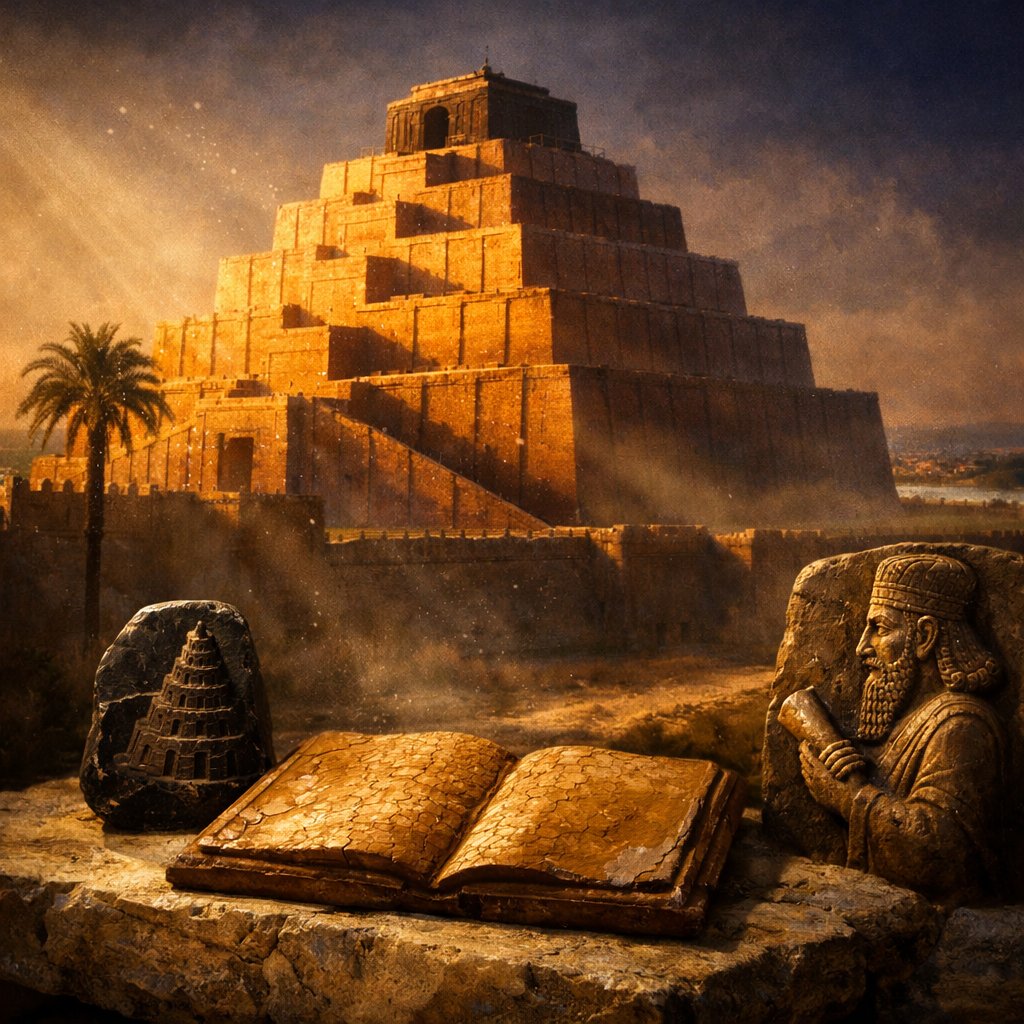
A second documentary anchor entered the file in the late twentieth century. In October 1995 and May 1999 the Schøyen Collection in Oslo acquired two black-stone fragments, listed under MS 2063 and conjoined into a stele 47 by 25.5 by 11 centimetres, that had been removed in or shortly after 1900 from the German trench at Amran ibn Ali within Babylon’s southern citadel. The stele bears, on its principal face, a carved relief showing Etemenanki in elevation as a stepped tower of seven stages with a temple structure on its summit, and to its right the standing figure of Nebuchadnezzar II in royal dress holding a staff in his left hand and a scroll bearing the rebuilding plans in his right. A three-line cuneiform epigraph beside the ziggurat names it as Etemenanki in Babylon. A longer inscription below the relief is a variant of Nebuchadnezzar’s well-known building texts, describing the king’s restoration of Etemenanki and of Eurmeiminanki, the parallel ziggurat at Borsippa some seventeen kilometres south. The stele has been edited and published most fully by Olof Pedersén in Iraq 86 (2024) [3]. After 28 years in Oslo, it was returned to the Iraq Museum in Baghdad in 2023.
The stele is the only known contemporary visual representation of Etemenanki, and its alignment with the Esagila tablet’s seven-stage description is exact. It is, in the strict archaeological sense, the closest thing the corpus has to a self-portrait of the Tower of Babel. The convergence of three records — the tablet’s measurements, the stele’s depiction, and Koldewey’s foundation plan — produces a triangulated reconstruction that the Genesis text does not produce on its own and could not have produced without the cuneiform corpus.
The Languages Question and the Polyglot City
The other half of the Genesis narrative is the linguistic one: the deity confounds the builders’ speech, and they cease to understand one another. The historical referent for this element is not, in any straightforward way, Etemenanki itself. It is the famously polyglot character of late-period Babylon. By the sixth century BCE, the city’s population spoke and wrote in at least three languages in daily public use: Akkadian, the inherited East Semitic vernacular of Mesopotamia, by then in its Neo-Babylonian dialect; Aramaic, the West Semitic lingua franca that had spread with the Assyrian deportations and was rapidly displacing Akkadian as the spoken language; and Sumerian, no longer a vernacular but preserved as a sacerdotal and scholarly language in the temple scriptoria, much as Latin was preserved in medieval Europe. To these one can add Elamite, Phoenician, Old Persian after the 539 BCE Achaemenid conquest, and Egyptian in the merchant quarters.
Joan Oates, in her standard volume Babylon (Thames and Hudson, revised edition 1986), characterised the city in this period as among the most linguistically diverse populations in the ancient Near East [4]. The biblical etiology, in which the speakers at Babel cease to understand one another and disperse, can be read as a theological reading of an empirical fact about Babylon: a city in which a builder, a scribe, and a market porter were unlikely to share a first language. Genesis frames the diversity as divine confounding; the historian frames it as the consequence of imperial deportation, trade, and the long survival of liturgical Sumerian beside vernacular Akkadian beside spoken Aramaic. Both framings point at the same urban reality from different epistemological directions.
What the Archaeology Confirms and What It Cannot
The cross-record confirms that a seven-stage ziggurat of approximately 91-by-91-metre footprint stood within the Marduk precinct at Babylon, that it was rebuilt to monumental scale by Nabopolassar and Nebuchadnezzar II, that its dimensions and seven-stage form were recorded on the Esagila tablet, that it was depicted with Nebuchadnezzar on the Schøyen stele, and that its foundation walls were recovered intact by Koldewey’s team in 1913. The archaeology does not confirm that this ziggurat was the structure the biblical authors had in mind, only that it is the candidate that fits the biblical description most closely in date, geography, building technique, and physical form.
Other Mesopotamian ziggurats — at Ur, Uruk, Borsippa, Eridu, Nippur — were operational in the same broad period and could in principle have contributed to the biblical motif. The Borsippa ziggurat, which preserved its mass into late antiquity and was for centuries shown to travellers as the actual Tower of Babel, was the candidate most often named in medieval and early-modern European pilgrim accounts. The modern case for Etemenanki rests on its location at Babylon itself, the city the biblical text names; on its scale, larger than the other Neo-Babylonian ziggurats; and on the persistence of its silhouette in the skyline through the Persian and Hellenistic periods, when the Israelite communities of the Babylonian exile would have known the city directly. Andrew George’s textual work makes the case that the cluster of biblical motifs — Shinar, baked brick and bitumen, the gate of the god, the dispersal of speech — fits Babylon and its ziggurat rather than any other candidate.
Reading the Two Records Together
A historian’s discipline, faced with two records that overlap without converging, is to keep both visible. Genesis 11:1-9 is doing theological work: explaining human linguistic and cultural diversity as a consequence of moral overreach, framing imperial monumental architecture as hubris against the divine, and providing an etiology for the dispersal of peoples that the rest of the Hebrew Bible will need. The archaeological record at Etemenanki is doing different work: the Neo-Babylonian dynasty’s self-presentation as legitimate restorers of Marduk’s cult, the public theology of a state ziggurat, the engineering ambition of a polity at the height of its power. The two records bear on one another only because the city, the building, and the linguistic diversity all in fact existed and were known to writers on both sides of the cuneiform-Hebrew divide. The Tower of Babel as a physical object is, with high probability, a memory of Etemenanki mediated through the Israelite encounter with the Neo-Babylonian capital during the exile of 586 to 539 BCE; the Tower of Babel as a story is a theological reading of that memory in which the empirical fact of a multilingual imperial city becomes the etiology of human diversity, and the empirical fact of a stepped ziggurat reaching toward the heavens becomes the moral parable of a tower the deity could not permit. Both readings are accurate to what they are doing. Neither alone exhausts the case [5].
Frequently Asked Questions
Was the Tower of Babel a real building?
The Genesis 11:1-9 narrative is a religious-mythological etiology rather than a chronicle, and the biblical text itself names neither a specific structure nor a specific date. The historical-archaeological referent that fits the description most closely is Etemenanki, the seven-stage ziggurat of Marduk at Babylon, rebuilt by the Neo-Babylonian kings Nabopolassar and Nebuchadnezzar II in the seventh and sixth centuries BCE and recovered by Robert Koldewey’s German Oriental Society excavations in 1899-1917. The mainstream scholarly view is that Etemenanki almost certainly inspired the biblical motif, though the Genesis story is doing theological rather than descriptive work.
What is Etemenanki?
Etemenanki is a Sumerian name conventionally translated as “House of the Foundation of Heaven and Earth,” and it designated the seven-stage ziggurat of Marduk that stood at Babylon adjacent to the temple complex called Esagila. The structure was rebuilt to its largest scale by Nabopolassar (reigned 626-605 BCE) and his son Nebuchadnezzar II (reigned 605-562 BCE), and its dimensions, footprint, and seven-stage form are documented on the cuneiform Esagila tablet now in the Louvre.
How tall was Etemenanki?
The Esagila tablet, copied at Uruk in 229 BCE from an earlier Borsippa exemplar, gives Etemenanki an overall height of seven nindan totalling about 91 metres on a square 91-by-91-metre footprint. Modern Assyriologists, including Andrew George, have argued that the tablet’s height figures may exceed the load-bearing limits of unfired brick and propose a revised reconstruction at approximately 66 metres. The seven-stage form and the square 91-metre footprint, however, are not seriously contested and are confirmed by Koldewey’s 1913 foundation plan.
Who excavated the Tower of Babel?
Robert Koldewey (1855-1925), a German architect-archaeologist working for the Deutsche Orient-Gesellschaft and the Royal Museums of Berlin, directed the excavation of Babylon from March 1899 through the First World War, with field campaigns continuing in reduced form until 1917. In 1913, an exceptionally low water table allowed Koldewey to expose the foundation walls of Etemenanki and map its 91.48-by-91.66-metre footprint, the measurement that has anchored every subsequent reconstruction.
What is the Schøyen Tower of Babel Stele?
The Schøyen Tower of Babel Stele, catalogued as MS 2063, is a black-stone stele 47 by 25.5 by 11 centimetres in two conjoining fragments, recovered in or shortly after 1900 from the German trench at Amran ibn Ali within Babylon, acquired by the Schøyen Collection in Oslo in October 1995 and May 1999, and returned to the Iraq Museum in Baghdad in 2023. It bears a carved relief of Etemenanki in elevation, the standing figure of Nebuchadnezzar II holding a staff and the rebuilding plans, a three-line cuneiform epigraph naming the ziggurat, and a longer building inscription describing Nebuchadnezzar’s restoration of the structure.
Where was the biblical Shinar?
Shinar is the Hebrew designation in Genesis for southern Mesopotamia, the alluvial plain between the Tigris and the Euphrates that is the geographical setting of Babylon, Uruk, Ur, and the other Sumerian and Akkadian cities. The construction technique Genesis 11 specifies, fired brick set in bitumen mortar, is the signature of Babylonian monumental architecture rather than the Levantine stone idiom further west, and the geographical clue points squarely at southern Iraq.
Why does Genesis link the tower to the confusion of languages?
The Genesis 11:9 etymology derives the place name Babel from the Hebrew root balal, “to confuse,” a folk-etymological pun on the Akkadian Bāb-ilim, “gate of the god,” from which the toponym Babylon descends. The historical referent for the linguistic-confusion motif is the famously polyglot character of late-period Babylon, which Joan Oates documented as one of the most linguistically diverse populations of the ancient Near East — Akkadian, Aramaic, Sumerian as a liturgical language, Elamite, Phoenician, Old Persian, and Egyptian all in concurrent use.
Are Etemenanki and the Borsippa ziggurat the same structure?
No. Etemenanki stood at Babylon itself, in the Marduk precinct on the eastern bank of the Euphrates. Eurmeiminanki, the parallel ziggurat at Borsippa some seventeen kilometres south, was a separate Nebuchadnezzar restoration. Both are mentioned in the Schøyen stele’s inscription. The Borsippa ziggurat preserved more of its mass into late antiquity than Etemenanki, and was for centuries shown to medieval and early-modern European pilgrims as the Tower of Babel, but the modern scholarly identification, on the basis of biblical geography and the Esagila tablet, is with Etemenanki at Babylon.
What did Andrew George contribute to the case?
Andrew George’s House Most High: The Temples of Ancient Mesopotamia (Eisenbrauns, 1993) is the standard reference for the Mesopotamian temple corpus, and assembles the cuneiform texts that name and describe Etemenanki across more than a millennium of attestations. George’s textual reconstruction of the building’s dimensions, his analysis of the Esagila tablet’s metrology, and his cautious revisionism on the height question (proposing roughly 66 metres rather than 91) underpin the modern philological reading of the structure.
What did Joan Oates contribute?
Joan Oates’s Babylon (Thames and Hudson, revised edition 1986) is the standard accessible synthesis of the city’s history and archaeology from the Old Babylonian period through the Hellenistic. Oates’s chapter on the Neo-Babylonian capital integrates Koldewey’s excavation results, the cuneiform documentary record, and the late-period demographic evidence into a coherent picture of Babylon as a multilingual imperial city. Her treatment of the Akkadian-Aramaic-Sumerian polyglot environment is the standard reference for the linguistic-diversity element of the Babel narrative.
Did the Israelites of the Babylonian exile see Etemenanki?
Almost certainly. The Babylonian exile of the Judahite elite, beginning with the deportations of 597 and 586 BCE under Nebuchadnezzar II and ending with the Achaemenid conquest of Babylon in 539 BCE under Cyrus the Great, placed a significant Israelite community in the city for roughly half a century, during which Etemenanki was the dominant feature of the urban skyline. The historiographic consensus is that the Genesis 11 narrative draws on direct Israelite knowledge of Babylon and its ziggurat, mediated through the exile experience and refracted through the theological frame of Genesis.
How does the Tower of Babel narrative differ from the archaeological record?
Genesis 11:1-9 is theological etiology: it explains human linguistic and cultural diversity as the consequence of a single moral failure, frames imperial monumental architecture as overreach against the divine, and uses the destruction of the tower to drive the dispersal of peoples narrative. The archaeological record at Etemenanki is administrative-religious: a Neo-Babylonian dynasty’s restoration of the cult ziggurat of the chief deity, documented in royal inscriptions, building texts, and a carved stele, and recovered intact in foundation by Koldewey. The Genesis story uses the building; it does not describe it. The careful reader holds both records visible without conflating them.