By Theodora Marsh · Published May 13, 2026 · Updated September 10, 2026
Last updated: September 10, 2026.
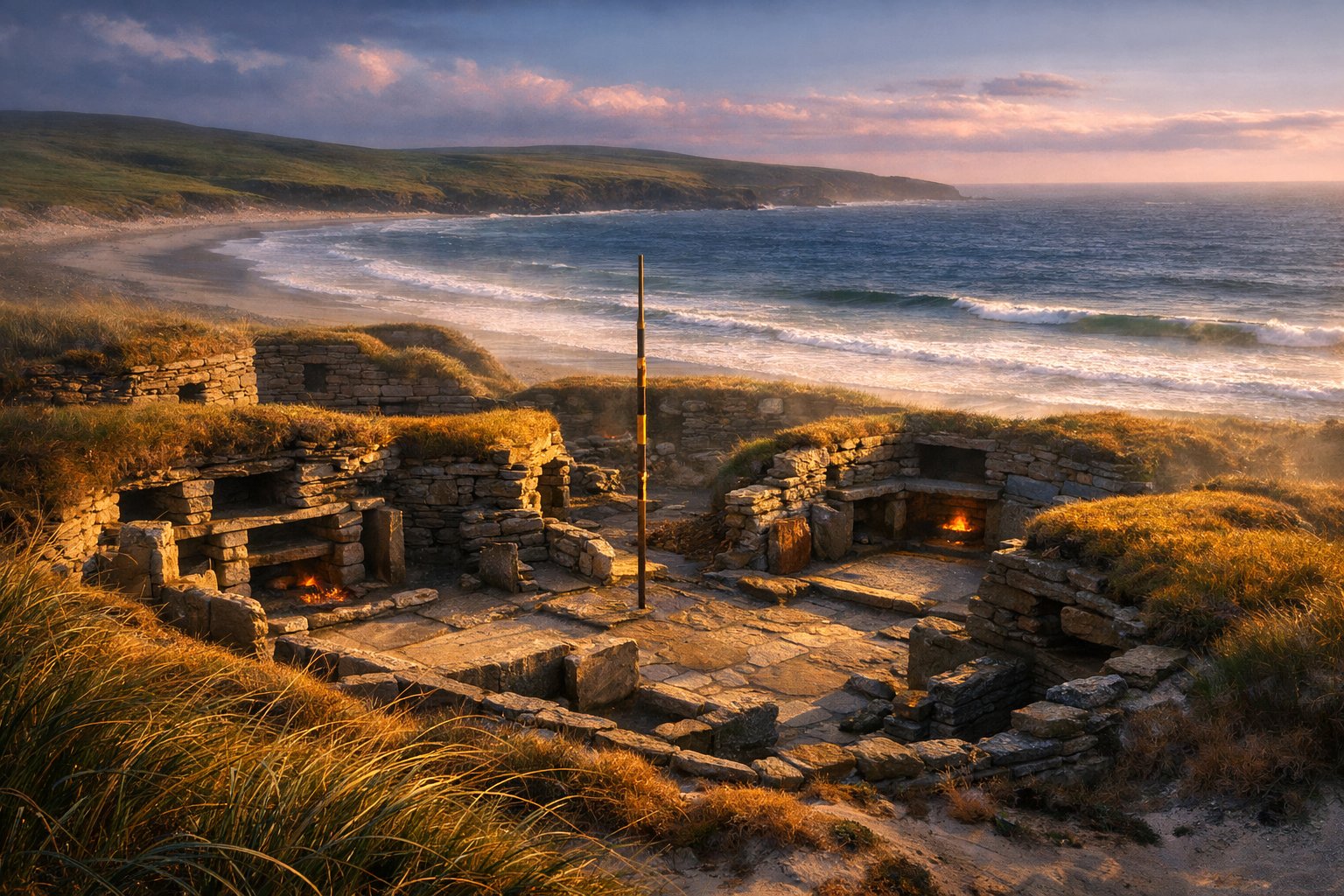
A wet wind comes off the Bay of Skaill at any hour you care to visit, and it has been coming off that bay for about five thousand years. Stand on the dune-crest above the village and the houses look smaller than the photographs promise: a clutch of stone-built dwellings the size of a parish hall, sunk into a midden of their own making, roofed now only by Orkney sky. This is Skara Brae, on the west coast of Mainland Orkney, and what survives here survives nowhere else in Western Europe at this resolution. The beds are still in the rooms. The dressers still face the door [1].
The headline claim, the one that draws scholars and slow travelers to a cold beach above the Atlantic, is straightforward enough to fit in a single paragraph. The longer claim, the one that takes a day on site and a long winter of reading to absorb, is more interesting.
Direct Answer: What Skara Brae Is and Why It Matters
Skara Brae is a Neolithic stone village on the Bay of Skaill, Mainland Orkney, occupied roughly 3180 to 2500 BCE [1]. Eight semi-subterranean dwellings survive with their original flagstone beds, dressers, hearths, and wall-cells in place. Its preservation, by sand and refuse, makes it the most complete Neolithic domestic settlement in Western Europe and a core component of the Heart of Neolithic Orkney UNESCO World Heritage property [2].
The Storm of 1850 and the Long Excavation
The village reappeared the way old things in Orkney often reappear: a winter storm tore the turf off a dune called Skerrabra, and stones that had been buried since the late third millennium BCE were suddenly weatherworn into daylight [1]. William Watt, the laird of Skaill House, began clearing the site in 1850 and exposed the first four dwellings; further storms in 1924 stripped more of the deposit and prompted a second campaign. From 1928 to 1930 the Australian-born prehistorian Vere Gordon Childe ran the excavation that would set the interpretive frame for everything that followed, publishing the results in 1931 as Skara Brae: A Pictish Village in Orkney [3]. The title, with its mistaken attribution to Iron Age Picts, has been quietly outgrown by the radiocarbon record. The dwellings are some two thousand years older than Childe assumed.
It is easy, walking the perimeter today on the timber boardwalks of Historic Environment Scotland, to forget how recently we learned to date this place correctly. The radiocarbon chronology that places construction at around 3180 BCE and abandonment around 2500 BCE comes from material excavated in successive seasons by D. V. Clarke in the 1970s and by Colin Richards and his teams from the 2000s onward, with sustained refinement in the Times of Their Lives Bayesian dating program [4]. The village is older than the pyramids at Giza by roughly five hundred years. It is older than Stonehenge in its earliest stone phase. It is, in the only sense that matters for the felt experience of standing on the dune-crest, very old, and the people who lived in it were not the romanticized ancestors of any modern Orcadian story. They were a Late Neolithic Atlantic-Façade community, kin by trade and probably by belief to the builders of the Ring of Brodgar a few kilometers inland.
What Survives: The Stone Furniture of a Vanished Domesticity
Most Neolithic settlements in Europe leave the archaeologist a floor plan in postholes and a thin scatter of pottery. Skara Brae leaves a room. House 1 and House 7, the two most-photographed dwellings, present what anyone who has ever furnished a small apartment will recognize as a working domestic layout. A central hearth set into the flagstone floor; a stone-slab dresser placed on the axis opposite the entrance; two beds, the larger to the right of the doorway, the smaller to the left; small wall-cells let into the thickness of the walls for storage or for the privacy that a single-room house otherwise denies its occupants [3]. These are not approximations. They are the actual objects, in the actual positions in which the last occupants left them.
The preservation is not a miracle of stone. It is a circumstance of refuse. The villagers built their houses semi-subterraneously into a midden of their own discarded shells, ash, bone, and decomposing material, partly for insulation against the Atlantic wind and partly, one suspects, because they had nowhere else to put the rubbish on a small island [3]. When the village was abandoned, sand from the dune system buried it under several meters of stratified blow-sand. The midden insulated the stone. The sand sealed the stratigraphy. For four and a half millennia, the rain ran off and the salt air stayed mostly out, and the beds stayed in the rooms.
The Carved Stone Balls and the Question of Decoration
Among the small finds that left the site for the National Museum of Scotland are carved stone balls of the type unique to Late Neolithic Scotland, jet and bone ornaments, and pottery of the Grooved Ware tradition that Skara Brae helped to define [5]. The archaeologist Antonia Thomas has spent more than a decade documenting incised decoration on the structural stones themselves: lozenges, chevrons, lattice patterns, faint cup-marks on lintels and bed-slabs that the early excavations missed because the light was wrong [6]. Stand inside House 7 with a guide who knows where to look, and patterns emerge in the doorway stones that no amount of photography quite captures. The houses were not bare. They were marked.
The Abandonment Question: Storm, Climate, or Slow Walking-Away
No question about Skara Brae draws more breathless prose than this one, and most of the breathless prose is wrong. The popular telling, which Childe leaned into and many guidebooks still recycle, is that a single catastrophic sand-storm overwhelmed the village while bread was on the hearth and beads scattered in the passage [3]. The catastrophist reading was always doing more narrative work than the evidence asked of it. The current consensus, after Clarke’s 1970s re-excavations and Richards’s continuing program, is gentler and stranger: the village seems to have been gradually abandoned over a generation or two around 2500 BCE, with some houses falling out of use while others continued, and the final occupants leaving in a coordinated way that may have been ceremonial rather than catastrophic [4].
The climate context matters. The transition from the Neolithic to the Early Bronze Age in northern Scotland coincides with the well-documented 4.2-kiloyear climate event, a period of cooling and increased storminess in the North Atlantic that is implicated in the decline of complex societies from the Indus Valley to the Aegean [7]. Sand encroachment in coastal Orkney increased during this window. The houses at Skara Brae were not destroyed by a single storm so much as outlasted by a worsening climate that made farming and pastoralism on the dune fringe progressively harder. Walking the boardwalk today, with the marram grass rattling and the sea louder than your voice, the slow version of the story is the one that feels true.
Skara Brae and the Heart of Neolithic Orkney
The village is not, and was never, an isolated curiosity. It is one element of what UNESCO inscribed in 1999 as the Heart of Neolithic Orkney, a property that also includes the Ring of Brodgar, the Stones of Stenness, and the chambered cairn of Maeshowe, with the ongoing excavations at the Ness of Brodgar adding an entire temple complex to the inventory in the years since [2]. The four monuments lie within a few kilometers of one another on the West Mainland, and the working assumption among Orkney archaeologists is that they should be read as a single Neolithic landscape rather than as four separate sites.
Pottery typology links Skara Brae to the wider Grooved Ware horizon that spread from Orkney through mainland Britain in the late fourth and early third millennia BCE, a network of stylistic and probably ritual exchange that connected the village to Avebury and to the early stone phase of Stonehenge [5]. The carved stone balls map a parallel distribution. To stand at Skara Brae and look inland toward the loch country where Brodgar and Stenness rise out of the heather is to stand inside a Neolithic argument about how a small island community organized its domestic, ceremonial, and mortuary life across a working landscape. Anna Ritchie’s Prehistoric Orkney remains the indispensable on-site companion for the visitor who wants to follow that argument across the islands [1].
Why “Most Complete” Is Not a Marketing Phrase
The phrase Most Complete Neolithic Village does the kind of work that tourism boards usually rough up beyond plausibility. In this case the claim survives scrutiny. The criteria are domestic: structural integrity of the walls, in-situ preservation of internal fittings, depth of stratigraphic record, and continuity of the original floor surfaces. No other Neolithic settlement in Western Europe scores on all four. The Brittany village at Er Lannic is submerged. Cespedosa de Tormes and Los Millares preserve walls without furniture. The Knap of Howar on the Orkney island of Papa Westray is older but smaller and less intact. Skara Brae preserves the village as a working space, and it does so because of the rare physical bargain that sand and midden struck around it after the last family left [2].
There is a quieter argument, too, in the way the site is laid out for the visitor. Historic Environment Scotland’s interpretation team has resisted the temptation to reconstruct interiors. There is one full-scale replica house at the visitor center, glassed-in and useful, and beyond it the real dwellings, open to the weather, with their stone furniture in the positions of the late third millennium BCE. To stand in the cold rain and read the architecture of someone else’s domestic intimacy across a five-thousand-year gap is an experience that no amount of reconstruction can replace. It is not a feeling to mistake for understanding. It is a kind of attention, and it is the one Skara Brae rewards.
Visiting Skara Brae: Practical Notes for the Patient Traveler
The village lies about nine kilometers north of Stromness on the B9056, on the grounds of Skaill House. The site is managed by Historic Environment Scotland and is open year-round, with reduced winter hours and timed ticketing for peak summer [8]. The combined Skara Brae and Skaill House ticket is the right purchase; the Georgian laird’s house holds the early excavation diaries and a small but well-curated display on William Watt’s clearance of 1850. Allow three hours on site. Bring a waterproof. The wind is real.
For the slow traveler, the village rewards a return visit in different weather. In low summer evening light the stone furniture warms to a tea-colored glow that the morning never produces. In winter storm-light the site reads as the abandoned settlement it actually is, and the catastrophist version of the abandonment story momentarily feels more plausible than the gradualist one. Both are useful corrections to the lecture-hall flatness of the radiocarbon dates. For deeper context, the Orkney Museum in Kirkwall and the Ness of Brodgar Trust’s visitor seasons add the wider Neolithic landscape that Skara Brae is the domestic anchor of. Read Anna Ritchie before you go and Antonia Thomas’s Art and Architecture in Neolithic Orkney on the flight home. The village is older than the language you brought to it. It is worth meeting on its own terms.
Frequently Asked Questions
How old is Skara Brae? The village was occupied from approximately 3180 BCE to 2500 BCE, making it about 5,000 years old and roughly 500 years older than the pyramids at Giza [1][4].
Where is Skara Brae located? On the Bay of Skaill on the west coast of Mainland Orkney, Scotland, about nine kilometers north of Stromness, on the grounds of Skaill House [8].
Who discovered Skara Brae? A winter storm in 1850 stripped turf from the dune called Skerrabra and exposed stone walls. William Watt, the laird of Skaill House, conducted the first clearance. V. Gordon Childe ran the formal excavation from 1928 to 1930 [1][3].
Why is Skara Brae called the most complete Neolithic village in Europe? Because it preserves not only its dwelling walls but also the original stone furniture (beds, dressers, hearths, wall-cells) in their in-situ positions, with intact stratigraphy and continuous floor surfaces, a combination no other Neolithic site in Western Europe matches [2].
Why was Skara Brae abandoned? Current scholarship favors a gradual abandonment around 2500 BCE linked to the 4.2-kiloyear climate event, with increasing storminess and sand encroachment making the dune-fringe settlement progressively harder to maintain, rather than a single catastrophic storm [4][7].
What is the Heart of Neolithic Orkney? A UNESCO World Heritage property inscribed in 1999, comprising Skara Brae, the Ring of Brodgar, the Stones of Stenness, and Maeshowe, together representing a single Neolithic ceremonial and domestic landscape on West Mainland [2].
Can you go inside the houses at Skara Brae? No. The original dwellings are viewed from a perimeter boardwalk to protect the stratigraphy. Historic Environment Scotland maintains one full-scale replica dwelling at the visitor center that can be entered [8].
What artifacts have been found at Skara Brae? Carved stone balls unique to Late Neolithic Scotland, jet and bone ornaments, Grooved Ware pottery, bone tools, and incised wall decorations documented by Antonia Thomas’s recent surveys [5][6].
How long does it take to visit Skara Brae? About three hours, including time at the on-site visitor center, the replica dwelling, and the adjoining Skaill House, where the early excavation diaries are displayed [8].
What is Grooved Ware pottery? A Late Neolithic ceramic tradition characterized by flat-bottomed bucket-shaped vessels with incised parallel grooves, first defined from material at Skara Brae and now mapped across Britain into the early stone phase of Stonehenge [5].
For further reading on the parent topic, see the Mystical Places and Lost Worlds pillar, which sets Skara Brae in the wider context of preserved sacred and domestic landscapes across the Atlantic Façade and beyond.
Sources
- Ritchie, Anna. Prehistoric Orkney. Historic Scotland / Batsford, 1995 (revised editions through 2011). Historic Environment Scotland: Skara Brae history.
- UNESCO World Heritage Centre. “Heart of Neolithic Orkney.” Inscribed 1999. whc.unesco.org/en/list/514.
- Childe, V. Gordon. Skara Brae: A Pictish Village in Orkney. London: Kegan Paul, Trench, Trubner & Co., 1931.
- Bayliss, Alex; Marshall, Peter; Richards, Colin; et al. “Islands of History: The Late Neolithic Timescape of Orkney.” Antiquity 91 (359): 1171-1188, 2017. doi:10.15184/aqy.2017.140.
- Clarke, D. V., and Niall Sharples. “Settlements and Subsistence in the Third Millennium BC.” In The Prehistory of Orkney, ed. Colin Renfrew. Edinburgh University Press, 1985.
- Thomas, Antonia. Art and Architecture in Neolithic Orkney: Process, Temporality and Context. Archaeopress, 2016.
- Weiss, Harvey. “Global Megadrought, Societal Collapse and Resilience at 4.2-3.9 ka BP across the Mediterranean and West Asia.” PAGES Magazine 24 (2): 62-63, 2016.
- Historic Environment Scotland. “Skara Brae Prehistoric Village: Visitor Information.” historicenvironment.scot/visit-a-place/places/skara-brae.
For broader exploration of mystical places and lost worlds, see Mount Everest: The Third Pole’s Mystical Aspects and Understanding Earth’s Energy Grid: Ley Lines and Vortexes.