By Felix Chen · Published May 13, 2026 · Updated September 10, 2026
Last updated: September 10, 2026.
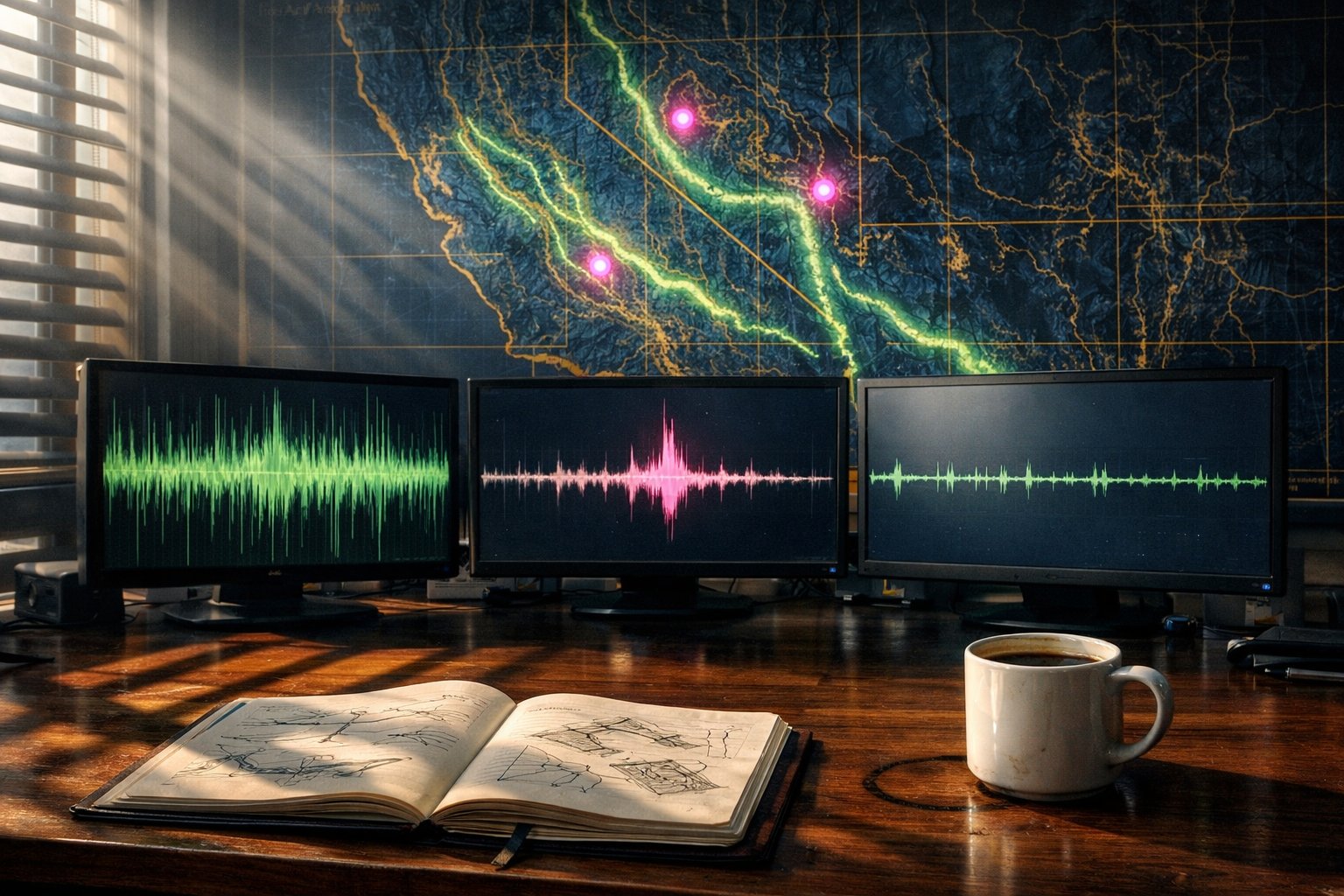
Three earthquake swarms popped off in the western United States within a thirty-day window this spring. The Brawley Seismic Zone in California’s Imperial Valley logged more than 350 events over a long weekend, peaking at magnitude 4.7. A shallow cluster surfaced inside the Nevada Test and Training Range with a magnitude 4.4 lead event near Alamo. And a quieter swarm of roughly thirty small shocks nudged the ground around Kanosh, Utah, with a largest magnitude of 3.6. The combination has drawn understandable attention, including a recurring claim that the Nevada cluster is the seismic fingerprint of a covert underground test. The data does not support that reading. Walk through it with me [1][2][3].
Direct Answer: What Spring 2026’s Three Swarms Actually Were
The Brawley, Nevada Test and Training Range, and Kanosh sequences were three independent, tectonically normal earthquake swarms in well-known seismic zones. Brawley sits on a transtensional fault network connecting the San Andreas and Imperial faults. The Nevada cluster fell within the Basin and Range extension regime near the Walker Lane shear zone. Kanosh lies on the central Utah swarm corridor. None show the seismic signature of an underground explosion [1][2][3][4].
What an Earthquake Swarm Is, Technically
The United States Geological Survey defines a swarm as a sequence of mostly small earthquakes with no identifiable mainshock. That is the negative half of the definition. The positive half is that the events cluster tightly in time and space, the largest event often arrives somewhere in the middle or near the end rather than at the start, and the magnitude distribution stays flat rather than dropping off the way aftershocks drop off after a mainshock [5].
Contrast that with the standard mainshock-aftershock sequence. A fault ruptures, releases most of its stored elastic strain in one event, and the crust then chatters as nearby asperities adjust. The Reasenberg-Jones model and the more general Epidemic-Type Aftershock Sequence model, or ETAS, describe that decay quantitatively: each event triggers a forecast rate of secondary events that falls off as a power law in time. ETAS works well for tectonic mainshock sequences. It works less well for swarms, because swarms appear to have an extra ingredient that ordinary tectonic loading does not provide [5][6].
That extra ingredient is usually pressurized fluid moving through a fractured rock volume, or slow aseismic slip on a buried fault patch. Either one can drive a cascade of small failures without a single dominant rupture. The University of Utah Seismograph Stations have used this fluid-migration model for years to explain why central Utah produces so many small swarms in places like Kanosh, Black Rock Desert, and the Sevier Valley [3][7].
In short, a swarm is a swarm because the energy budget is being spent in many small pieces rather than one big one. That has consequences for hazard, for forecasting, and, as I will get to, for the question of whether a covert underground test could plausibly hide inside one.
Brawley, Imperial Valley: A Fault Network That Does This for a Living
The Brawley Seismic Zone is the tectonic seam stitching the southern end of the San Andreas Fault to the northern end of the Imperial Fault. It is not a single throughgoing strand. It is a braided network of short, mostly strike-slip faults set inside a region of regional extension, often described as transtensional because the crust is being pulled apart while it is also sliding sideways. The 2026 sequence began with a magnitude 3.5 event roughly two miles west-southwest of Brawley at a depth of about eight to nine miles, and grew over the next forty-eight hours into more than 350 catalogued events, the largest a magnitude 4.7 [1][2].
If that pattern sounds familiar, it is because the Brawley zone has done it before. The 1981 Westmorland swarm climaxed with a magnitude 5.8. The 2005 swarm peaked at 5.1. The August 2012 swarm logged more than 300 small to moderate shocks and topped out at magnitude 5.5 [8][9]. Lucy Jones, the longtime Caltech seismologist who has spent more of her career on this zone than most people have on any single fault, told reporters during the May 2026 sequence that the region has produced swarms like this “probably hundreds of times” [2]. That is roughly the right order of magnitude. The catalog shows a small swarm somewhere in the Salton Trough almost every year.
The focal mechanisms reported in the USGS moment-tensor solutions for the spring 2026 events are dominantly right-lateral strike-slip with a normal-faulting component, consistent with the long-known tectonic regime. The depths fall in the five to ten mile range, where the Imperial Valley sediments give way to crystalline basement. None of those numbers indicate a non-tectonic source.
Nevada Test and Training Range: Shallow, but Shallow in the Tectonic Sense
The April 29 to 30, 2026 sequence inside the Nevada Test and Training Range, centered roughly 30 km south-southwest of Alamo, produced 17 felt events in a single day with a lead magnitude 4.4 at a reported depth near 4.0 kilometers, about 2.5 miles down [10][11]. The depth is unusually shallow by Pacific-coast standards, which is what attracted attention, and it sits inside the same military reservation that includes Area 51. The combination did the rest.
Geographically the cluster sits inside the Basin and Range province, the broad zone of extensional faulting that stretches from the Wasatch Front of Utah to the eastern Sierra Nevada. Specifically it falls near the southeastern edge of the Walker Lane, the right-lateral shear belt that absorbs an estimated 15 to 25 percent of the relative motion between the Pacific and North American plates [12][13]. The Walker Lane is not a single fault but a system of subparallel dextral strike-slip strands embedded in a region that is also being pulled apart. Shallow, small, normal-faulting events are the expected style of seismicity in that corner of Nevada.
“Shallow” in the Walker Lane sense means three to ten kilometers, not zero. That distinction matters for what comes next.
Kanosh, Utah: The Quietest of the Three
The Kanosh swarm, recorded by the University of Utah Seismograph Stations, produced at least 32 small earthquakes beginning the morning of April 19 and continued at low rates into mid-May. The largest event was a magnitude 3.6 at 8:43 a.m. Mountain time, located roughly eight miles south of Kanosh and east of the Black Rock Desert, at depths between three and ten kilometers [3][7]. Central Utah is a recognized swarm corridor. A 2023 paper in Geochemistry, Geophysics, Geosystems characterized the region as the product of “interactions of regional tectonics, local structures, and hydrothermal systems,” a useful three-word summary of what drives small swarms there [14].
The most likely physical driver for the Kanosh swarm is pore-pressure migration through fractured Tertiary volcanics in a region that hosts active hydrothermal systems. That is the same broad mechanism invoked for the 2018 to 2019 Milford swarms and for the older sequences near the Black Rock cinder cones. Utah Geological Survey staff explicitly addressed the question of whether the activity signaled impending volcanic unrest. Their answer was no: swarms of this style and size are unrelated to magma transport at the kinds of crustal depths and rates required for an eruption [3].
Why a Covert Underground Test Would Not Hide in Any of This
Forensic seismology, the discipline of telling explosions from earthquakes in the seismic record, is sixty years old and quite good at its job. Three discriminants do most of the work [15][16].
Depth. Engineered underground tests are detonated at depths measured in hundreds of meters, not kilometers. Even the deepest Soviet-era cratering shots were under a kilometer. By the time a test is two kilometers down, the engineering cost becomes prohibitive and the seismic coupling actually degrades. Calculated depths for nuclear explosions are typically reported as zero or near-zero in the international seismic catalogs. The NTTR swarm’s reported depth of approximately four kilometers is well outside that range, and the other events in the cluster spread across a depth band rather than stacking at a single point source the way a test would.
Source mechanism. An explosion is, to first order, an isotropic compression of the surrounding rock. It radiates primary (P) waves strongly in every direction and shear (S) waves only weakly, and only through secondary mechanisms like tensile cracking or near-source asymmetry. An earthquake is a shear failure on a fault plane. It radiates a double-couple pattern with strong S waves and a characteristic four-lobed P-wave amplitude distribution. The moment-tensor inversions published by USGS for the NTTR, Brawley, and Kanosh events all show clear double-couple solutions consistent with shear faulting [15][16].
Frequency content. Explosions are short, impulsive, and rich in high-frequency energy because the source process completes in milliseconds. Tectonic earthquakes radiate a broader band of frequencies because the rupture takes longer, even for small events, and the slip is distributed over a finite fault area. The standard discriminant, the ratio of body-wave magnitude (mb) to surface-wave magnitude (Ms), separates explosions and earthquakes cleanly above about magnitude 4 because explosions produce surface waves inefficiently relative to body waves [15][16].
A magnitude 4.4 event would also be obnoxiously loud, geopolitically speaking. The yield needed to produce a magnitude 4.4 seismic event at the relevant depths is in the kiloton range, comparable to a small fission device. That is not a stealthable signal.
The CTBTO Watches This for a Living
The Comprehensive Nuclear-Test-Ban Treaty Organization operates the International Monitoring System, a global network of 170 seismic stations, 60 infrasound stations, 11 hydroacoustic stations, and 80 radionuclide stations [17]. The seismic component alone is dense enough to locate magnitude-2.5 events worldwide within minutes. North Korea’s six declared underground tests between 2006 and 2017 were all detected, located, and discriminated as explosions within hours of detonation, including the smallest, in 2006, which yielded around half a kiloton [16][17].
A covert test inside the NTTR would have to defeat that entire network. It would also have to defeat the radionuclide stations sniffing for the noble-gas isotopes that vent from even well-contained underground shots, the infrasound network designed to catch atmospheric coupling, and the regional seismic stations of the University of Nevada Reno, the Southern California Seismic Network, and the United States National Seismic Network. The probability that all four independent technologies miss a kiloton-class event is, generously, very small.
For the conspiracy-vs-coincidence audit framed for the general reader, see Augustus Kane’s companion piece “Area 51 Earthquake Swarm: Underground Test, Natural Cluster, or Mythology.” It walks through the cultural side of the question, why Area 51 in particular collects these readings, and what the historical record of actual covert testing says about how secrets that big tend to keep. My job here is the seismology.
Three Swarms in Thirty Days Is Not a Statistical Anomaly
The western United States produces roughly five to fifteen small earthquake swarms a year that meet a reasonable working definition, depending on the catalog cutoff. Some of them make the news; most do not. In a thirty-day window, drawing two swarms from the same broad region is more likely than not. Drawing three, while less common, is well within the long-run distribution. The Western US Seismic Network logs more than a thousand magnitude 2 and above events a year inside the Basin and Range alone [10].
It is also worth noting that the three swarms were tectonically independent. The Brawley zone is a transtensional pull-apart at the southern end of the San Andreas system, dominated by right-lateral strike-slip. The NTTR cluster sits in the dextral-shear-plus-normal-faulting regime of the southern Walker Lane. The Kanosh sequence is a fluid-driven cluster in central Utah’s swarm corridor. Three different physical settings, three different fault styles, three different probable drivers. The only thing they share is the calendar.
What This Means for Hazard, Forecasting, and the Next Six Months
The Brawley zone has a documented history of producing magnitude 5 and 5.5 events at the tail end of these swarms, so the operational forecast guidance issued by USGS for the May 2026 sequence included a non-zero probability of a larger event over the following week. None materialized, and the sequence decayed to background within ten days. The NTTR cluster has been quiet since early May. The Kanosh swarm continues at low rates, consistent with prior central-Utah sequences that typically run for weeks to a few months before fading [3][9][10].
If you want a useful piece of seismic intuition to carry away from this: the size of the largest event in a swarm is a poor predictor of what comes next, but the location is an excellent predictor of where to expect the next swarm. The same rock that swarmed in 1981, 2005, 2012, and again in 2026 is very likely to swarm again before this decade is out. The interesting question is not why this stretch of crust is unusually active. The interesting question is what fluid or slow-slip ingredient is doing the extra work that ordinary tectonic loading cannot do alone, and how to image it before the next sequence starts. The answer to that one is, honestly, we don’t yet know. The instruments are getting better. So is the data.
Adjacent reading in science and natural anomalies: 3I/ATLAS Chemistry: Reading the Nature Astronomy Deuterium Paper and Quantum Entanglement: Spooky Action at a Distance.