
Drafted with AI assistance from the sources listed; images are AI-generated illustrations. How EsoVitae is made
What Is the Banshee in Irish Tradition?
The banshee (Irish bean sídhe, “woman of the fairy mound”) is a female spirit in Irish folk tradition whose wailing cry, the caoineadh, is held to foretell a death in certain old Gaelic families. She belongs to the wider Otherworld of the Sídhe, the supernatural people of pre-Christian Ireland, and survives in living oral memory recorded into the twenty-first century.
There is a particular cadence to how people describe hearing her. They give the year. They give the townland. They give the relative whose death the cry preceded, and they give the hour, often after dark and before the news could have travelled. The folklorist’s first instinct is not to arbitrate whether what they heard was a spirit. It is to listen to how they tell it, and to notice the patterns that recur across hundreds of accounts collected in the National Folklore Collection at University College Dublin between the 1930s and the present day [1].
This article gathers what the historical record, the comparative folklore literature, and the modern ethnographic scholarship say about the banshee. It draws on the work of Patricia Lysaght, whose 1986 monograph The Banshee: The Irish Supernatural Death-Messenger remains the standard reference, and situates the tradition within the broader landscape of paranormal and supernatural phenomena as catalogued on this site.
The Name and the Cry: What “Banshee” Actually Means
The word banshee is the Anglicised spelling of the Irish bean sídhe, literally “woman of the síd,” where síd denotes the burial mound or fairy hill into which the older Otherworld peoples were said to have withdrawn after the arrival of the Gaels. The cognate Scottish Gaelic form is bean shìth; the related figure in the Scottish Highlands is the bean-nighe, the washer at the ford, catalogued in the Encyclopaedia Britannica entry on the banshee [1][2].
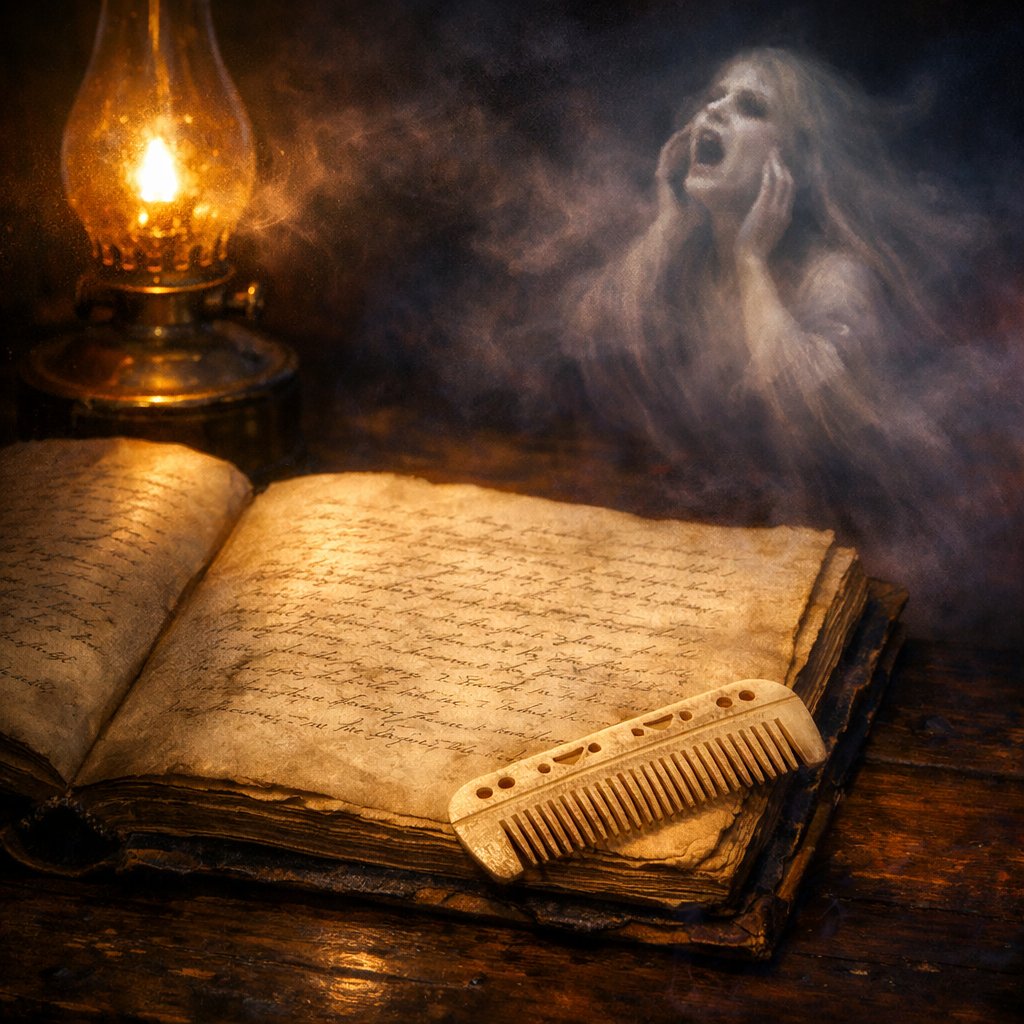
The cry attributed to her is the caoineadh, anglicised as “keen,” the formal lament once performed at Irish wakes by women called mná caointe, the keening women. The keen is a sung mourning form with antiphonal structure, attested in Irish-language sources back to the Middle Ages and still performed sporadically into the twentieth century before its decline under clerical pressure. The banshee’s cry, in the testimony of the people who reported hearing it, sounded like the keen — pitched between speech and song, broken by sobs, sustained in a way the human voice does not naturally sustain [1].
Where the consensus and the evidence diverge: popular treatments often translate bean sídhe as “fairy woman” in a Tinkerbell sense. The Irish term carries no such diminutive register. The Sídhe are the people of the mounds, the older inhabitants of the land, sometimes equated with the Tuatha Dé Danann of the mythological cycle. The banshee is one of their women, attached by long custom to specific human lineages [2].
Old Families and the Banshee: The Genealogical Pattern
The most distinctive feature of the Irish banshee tradition, separating it from generic ghost lore, is its attachment to particular families across documented generations of inheritance. Patricia Lysaght’s 1986 fieldwork-based monograph documents the consistent claim that the banshee follows old Gaelic and Old English families whose surnames begin with O or Mac, with a smaller cohort of Norman families absorbed into the pattern after the twelfth century [3].
Across the documentary record, the families most often named include the O’Briens of Thomond, the O’Neills of Ulster, the O’Connors of Connacht, the MacCarthys of Munster, and the O’Gradys, among others. Several Norman families, the FitzGeralds and Burkes prominent among them, were credited with their own banshees by the early modern period, an absorption that itself tells a story about how the tradition adapted to political reality [3]. The genealogical specificity is the load-bearing fact: the banshee does not announce a death to whoever happens to be in the room. She announces it to her family, sometimes across hundreds of miles, sometimes to relatives who do not yet know they are about to be bereaved.
Some families name a specific tutelary figure rather than a generic banshee. Aoibheall (variously Aibell or Eevell), associated with the rock of Craglea near Killaloe, is the named banshee of the O’Briens; she is recorded in the twelfth-century literature surrounding Brian Boru as having appeared to him before the Battle of Clontarf in 1014 to predict his death. Cliodhna, queen of the Munster fairies and associated with Carrig Cliodhna in County Cork, served a similar role for the MacCarthys. Áine, linked to Knockainey in Limerick, was claimed by branches of the FitzGerald line [1][2].
Forms and Variants: Old Crone, Young Maiden, Washer at the Ford
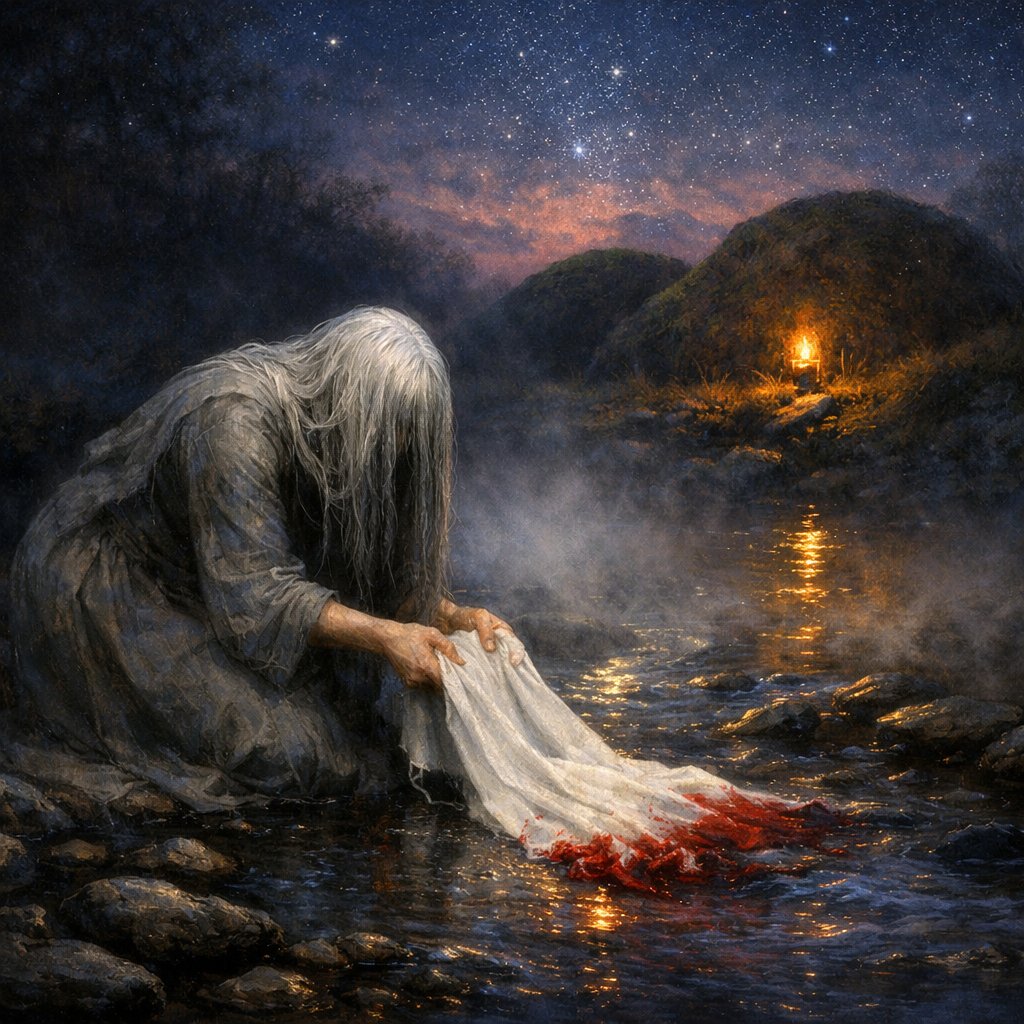
Across the field record collected by the Folklore of Ireland Society from the 1920s onward, the banshee appears in three recurring forms across the documented corpus. She is described as an ancient, hunched woman with long white or grey hair; as a beautiful young woman in a winding-sheet or pale grey cloak; and, more rarely in Irish tradition but central in the Scottish Gaelic cognate, as a washer at the ford rinsing the bloodstained linen of the one about to die [3][4].
The Crone and the Comb Motif
The crone form predominates in Munster accounts. Witnesses describe her seated on a stone wall or by a stream, combing long pale hair with a silver or bone comb. The combing motif is so common it functions as a folkloric type-marker; the comb itself, in some Connacht traditions, must never be picked up if found by the roadside, on pain of attracting the banshee’s attention. Stripped of folklore, the comb motif is a portable diagnostic: where it appears in a story, the storyteller has access to the older stratum of the tradition rather than a Victorian print revival [3].
The Maiden and the Washer Forms
The young-maiden form, sometimes called the bean chaointe in this register, is more frequent in Leinster and in the literary tradition. The figure of a beautiful weeping girl in pale garments appears in Anglo-Irish literature from Thomas Crofton Croker’s Fairy Legends and Traditions of the South of Ireland (1825) onward, often translated for English audiences through the softening filter of Romantic aesthetics [4]. The washer-at-the-ford variant is the most archaic and the most disturbing: a woman crouched at a riverside washing a shirt or shroud that, when the witness draws closer, is recognised as belonging to the witness’s own kin. This figure is more developed in the Scottish Highland tradition as the bean-nighe, but it occurs in Irish material from counties Donegal and Mayo [2].
How the Record Was Made: From Folk Belief to Folklore Studies
The systematic scholarly recording of the banshee tradition begins in the early nineteenth century with antiquarian collectors and culminates in the twentieth-century fieldwork programmes of the Irish state. Lady Wilde’s Ancient Legends, Mystic Charms, and Superstitions of Ireland (1887) preserved oral material her husband Sir William Wilde had gathered in his medical practice in the west; William Butler Yeats’s Fairy and Folk Tales of the Irish Peasantry (1888) brought the figure into English-language literary modernism through the editorial work indexed in the JSTOR archive of Béaloideas, the journal of the Folklore of Ireland Society [4][5].
The decisive shift came with the founding of the Irish Folklore Commission in 1935, later absorbed as the National Folklore Collection at University College Dublin. Between 1935 and 1971, full-time and part-time collectors recorded thousands of banshee accounts on Ediphone wax cylinders and in handwritten manuscripts, indexed by county, parish, and informant. The Schools’ Collection of 1937 to 1939, in which fifth- and sixth-class pupils across the Irish Free State recorded local folklore from elders, contributes a particularly dense seam of banshee testimony, much of it now searchable through the Dúchas digital archive [1].
Patricia Lysaght’s analysis of this corpus, building on the earlier work of Séamus Ó Duilearga and Bo Almqvist, treats the banshee not as a question of belief or disbelief but as a culturally specific form of death-prediction tradition. Lysaght documents the recurring narrative structures: the cry heard at the threshold, the kin-death confirmed within days, the consistency of the family-attachment pattern, and the relative rarity of multi-witness accounts compared to the high frequency of single-witness ones. Her 1986 monograph, published by Glendale Press and reissued by Oxford University Press in expanded editions, remains the methodological model for any serious treatment of the subject [3].
The Comparative Frame
Death-announcing female spirits attached to lineages occur in several Indo-European traditions. The bean-nighe in Scottish Gaelic folklore, the Welsh cyhyraeth, the Breton Ankou in male form, and the Slavic poludnitsa in different functional register all bear comparative interest. Stith Thompson’s Motif-Index of Folk-Literature catalogues the banshee under motifs F260 (Behavior of fairies) and M301.6 (Banshees as prophets), allowing cross-cultural retrieval; the Aarne-Thompson-Uther tale type system handles narrative variants where the banshee figures as character rather than motif [4].
The Banshee in the Modern Imagination
The banshee has been continuously present in English-language popular culture since the mid-nineteenth century, refracted through successive Romantic, Gothic, fantasy, and horror filters across two centuries of literary and cinematic adaptation in Britain, Ireland, and the United States. Daniel Maclise’s 1841 painting The Origin of the Harp visualised an early Romantic version; Charles Reade’s novels and later W. B. Yeats’s plays carried the figure into late Victorian print; twentieth-century cinema flattened her, variably, into a screaming wraith largely detached from her family-attachment specificity [5].
In its Béaloideas journal issue of 1991, the Folklore of Ireland Society published a debate among collectors about whether the modern Hollywood banshee should be regarded as the same tradition at all, given how much of the Irish ethnographic substrate the cinema version had shed. The consensus reached was conservative: the cinematic figure is a related but distinct tradition, useful for tracking modern reception, less useful for understanding the Irish material itself [3].
As of 2025, the National Folklore Collection continues to receive contemporary banshee accounts through its ongoing fieldwork programme, and the Dúchas project at University College Dublin has digitised approximately 700,000 pages of the older corpus, making it possible for researchers and the descendants of original informants to retrieve specific accounts by townland, surname, and date [1]. The tradition is not historical only. People still hear something they call a banshee, and they still describe it the same way their great-grandparents did. For further reading on related figures in adjacent traditions, see the mystical places and lost worlds catalogue, where the Sídhe mounds themselves are treated as a class of landscape.
Frequently Asked Questions
What does the word “banshee” mean?
Banshee is the Anglicised spelling of the Irish bean sídhe, “woman of the fairy mound.” Bean means woman; sídhe refers to the burial mound or supernatural dwelling-place. The cognate Scottish Gaelic form is bean shìth.
Is the banshee good or evil in Irish tradition?
Neither, in the Irish material. She is generally understood as a tutelary spirit attached to her family who mourns an approaching death; her cry is a warning and a lament, not a threat. The malevolent screaming-wraith of modern cinema is a separable later tradition.
Which families is the banshee said to follow?
The tradition attaches her most consistently to old Gaelic families whose surnames begin with O or Mac, including the O’Briens, O’Neills, O’Connors, MacCarthys, and O’Gradys, with several Norman families such as the FitzGeralds and Burkes incorporated after the medieval period.
What is the difference between a banshee and a regular ghost?
A ghost in Irish folk usage is a returning human dead; the banshee is one of the Sídhe, a member of the older Otherworld people, not a human spirit at all. She does not return; she has always been here, attached to her family across generations.
What is the keening tradition?
Keening, from the Irish caoineadh, is the formal lament once sung by professional mourning women, the mná caointe, at Irish wakes. It is antiphonal, sung between speech and song, and is the human-performed form the banshee’s cry is said to resemble.
When did people start writing about the banshee in English?
English-language descriptions appear from at least the seventeenth century in Anglo-Irish travel and antiquarian writing, but the figure entered systematic literary print with Thomas Crofton Croker’s Fairy Legends and Traditions of the South of Ireland (1825) and Lady Wilde’s Ancient Legends (1887).
Are there any named banshees from history?
Yes. Aoibheall, associated with Craglea near Killaloe, is named in the literature of the Battle of Clontarf (1014) as the banshee of the O’Briens. Cliodhna, queen of the Munster fairies, served the MacCarthys. Áine of Knockainey was attached to branches of the FitzGerald line.
What is the comb motif in banshee folklore?
A widespread folk belief, especially in Connacht and Munster, holds that the banshee combs her long pale hair with a silver or bone comb, and that any comb found by the roadside should be left untouched. Picking it up is said to risk drawing her attention to the picker’s household.
Who is the leading modern scholar of the banshee?
Patricia Lysaght, whose 1986 monograph The Banshee: The Irish Supernatural Death-Messenger remains the standard reference. Her work synthesises the National Folklore Collection’s manuscript and audio records with comparative European death-messenger traditions.
Has the banshee tradition died out in modern Ireland?
No. The National Folklore Collection at University College Dublin continues to receive contemporary accounts, and ongoing ethnographic research finds the tradition active, particularly in rural districts of Munster and Connacht, although the social occasions for its transmission have narrowed.
Comparative Death-Messenger Figures in Celtic and Adjacent Traditions
The comparative folklore literature places the banshee within a wider Indo-European family of female death-announcing spirits attached to specific persons, families, or geographic districts across Celtic and adjacent regions of medieval and modern Europe. The table below sets out the principal cognates and parallels recurring in scholarship from Stith Thompson onward.
| Figure | Tradition | Form | Function |
|---|---|---|---|
| Bean sídhe (banshee) | Irish | Female; crone, maiden, or washer | Foretells death in attached family by cry |
| Bean-nighe | Scottish Gaelic | Female; washer at the ford | Foretells death by washing the doomed person’s linen |
| Cyhyraeth | Welsh | Disembodied voice or moan | Foretells death by groaning before the event |
| Ankou | Breton | Male; skeletal driver of the death-cart | Collects the souls of the parish dead |
| Caoineag | Scottish Highland | Female; weeping spirit | Foretells death in clan by lamenting at night |