

Drafted with AI assistance from the sources listed; images are AI-generated illustrations. How EsoVitae is made
Anyone looking at the Mokele-mbembe file is looking at two things at once: a folkloric tradition recorded across the Likouala swamp basin for at least two hundred years, and a thin, ambiguous documentary record of expeditions that have not produced a body, a verified track cast, a clean photograph, or an authenticated specimen. For broader context on this niche, see the Cryptids and Mythical Creatures pillar.
Direct Answer: What the 1776-2024 Mokele-mbembe Record Actually Shows
Across 248 years of Western contact and Indigenous testimony in the Congo River basin, roughly 250 collated reports name a large aquatic animal called Mokele-mbembe, with sightings clustered around Lac Tele, the Likouala-aux-Herbes, and the Sangha River; no expedition has produced verifiable physical evidence, and zoological consensus treats the corpus as folkloric or misidentification.
The Reporting Record: From 1776 Mission Logs to 2024 Field Notes
The earliest documented Western reference traces to a 1776 memoir by French missionary Abbe Lievin-Bonaventure Proyart, who described enormous animal tracks “three feet in circumference” near a Congo basin river, attributed by local informants to a creature he never observed directly [1]. Proyart was a Spiritan missionary collecting natural history alongside catechism; his account is secondhand, but the textual record begins there.
The German big-game importer Carl Hagenbeck revived Western interest in 1909 with claims, in his memoir Beasts and Men, of “half-elephant, half-dragon” reports from Rhodesian and Congo region hunters [2]. Hagenbeck’s framing was commercial — he sent collectors hoping to bring back a live specimen for his Hamburg Tierpark — and no animal was returned. The Smithsonian-Carnegie Expedition of 1919-1920, led in part by Leicester Stevens, produced no confirming evidence and is the first documented zoological-institution attempt to verify the reports [3].
The modern reporting cluster begins in the late 1970s. Herpetologist James Powell conducted interview-based fieldwork in Gabon in 1976 and Congo in 1979, collecting accounts from Bantu and pygmy informants and circulating photo-array tests in which informants reportedly selected sauropod illustrations more often than other large vertebrates [4]. Powell collaborated with University of Chicago biologist Roy P. Mackal, whose 1980 and 1981 expeditions into the Likouala swamps remain the most thoroughly documented Western fieldwork on the corpus [5].
Geographic Clustering: Where the 250 Reports Concentrate
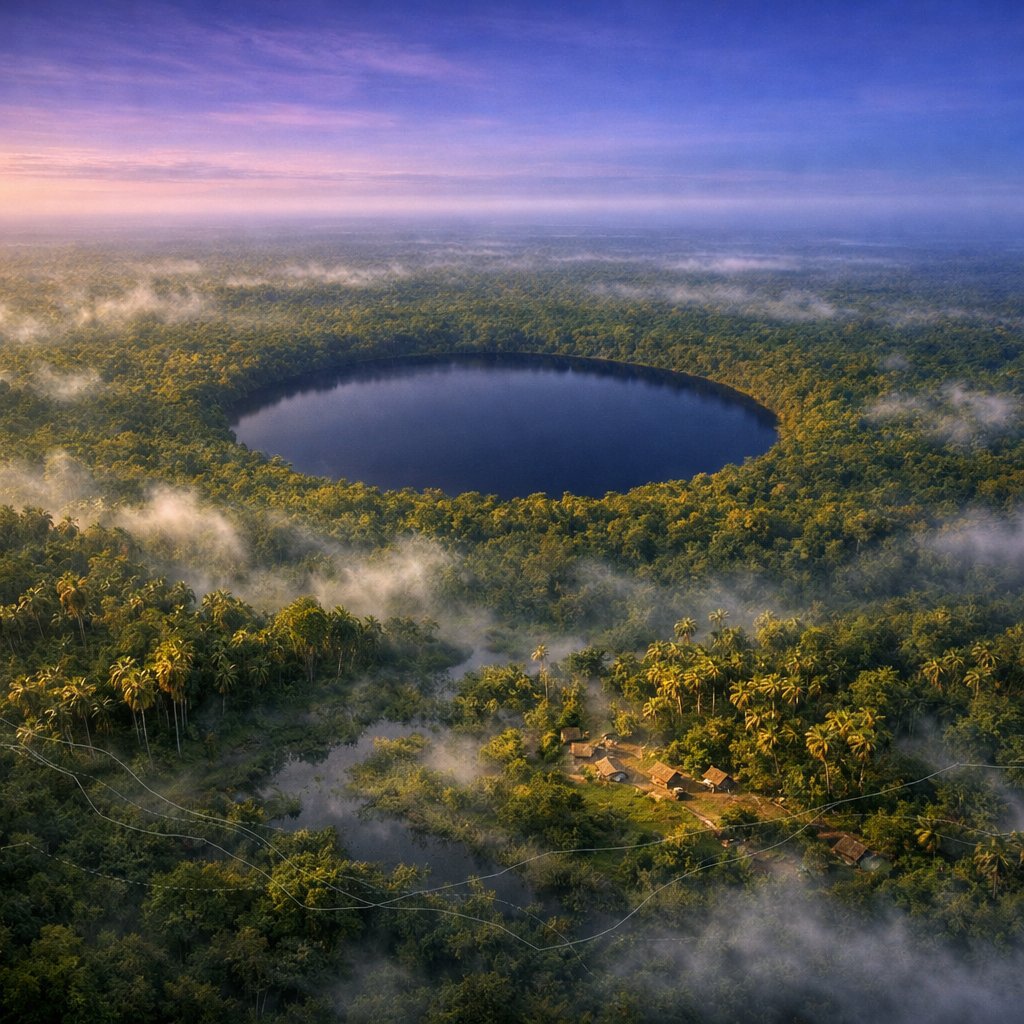
Of the roughly 250 collated reports from 1776 through 2024, the densest geographic cluster sits inside the Likouala-aux-Herbes sub-basin of the Republic of the Congo (see also the Global Cryptid Sightings archive), with secondary clusters along the Sangha River (Cameroon-Congo border), the Ubangi tributaries, the upper Ogowe in Gabon, and a smaller satellite signal from Lake Bangweulu in Zambia [5][6]. Mackal’s 1980-81 mapping placed the highest informant density at Lac Tele, a circular lake approximately 5 km in diameter in the heart of the Likouala swamp forest [5].
The Congolese biologist Marcellin Agnagna, then of the Brazzaville Zoo, led a 1983 expedition that produced the most-cited single-witness account: Agnagna reported observing a large animal in Lac Tele for approximately 20 minutes on May 1, 1983, and attempted film documentation [7]. His camera was misconfigured; the resulting footage was overexposed and inconclusive. Agnagna later published a description in Cryptozoology volume 2 (1983), and the case is treated as the high-water mark of a researcher-witness report inside the corpus.
British cryptozoologist William J. Gibbons mounted four expeditions between 1985 and 2011, focused on Lac Tele and surrounding villages including Boha, Edzama, and Itanga; his reports add interview density but no verifiable physical specimen [8]. The geographic stability across two centuries — informants in unrelated villages, separated by hundreds of kilometers of swamp forest, naming the same creature with overlapping morphological descriptions — is one feature the corpus’s defenders cite, and one its skeptics interpret as evidence of a shared cultural template rather than a shared biological observation.
What the Reports Describe: Morphology, Behavior, and the Misidentification Floor
Across the corpus, informant descriptions converge on a quadrupedal aquatic herbivore, brownish to reddish-grey, with a long flexible neck, a relatively small head, a long thick tail, and a body the size of a large elephant or larger [4][5]. What the footage actually shows across the few film and photographic claims (Agnagna 1983, the 1992 Japanese Nichi Eiga aerial sequence, the 2000 Genesis Park stills) is at best a long dark object on water with no diagnostic features visible [7][9].
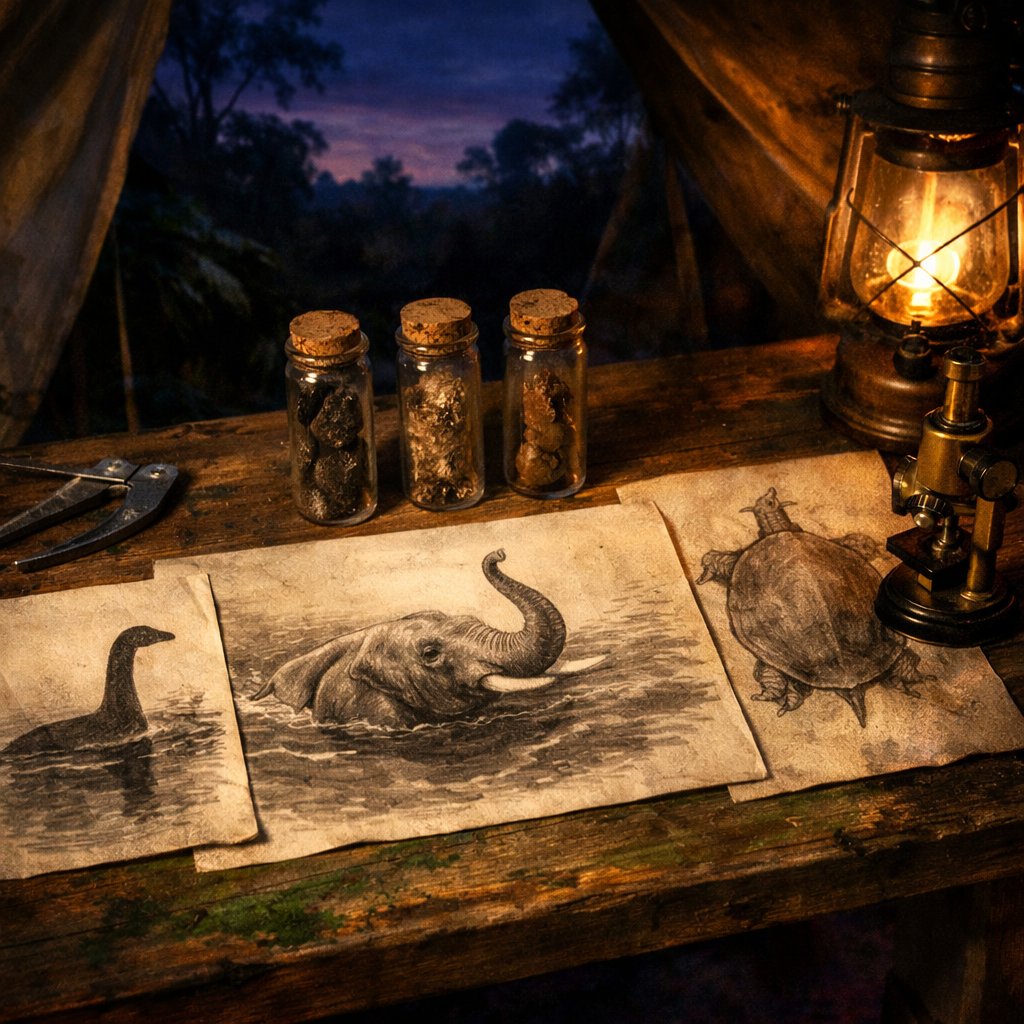
The biological constraint is severe. A breeding population of an animal the size described — a “small Apatosaurus“, as Mackal speculated — would require territory, forage, calving sites, juvenile mortality, and a verifiable scat and track record across a 200-year window of intermittent Western and continuous Indigenous observation. No skeletal material, no scat, no nesting site, no carcass, and no clean track cast has entered the institutional record [10]. Standard candidate misidentifications include the African forest elephant (Loxodonta cyclotis) swimming with trunk raised, the Nile crocodile (Crocodylus niloticus) and slender-snouted crocodile (Mecistops cataphractus), the soft-shelled turtle Trionyx triunguis, and the rhinoceros — though the latter has no extant range in the Congo basin and would be itself a zoological event [10][11].
Decade-by-Decade Expedition Timeline
The expedition cadence is uneven across the corpus, concentrated in two windows: the colonial-era institutional attempts of 1909-1932 and the modern cryptozoological surge of 1976-2011. The table below collates the principal documented expeditions with primary-source attribution.
| Year | Expedition / Lead | Region | Outcome |
|---|---|---|---|
| 1776 | Abbe Proyart (memoir) | Congo basin (unspecified) | Secondhand track report; no field observation [1] |
| 1909-1913 | Hagenbeck collectors | Rhodesia / Congo | No specimen returned [2] |
| 1919-1920 | Smithsonian-Carnegie / Stevens | Congo basin | No confirming evidence [3] |
| 1932 | Ivan Sanderson / W. Lumley field season | Cameroon / Mainyu River | Single ambiguous sighting; no specimen [12] |
| 1976 | James Powell | Gabon (Ogowe) | Interview corpus; photo-array tests [4] |
| 1980-1981 | Roy P. Mackal (two seasons) | Likouala-aux-Herbes | Most extensive Western fieldwork; no specimen [5] |
| 1983 | Marcellin Agnagna | Lac Tele | 20-min observation claim; inconclusive film [7] |
| 1985-2011 | William J. Gibbons (four expeditions) | Lac Tele / Boha villages | Interview density; no specimen [8] |
| 1992 | Nichi Eiga / Tabuchi (aerial) | Lac Tele | Aerial footage of dark wake; inconclusive [9] |
| 2018-2024 | Local guides / interview-only reports | Likouala villages | Continued oral tradition; no Western expeditions |
Witness Categories and the Evidence Ladder
A useful first cut on the 1776-2024 corpus is by witness category, because the evidentiary weight of each category differs substantially. Indigenous oral tradition contributes the longest temporal baseline — Bantu and Aka informants in villages like Boha, Edzama, and Itanga maintain accounts that name Mokele-mbembe alongside other locally classified animals such as Emela-ntouka and Mbielu-mbielu-mbielu [4][5]. Colonial-era European witnesses contribute thirty-odd secondhand reports between roughly 1880 and 1940, most of them mediated through hunters, missionaries, or rubber-trade administrators with no zoological training. The modern researcher-witness category — Agnagna 1983, Powell field interviews, Mackal field interviews — sits at the top of the evidence ladder, and even there, no observation has been corroborated by a second researcher on scene with functional documentation.
Two things get conflated here. The folkloric corpus and the zoological corpus are different objects. The folkloric corpus is robust — a stable, multi-village, multi-generational naming tradition that any serious ethnographer treats as data about how Congo basin communities classify and discuss large freshwater animals. The zoological corpus is thin — perhaps a dozen direct sightings by a named, traceable witness during a Western expedition window, each ambiguous. Conflating the two produces both the “obviously real, the locals have always said so” reading and the “obviously fake, where’s the body” reading. A field biologist’s job is to keep them separate. The first is a strong ethnographic record; the second is a weak zoological one.
What a Confirming Specimen Would Look Like
The biological constraint set on a confirming specimen is specific. What biology would require for the Mokele-mbembe corpus to resolve into a recognized species: a holotype specimen lodged in a recognized museum collection (skin, skull, or skeleton minimum), a documented type-locality with GPS coordinates, a peer-reviewed species description in an indexed journal, photographic or video documentation showing diagnostic morphological features, and ideally eDNA or scat-DNA recovery placing the taxon within a defensible phylogenetic position [10][14]. None of the five conditions has been met across 248 years.
eDNA sampling is the technique most likely to shift the record without requiring a kill or capture. As of May 2026, no published peer-reviewed eDNA survey has targeted Mokele-mbembe specifically, though general Congo-basin freshwater eDNA work — including surveys by the Royal Museum for Central Africa in Tervuren and by Wildlife Conservation Society field teams — has not produced unidentified vertebrate signatures consistent with a large unknown aquatic herbivore [13][14]. Camera-trap density in the Likouala swamp forest remains low compared to terrestrial Central African study sites; the swamp’s hydrology makes deployment hard, but it is not zero, and a multi-season camera-trap effort at Lac Tele has not been mounted with modern equipment as of 2024.
Reading the Corpus: Folklore as Data, Biology as the Test
As of May 2026, the public record contains zero authenticated physical specimens of Mokele-mbembe, and the IUCN does not list the taxon. The load-bearing fact: a 200-year reporting tradition with consistent geographic and morphological features, no specimen, and a swamp habitat ecology that — per remote-sensing surveys by the Wildlife Conservation Society in the 1990s and 2000s — is small enough that a megafaunal aquatic herbivore would be expected to leave detectable signs [13][14].
That tension is the case. Indigenous testimony deserves the same evidentiary respect as any informant corpus in field biology; misidentification, cultural transmission, and the colonial-era literature’s tendency to flatten distinct local words into a single category all sit alongside it. The zoologist’s reasonable posture is the open file: keep the corpus, weight it appropriately, and recognize that the absence of a specimen across 248 years is itself evidence — not proof of non-existence, but proof that the search-effort-to-evidence ratio has now climbed past the threshold at which an undescribed large vertebrate would normally be expected to enter the record. The graveyard chapter has room for the Mokele-mbembe file. So does the open file. The honest position holds both at once.